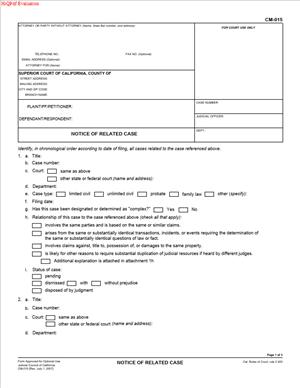
CM-015 – Notice of Related Case
Fill out nowJurisdiction: Country: United States | Province or State: California
The CM-015 – Notice of Related Case is a court form used in California civil cases. It tells the court that your case is connected to another case already filed. This helps the court manage both cases in a coordinated way.
If you are representing yourself, you may come across this form early in your case. It usually appears after you file a complaint or when you learn about another case involving the same parties or similar facts. The form is part of the court’s case management process.
Filing the CM-015 – Notice of Related Case does not argue your side. It does not explain why you are right or wrong. Instead, it alerts the court to a possible overlap between cases.
This document matters because related cases can affect scheduling, judicial assignments, and rulings. If the court is not informed, two judges might make decisions about the same issue without knowing about each other’s cases.
Understanding what this form does and how to complete it clearly helps you avoid delays and confusion in your case.
What is CM-015 – Notice of Related Case?
Clear definition
The CM-015 – Notice of Related Case is a formal court filing used in California civil proceedings. It notifies the court that your case is related to another pending or previously filed case.
Two cases are generally considered related when they involve the same parties, the same facts, or overlapping legal issues. The goal is to prevent inconsistent rulings and unnecessary duplication of work.
This form does not combine cases automatically. It simply informs the court so a judge can decide whether the cases should be assigned to the same department or handled together in some way.
Who typically uses this form?
Plaintiffs often file this form after starting a lawsuit and discovering that a similar case already exists. Defendants may also file it if they are aware of another case involving the same dispute.
Attorneys commonly prepare and file this document as part of early case management. Self-represented litigants also use it when they learn that their matter overlaps with another case.
The form can be filed by any party who believes the cases are related. It is not limited to one side.
Why might you need this form?
You might need this form if your lawsuit involves the same people and events as another case. For example, there may already be a case about the same contract, accident, or property.
You may also need it if your case depends on issues being decided in another case. If both cases require a court to interpret the same agreement or determine the same set of facts, they may be related.
Filing the form allows the court to evaluate whether both cases should be assigned to the same judge. This can reduce conflicting decisions.
In some courts, there are time limits for notifying the court about related cases. Filing the document promptly keeps the case moving smoothly.
Typical real-life scenarios
- Two business partners sue each other in separate lawsuits over the same failed venture. Each case involves the same financial records and claims of misconduct. These cases are often considered related.
- A person files a personal injury lawsuit after a car accident. Meanwhile, a passenger in the same vehicle files a separate lawsuit against the same driver. Both cases arise from the same event and may involve the same evidence.
- In a construction dispute, a homeowner sues a contractor. The contractor later files a separate action against a subcontractor over the same project. The cases may involve shared contracts and overlapping factual questions.
- In family-related property disputes, one case may address ownership while another addresses fraud or breach of agreement tied to the same property. Even if the legal theories differ, the underlying facts may connect the cases.
When would you use CM-015 – Notice of Related Case?
You would use this form when you become aware of another case that appears connected to yours. This often happens shortly after filing a complaint or receiving one.
You may also use it after reviewing court records and discovering an earlier-filed action involving the same dispute. Sometimes the connection becomes clear during early hearings or settlement discussions.
If you are a plaintiff, you might file it when you know that a defendant is already involved in a similar lawsuit. If you are a defendant, you might file it when you see that the claims against you mirror claims in another pending case.
The form is generally used in civil matters handled by the Superior Court. It plays a role in case coordination, not in arguing motions or presenting evidence.
Timing matters in practice. Courts often expect parties to notify them of related cases as soon as reasonably possible after learning about them. Early submission helps the court make administrative decisions before major rulings occur.
Legal characteristics of CM-015 – Notice of Related Case
The CM-015 – Notice of Related Case is a procedural document. Its purpose is administrative rather than substantive. It does not decide rights or impose obligations between the parties.
For the filing to be effective, it must accurately identify both cases. This includes the correct case names, numbers, and court locations. Incomplete or incorrect information can delay review.
Courts commonly review the form to determine whether the cases meet their definition of “related.” Each court may have local rules explaining what qualifies as related. These definitions often focus on shared parties, events, or legal issues.
Problems can arise if the form is filed too late or if it fails to clearly describe the relationship between the cases. Vague explanations may make it harder for the court to evaluate the connection.
The form does not merge cases by itself. A judge typically decides whether to assign them to the same department or coordinate them in another way. Until the court makes that decision, both cases continue on their own track.
It also does not replace other required filings. You still need to meet all deadlines for pleadings, responses, and hearings in your own case.
Is it legally binding?
The CM-015 – Notice of Related Case is not legally binding in the way a contract or court order is binding. It does not create new legal duties between the parties.
However, it is a formal statement to the court. When you sign and file it, you are representing that the information provided is accurate to the best of your knowledge. Courts rely on this information when making case management decisions.
If the court determines that the cases are related, it may issue orders affecting assignment or scheduling. Those orders, not the form itself, are binding.
In that sense, the form acts as a trigger. It starts a review process that can lead to binding procedural decisions.
How to fill out CM-015 – Notice of Related Case
Step 1 – Identify your case information
At the top of the form, enter the basic details about your case. This usually includes the court name, branch, case number, and the names of the parties. Make sure these match exactly what appears on your complaint or other official filings. Accuracy here prevents administrative confusion.
Step 2 – Identify the related case
Provide the full case name and case number of the related case. Include the court where it is filed and, if known, the department or judge assigned. Double-check the case number from official records to avoid errors. Even a small typo can delay review.
Step 3 – Explain how the cases are related
In the section asking about the relationship, describe the connection clearly and briefly. Focus on shared parties, shared facts, or overlapping legal issues. For example, you might state that both cases arise from the same contract, accident, or transaction. Keep your explanation factual and direct.
Step 4 – Indicate the status of the related case
The form may ask about the current status of the related case. Provide information such as whether it is pending, dismissed, or already decided. If hearings or trial dates are scheduled, include that information if requested. This helps the court assess timing concerns.
Step 5 – Review for completeness and consistency
Before signing, read through the entire document. Confirm that all names, numbers, and descriptions are consistent with court records. Make sure you have not left any required section blank. Clear and complete information reduces the chance of rejection.
Step 6 – Sign and date the form
Sign the form where indicated. By signing, you confirm that the information is true to the best of your knowledge. Print your name and add the date. If you are self-represented, indicate that you are appearing in propria persona if the form requests it.
Step 7 – File and serve the form
Submit the completed form to the clerk of the court handling your case. Follow the court’s filing procedures for civil documents. Provide a copy to all other parties in your case, as required for service. Keep a stamped copy or confirmation for your records.
Legal terms you might encounter in CM-015 – Notice of Related Case
- Related Case: A related case is another court case that shares common parties, facts, events, or legal issues with your current case. On this form, you must identify that other case clearly. The court uses this information to decide whether the cases should be handled together or assigned to the same judge.
- Case Number: This is the unique number assigned to each court case when it is filed. You must list the exact case number of the related case. Even a small error in the number can cause confusion or delay.
- Department: In many courts, a department refers to the specific courtroom or judicial division assigned to a case. You may need to list the department handling the related case. This helps the court coordinate between judges.
- Judicial Officer: This term refers to the judge or commissioner assigned to a case. Identifying the judicial officer for the related case helps the court determine whether reassignment is necessary.
- Common Issues of Law or Fact: This phrase means that two cases involve similar legal questions or arise from the same events. In this document, you must briefly explain how the cases overlap. The court relies on your explanation to assess whether the relationship is significant.
- Lead Case: When multiple related cases exist, the court may designate one as the lead case. The lead case often becomes the primary file for hearings or consolidated proceedings. You are not deciding this on the form, but your notice may influence that determination.
- Consolidation: Consolidation means combining two or more cases into one proceeding. Filing this notice does not automatically consolidate cases. It simply alerts the court that consolidation might be appropriate.
- Service: Service means formally delivering a copy of the filed form to the other parties in your case. You must follow proper service procedures after filing. Proof of service may be required to show the court you notified everyone involved.
- Pending: A pending case is one that is still active and not yet resolved. When you list a related case, you usually need to indicate whether it is pending, dismissed, or already decided. This status affects how the court handles your notice.
- Assignment: Assignment refers to the court’s internal process of designating a judge or department to handle a case. A notice of a related case may result in reassignment. That decision is made by the court, not by you.
FAQs
Do I have to file CM-015 – Notice of Related Case as soon as I learn about another case?
You should act promptly once you become aware of a related case. Courts expect you to notify them without delay. Waiting too long can cause scheduling conflicts or inconsistent rulings. Check your case file and confirm the other case number and status before submitting this form.
What if I am not completely sure the cases are related?
If the cases share parties, events, or legal issues, it is usually safer to disclose the connection. You do not need to prove the cases are identical. You only need to explain the overlap clearly and honestly. The court will decide whether the relationship is significant.
What information do I need in front of me before I complete this document?
You need the full case number of the related case, the court where it is filed, the names of the parties, and the current status. You should also know whether a judge or department has already been assigned. Double-check spelling and numbers to ensure accuracy.
Does filing this form automatically move my case to another judge?
No. Filing this document only alerts the court. The court reviews the information and decides whether reassignment or coordination is appropriate. You will receive notice if any change occurs.
Do I need to attach copies of the related case filings?
Usually, you do not need to attach full copies unless the court specifically requires it. However, you must accurately describe how the cases are connected. If you reference specific orders or rulings, make sure the details are correct.
Who must sign the CM-015 – Notice of Related Case?
The party filing the notice must sign it. If you are self-represented, you sign your own name. If an attorney represents you, the attorney signs. The signature confirms the information is true to the best of your knowledge.
How do I know if the court accepted this form?
After filing, the clerk typically stamps or electronically confirms receipt. Check your case docket or file-stamped copy. If you do not see confirmation, follow up with the clerk’s office to verify acceptance.
Do I need to serve the other parties after filing?
Yes. You must provide a copy to all other parties in your case. Follow the proper service method allowed in your case type. Keep proof of service for your records because the court may require confirmation that notice was given.
Checklist: Before, During, and After CM-015 – Notice of Related Case
Before
- Confirm the full and correct case number of the related case.
- Verify the exact spelling of all party names in both cases.
- Check the current status of the related case (pending, dismissed, resolved).
- Identify the court location and department handling the related case.
- Review your own case file to ensure consistency in party names and details.
- Gather any prior orders that mention coordination or related matters.
- Make sure you understand how the cases overlap factually or legally.
During
- Enter your current case number exactly as it appears on court documents.
- Clearly list the related case number without transposing digits.
- Provide a concise but specific explanation of how the cases are connected.
- Indicate the status of the related case accurately.
- Complete all required fields; do not leave mandatory sections blank.
- Review spelling, dates, and department information for accuracy.
- Sign and date the form in the designated signature area.
After
- Make at least one copy for your records.
- File the original with the court using the accepted filing method.
- Confirm the clerk processed and stamped your filing.
- Serve a copy on all other parties in your case.
- Complete and retain proof of service documentation.
- Monitor your case docket for any reassignment notice.
- Keep all documents together in your case file for future reference.
Common mistakes to avoid with CM-015 – Notice of Related Case
- Mistake: Listing the wrong case number because you relied on memory instead of checking court documents, which can misdirect the court and delay review; do not forget to verify every digit before filing.
- Mistake: Giving a vague explanation of how the cases are related, often due to uncertainty about legal terms, which can lead the court to overlook the connection; do not forget to describe shared parties, events, or issues clearly.
- Mistake: Failing to update the status of the related case, which happens when you assume it is still pending, potentially causing confusion; do not forget to confirm the most recent case status.
- Mistake: Forgetting to sign and date the form, usually because you focus only on the case details, which can result in rejection by the clerk; do not forget that your signature validates the filing.
- Mistake: Not serving the other parties after filing, often due to misunderstanding service requirements, which may create procedural problems; do not forget to complete and keep proof of service.
- Mistake: Submitting incomplete party information because you copied from an outdated document, which may cause inconsistencies in the court record; do not forget to match names exactly as they appear in the official caption.
- Mistake: Assuming filing this notice automatically consolidates the cases, which can lead to missed hearings if you stop monitoring your original department; do not forget that the court must issue an order before any consolidation occurs.
- Mistake: Waiting too long to file after discovering the related case, often due to uncertainty about relevance, which can affect scheduling and judicial efficiency; do not forget that timely notice supports proper case management.
What to do after filling out CM-015 – Notice of Related Case
Once you complete the form, your next steps focus on proper filing, notice, and follow-up. Accuracy and documentation matter. Treat this as part of your official court record.
Start by reviewing the entire document one more time. Make sure names, numbers, and dates match your existing court filings. Even small inconsistencies can create confusion in the clerk’s office.
- Step 1: Make at least two copies of the completed form—one for your records and one for service on the other party.
- Step 2: File the original with the court clerk using the approved filing method for your case, whether in person or electronically.
- Step 3: Obtain confirmation of filing, such as a file-stamped copy or electronic receipt.
- Step 4: Serve a copy on every other party in the case using an approved method of service.
- Step 5: Complete a proof of service form if required and file it with the court.
- Step 6: Check the court docket within several days to confirm the filing appears in the record.
- Step 7: Watch for any notice from the court about reassignment or coordination.
- Step 8: Keep all related case documents together in a clearly labeled section of your file.
- Step 9: Update your personal case calendar if a new department or judge is assigned.
- Step 10: Bring a copy of the filed notice to your next court hearing in case the judge asks about related matters.
If the court decides the cases are related, you may receive written notice explaining any changes. Read that notice carefully. It may include new hearing dates or a new department number.
Continue monitoring both cases if they remain active. Do not assume that one replaces the other unless the court issues a clear order stating that the matters are consolidated or reassigned.
Staying organized helps you avoid missed deadlines. Keep digital and paper copies in a secure place. Label them clearly so you can quickly reference the related case details if questioned in court.
Disclaimer: This guide is provided for informational purposes only and is not intended as legal advice. You should consult a legal professional.