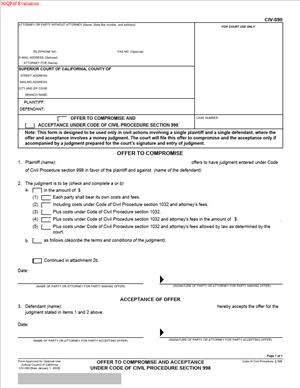
CIV-090 – Offer to Compromise and Acceptance Under Code of Civil Procedure Section 998
Fill out nowJurisdiction: Country: United States | Province or State: California
If you are involved in a civil lawsuit in California, you may come across the CIV-090 – Offer to Compromise and Acceptance Under Code of Civil Procedure Section 998. This document is used to formally offer to settle a case before trial.
The CIV-090 – Offer to Compromise and Acceptance Under Code of Civil Procedure Section 998 is not a typical motion or request for a hearing. It is a settlement tool. It allows one party to make a written offer to resolve the dispute under specific terms.
If the other side accepts the offer within a set time, the case can end without going to trial. If the offer is not accepted and the case proceeds, the form can later affect who pays certain costs.
This form matters because it can shift financial risk. In some situations, rejecting a reasonable offer may have cost consequences at the end of the case.
You are most likely to see this document in civil cases involving money damages, such as personal injury, property damage, contract disputes, or other claims where one party seeks payment from another.
What is CIV-090 – Offer to Compromise and Acceptance Under Code of Civil Procedure Section 998?
Clear definition
CIV-090 – Offer to Compromise and Acceptance Under Code of Civil Procedure Section 998 is a court form used in California civil cases to make a formal settlement offer under Code of Civil Procedure section 998.
It is a written proposal from one party to another. The offering party states the amount or terms they are willing to accept or pay to resolve the case. The receiving party has a limited time to accept.
If accepted in writing and properly filed, the offer becomes part of the court record and can lead to entry of judgment based on its terms.
This document is different from informal settlement discussions. It follows specific legal rules and can create cost consequences if rejected.
Who typically uses this form?
Plaintiffs often use this form when they believe their case is strong and want to encourage early settlement. They may offer to accept a certain amount of money to resolve all claims.
Defendants also commonly use this form. A defendant might offer to pay a set amount to avoid the uncertainty and expense of a trial.
Attorneys frequently prepare this form in represented cases. However, self-represented litigants can also use it if they understand the requirements and timing.
Insurance-related disputes often involve these offers. However, the form can be used in many types of civil actions in the Superior Court of California.
Why might you need this form?
You might need this form if you want to make a serious settlement offer that carries legal weight. Unlike a casual email or conversation, this form creates formal consequences.
The document can put pressure on the other side to evaluate the strength of their case. If they reject a reasonable offer and do not do better at trial, they may face financial consequences related to costs.
You may also need this form if the other side has served you with a section 998 offer and you want to formally accept it. The same document includes a section for acceptance.
Using this form can narrow the issues in dispute. In some cases, it leads to full resolution. In others, it clarifies each side’s position before trial.
Typical real-life scenarios
- In a car accident case, the injured driver sues for medical bills and lost wages. Before trial, the defendant serves a section 998 offer proposing to pay a specific amount to resolve the claim. The plaintiff reviews the offer and decides whether to accept.
- In a contract dispute between two small businesses, one party believes the claimed damages are overstated. That party serves a 998 offer for a lower amount, hoping to limit potential cost exposure if the case goes to trial.
- In a landlord-tenant property damage case filed in civil court, the landlord may use this form to offer a compromise payment instead of continuing with litigation.
- In a personal injury case nearing trial, a plaintiff may serve a 998 offer that includes specific terms about costs and dismissal. The defendant must evaluate the financial risk of rejecting it.
- In a case with multiple defendants, one defendant might use the form to make a separate offer to resolve claims against them only, leaving the rest of the case pending against others.
When would you use CIV-090 – Offer to Compromise and Acceptance Under Code of Civil Procedure Section 998?
You would use this form during an active civil case in the Superior Court of California. The case must already be filed, and the parties must be identified in the lawsuit.
Timing matters. A section 998 offer is often used after some information has been exchanged, such as through discovery. This allows each side to better assess the value of the case.
Plaintiffs may use it when they want to signal confidence in their claimed damages. Defendants may use it when they believe the plaintiff is demanding more than the case is worth.
The form is typically served before trial. It can also be used earlier in the case, but it must comply with statutory timing rules to be effective.
You would not use this document to start a lawsuit. It is only used within an existing civil action.
If you receive this form from the other side, you would use the acceptance portion if you agree to the stated terms within the allowed time.
Legal characteristics of CIV-090 – Offer to Compromise and Acceptance Under Code of Civil Procedure Section 998
This form is governed by California’s Code of Civil Procedure section 998. That statute outlines how offers must be made, served, accepted, and enforced.
For the offer to be effective, it must be in writing and clearly state the terms. The amount offered or the specific conditions must be understandable. Ambiguous terms can create disputes later.
The offer must allow the receiving party a statutory period to accept. If the offer expires without acceptance, it is generally considered withdrawn.
Service must follow the rules for serving documents in a civil case. Improper service can affect enforceability.
One key feature of a section 998 offer is its potential impact on costs. If a party rejects a valid offer and does not obtain a more favorable result at trial, the court may consider shifting certain costs.
Common problems include unclear language about costs and fees, failure to identify all parties correctly, and mistakes in describing how judgment will be entered. Offers that attempt to impose unrelated conditions can lead to disputes about validity.
This form does not decide the case by itself. It is not a motion and does not require a judge’s approval to be made. It becomes significant if accepted or later reviewed in connection with costs.
Although section 998 is specific to California, cost-shifting settlement mechanisms exist in other jurisdictions. The details vary, and the exact consequences depend on the governing rules of that state.
Is it legally binding?
An offer made using this form is not automatically binding just because it is served. It becomes binding if the receiving party accepts it in writing within the allowed time and the acceptance complies with the statutory requirements.
Once properly accepted, the agreement can form the basis for entry of judgment. At that point, it carries the same force as other judgments in the case.
If the offer is not accepted within the statutory period, it generally expires. It cannot be accepted later unless the offering party renews or extends it.
Even when not accepted, a valid offer can still have legal consequences. If the case goes to trial and the result is less favorable to the rejecting party than the offer, cost-shifting rules may apply.
Whether an offer is enforceable can depend on clear drafting, proper service, and compliance with procedural requirements.
How to fill out CIV-090 – Offer to Compromise and Acceptance Under Code of Civil Procedure Section 998
Step 1 – Caption and court information
At the top of the form, fill in the name of the court, including the county and branch if applicable. Enter the case title exactly as it appears on other filed documents. Include the case number assigned by the court. Make sure the party names match the complaint and other pleadings.
Step 2 – Identify the offering party
In the section that states who is making the offer, clearly identify the party or parties making the proposal. Use the same names used in the case caption. If multiple parties are involved, be precise about whether the offer is made by one party, several parties jointly, or all defendants or plaintiffs.
Step 3 – State the terms of the offer
Write the specific terms of the compromise. This usually includes a dollar amount and may address costs or dismissal of claims. The language must be clear and complete so the other side can understand exactly what is being offered. Avoid vague statements that could create confusion later.
Step 4 – Specify how judgment will be entered or claims dismissed
Indicate whether the offer allows for entry of judgment in favor of the offering party or calls for dismissal of the action. Follow the structure provided on the form. Ensure the terms align with the intended resolution of all or part of the case.
Step 5 – Sign and date the offer
The offering party or its attorney signs and dates the form. The signature confirms that the offer is formally made under section 998. Use the same signature format as on other court filings.
Step 6 – Complete the acceptance section if applicable
If you are accepting an offer that was served on you, fill out the acceptance portion of the form. Clearly indicate that you accept the stated terms. Sign and date the acceptance within the statutory time period.
Step 7 – Prepare for service
After completing the offer or acceptance, prepare it for service on the other party or their attorney. Service must follow the procedural rules for civil cases. Keep a copy for your records.
Step 8 – File the accepted offer if required
If the offer is accepted, the signed acceptance may be filed with the court so that judgment can be entered according to its terms. Confirm that the document includes both the offer and the written acceptance before submitting it for filing.
Legal terms you might encounter in CIV-090 – Offer to Compromise and Acceptance Under Code of Civil Procedure Section 998
- Offer to Compromise: This is a formal written proposal to settle the case for specific terms. In this document, the offering party states exactly what they are willing to pay or accept to resolve the dispute. The offer must be clear, complete, and capable of being accepted without adding new terms.
- Acceptance: This is the written agreement by the receiving party to accept the offer exactly as stated. The acceptance section on the form must match the offer without changes. Once signed and served, it creates the basis for entry of judgment or dismissal.
- Judgment: A judgment is the court’s official decision resolving the case. If the offer is accepted, the parties may ask the court to enter judgment according to the terms in the document. The judgment will reflect the amount or relief stated in the offer.
- Dismissal: A dismissal ends the case without a trial. The offer may provide that the case will be dismissed instead of entering a judgment. The form should clearly state whether the dismissal is with prejudice, meaning the claims cannot be filed again.
- Costs: Costs are certain expenses related to the lawsuit, such as filing fees or service fees. The offer may state whether costs are included in the settlement amount or will be added. This detail must be spelled out in the terms section.
- Service: Service means delivering the document to the other party in a legally recognized way. Even though this offer is not filed with the court when made, it must be properly served. Proof of service should be completed and kept.
- Entry of Judgment: This is the act of submitting the accepted offer to the court so the clerk or judge can officially record it as a judgment. The form may include language allowing either party to file it for entry if accepted. This step changes the public court record.
- With Prejudice: This phrase means the claims are permanently resolved and cannot be brought again. If the offer provides for dismissal with prejudice, it ends the dispute fully. You must use this phrase carefully because it affects future rights.
- Time for Acceptance: This refers to the deadline for the receiving party to accept the offer. The law sets a time limit, and the offer remains open only for that period unless withdrawn earlier under proper rules. The document should clearly show when it was served, because that date controls the deadline.
- Authorized Signature: The person signing must have authority to bind the party. For individuals, this is usually the party themselves. For businesses, it must be an officer or authorized representative.
FAQs
When does the deadline to accept this document start?
The deadline starts from the date the offer is served, not the date it is signed. You must check the proof of service to confirm the exact service date. Count the days from that date to determine the last day to accept. If you are accepting, make sure your acceptance is signed and served before the deadline expires.
Do I file CIV-090 – Offer to Compromise and Acceptance Under Code of Civil Procedure Section 998 with the court right away?
No. When you make the offer, you serve it on the other party but do not file it with the court. If the offer is accepted, then you file the signed offer and acceptance so the court can enter judgment or note the dismissal. Filing too early can create confusion in the court record.
What if the other side changes the terms before signing?
If the receiving party changes any wording, amount, or condition, that is not an acceptance. It becomes a counteroffer. This document must be accepted exactly as written to be effective. If you see edits, review them carefully and decide whether to accept the new proposal in writing.
Whose name should appear in the caption and signature lines?
Use the exact party names as they appear in the court’s case caption. Check prior filings to match spelling and formatting. The person signing must also print their name clearly and indicate their role if signing for a business or organization.
Do I need to attach anything to this form?
In most situations, you do not attach evidence or additional documents. However, you must complete a proof of service showing how and when the offer was delivered. Keep a copy of everything for your records, including the signed proof of service.
What happens in the public record if the offer is accepted?
If accepted, the signed document is filed with the court. The court may enter judgment based on its terms or record a dismissal. This means the case status will change in the court system to show it has been resolved.
Can I withdraw the offer after serving it?
You generally cannot withdraw the offer during the statutory acceptance period unless specific legal conditions apply. Once served, it remains open for the time allowed by law. Before serving, review the terms carefully so you are confident in the amount and conditions.
What if the acceptance section is signed but not dated?
A missing date can create disputes about whether the acceptance was timely. Always check that the acceptance includes a signature and date. When filing CIV-090 – Offer to Compromise and Acceptance Under Code of Civil Procedure Section 998 after acceptance, make sure all signature blocks are complete and legible.
Checklist: Before, During, and After CIV-090 – Offer to Compromise and Acceptance Under Code of Civil Procedure Section 998
Before
- Review the complaint, answer, and any cross-complaints to confirm all parties and claims.
- Decide the exact settlement amount or terms you are willing to offer or accept.
- Clarify whether the amount includes costs or if costs will be added.
- Confirm the correct case number and court name for the caption.
- Verify the legal names of all parties as listed in prior filings.
- Make sure you understand the acceptance deadline rules.
- Prepare a proof of service form.
- Confirm who has authority to sign for each party.
During
- Complete the caption exactly as it appears in the case.
- Clearly identify the offering party by name.
- State the full settlement amount in numbers and words if needed.
- Specify whether the offer includes costs or fees.
- Indicate whether judgment will be entered or the case dismissed.
- Sign and date the offer in the correct signature block.
- Serve the document using an approved method.
- Complete and sign the proof of service.
After
- Calendar the deadline for acceptance based on the service date.
- Monitor for written acceptance before the deadline.
- If accepted, confirm the acceptance section is fully completed.
- Make copies of the signed offer and acceptance.
- File the accepted document with the court for entry of judgment or dismissal.
- Keep stamped copies for your records.
- Update your case file to reflect the resolution terms.
- Follow through on payment or other obligations stated in the offer.
Common mistakes to avoid with CIV-090 – Offer to Compromise and Acceptance Under Code of Civil Procedure Section 998
- Mistake: Leaving settlement terms vague because you assume both sides “understand,” which happens when parties negotiate informally; this can make the offer unenforceable, so do not forget to state the exact amount and conditions in writing.
- Mistake: Forgetting to address costs, which often occurs when focusing only on the main dollar figure; this can lead to disputes later, so do not forget to specify whether costs are included or added.
- Mistake: Filing the offer with the court before it is accepted, which happens due to confusion about procedure; this can create procedural issues, so do not forget that the offer is served first and filed only if accepted.
- Mistake: Using incorrect party names from memory, which is common in long cases; this can delay entry of judgment, so do not forget to copy names exactly from the court caption.
- Mistake: Missing the acceptance deadline because you miscounted days, which happens when you rely on the signing date instead of service date; this can void the acceptance, so do not forget to calculate from the date of service.
- Mistake: Allowing someone without authority to sign, which can occur in business disputes; this can invalidate the agreement, so do not forget to confirm the signer’s authority.
- Mistake: Failing to keep proof of service, which often happens when parties focus only on the main document; this can create disputes about timing, so do not forget to complete and retain the proof of service.
- Mistake: Altering language in the acceptance section, which sometimes happens when trying to “clarify” terms; this can turn the acceptance into a counteroffer, so do not forget that acceptance must match exactly.
What to do after filling out CIV-090 – Offer to Compromise and Acceptance Under Code of Civil Procedure Section 998
Once you complete the form, pause and review every section carefully. Make sure the case caption matches the court record. Confirm the amount, terms, and signatures are correct. Small errors can delay resolution.
If you are making the offer, your next move is service. Do not file it with the court at this stage. Keep it organized in your case file with the proof of service attached.
If you are accepting the offer, double-check that you did not change any language. Sign and date the acceptance section clearly. Make sure your signature is legible.
- Step 1: Make at least two copies of the signed document, one for you and one for the other party.
- Step 2: Serve the signed document using an approved method and complete the proof of service.
- Step 3: If the offer has been accepted, prepare the original signed document for filing with the court.
- Step 4: File the accepted offer and acceptance with the clerk so judgment can be entered or dismissal recorded.
- Step 5: Request a stamped copy for your records at the time of filing.
- Step 6: Calendar any payment deadlines stated in the document.
- Step 7: If payment is required, document when it is received or sent and keep proof.
- Step 8: Update your personal case file to show the matter has been resolved.
- Step 9: Confirm the court docket reflects the entered judgment or dismissal.
- Step 10: Store the final stamped copy in a safe place for future reference.
After filing, monitor the case status. If the court enters judgment, review it to confirm it matches the agreed terms. If the case is dismissed, verify that it states “with prejudice” if that was part of the agreement.
Stay organized. Keep digital and paper copies of the signed offer, acceptance, proof of service, and any proof of payment. These documents protect you if questions arise later.
Disclaimer: This guide is provided for informational purposes only and is not intended as legal advice. You should consult a legal professional.