UD-101- Plaintiff’s Mandatory Cover Sheet and Supplemental Allegations – Unlawful Detainer
Fill out nowJurisdiction: Country: United States | Province or State: California
What is a UD-101- Plaintiff’s Mandatory Cover Sheet and Supplemental Allegations – Unlawful Detainer?
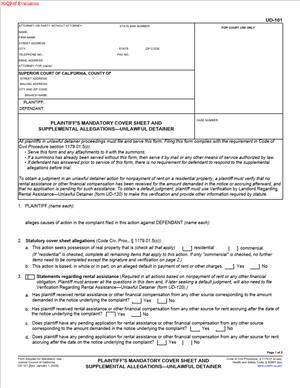
UD-101 is the mandatory cover sheet and set of supplemental allegations you file with a California unlawful detainer complaint. It belongs to the Superior Court of California’s Landlord and Tenant forms. You attach it to the initial complaint when you seek possession of real property, often with a claim for past-due rent or other charges. The court uses it to quickly understand the type of eviction case, confirm statutory prerequisites, and route the case to the proper track.
You use UD-101 to tell the court what kind of tenancy is involved and why you are seeking possession. You disclose if the property is residential or commercial and whether the case is based on nonpayment, a lease breach, expiration of a fixed term, foreclosure holdover, or other legal cause. In nonpayment cases, the form captures details about notices, timelines, the period when rent became due, and any rent-relief steps required before filing. In residential cases, it also triggers additional disclosures tied to past emergency periods and other prefiling requirements.
Who typically uses this form?
Plaintiffs in eviction actions. That includes individual landlords, property managers authorized to sue, and businesses that own or manage rental property. Attorneys complete it for clients. Self-represented landlords complete it themselves. Tenants do not file this form, but they rely on it to understand the plaintiff’s allegations and challenge defects.
Why would you need this form?
Because the court requires it with every unlawful detainer complaint, without it, your filing may be rejected or delayed. Even if accepted, a missing or incomplete UD-101 can lead to motions, demurrers, or trial issues that slow your case. The form also becomes a sworn part of your pleading. It helps you present clean, organized facts and show compliance with required notices and waiting periods.
Typical usage scenarios
You served a three-day notice to pay rent or quit, and the tenant did not pay. You served a notice to cure a lease breach, and the conduct continued. The lease terminated, and the tenant remained in possession. You completed the steps required for rent relief during the designated periods and now seek possession and rent. In each of these, UD-101 explains your theory of possession and confirms the timing and content of your notices, so the court can set the case for the correct hearing path.
When Would You Use a UD-101- Plaintiff’s Mandatory Cover Sheet and Supplemental Allegations – Unlawful Detainer?
You use UD-101 each time you file a California unlawful detainer complaint in Superior Court. That covers residential and commercial cases. It applies whether you claim only possession or possession plus money. If you join other limited civil claims tied to the tenancy, you still file UD-101. If you are a master landlord suing a subtenant, you still file UD-101. If you are a successor owner after foreclosure or a buyer at trustee’s sale, you still file UD-101.
Consider a residential nonpayment case. The tenant missed several months of rent. You served the correct pay-or-quit notice. During certain past periods, you also had to serve a special form of notice and give an opportunity to return a declaration of financial hardship. For a stretch of time, you needed to pursue government rent relief or document why you could not. UD-101 asks you to check and explain which steps were applied and what you did. The court uses this to confirm that your complaint may proceed.
Consider a commercial nonpayment case. Emergency-era rules were different for commercial tenancies. UD-101 lets you identify the property as commercial and avoid residential-only questions. It still captures the notice used, the dates, the amounts demanded, and your basis for possession.
Consider a holdover at the end of a fixed-term lease. You served a notice of termination or relied on the lease’s end date. The tenant remained. UD-101 shows that this is a no-fault or holdover basis, not a rent case. The court will not expect proof of rent-relief steps that only apply to nonpayment of residential rent.
Consider a breach other than rent. You served a notice to cure or quit, such as for unauthorized occupants, nuisance, or illegal use. UD-101 flags that this is a breach case and confirms the kind of notice and timing.
Consider a post-foreclosure occupancy. You served the required notice after a foreclosure sale. UD-101 indicates that the case is based on a change in ownership and identifies the property type so the court can apply the correct timeframes.
In short, if your lawsuit seeks to recover possession of property through the unlawful detainer process in California, you file UD-101 with your complaint. It does not replace the civil case cover sheet, but for eviction actions, it is mandatory and specific to the landlord-tenant context.
Legal Characteristics of the UD-101- Plaintiff’s Mandatory Cover Sheet and Supplemental Allegations – Unlawful Detainer
UD-101 is legally required in California unlawful detainer actions. Courts treat it as part of your pleading. When you sign UD-101, you make sworn allegations under penalty of perjury. That matters. The court relies on those sworn statements to determine if your case can proceed, what defenses may be available, and how quickly it should be heard. Because unlawful detainers are fast-track cases, the court needs this information at filing.
What ensures enforceability?
First, the form’s status as a mandatory judicial form means the clerk expects it with your complaint. Second, the verification block binds you to the truth of your statements. Third, the content aligns with statutory prerequisites for eviction. For example, when the claim is nonpayment, the law requires particular notices, timelines, and, during certain defined periods, additional steps tied to rent relief. UD-101 forces you to confirm that you completed those steps. If you did not, the court can dismiss or stay the case.
The form also structures the burden of proof. If you check that rent came due during special protection periods, the court knows to look for your compliance with additional requirements. If you check that the property is commercial, the court knows those additional residential protections do not apply. If you assert a holdover or breach, the court expects proof of the right kind of notice and proper service.
General legal considerations flow from accuracy and completeness. Your checked boxes and dates must match your complaint, your exhibits, and your proof of service of the notice. If your notice demanded charges that cannot be included, or used the wrong time period, your UD-101 will expose the defect. If you assert you applied for rent relief when you did not, you risk credibility issues and sanctions. If you assert the tenant did not return a required declaration but your file shows otherwise, you undermine your case.
Finally, UD-101 signals the case category. Some courts triage rent cases differently from other causes. Some assign early settlement conferences when rent-relief issues appear. The form helps the judge identify whether immediate possession is the proper remedy, whether a stay may apply, and whether to schedule a trial on a priority calendar. Filing it correctly protects speed and due process in a summary proceeding that moves fast.
How to Fill Out a UD-101- Plaintiff’s Mandatory Cover Sheet and Supplemental Allegations – Unlawful Detainer
Follow these steps. Keep your answers consistent with the complaint and attachments. Type or print clearly. Use dates in month/day/year format.
1) Prepare your file and facts
- Gather the signed lease or rental agreement.
- Collect all notices served and proofs of service.
- Print a rent ledger showing charges, payments, and balances by month.
- Identify property type: residential or commercial.
- Confirm the exact reason for eviction.
- Note when the unpaid rent (if any) became due.
- If residential nonpayment occurred during protected periods, locate any declarations served or returned.
- If you applied for rent relief, have the program name, application number, status, and dates.
2) Complete the caption and attorney section
- Enter your name and contact information at the top.
- If you have an attorney, list their name, firm, bar number, address, phone, and email. Identify who they represent.
- Identify the Superior Court county and branch address where you are filing.
- List the plaintiff and defendant names exactly as on the complaint.
- Leave the case number blank if you are filing the complaint; the court will assign it.
3) Identify the property and tenancy
- Check whether the property is residential or commercial.
- Provide the street address of the rental unit, including unit number, city, and ZIP code.
- If the tenancy is subsidized or subject to special programs, indicate that if the form asks. Some versions prompt for this to flag additional notice requirements.
- If subtenants or unnamed occupants are present, confirm that the complaint includes “Does 1–10” or “All Occupants” if you plan to seek a judgment against them. The form may prompt for this context.
4) State the basis for unlawful detainer
- Choose the primary ground for possession:
- Nonpayment of rent or other sums due under the rental agreement.
- Breach of a term other than payment (for example, unauthorized occupants, nuisance, or illegal activity).
- Holdover after lease expiration or termination of a periodic tenancy with proper notice.
- Post-foreclosure holdover where you acquired title through a trustee’s sale.
- Other legally recognized just causes are applicable.
- If more than one ground applies, select all that fit and be ready to support each with the correct notice.
5) Describe the notice served
- Identify the type of notice:
- Three-day notice to pay rent or quit (or commercial pay-or-quit variant).
- Three-day notice to perform the covenant or quit.
- Thirty-, sixty-, or ninety-day termination notice for no-fault or end-of-term cases, as applicable.
- Post-foreclosure notice to quit.
- Any special fifteen-day notice used during prior emergency periods for residential nonpayment.
- Enter the date you served the notice and the date it expired.
- Identify how it was served: personal service, substituted service, or posting and mailing, consistent with your proof of service.
- Confirm that the notice accurately stated the amount due and did not include charges that cannot be demanded in that notice.
- If a special notice was required during protected periods, confirm that the required language and enclosures were provided. If a declaration form was required, state whether you served it and whether the tenant returned it.
6) Address timing and protected rental-debt periods (residential nonpayment only)
- If any rent became due during designated emergency periods, check the box that applies.
- Indicate which months fall into those periods.
- State whether the tenant returned a signed declaration of financial distress for any of those months.
- If you are seeking amounts that came due outside those periods, separate those amounts from any amounts that are limited to collection in a different forum.
- If the form asks whether you pursued rental assistance before filing, answer truthfully. Provide the status:
- Applied and approved, with amounts and dates.
- Applied and denied, with dates.
- Applied and pending at filing, with application number and last update.
- Could not apply because the program was closed or ineligible for the tenancy, with a short explanation.
7) State amounts demanded and relief sought
- If you seek possession only, indicate that.
- If you also seek rent or other damages, list the unpaid rent, the period covered, and any allowable fees or utilities as permitted by your notice.
- Do not include amounts that the law prohibits in an eviction demand. Keep those separate for a future civil action if needed.
- If you seek forfeiture of the lease, indicate that only if your notice supports it.
8) Residential just-cause context (if applicable)
- If the property is a covered residential tenancy requiring just cause, indicate whether your ground is at-fault or no-fault under that framework.
- If no-fault, confirm whether you offered relocation assistance or a rent waiver when required, and state the amount or credit provided.
- If the property is exempt from those rules, check the appropriate exemption and state the facts supporting the exemption, such as owner-occupied duplex or certain single-family criteria, if the form prompts for it.
9) Compliance with local rules or ordinances (if prompted)
- Some versions of the form ask whether a local prefiling program or notice was applied. If so, indicate that you complied. Examples include local termination requirements, additional disclosures, or pre-filing resolution steps. Provide short facts, not legal argument.
10) Facts about the tenancy and occupants
- Provide the start date of the tenancy and whether there is a written lease or a month-to-month rental agreement.
- State the current monthly rent and due date.
- If there are additional named co-tenants or subtenants, list them if the form asks.
- If you included occupants as Doe defendants in the complaint, confirm that strategy here if prompted.
11) Verification under penalty of perjury
- Read the verification carefully. Your signature makes the information part of your sworn pleading.
- Date and sign the verification. If a business entity is the plaintiff, an authorized representative or attorney signs.
- Print your name and title, such as owner, property manager, or authorized agent.
- If your attorney signs, they must be able to attest to the facts based on knowledge and file records. Many attorneys prefer the client to sign if the facts are client-controlled.
12) Attachments and consistency check
- Attach copies of the notices and proofs of service to your complaint, as required. UD-101 references them and must match.
- If you reference a rent-relief application, bring documentation to the first hearing and trial. The court may ask for it based on your UD-101.
- Confirm that dates, amounts, and property information match across:
- The complaint.
- UD-101.
- The notice and proof of service.
- Any rental assistance records.
- Your rent ledger.
13) Filing and service
- File UD-101 with the complaint at the proper courthouse for the property’s location.
- Pay the filing fee or submit a fee waiver application, if applicable.
- Serve the summons and complaint according to the unlawful detainer service rules. You do not serve UD-101 separately if it is attached to the complaint. The tenant will receive it with the pleading pack.
14) Common pitfalls to avoid
- Do not check “nonpayment” if your notice was only a breach notice without rent amounts. Match the ground to notice.
- Do not include emergency-period rent in a possession claim if the law restricts that. Identify those months and handle them as directed by the form’s options.
- Do not claim you applied for rent relief if you only visited a website. If you started but did not submit, say so.
- Do not skip the verification. An unsigned or undated UD-101 can trigger a rejection or challenge.
- Do not round dates. Exact service and expiration dates matter.
15) Practical examples to guide your entries
- Residential nonpayment across two periods: You served a three-day notice that covered one recent month and several months from earlier emergency periods. On UD-101, you check that this is residential nonpayment, identify which months fall into protected periods, confirm you served the required form of notice during those periods, indicate that the tenant returned a declaration for two months, and state you applied for rent relief and the outcome. You separate the recent month as recoverable in this case and identify the older months as handled per the form’s instructions.
- Commercial nonpayment: You check “commercial,” identify a three-day commercial pay-or-quit notice, list service and expiration dates, and provide the rent ledger totals. You skip residential-only items and do not claim any rent-relief steps that do not apply.
- Holdover after fixed term: You check “holdover,” attach the lease showing the end date, identify the termination notice if used, and state the date the tenancy ended. There is no rent-relief section to complete because the ground is not nonpayment.
16) Before you submit, run a final audit
- Ground for eviction matches the notice.
- Dates align across all documents.
- Amounts demanded in the notice match the ledger and what you claim.
- Required emergency-period steps are correctly described if applicable.
- Verification is signed and dated by the correct person.
If you approach UD-101 this way, you provide the court exactly what it needs to move your case forward. You also reduce the risk of procedural challenges that can derail fast-track eviction timelines.
Legal Terms You Might Encounter
- Plaintiff means the party bringing the unlawful detainer case. On this form, that’s you as the property owner or authorized agent. You will list your legal name, confirm your right to possession, and state why you seek eviction. Make sure the plaintiff’s name matches all other case documents.
- Defendant means the tenant or occupant you are suing. The form asks you to identify each defendant by name. If you include unnamed occupants, the form helps you explain why you included them. Use consistent names across the complaint, summons, and proof of service.
- Unlawful detainer is the court process to recover possession when a tenant stays without a legal right. This form is the cover sheet that explains the basis for your eviction claim. It helps the court see the type of case and the notice you used at a glance.
- Premises refers to the rental property at issue. You will list the full property address. That means unit number, city, and zip code. Details must match your notice and lease. If the address differs in any document, explain why or correct it before filing.
- Notice to quit (or pay or quit) is the written notice you served before filing. On this form, you describe the notice type, the service date, the method of service, and the date the notice expired. You also confirm whether you attached a copy to your complaint.
- Breach means the tenant violated the rental agreement. Typical breaches include unpaid rent, unauthorized occupants, or illegal use. The form asks you to check the breach type and include key facts. Keep your allegations short, specific, and tied to the notice you served.
- Holdover means the tenant stayed after the lease ended or after a proper termination notice expired. On the form, you indicate a holdover basis if that applies. You confirm that any required notice was given and that the time to move out has passed.
- Possession means the legal right to control and occupy the unit. Your lawsuit asks the court to restore possession to you. The form lets you state that you seek possession and, if requested, a writ of possession after judgment.
- Damages are the money you claim. That can include unpaid rent, holdover damages, fees authorized by the lease, and daily damages. The form prompts you to state amounts and dates. If the amount changes after filing, you note that on later filings, not on this cover sheet.
- Service means how you delivered the notice to the tenant. The form requires you to confirm the service method, such as personal, substituted, or posting and mailing. Inaccurate service details can derail your case. Match the method in your proof of service.
- Subsidized tenancy refers to a rental that receives housing assistance. The form asks if the unit is subsidized or subject to special rules. If it is, you must state that. Some programs require specific notice language. The form captures whether those steps were followed.
- Just cause means a legal reason is required to end a tenancy. The form may ask whether the property is subject to just cause rules. If so, you identify the cause category. Keep your cause aligned with the facts in your notice and your lease.
FAQs
Do you need to file this form with your complaint?
Yes. Courts require this cover sheet with unlawful detainer complaints. It highlights your claim type, notice details, and key facts. If you omit it, your filing can be rejected or delayed. Attach it to the front of your complaint packet.
Do you list every tenant and occupant on the form?
List each named tenant defendant. If you intend to include unnamed occupants, indicate that as well. Use the same spellings on the complaint, summons, and all proofs of service. Consistent names reduce service challenges and default issues.
Do you attach the notice to quit to this form?
You typically attach notices to the complaint, not stapled to this cover sheet. The form asks you to confirm the notice type, service date, and expiration. Make sure the notice attached to the complaint matches the details on this form.
Do you include rent amounts that accrue after filing?
This cover sheet summarizes the claim at filing. For rent that accrues later, note that in your judgment request or trial documents. Do not alter the cover sheet after filing. Keep a running ledger for accuracy in court.
Do you need to include the full lease on this form?
No. You summarize the agreement terms relevant to your claim. The complaint usually includes or describes the lease and key provisions. Keep the summary on this form short and consistent with the lease you will present in court.
Do you check both “nonpayment” and “breach” if rent and other violations apply?
Check the category that matches your notice. Your notice controls your claim. If your notice is for nonpayment only, check nonpayment. If it is for other material breaches, check the breach. Mixed notices require careful alignment across all documents.
Do you need to identify rent control or just-cause coverage?
If the property is covered, indicate that on the form. The form captures whether special rules apply and whether you followed them. Align any cause or exemptions with your notice. Inconsistent entries can trigger demurrers or delays.
Do you file this form for commercial tenancies?
Yes, if the case is an unlawful detainer. The form captures whether the tenancy is residential or commercial. Make sure the notice type and cure periods match the tenancy type described. Commercial cases follow different lease terms and notice language.
Checklist: Before, During, and After the UD-101- Plaintiff’s Mandatory Cover Sheet and Supplemental Allegations – Unlawful Detainer
Before signing
- Lease or rental agreement. Have the signed version and any renewals or addenda.
- Complete rent ledger. Include dates, amounts due, amounts paid, and running balance.
- Copy of the notice. Use the exact notice you served, with the correct service date.
- Proof of service of the notice. Keep declarations and mailing receipts, if any.
- Property details. Confirm the full address, unit number, and legal owner name.
- Tenant roster. List all adult occupants, minors as appropriate, and unnamed occupants if included.
- Subsidy documents, if any. Keep housing assistance contracts and required attachments.
- Rent control or just-cause status. Confirm coverage and any exemptions you will claim.
- Filing details. Know the case type, court location, and whether e-filing is required.
- Fee planning. Prepare filing fees or a fee waiver request, if applicable.
During signing
- Case category. Verify you checked the correct claim basis (nonpayment, breach, or holdover).
- Tenancy type. Confirm that residential or commercial matches the lease and your notice.
- Notice details. Check notice date, service method, and expiration date for accuracy.
- Amounts claimed. Ensure rent, damages, and daily amounts match your ledger and complaint.
- Parties’ names. Confirm spelling and order match the complaint and summons.
- Property address. Verify the unit number and city. Align with the notice and lease.
- Subsidy and coverage. Indicate any special program or just-cause coverage correctly.
- Attachments referenced. Make sure anything you say that is “attached” is attached to the complaint.
- Signature and date. Sign where required. Include printed name and role (owner or agent).
After signing
- Assemble your packet. Place this form on top of the complaint and required attachments.
- File with the court. Use the court’s filing method. Pay any filing fee or submit a fee waiver.
- Get conformed copies. Keep stamped copies for your records and for service.
- Serve defendants. Serve the summons, complaint, and required attachments. Follow service rules.
- Keep proof of service. File proofs with the court within the required time after service.
- Track deadlines. Calendar response dates and hearing dates are once issued.
- Update your file. Add new rent charges and payments to your ledger after filing.
- Store securely. Keep copies of all forms, notices, and proofs in one organized place.
Common Mistakes to Avoid
Don’t forget to match the notice details exactly.
- Consequence: Clerks or judges may reject your filing or find the notice defective.
- Tip: Cross-check the service date, method, and expiration on the form against the notice and proof.
Don’t misidentify the tenancy type.
- Consequence: You may use the wrong notice period or cause standard, undermining your case.
- Tip: Confirm residential vs. commercial and any special coverage before you check the box.
Don’t list the wrong parties or miss occupants.
- Consequence: You might need to re-serve or amend, causing delay and extra cost.
- Tip: Use the lease, applications, and mail labels to capture all names used at the unit.
Don’t overstate amounts or mix time periods.
- Consequence: The court may doubt your ledger or limit damages.
- Tip: Show rent due through the filing date only. Track later charges separately.
Don’t skip the signature or date.
- Consequence: The court can reject your packet or require resubmission.
- Tip: Sign in ink or follow e-sign rules for e-filing. Print your name and role clearly.
What to Do After Filling Out the Form
- Assemble your complaint package. Place this cover sheet in front. Include the complaint, the notice, the proof of service of the notice, the lease or key excerpts, and any required addenda. Make sure page numbers and exhibits are readable.
- File with the court. Submit in person or through the court’s e-filing system, as required. Pay the filing fee or submit a fee waiver request. Ask for conformed copies for service.
- Serve the defendants. Arrange service of the summons, complaint, and all required attachments on each named defendant and any occupants as allowed. Choose a server who can complete a proof of service that meets court rules.
- File proofs of service. Once service is complete, file proofs promptly. Keep copies. Calendar the response deadline based on the service date and method used.
- Track payments and occupancy. Update your ledger daily. Note any move-out, return of keys, or partial payments. Keep communications professional and documented.
- Prepare for the next step. If defendants respond, prepare for a hearing or trial. Gather exhibits, including the lease, notices, ledgers, and photos if relevant. If no response, consider requesting a default judgment with possession and damages as allowed.
- Request judgment and writ when eligible. If you win or obtain a default, submit the judgment forms and request a writ of possession. Coordinate with the sheriff for enforcement after issuance.
- Amend if you find a material error. If you discover a serious mistake in the complaint package, consider correcting it through an amendment or a refiling process. Keep this form consistent with any amended complaint.
- Close your file properly. After resolution and any lockout, store the entire case file securely. Keep ledgers, notices, and judgments together. Note any balances for collection, if pursued.
- Review lessons learned. Adjust your notice practices, ledger format, and packet assembly steps to prevent issues in future cases. Update your templates and checklists as needed.
Disclaimer: This guide is provided for informational purposes only and is not intended as legal advice. You should consult a legal professional.