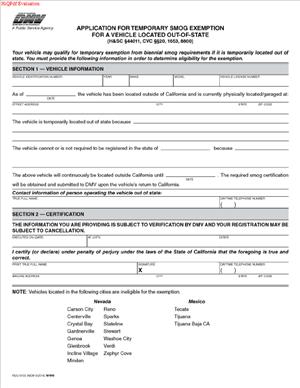
REG 5103 – Application for Temporary Smog Exemption for a Vehicle Located Out-Of-State
Fill out nowJurisdiction: Country: United States | Province or State: California
REG 5103 – Application for Temporary Smog Exemption for a Vehicle Located Out-Of-State is a California Department of Motor Vehicles form used when your vehicle is temporarily outside California and cannot complete a required smog inspection. It allows you to request a temporary exemption so you can move forward with certain DMV transactions.
You may come across this form while renewing your vehicle registration or resolving a registration issue. If your vehicle is not physically in California, getting a smog inspection may not be possible at that time. This document gives you a way to explain that situation formally.
This form matters because California generally requires a smog inspection before completing many registration transactions. Without either a valid smog certificate or an approved exemption, your registration may not be finalized.
If you are filling this out, you likely want to avoid penalties, delays, or registration lapses while your vehicle is out of state. Understanding what the form does, and what it does not do, helps you complete it accurately and avoid rejection.
What is REG 5103 – Application for Temporary Smog Exemption for a Vehicle Located Out-Of-State?
Clear definition
REG 5103 – Application for Temporary Smog Exemption for a Vehicle Located Out-Of-State is a written request submitted to the California DMV. In it, you state that your vehicle is currently outside California and cannot undergo a required smog inspection within the state.
The form is not a smog certificate. It does not confirm that your vehicle meets emissions standards. Instead, it asks the DMV to temporarily waive the requirement to submit a California smog certificate because of the vehicle’s location.
This document typically includes identifying details about you and the vehicle. It may ask for the vehicle identification number, license plate number, and your contact information. It also requires a statement confirming that the vehicle is out of state.
By signing the form, you confirm that the information you provide is true. The DMV relies on this statement when deciding whether to grant a temporary exemption.
Who typically uses this form?
Vehicle owners who are temporarily living, working, or studying outside California often use this form. For example, someone on a short-term job assignment in another state may not be able to bring the vehicle back in time for a smog check.
Military members stationed outside California sometimes need this form. If their vehicle remains with them at their duty station, completing a California smog inspection may not be practical.
College students who attend school in another state also fall into this category. If the car stays near campus, they may not be able to return to California before registration deadlines.
Business owners or individuals who store a vehicle out of state for part of the year may use this form as well. The key factor is that the vehicle is physically outside California when the smog inspection is due.
Why might you need this form?
California law generally requires a smog inspection before certain registration renewals or transfers. If the DMV’s records show that a smog certificate is required, you must either submit one or obtain an approved exemption.
When your vehicle is outside California, you cannot complete a California smog inspection in the usual way. Most other states’ emissions tests are not automatically accepted in place of California’s requirements.
This form allows you to explain that the vehicle’s location makes compliance temporarily impossible. It creates a formal record of your request and gives the DMV a basis to process your registration under specific conditions.
Without this filing, your registration renewal may be delayed. In some cases, late fees or penalties may apply if deadlines pass without action.
Typical real-life scenarios
- You accept a six-month work assignment in another state and take your car with you. During that time, your California registration renewal notice arrives and requires a smog inspection. You cannot return to California before the due date. This form provides a way to request a temporary exemption until the vehicle is back in the state.
- You are an active-duty service member stationed outside California. Your vehicle is registered in California but remains at your duty station. When renewal time comes, you need a way to address the smog requirement while the vehicle is out of state.
- You are a college student attending school across the country. Your car stays with you near campus. Your registration requires a smog check, but flying home just for the inspection is not realistic. The form allows you to formally notify the DMV of the vehicle’s location.
- You own a seasonal property in another state and keep a vehicle there for part of the year. The registration cycle happens while the car is stored out of state. This document can be used to request temporary relief from the smog requirement until you return the vehicle to California.
When would you use REG 5103 – Application for Temporary Smog Exemption for a Vehicle Located Out-Of-State?
You would use REG 5103 – Application for Temporary Smog Exemption for a Vehicle Located Out-Of-State when the DMV indicates that a smog certificate is required, but the vehicle is physically outside California.
This situation often arises during registration renewal. Renewal notices may state that a smog inspection is necessary before the registration can be completed. If you cannot bring the vehicle into California in time, this form becomes relevant.
It may also apply during certain ownership transfers or other registration updates. If a smog certificate is part of the transaction and the vehicle is out of state, a temporary exemption request may be appropriate.
The key timing issue is the due date. If your registration is about to expire and you cannot meet the smog requirement because of the vehicle’s location, you may look to this form to prevent gaps in registration.
This form is generally used by the registered owner of the vehicle. In some cases, an authorized representative may assist with the submission, but the owner’s information and signature are central to the document.
It is important to understand that this form addresses only the temporary issue of the vehicle being out of state. Once the vehicle returns to California, the standard smog requirements typically apply again.
Legal characteristics of REG 5103 – Application for Temporary Smog Exemption for a Vehicle Located Out-Of-State
This form functions as a sworn statement to a government agency. Its effectiveness depends on accurate and complete information. The DMV reviews the details you provide to determine whether a temporary exemption can be granted.
For the document to be considered valid, it usually must be fully completed and signed. Missing information, incorrect vehicle identification numbers, or mismatched owner details can lead to processing delays or rejection.
Common problems include listing the wrong license plate number, failing to sign the form, or leaving required sections blank. Inconsistent information between the form and DMV records may also cause issues.
The form’s impact is limited. It does not permanently remove the smog requirement. It generally provides a temporary accommodation based on the vehicle’s location at a specific time.
While this form is specific to California, other states may have their own rules regarding emissions and registration. Some states allow out-of-state emissions tests under certain conditions, while others do not. This document applies within California’s regulatory framework.
The DMV may impose conditions when granting a temporary exemption. For example, the exemption may last only until a certain date or until the vehicle returns to California. Once the vehicle is back in the state, completing a smog inspection may become necessary before the next registration step.
This form does not guarantee approval. The DMV evaluates each submission based on its records and applicable rules. Providing clear and accurate information increases the likelihood of smooth processing.
Is it legally binding?
REG 5103 – Application for Temporary Smog Exemption for a Vehicle Located Out-Of-State includes a declaration that the information you provide is true and correct. When you sign it, you are making a formal statement to a government agency.
In that sense, the form is legally significant. False or misleading information on a DMV document can carry consequences under general laws that apply to statements made to public agencies.
However, the form is not a contract between you and the DMV. It does not create ongoing rights beyond the specific temporary exemption being requested. Its purpose is administrative.
If the DMV approves the exemption, it typically applies for a limited period or under specific conditions. Once those conditions change, such as when the vehicle returns to California, the standard requirements may resume.
How to fill out REG 5103 – Application for Temporary Smog Exemption for a Vehicle Located Out-Of-State
Step 1 – Review your registration notice
Start by looking at your registration renewal notice or other DMV communication. Confirm that a smog inspection is required and note any deadlines. Make sure the vehicle is currently outside California and cannot reasonably complete a smog inspection within the state before the due date.
Step 2 – Gather your vehicle information
Collect the vehicle identification number, license plate number, and current registration details. Have your driver’s license or identification information available. Using official documents helps prevent errors when copying numbers onto the form.
Step 3 – Enter the registered owner’s details
Fill in your full legal name as it appears on DMV records. Provide your current mailing address and contact information. If your mailing address differs from the vehicle’s garaging address, enter the information exactly as requested in each section.
Step 4 – Provide vehicle identification information
Carefully write the vehicle identification number and license plate number in the spaces provided. Double-check each character. A single incorrect digit can cause delays because the DMV may not be able to match the form to the correct vehicle.
Step 5 – State that the vehicle is located out of state
Complete the section that asks about the vehicle’s current location. Indicate that the vehicle is outside California. If the form requests the state or general location, provide clear and accurate information.
Step 6 – Review the temporary exemption statement
Read the declaration on the form closely. This section usually explains that the exemption is temporary and that you understand a smog inspection may be required once the vehicle returns to California. Make sure you understand the timeframe or conditions described.
Step 7 – Sign and date the form
Sign your name in the space provided. Use your usual legal signature. Enter the date of signing. Your signature confirms that the information in the document is true to the best of your knowledge.
Step 8 – Check for completeness
Before submitting, review every section. Confirm that no required fields are blank. Verify that all numbers match your registration documents. A careful final review can reduce processing delays.
Step 9 – Submit the form as instructed
Follow the submission instructions provided with your registration materials. This may involve mailing the form or delivering it with other registration documents. Keep a copy of the completed form for your records so you can refer to it if questions arise.
Legal terms you might encounter in REG 5103 – Application for Temporary Smog Exemption for a Vehicle Located Out-Of-State
- Registered Owner: This is the person or legal entity listed in official records as owning the vehicle. On this form, the registered owner is the one who must provide identifying details and sign the certification. The name you enter must match the name on the current registration record to avoid delays.
- Vehicle Identification Number (VIN): The VIN is the unique 17-character code assigned to your vehicle. You must copy it exactly as shown on your registration card or title. A single incorrect digit can cause the request to be rejected because the system will not match your vehicle.
- License Plate Number: This is the number displayed on your vehicle’s plates. It connects your request to your specific registration record. Enter it exactly as it appears, including any special letter or number combinations.
- Registration Renewal Notice: This is the notice sent to you when your registration is due for renewal. It often shows whether a smog certification is required. You use the information on that notice to complete this document accurately.
- Smog Certification Requirement: This refers to the obligation to provide proof that your vehicle passed an emissions inspection. The exemption request temporarily delays that requirement because the vehicle is not currently in the state.
- Temporary Exemption: A temporary exemption means the smog requirement is postponed, not canceled. You are still responsible for completing the inspection once the vehicle returns. The form records your statement that the vehicle is currently located elsewhere.
- Certification Statement: This is the section where you declare that the information you provided is true and correct. By signing, you confirm the vehicle is out of state and acknowledge future obligations. This statement carries legal weight.
- Authorized Signature: This is the signature of the registered owner or an authorized representative. If someone signs on behalf of a business or another person, they must have proper authority. An unsigned form is incomplete and will not be processed.
- Out-of-State Location: This refers to the physical place where the vehicle is currently kept outside the state. You may need to provide a general location, such as the state or city. The purpose is to explain why the vehicle cannot undergo inspection at this time.
FAQs
Do I still have to renew my registration if I request a temporary smog exemption?
Yes. This document only addresses the smog inspection requirement. You are still responsible for paying registration fees and completing any other renewal steps. The exemption allows you to move forward with renewal without submitting a smog certificate right now.
What exact information must match my registration record?
The registered owner’s name, vehicle identification number, and license plate number must match what appears in official records. Even small differences, such as a missing middle initial or transposed VIN digits, can cause processing delays. Double-check these fields against your most recent registration card or renewal notice before submitting.
Can someone else sign this form for me?
Only the registered owner or a person with legal authority may sign. If the vehicle is owned by a business, an authorized officer or manager typically signs. Make sure the printed name and signature are consistent, and confirm that the signer’s role supports their authority to certify the information.
How long does the temporary exemption last?
The exemption generally applies to the current registration cycle tied to your renewal. It does not permanently remove the smog requirement. Once the vehicle returns, you must complete the required inspection before the next renewal or as otherwise required by law.
What happens if my vehicle returns sooner than expected?
If your vehicle comes back before the end of the exemption period, you should complete the required smog inspection promptly. Keep proof of completion for your records. Waiting too long could affect future registration transactions.
Will this form change the ownership record of my vehicle?
No. This form does not transfer title or update ownership details. It only records your request to delay the smog certification requirement because the vehicle is out of state. If you need to change ownership or address information, that requires a separate filing.
Do I need to attach proof that the vehicle is out of state?
In many cases, you are relying on your signed certification rather than submitting additional documents. However, you should review the instructions that accompany the REG 5103 – Application for Temporary Smog Exemption for a Vehicle Located Out-Of-State to see if any supporting information is requested. Providing complete and truthful information is essential because you are certifying under penalty of law.
What if I make a mistake after submitting the REG 5103 – Application for Temporary Smog Exemption for a Vehicle Located Out-Of-State?
If you realize you entered incorrect information, act quickly. You may need to submit a corrected document or contact the appropriate office to clarify the error. Do not assume the mistake will be ignored, especially if it involves the VIN, license plate number, or owner name.
Checklist: Before, During, and After REG 5103 – Application for Temporary Smog Exemption for a Vehicle Located Out-Of-State
Before
- Review your renewal notice to confirm a smog certification is required.
- Confirm that your vehicle is physically located outside the state.
- Gather your registration card to verify the VIN and license plate number.
- Check the exact spelling of the registered owner’s name.
- Confirm who is authorized to sign if the vehicle is owned by a business.
- Read all instructions attached to the form.
- Make sure your mailing address on record is current.
During
- Enter the registered owner’s name exactly as shown on official records.
- Carefully copy the full 17-character VIN without skipping characters.
- Fill in the license plate number clearly and accurately.
- Provide the out-of-state location information as requested.
- Review each field for completeness before moving on.
- Read the certification statement in full before signing.
- Sign and date the form in the correct place.
- Print clearly if completing the form by hand.
After
- Make a copy of the completed and signed form for your records.
- Submit the form using the method described in the instructions.
- Keep proof of submission, such as a receipt or confirmation.
- Monitor your registration status to confirm processing.
- Complete all other renewal requirements, including fee payment.
- Calendar a reminder to complete the smog inspection when the vehicle returns.
- Store the exemption paperwork with your vehicle records.
Common mistakes to avoid with REG 5103 – Application for Temporary Smog Exemption for a Vehicle Located Out-Of-State
- Mistake: Entering an incorrect VIN because you copied it from memory instead of the registration card, which can cause rejection and delay your renewal; always copy directly from an official document and double-check each character.
- Mistake: Using a nickname or shortened version of the owner’s name, which happens when people rush, leading to mismatches in the system; do not forget to match the exact legal name on file.
- Mistake: Forgetting to sign and date the form, often because the signature line is at the end, resulting in automatic return or processing delays; always review the last page before submitting.
- Mistake: Assuming the exemption removes the smog requirement permanently, which can create problems at the next renewal; remember this is temporary and plan for future compliance.
- Mistake: Submitting the form without paying required renewal fees, which happens when people focus only on the smog issue; do not forget that registration and exemption are separate steps.
- Mistake: Providing vague or incomplete out-of-state location information, which may raise questions about eligibility; be clear and accurate about where the vehicle is kept.
- Mistake: Waiting until the last minute before registration expires, which increases stress and limits time to fix errors; do not forget to allow processing time.
What to do after filling out REG 5103 – Application for Temporary Smog Exemption for a Vehicle Located Out-Of-State
Once you complete the form, shift your focus to submission and follow-up. Your goal is to make sure your registration stays current and your records stay organized.
- Step 1: Review the entire form one more time for accuracy and completeness.
- Step 2: Make a clear copy or digital scan for your personal records.
- Step 3: Submit the form using the accepted submission method listed in the instructions.
- Step 4: Pay any required registration renewal fees if you have not already done so.
- Step 5: Keep proof of submission, such as a confirmation page, receipt, or mailing record.
- Step 6: Monitor your registration status through official channels to confirm the exemption was processed.
- Step 7: Watch your mail or account notifications for any follow-up requests.
- Step 8: If you receive a notice requesting additional information, respond promptly and include reference details from your original submission.
- Step 9: Note the vehicle’s expected return date to the state.
- Step 10: Schedule a smog inspection soon after the vehicle returns so you are prepared for the next renewal cycle.
Stay organized. Keep the exemption form, confirmation, and any related correspondence together in one file. When the vehicle comes back, act quickly to complete the required inspection. That way, you avoid penalties, late fees, or unexpected registration holds in the future.
Disclaimer: This guide is provided for informational purposes only and is not intended as legal advice. You should consult a legal professional.