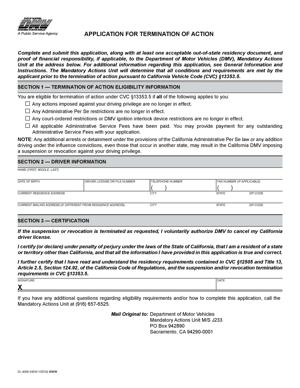
DL-4006 – Application for Termination of Action
Fill out nowJurisdiction: Country: United States | Province or State: California
If you are dealing with a suspended, revoked, or otherwise restricted driving privilege in California, the DL-4006 – Application for Termination of Action is a form you may encounter during the process. This document is used within the California Department of Motor Vehicles system to request that a specific administrative action be ended.
The DL-4006 – Application for Termination of Action is not a general complaint form. It is tied to an existing action already on record. That action may involve a suspension, revocation, or another enforcement measure affecting your driving status.
You typically use this form when you believe the reason for the action no longer applies. It allows you to formally ask the department to review your situation and consider ending the action.
If you are filling it out yourself, you need to understand what action is on your record, why it was imposed, and what has changed. This form connects those details in a structured way.
What is DL-4006 – Application for Termination of Action?
Clear definition
DL-4006 – Application for Termination of Action is an official California DMV document used to request the termination of an existing administrative action related to your driving privilege. An “action” generally refers to a formal measure taken by the department, such as a suspension or revocation.
The form functions as a written request. It identifies you, identifies the specific action, and explains why you believe it should be ended. It becomes part of your DMV record once submitted.
This document does not automatically remove the action. It triggers a review process. The department evaluates the information you provide and decides whether the action qualifies for termination.
Who typically uses this form?
Individuals with a current suspension or revocation often use this form. You may be a driver who completed required steps and now seeks to restore your status.
People who resolved an underlying issue, such as satisfying a court requirement or completing a mandated program, may also use it. The form provides a way to notify the department that the condition leading to the action has changed.
In some cases, a legal representative prepares or helps complete the form. However, many people fill it out on their own as part of managing their DMV record.
The applicant is usually the affected driver. The request is personal and tied to your driver record and identification number.
Why might you need this form?
You might need this form if your driving privilege is still restricted even though you believe you have met all conditions. The department’s records do not always update automatically when outside requirements are completed.
You may also need it if an action was based on information that has since been corrected. For example, a reporting error or duplicate record could have triggered an enforcement measure.
Another reason is time-based eligibility. Some actions remain in effect for a defined period. Once that period passes, you may seek formal termination through this filing.
This form matters because driving status affects daily life. Employment, family responsibilities, and personal mobility often depend on a valid license. The form provides a structured method to request review instead of relying on informal communication.
Typical real-life scenarios
- You completed a required driving program after a suspension. The program provider reported completion, but your record still shows the action as active. You use the form to request that the department terminate the suspension.
- You satisfied a financial responsibility requirement that led to a revocation. After providing proof of insurance and meeting other conditions, you file the form to ask for the action to be lifted.
- A court dismissed or modified a charge that triggered DMV action. The department’s record still reflects the original action. You submit the application to request an update and termination based on the new outcome.
- You were subject to a medical or administrative review. After providing updated documentation, you believe the condition no longer supports continued restriction. The form becomes your formal request for termination of that action.
When would you use DL-4006 – Application for Termination of Action?
You would use this form after an action has already been imposed. It is not used to prevent an action before it takes effect. It addresses an existing record.
Timing often matters. Many actions have specific eligibility points for review. For example, there may be a minimum suspension period before termination can be considered.
You may also use the form after completing required steps. These steps could include paying fees, completing education programs, filing proof of compliance, or meeting other administrative conditions.
In some situations, a notice from the department may reference the option to request termination. In other cases, you may learn about the form during a status inquiry or administrative hearing process.
The form is generally tied to individual drivers. Businesses or organizations typically use different documents for vehicle registration or commercial matters. This form focuses on personal driving privilege actions.
If you are unsure whether your situation qualifies, the key question is whether a formal DMV action is currently active on your record. The form is designed to address that type of entry.
Legal characteristics of DL-4006 – Application for Termination of Action
This form is part of an administrative process, not a court judgment by itself. It operates within the DMV’s authority to manage driver licensing and enforcement records.
For the form to be effective, it must clearly identify you. That usually includes your full legal name, driver license number, date of birth, and contact information. Errors in identifying details can delay processing.
It must also clearly identify the action you want terminated. If the request is vague or incomplete, the department may not be able to match it to the correct record.
Supporting information is often important. While the form itself is the request, the decision typically depends on whether required conditions have been met. Missing documentation is a common reason for delay or rejection.
Accuracy is critical. Inconsistent dates, mismatched names, or unclear explanations may lead to follow-up requests. In some cases, incomplete submissions are returned without action.
High-level differences can exist in how administrative reviews are handled. For example, some actions may require additional hearings or internal review steps before termination is possible. The form does not override those procedures.
It is also important to understand what this document does not do. It does not erase past violations from your history. It does not automatically reinstate driving privileges without meeting all separate reinstatement requirements. It does not replace payment of required fees.
The form initiates review. The outcome depends on eligibility, compliance, and the department’s evaluation of your record.
Is it legally binding?
The DL-4006 – Application for Termination of Action becomes part of your official DMV record once submitted. The information you provide is treated as a formal statement to a government agency.
Your signature generally confirms that the information is true and correct to the best of your knowledge. Providing false information on a government form can carry consequences under administrative or other applicable rules.
However, the form itself does not create a binding agreement between you and the department. It is a request. The binding effect comes from the department’s decision to grant or deny termination of the action.
If the department approves the request, the termination of the action becomes part of your official record. That decision changes your legal driving status as reflected in DMV records.
If the request is denied, the original action remains in place. The form does not independently alter your rights or obligations until the department acts on it.
How to fill out DL-4006 – Application for Termination of Action
Step 1 – Review your current driving record
Before writing anything on the form, confirm the exact action listed on your record. Identify the type of action, the effective date, and any conditions attached to it. This helps you complete the form accurately and reference the correct entry.
Step 2 – Enter your personal identification information
Provide your full legal name as it appears on your driver’s license. Include your driver license number, date of birth, and current contact details. Make sure the information matches your official records to avoid processing delays.
Step 3 – Identify the action you want terminated
Clearly state the specific suspension, revocation, or administrative action. Use the date of the action and any reference number shown in notices you received. This ensures the department reviews the correct entry.
Step 4 – State the basis for your request
Explain why you believe the action qualifies for termination. Reference completed requirements, elapsed time periods, or changes in status. Keep your explanation clear and focused on relevant facts.
Step 5 – Attach supporting documentation if required
Include copies of any documents that show you satisfied conditions related to the action. This may involve certificates, court documents, or proof of compliance. Make sure the copies are legible and correspond to the action identified on the form.
Step 6 – Review the form for accuracy and completeness
Read each section carefully before signing. Confirm that names, numbers, and dates are correct. Check that your explanation matches the action you listed and that all required fields are filled in.
Step 7 – Sign and date the application
Sign your name in the designated area. Enter the current date. Your signature indicates that the information provided is accurate to the best of your knowledge.
Step 8 – Submit the completed form
Follow the submission instructions provided with the form. Ensure that the form and any attachments are sent to the correct office or address indicated for this type of request. Keep a copy of the completed application and attachments for your records.
Legal terms you might encounter in DL-4006 – Application for Termination of Action
- Termination of Action: This refers to the formal ending of an enforcement or administrative action recorded on your driving record. On this form, you are asking the agency to officially close or remove a specific action. The term signals that the matter is complete and should no longer restrict your driving privileges.
- Administrative Action: An administrative action is a measure taken by a government agency, such as a suspension, revocation, or restriction of your driving privilege. This form asks you to identify the specific action you want terminated. You must match the description and date exactly as it appears on your record.
- Driving Privilege: This term refers to your legal authorization to operate a motor vehicle. It is not the same as simply holding a physical driver’s license card. When an action affects your driving privilege, you may be prohibited or limited from driving even if you still have the card.
- Suspension: A suspension is a temporary withdrawal of your driving privilege. The record usually shows a start date and sometimes an end date. On this form, you may need to confirm that all suspension conditions have been satisfied before requesting termination.
- Revocation: A revocation is a more serious withdrawal of driving privilege. It often requires a reapplication process. If your record shows a revocation, you must clearly identify it and confirm that reinstatement requirements have been completed before seeking termination of the action.
- Compliance: Compliance means you have fulfilled all required conditions tied to the action. This could include paying fines, completing a course, filing proof of insurance, or serving a suspension period. The form may require you to state or certify that you are in full compliance.
- Proof of Insurance (Financial Responsibility): This refers to documentation showing that you meet minimum insurance requirements. Certain actions remain active until proper proof is filed. If your termination request depends on insurance compliance, you must attach or confirm this proof.
- Effective Date: The effective date is the date the original action began or the date it is set to end. You may need to reference this date exactly as it appears in the record. Entering the wrong date can delay processing.
- Certification: Certification is your signed statement that the information provided is true and correct. When you sign the form, you are making a formal declaration. Incorrect or false information can lead to denial or additional penalties.
- Reinstatement: Reinstatement is the process of restoring your driving privilege after an action. Termination of an action does not always automatically mean reinstatement. You may need to confirm that reinstatement requirements and fees have been completed separately.
FAQs
How do I know which action to list on the DL-4006 – Application for Termination of Action?
Start by reviewing your current driving record. Look for the exact wording, date, and type of action shown. Copy the description exactly as it appears, including any reference numbers or effective dates, so the agency can match your request to the correct entry.
What if my name on this form is slightly different from what appears on my driving record?
Your name must match the record exactly. If you recently changed your name or there is a spelling difference, you should use the name as it appears on the record and include any required identifying details, such as your driver’s license number and date of birth. Inconsistent information can delay processing.
Do I need to attach documents when I submit this document?
You may need to attach proof that you satisfied the requirements tied to the action. This could include proof of insurance, a completion certificate, or confirmation of payment. Review the action listed on your record and attach clear copies of anything that shows compliance.
When does the termination become effective?
Termination is not effective on the date you sign the form. It becomes effective when the agency processes and approves your request. You should wait for confirmation or check your updated driving record before assuming the action has been removed.
Can someone else sign the DL-4006 – Application for Termination of Action for me?
In most cases, you must sign it yourself because you are certifying the accuracy of your personal information. If someone is authorized to act on your behalf, you may need additional documentation showing that authority. Without proper authorization, the request may be rejected.
What happens if I leave a section blank?
Incomplete forms are commonly returned or delayed. If a section does not apply, follow the instructions on the form for indicating that. Leaving required fields blank makes it difficult for staff to process your request.
Will this form automatically restore my license?
Not necessarily. This form addresses termination of a specific action. You may still need to complete reinstatement steps, pay fees, or meet other requirements before your driving privilege is fully restored.
How can I confirm that the action was removed from my record?
After submission, you can verify by obtaining an updated copy of your driving record. Look for the removal or closure of the listed action. Do not rely only on mailing the form; confirmation comes from the updated record status.
Checklist: Before, During, and After DL-4006 – Application for Termination of Action
Before
- Obtain a current copy of your driving record.
- Identify the exact action you want terminated.
- Confirm that all compliance requirements are complete.
- Gather supporting documents such as proof of insurance or completion certificates.
- Verify your legal name as it appears on your record.
- Confirm your driver’s license number and date of birth.
- Review whether any reinstatement fees are outstanding.
- Read all instructions on the form carefully.
During
- Enter your full legal name exactly as shown on your record.
- Provide your correct driver’s license number.
- List the action type and effective date accurately.
- Clearly state the reason for requesting termination.
- Attach copies of supporting documents if required.
- Double-check that all required fields are completed.
- Review spelling, dates, and identification numbers.
- Sign and date the certification section.
After
- Make a complete copy of the signed form and attachments.
- Submit the form using the required submission method.
- Note the date you sent or delivered the application.
- Monitor for written confirmation or status updates.
- Follow up if you do not receive confirmation within a reasonable time.
- Obtain an updated driving record to verify termination.
- Keep all documents in a secure personal file.
- Address any additional reinstatement steps if required.
Common mistakes to avoid with DL-4006 – Application for Termination of Action
- Mistake: Listing the wrong action because you rely on memory instead of your current driving record, which happens often when multiple entries exist, leading to processing delays or denial, so do not forget to copy the exact wording and date from your record.
- Mistake: Using a nickname or recently changed name that does not match the official record, which happens after marriage or correction of spelling, causing identity verification issues, so do not forget to use the name exactly as it appears in the system.
- Mistake: Forgetting to attach required proof of compliance, which happens when you assume the agency already has the document, resulting in rejection or a request for more information, so do not forget to include clear copies of supporting documents.
- Mistake: Leaving required fields blank because you think they are optional, which happens when instructions are skimmed, leading to the form being returned unprocessed, so do not forget to complete every mandatory section.
- Mistake: Signing without reviewing dates and identification numbers, which happens when you rush, causing mismatched information and delays, so do not forget to double-check all numbers before signing.
- Mistake: Assuming termination automatically restores full driving privileges, which happens due to confusion between termination and reinstatement, resulting in unintentional unlawful driving, so do not forget to confirm your reinstatement status separately.
- Mistake: Sending original supporting documents instead of copies, which happens when you want to provide “official” paperwork, risking loss of important records, so do not forget to keep originals and submit copies unless instructed otherwise.
- Mistake: Failing to keep a copy of the completed form, which happens when you submit it immediately after signing, making it harder to respond to questions later, so do not forget to retain a full copy for your records.
What to do after filling out DL-4006 – Application for Termination of Action
Once you complete the form, slow down and review it one more time. Confirm that your identifying information matches your driving record exactly. Make sure your attachments are legible and complete.
- Step 1: Make at least one full copy of the signed form and every attachment.
- Step 2: Confirm the correct submission method and location listed in the form instructions.
- Step 3: Submit the form using the approved method and keep proof of submission if available.
- Step 4: Record the date you submitted the application in your personal records.
- Step 5: Allow reasonable processing time before checking status.
- Step 6: Obtain an updated driving record to confirm the action has been terminated.
- Step 7: If the action still appears, review whether additional information was requested.
- Step 8: Complete any remaining reinstatement requirements, such as paying fees if applicable.
- Step 9: Store copies of all paperwork in a secure file for future reference.
- Step 10: Update your personal records to reflect the current status of your driving privilege.
Do not assume the issue is resolved until you see confirmation on your driving record. If you receive correspondence requesting clarification or additional documents, respond promptly and keep copies of everything you send. Staying organized reduces delays and helps you avoid repeating the process.
Disclaimer: This guide is provided for informational purposes only and is not intended as legal advice. You should consult a legal professional.