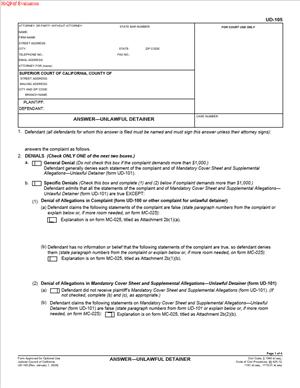
UD-105 – Answer—Unlawful Detainer
Fill out nowJurisdiction: Country: United States | Province or State: California
What is a UD-105 – Answer—Unlawful Detainer?
UD-105 is the official California court form you use to respond to an eviction lawsuit. The lawsuit is called an unlawful detainer. Your landlord starts it by serving you with a Summons and Complaint. You use UD-105 to tell the court your side and list your defenses. It stops a default judgment if you file on time.
Tenants use this form. That includes subtenants, roommates on the lease, and “all occupants” named in the case. Both residential and commercial tenants can use it. Landlords do not file this form.
You need UD-105 after you receive a Summons and Complaint—Unlawful Detainer. The clock starts the day after the service. You usually have five court days to respond. Weekends and court holidays do not count. If you do nothing, the landlord can get a default judgment and a sheriff’s lockout.
Typical usage scenarios
- You paid the rent or tried to pay, but your landlord refused it.
- The notice was defective, served wrong, or did not give enough time.
- The rent demand included illegal fees or the wrong amount.
- Your landlord did not fix major problems that affect health or safety.
- You believe the landlord is retaliating for protected activity.
- You need a reasonable accommodation because of a disability.
- The property is under rent control or “just cause” rules, and they were ignored.
- The case includes “COVID-19 rental debt”, and the landlord skipped required steps.
- You want a jury trial.
UD-105 is not a request for more time. It is your formal Answer. It admits or denies what the landlord alleged. It also states your affirmative defenses. Those defenses preserve your rights for trial. If you skip a defense, you may lose it.
In short, UD-105 is your chance to explain why you should not be evicted. You file it with the court and serve the landlord within the deadline. That keeps you in the case and forces the landlord to prove the claim.
When Would You Use a UD-105 – Answer—Unlawful Detainer?
You use UD-105 as soon as you are served with an eviction lawsuit. The most common trigger is a three-day notice to pay rent or quit. Maybe you paid part of the rent. Maybe the notice demanded late fees, utilities, or other charges. Maybe the notice gave no address or method for payment. You would use UD-105 to deny the claim and assert that the notice is invalid.
You also use it after a 30-day, 60-day, or 90-day termination notice. That often happens when a fixed term ends or the landlord claims “just cause.” If the building has rent control or registration rules, you can assert those defenses. If the landlord used the wrong notice, the case can fail.
You would also file UD-105 if the landlord says you broke the lease. That can include unauthorized occupants, pets, or nuisance claims. You can raise defenses such as waiver or acceptance. For example, the landlord kept taking rent after the alleged breach. Or the landlord knew about the issue for months and did nothing. You can force them to prove a material breach and proper notice.
If the unit has serious health or safety issues, UD-105 lets you assert habitability defenses. That might include mold, sewage leaks, no heat, or broken locks. You can claim you withheld rent because of those issues. You can also claim you gave written notice and a chance to fix. You can ask for an offset for the repair costs you paid.
If you have a disability and need a reasonable accommodation, you can state that. You can ask for more time or different terms if the eviction relates to disability. If you faced domestic violence or similar abuse, you can assert legal protections. That includes limits on evictions based on abuse incidents.
If the case involves rent debt between 2020 and 2022, you can raise COVID-related defenses. That includes missing 15-day notices and tenant declarations. You can also assert issues with rent relief compliance. These defenses still matter if the landlord seeks old rent from that period.
If you are an occupant after a foreclosure, you may need a 90-day notice. If that did not happen, you can state that. If you are a bona fide tenant, that defense applies. UD-105 gives you space to explain.
Commercial tenants also use UD-105. The same core rules apply. You can challenge rent calculations, notices, service, and waivers. You can assert defenses tied to the lease and local regulations.
You do not use UD-105 to sue your landlord for money. Counterclaims do not belong in an eviction Answer. You can file a separate case later if needed. In UD-105, you can still claim offsets tied to rent and repairs.
Legal Characteristics of the UD-105 – Answer—Unlawful Detainer
UD-105 is a pleading in a civil case. It is legally binding once you sign and file it. It tells the court what you admit, deny, and assert as defenses. It frames the issues for trial. It puts the landlord on notice of your arguments.
Enforceability starts with timing. You must file the Answer within the legal deadline. That is usually five court days from service. If you were served by substitute service and mail, the time starts later. The five-day period starts ten days after the mailing date. Missing the deadline risks a default judgment.
Proper service also matters. After you complete UD-105, someone over 18 must serve it. They can mail a copy to the landlord or the landlord’s attorney. You cannot serve it yourself. Your server signs the proof of service. That proof must show who was served, how, and when. You file the Answer with the proof of service.
Your signature has legal weight. You sign under penalty of perjury. That means you are swearing the contents are true. There is no notarization requirement. If more than one defendant is answering, each should sign.
Your Answer must meet pleading rules. You can make a general denial or specific denials. If the complaint is verified, you often must deny allegations paragraph by paragraph. UD-105 helps you do that with checkboxes. You then assert affirmative defenses. If you do not raise a defense, you may waive it. Use the “other defenses” space to capture anything not listed.
Filing fees apply. If you cannot afford the fee, request a fee waiver. The court will decide based on your finances. If granted, the court files your Answer without payment. If denied, you must pay the fee by the deadline the court sets.
Once filed and served, your Answer stops a default. The case moves to trial scheduling. Eviction trials are fast. You may get a trial date in a few weeks. Your Answer preserves your right to a jury. If you want a jury, request it in the Answer. You also need to pay the jury fees or seek a waiver.
Local rules may require e-filing. Follow your court’s filing method and formatting. Keep copies of everything. Bring your file-stamped Answer to all hearings. You must attend trial. If you miss trial, you can lose even with a strong defense.
In short, UD-105 is enforceable because it is your official pleading. Timing, service, and clear defenses make it effective. It sets you up for trial and protects your rights.
How to Fill Out a UD-105 – Answer—Unlawful Detainer
Follow these steps in order. Have your Summons and Complaint in front of you. Copy names and the case number exactly.
1) Complete the caption at the top
- Attorney or Party Without Attorney: If you have a lawyer, they fill this. If not, list your name, mailing address, phone, and email. Mark “Defendant” as your role.
- Court name and address: Copy the exact court name and street address from your Summons. Include the branch name if shown.
- Case number: Copy it exactly. Leave it blank only if the Summons has no number yet.
- Plaintiff: Copy the landlord’s name from the Complaint.
- Defendant: List all defendants named in the case. Include “all occupants” if that appears in the Complaint.
2) Identify yourself as the answering defendant
- If there are multiple defendants, check the box next to your name where the form asks who is answering.
- If you are an unnamed occupant who received a “Prejudgment Claim of Right to Possession,” you can still answer. Write your name as “Doe occupant” and explain in the defenses area if needed.
3) Decide how to deny the allegations
- Read the Complaint paragraph by paragraph. Check if it is verified. A verified complaint has a signature under penalty of perjury.
- If the complaint is not verified, you can make a general denial. Look for the “General Denial” option on the form. Check it if appropriate.
- If the complaint is verified, or you prefer to, make specific denials. The form lets you deny key statements and admit limited facts. Be clear and concise.
- Do not admit more than you must. If you do not know, say you lack enough information to admit. The form provides a way to say this.
4) Choose and check your affirmative defenses
Use the checkboxes that apply. Then add brief facts for each defense. Keep it factual and short.
- Notice defects: Check this if the notice was wrong. Common errors include wrong rent amount, late fees included, no payment address, or wrong time period. Add a fact like, “Three-day notice demanded late fees. Not allowed.”
- Improper service of notice: Check this if the notice was not served correctly. Add facts like, “Notice left on door only. No mailing.”
- Payment or tender: Use this if you paid or tried to pay. Add, “Offered full rent on [date]. Landlord refused.”
- Landlord acceptance or waiver: Use this if the landlord accepted rent after the notice expired or after the alleged breach. Add dates and amounts.
- Habitability and repairs: Use this if serious problems exist. List major issues and dates you gave written notice. Add, “Withheld rent after notice due to no heat.”
- Retaliation: Use this if the eviction follows protected actions. For example, you reported code issues or joined a tenant group. Add, “Notice served two weeks after code complaint.”
- Discrimination: Use this if the reason or enforcement is discriminatory. Include the protected basis, such as disability, race, or family status. Add, “Eviction based on refusal to waive service animal.”
- Disability accommodation: Use this if you requested an accommodation or need one. Add, “Requested extra time due to disability on [date].”
- Rent control or just-cause rules: Use this if local law applies. Add, “Unit subject to just-cause. No valid reason stated.”
- Registration or certificate issues: Use this if the landlord must register the unit and did not. Add, “Unit not registered for current year.”
- COVID-19 rental debt: Use this if rent is from covered periods. Add, “No 15-day notice or declaration provided for Sept. 2020 rent.”
- Refusal to accept rent relief funds: Use this if the landlord refused rental assistance for covered debt. Add dates and what was offered.
- Foreclosure notice rights: Use this if you are a bona fide tenant after foreclosure. Add, “No 90-day notice served.”
- Procedural defects: Use this if the Complaint is missing required attachments. For example, the notice or proof of service of notice. Add, “Complaint lacks notice attachment.”
If a defense fits but is not listed, use the “Other affirmative defenses” area. State the defense name and a short fact.
5) Add factual details where the form prompts
- Be specific but brief. Dates, amounts, and what happened matter.
- Avoid arguments. Stick to facts that support the defense.
6) Request a jury trial if you want one
- Look for the checkbox for a jury demand. Check it if you want a jury.
- Remember, there are fees for a jury. Ask for a fee waiver if you qualify.
7) Ask for any appropriate relief
- The form usually includes a request to dismiss the case and for costs. That is standard. You can leave the default checked.
8) Sign and date the form
- Sign under penalty of perjury. Print your name and the date.
- Each defendant who is answering should sign. If only one sign, that Answer binds only that signer.
9) Complete the Proof of Service
- You cannot serve your own Answer. Ask a friend, coworker, or a professional server who is over 18.
- The server mails a copy to the landlord’s attorney. If the landlord has no attorney, mail it to the landlord’s address on the Complaint.
- The server completes the Proof of Service section on the form or a separate proof of service form. They sign and date it.
- The proof must show the address served, the person served, and the date mailed.
10) File your Answer with the court
- File within five court days of service. If served by substitute service and mail, your deadline starts later. Add ten days after mailing before counting five court days.
- File the original Answer with the court. Include the signed Proof of Service.
- Pay the filing fee or submit a fee waiver request with your Answer.
- Keep two copies. One is for you. One is for serving if not already mailed.
11) Prepare for next steps
- Watch your mail and case portal for hearing notices.
- Start gathering evidence. That includes photos, repair requests, receipts, texts, emails, and witnesses.
- Calendar all dates. Eviction cases move quickly.
Practical tips while you fill it out
- Read every word of the Complaint and the notice. Compare rent amounts, dates, and service details. One mistake can win a defense.
- Do not skip the affirmative defenses. If you think a defense might apply, include it. You can refine later.
- Keep statements simple. Use short sentences with clear facts. Avoid conclusions without facts.
- If you need more space, attach an extra page. Label it with the section number and a brief title. For example, “Attachment to Affirmative Defense—Habitability.”
- If English is not your first language, get help with translation. You are still responsible for accuracy.
- If you move during the case, file a change of address with the court. The court will mail notices to your address of record.
Common mistakes to avoid
- Missing the deadline. Count court days only. If unsure, file early.
- Serving the Answer yourself. Have someone else mail it.
- Forgetting the case number or court branch. Copy exactly from the Summons.
- Leaving the Proof of Service blank. The court needs it to accept your filing.
- Admitting facts you do not know. Use a denial if you are unsure.
- Failing to request a jury if you want one. You must ask early.
Finally, remember the goal. UD-105 protects your right to be heard. It preserves defenses and forces the landlord to prove the case. With a complete and timely Answer, you stay in the process and improve your options.
Legal Terms You Might Encounter
- Unlawful Detainer means an eviction case. The landlord claims you no longer have the right to stay. UD-105 is your written response to that claim.
- Plaintiff means the party who filed the case. In this form, the plaintiff is usually the landlord or property owner. You will serve them a copy of your Answer.
- Defendant means the person being sued. That is you and any other named tenants. Each named defendant should file an Answer or be included.
- Summons and Complaint are the papers that started the case. The Summons tells you when your Answer is due. The Complaint lists the landlord’s claims. You respond to those claims on UD-105.
- Service of Process means legal delivery of court papers. The landlord had someone serve you with the Summons and Complaint. You must also serve your Answer on the plaintiff or their attorney. You cannot serve it yourself.
- Answer means your formal response to the lawsuit. UD-105 is the Answer form for eviction cases. You admit or deny allegations and list defenses. The court reads this to understand your position.
- Affirmative Defenses are legal reasons the landlord should not win. You list these on UD-105. Common defenses can involve notice, payment, or living conditions. You must share specific facts for each defense you check.
- Possession means the right to live in or control the unit. The landlord asks for possession in the Complaint. You can respond with your position on possession in your Answer.
- Notice to Quit means a written demand to leave or fix an issue. It could claim unpaid rent or a lease breach. Many defenses on UD-105 relate to whether the notice was proper and served correctly.
- Proof of Service shows that a nonparty mailed your Answer. You file it with the court. It tells the court that the other side got your Answer.
- Default Judgment happens if you do not answer on time. The court may grant possession and money to the landlord. Filing UD-105 on time helps you avoid default.
- Rent and Damages are the money the landlord seeks. This can include back rent and other costs. You respond to these claims and defenses in UD-105.
- Habitability refers to safe, livable conditions. Serious conditions can support defenses. In your Answer, you can describe facts that relate to habitability issues.
- Verification means you swear the facts are true. Your signature on UD-105 confirms your statements. Do not sign if the content is not accurate.
- Demurrer is a challenge to legal sufficiency. It is different from an Answer. UD-105 is used when you choose to answer the claims, not challenge them procedurally.
FAQs
Do you have to file UD-105 if you have already moved out?
If the Complaint also asks for money, you still risk a money judgment. Filing protects your rights to contest those claims. If you moved out, say so in your Answer. It still helps to respond.
Do you need to file by a specific deadline?
Yes. Eviction cases move fast. Your deadline is short. Check your Summons for the due date. Act quickly to avoid default. If you are very close to the deadline, file the Answer first.
Do you have to pay a filing fee?
Most courts require a fee to file an Answer. If you cannot afford it, request a fee waiver. The clerk can explain how to ask for a waiver. Do not delay filing while you figure out fees.
Do you need to attach documents to UD-105?
You do not have to attach documents to file an Answer. You can attach pages if you need more space for defenses. Keep originals for your records. You can use your documents later in the case.
Do you have to serve the landlord with your Answer?
Yes. A nonparty must mail a copy to the landlord or their attorney. That person completes a Proof of Service. You file the Proof of Service with the court. Keep copies for your records.
Can you ask for more time to file?
You can ask the landlord’s attorney for a short extension. Get any agreement in writing. The court does not have to grant extra time without a formal request. If no extension is confirmed, file by the deadline.
Should you deny everything in the Complaint?
Deny what you believe is untrue. Do not deny facts you know are true. Be consistent with your documents and communications. Use UD-105 to state your version clearly.
Can you include your own claims against the landlord?
UD-105 is for your Answer and defenses. It is not for separate claims. Keep your defenses in the Answer. If you have separate claims, handle them through the proper process.
What if you missed the deadline?
File your Answer as soon as possible. If the court has already entered a default, the clerk may not accept it. You may need to seek relief from default. Act quickly and get help if you can.
Do you need a jury trial request in your Answer?
The Answer is not the usual place to request a jury trial. You can ask for a jury when the case is set for trial. Watch for trial-setting notices and follow directions on timing.
Checklist: Before, During, and After the UD-105 – Answer—Unlawful Detainer
Before signing
- Gather the Summons and Complaint. Confirm the case number and spelling of names.
- Collect any notices you received. Include notice dates and how they were delivered.
- Pull your lease or rental agreement. Include any renewals or addendums.
- Assemble payment records. Include receipts, bank statements, and messages about rent.
- Gather repair or condition records. Include photos, videos, and service requests.
- List all occupants, cotenants, and subtenants. Note who is named in the case.
- Confirm the landlord’s attorney information. Use the address on the Complaint.
- Outline your defenses with facts. Keep them short and specific.
- Decide who will serve your Answer by mail. That person cannot be you.
- Plan for the filing fee or fee waiver. Do not miss your deadline because of fees.
During signing
- Confirm your name and address match the case caption.
- Verify that the case number and court location are correct.
- Review your admissions and denials. Do not admit facts you dispute.
- Check the boxes for applicable defenses. Add facts in the space provided.
- If you attach pages, label them clearly. Reference the item number on the form.
- Review for consistency. Dates and amounts should match your records.
- Sign and date the form. Print your name under your signature.
- Have all named defendants sign if needed. Each should confirm the content.
- Complete the Proof of Service details for your server. You cannot serve it yourself.
After signing
- Make at least two copies of everything. One for the court. One for you.
- File your Answer with the court before the deadline. Bring the fee or waiver request.
- Have your server mail a copy to the plaintiff or their attorney.
- File the signed Proof of Service with the court. Keep a filed-stamped copy.
- Calendar upcoming dates. Watch for trial setting and any court notices.
- Organize your evidence by topic. Rent, notices, repairs, and communications.
- Update your mailing address with the court if you move. You must receive notices.
Common Mistakes to Avoid UD-105 – Answer—Unlawful Detainer
Missing the deadline
- Consequence: You risk a default judgment for possession and money.
- Don’t forget: Your time is very short. Check the Summons and act fast.
Not serving the Answer
- Consequence: The court may ignore your filing until service is proven.
- Don’t forget: Have a nonparty mail it and file a Proof of Service.
Admitting facts you dispute
- Consequence: You limit your defenses and trial arguments.
- Don’t forget: Deny what you disagree with and explain briefly.
Leaving defenses blank
- Consequence: You may waive defenses that could help you.
- Don’t forget: Check applicable defenses and add supporting facts.
Using the wrong case information
- Consequence: The clerk may reject your filing or misfile it.
- Don’t forget: Copy the case number, court address, and names exactly.
What to Do After Filling Out the Form UD-105 – Answer—Unlawful Detainer
File with the court
- Make two copies of your signed Answer. Keep the original for filing.
- Bring or submit your papers to the clerk before the deadline.
- Pay the filing fee or submit a fee waiver. Ask the clerk about accepted payment methods.
- Request a filed-stamped copy for your records.
Serve the other side
- Choose a server who is over 18 and not a party. You cannot serve your own Answer.
- The server mails a copy to the plaintiff or their attorney at the address on the Complaint.
- The server completes a Proof of Service form. They must sign and date it.
- File the Proof of Service with the court. Keep a filed-stamped copy.
Track what happens next
- Watch for a notice setting the trial or hearing. Write down the date and time.
- Prepare your documents for court. Sort records by topic and date.
- Keep communicating in writing. Save all messages about rent and repairs.
- Bring photo or video evidence to court if it helps your defense.
Consider amendments
- If you made a mistake, act quickly. You may need consent or court permission to amend.
- If the other side agrees in writing, attach the agreement to your request if needed.
- If you must seek court permission, explain what changed and why.
Coordinate with co-defendants
- Make sure each named defendant has filed an Answer.
- Use consistent facts across all Answers. Inconsistent stories weaken your case.
- Share copies of filings among co-defendants. Keep a joint timeline of events.
Continue settlement talks
- You can negotiate after filing your Answer.
- Get all terms in writing. Cover move-out dates, money, and case dismissal.
- Do not skip court dates unless you have a filed agreement and court notice.
Stay organized
- Keep a folder with copies of all filed papers.
- Maintain a calendar of deadlines and court dates.
- Update your address with the court if you move. You must get court mail.
If you learn new facts
- Write down the details and dates. Gather supporting documents.
- Decide whether those facts support a motion or an amendment.
- Do not wait until the last minute before trial to raise new issues.
If you cannot appear
- Notify the court promptly if an emergency arises.
- File the proper request to continue, if allowed. Explain your reasons.
- Confirm any new date in writing and serve the other side.
Prepare for trial
- Make a short outline of your defenses and key facts.
- Prepare witness lists and exhibits. Number your exhibits in advance.
- Bring three sets of exhibits. One for you, one for the other side, one for the court.
After judgment
- Read the court’s decision carefully. Note any deadlines that follow.
- If you lose, understand the timeline for next steps. Act quickly.
- If you settle, confirm the case status with the court. Keep proof of dismissal.
Disclaimer: This guide is provided for informational purposes only and is not intended as legal advice. You should consult a legal professional.