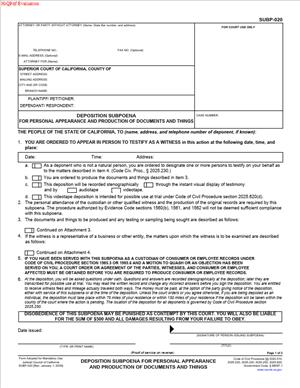
SUBP-020 – Disposition Subpoena for Personal Appearance and Production of Documents and Things
Fill out nowJurisdiction: Country: United States | Province or State: California
The SUBP-020 – Disposition Subpoena for Personal Appearance and Production of Documents and Things is a court form used in California civil cases. It orders a person to appear at a deposition and bring specified documents or items with them. If you are involved in a lawsuit and need information from someone who is not voluntarily providing it, this form may be part of that process.
This document combines two demands into one. It requires personal attendance at a deposition and the production of documents or tangible things. A deposition is a formal question-and-answer session held under oath, usually outside the courtroom.
You might encounter this form if you are representing yourself in a civil case. You may be trying to gather evidence to support your claims or defend against someone else’s claims. The form helps you formally request records and testimony before trial.
If you receive this form, it means someone is legally requiring your attendance and documents. Understanding what it requires and how it works can help you respond appropriately and prepare for what comes next.
What is SUBP-020 – Disposition Subpoena for Personal Appearance and Production of Documents and Things?
Clear definition
The SUBP-020 – Disposition Subpoena for Personal Appearance and Production of Documents and Things is a California court form used to compel a nonparty witness to appear at a deposition and bring specified documents or physical evidence. A nonparty is someone who is not one of the main sides in the lawsuit.
The form identifies the case, the parties involved, and the person being subpoenaed. It states the date, time, and location of the deposition. It also lists the documents or items the person must bring.
This document is part of the discovery process. Discovery is the stage in a civil case where both sides exchange information and gather evidence before trial.
Who typically uses this form?
Self-represented litigants and attorneys use this form in civil cases. It is commonly used by plaintiffs and defendants who need evidence from witnesses who are not directly part of the lawsuit.
For example, a business owner involved in a contract dispute might use the form to obtain financial records from a third-party accountant. A person in a personal injury case might use it to require a records custodian to bring maintenance logs or employment files.
Court reporters and deposition officers are also involved, since depositions are taken under oath and recorded. However, the party issuing the subpoena is responsible for completing and arranging service of the form.
Why might you need this form?
You may need this form if important information is in the hands of someone who is not cooperating. A subpoena creates a formal legal requirement to appear and produce evidence.
Documents can include emails, contracts, invoices, photographs, medical records, or electronic files. “Things” can include physical objects relevant to the case. The form allows you to clearly describe what you want produced.
Combining personal appearance and document production can be efficient. Instead of requesting documents separately, you can require the witness to bring them to the deposition. This allows you to ask questions about the documents on the spot.
Typical real-life scenarios
- In a business dispute, one party may believe that a former employee has relevant communications saved on a personal device. The subpoena can require that the employee appear and bring specific electronic records.
- In a property damage case, a property management company may hold inspection reports. A party may use this form to require a representative to appear and produce those reports for questioning.
- In an employment case, payroll records held by a third-party processor may be central to the dispute. The subpoena can require a records custodian to attend the deposition with certified copies of those records.
- In a personal injury case, a medical provider who is not a party to the lawsuit may have treatment records. The form can require that the provider’s custodian of records appear and bring the requested files.
When would you use SUBP-020 – Disposition Subpoena for Personal Appearance and Production of Documents and Things?
You would use this form during the discovery phase of a civil case. Discovery usually begins after the initial pleadings have been filed and the case is moving forward toward trial or settlement.
This form is typically used when informal requests have not been effective or when you need sworn testimony. A deposition allows you to ask follow-up questions and clarify the meaning of documents.
It is often used when the information is held by a third party. Parties to the lawsuit have other discovery tools available to them, such as interrogatories or requests for production. When dealing with someone outside the case, a deposition subpoena is commonly required.
Timing matters. Depositions are generally scheduled with advance notice to all parties. The subpoena sets a specific date and time, so it must be coordinated with procedural timelines in the case.
You may also use this form when you anticipate that a witness may not voluntarily attend a deposition. A subpoena creates a formal obligation to appear, subject to certain protections and objections allowed by law.
Legal characteristics of SUBP-020 – Disposition Subpoena for Personal Appearance and Production of Documents and Things
This form has specific legal elements that make it effective. It must clearly identify the court, case number, and names of the parties. It must state the full name of the person being subpoenaed and provide the deposition details.
The documents or items requested must be described with reasonable particularity. Vague or overly broad descriptions can create disputes or objections. Clear descriptions reduce confusion and increase the likelihood of compliance.
Service of the subpoena is a key requirement. The form must be properly served on the person named in it. Proof of service is typically required to show that the witness received formal notice.
There are also notice requirements to other parties in the case. In many situations, other parties must receive advance notice of the deposition and the document request. Failure to follow notice procedures can lead to objections or motions to quash.
Common problems include incorrect case information, incomplete descriptions of requested documents, or failure to coordinate the deposition officer. Missing signatures or failing to issue the subpoena through the proper channel can also cause issues.
This form does not decide the case. It does not determine who wins or loses. It is a discovery tool only. It does not replace trial testimony, although deposition testimony may later be used in court under certain conditions.
Procedural rules can vary depending on the type of civil case and the court involved. While the general structure of the form remains the same in California, local court practices may affect scheduling and logistics.
Is it legally binding?
When properly issued and served, this subpoena is legally binding on the person named in it. It requires that person to appear at the specified time and place and to produce the listed documents or things.
The obligation arises from the court’s authority. A subpoena is not just a request. It is a formal command backed by the court system. Ignoring it can lead to consequences, such as court orders or sanctions, depending on the circumstances.
However, the obligation is not unlimited. The person receiving the subpoena may have the right to object, seek a protective order, or move to quash it. These procedures are part of the legal framework and can affect how and whether the subpoena is enforced.
The binding effect depends on proper issuance, proper service, and compliance with procedural rules. If those elements are missing, enforcement may become more complicated.
How to fill out SUBP-020 – Disposition Subpoena for Personal Appearance and Production of Documents and Things
Step 1 – Complete the case caption
At the top of the form, fill in the name of the court, the case title, and the case number exactly as they appear on other filed documents. This information links the subpoena to the correct lawsuit. Double-check spelling and numbering to avoid confusion.
Step 2 – Identify the person being subpoenaed
Enter the full legal name of the individual or entity required to appear. If you are subpoenaing a business, you may need to identify a specific person, such as a custodian of records. Provide a complete and accurate name to ensure proper service.
Step 3 – Provide deposition details
Fill in the date, time, and address where the deposition will take place. This may be an office, a conference room, or another agreed location. Make sure the information is precise so the witness knows exactly where and when to appear.
Step 4 – Describe the documents and things to be produced
In the section that requests production, clearly list each category of documents or items. Use specific descriptions, such as date ranges, types of records, or subject matters. Clear descriptions help avoid disputes about what is required.
Step 5 – Indicate the method of recording
The form includes options for how the deposition testimony will be recorded. This may include stenographic recording, audio recording, or video recording. Mark the appropriate method and ensure arrangements are made with a qualified deposition officer.
Step 6 – Address consumer or employee records if applicable
If the requested documents involve personal records of a consumer or employee, additional notice procedures may apply. The form contains sections related to these situations. Complete the relevant portions carefully if they apply to your request.
Step 7 – Review and sign where required
Some subpoenas are issued by the court clerk, while others may be issued by an attorney of record. Ensure that the form is properly issued according to the applicable procedure. Check for required signatures before moving forward.
Step 8 – Arrange for service
Once completed and issued, the subpoena must be formally served on the person named. Personal service is commonly required. After service, complete the proof of service section to document when and how the person was served.
Step 9 – Provide notice to other parties
Before or at the time required by procedure, provide notice of the deposition and document request to all other parties in the case. This ensures transparency in the discovery process. Keep copies of all notices and related documents for your records.
Step 10 – Keep organized records
Retain a copy of the completed subpoena, proof of service, and any related correspondence. Bring copies to the deposition if needed. Organized records help you track compliance and respond to any objections or scheduling changes.
Legal terms you might encounter in SUBP-020 – Disposition Subpoena for Personal Appearance and Production of Documents and Things
- Deposition: A deposition is a formal question-and-answer session under oath, usually held before trial. On this form, it is the event where the person subpoenaed must appear and testify. The date, time, and location you list control when and where that testimony happens.
- Subpoenaing Party: This is the party that issues the subpoena. It can be you if you are self-represented. Your name, address, and contact information must be accurate because that is how objections or questions are directed.
- Deponent: The deponent is the person who must appear and provide testimony and documents. This may be a party, a witness, or a records custodian. You must clearly identify this person to avoid service problems or confusion.
- Personal Appearance: This means the individual must attend the deposition, either in person or as otherwise specified. The form makes clear that attendance is mandatory. Failure to appear can result in enforcement action by the court.
- Production of Documents and Things: This refers to the requirement to bring specified records, files, electronic data, or physical items. The form includes space for you to describe these materials in detail. Vague descriptions can lead to objections or incomplete production.
- Custodian of Records: A custodian of records is the person responsible for maintaining an organization’s records. If you are requesting business or institutional documents, you may direct the subpoena to this person. This ensures the right individual gathers and authenticates the materials.
- Consumer Records: These are personal records about an individual held by a business, such as financial or communication records. When you request consumer records, additional notice requirements often apply. The form includes sections that address these situations.
- Proof of Service: Proof of service is the written confirmation that the subpoena was properly delivered. Without a valid service, the subpoena cannot be enforced. This document is typically completed by the person who served the subpoena, not by you.
- Method of Recording: This identifies how the deposition will be captured, such as by audio, video, or stenographic recording. You must state the method clearly on the form. The chosen method affects logistics and cost.
- Objection: An objection is a formal disagreement with the subpoena or with specific document requests. The person subpoenaed may object before the deposition date. Your form must be clear enough to withstand reasonable objections.
FAQs
Do I need a court order before I can issue SUBP-020 – Disposition Subpoena for Personal Appearance and Production of Documents and Things?
In most cases, you do not need a separate court order to complete and issue this document in an active case. You must have a valid case number and an open court case. Make sure the caption exactly matches the court’s record, including the names of all parties and the case number, or the clerk may reject related filings.
Who is allowed to sign this form?
If you are representing yourself, you may sign as the attorney for a party. If you have a lawyer, your lawyer signs instead. Check that the signature line matches your role in the case and that your printed name and contact details are complete and legible.
How specific do I need to be when listing documents to be produced?
Be precise and practical. Identify date ranges, account numbers (if relevant), file categories, and formats such as emails or paper files. If you are too broad, the recipient may object. If you are too narrow, you may miss important evidence. The description section of this form is where clarity matters most.
What happens if the person ignores this document?
If the subpoena was properly completed and served, the court can enforce it. You would need proof of service showing when and how the person received it. Keep a filed or stamped copy of the SUBP-020 – Disposition Subpoena for Personal Appearance and Production of Documents and Things and the proof of service in your records to support any enforcement request.
Do I have to notify other parties before serving this form?
Yes, you generally must provide notice to the other parties in the case before the deposition date. Confirm the notice period required in your situation and document when and how notice was given. Keep copies of your notice and any responses for your file.
Can I request electronic records, like emails or digital files?
Yes, you can request electronically stored information. In the section describing items to be produced, specify the format if you need it in a certain way, such as PDF or native format. Clear instructions reduce disputes and delays.
What if I made a mistake after serving the form?
If you discover an error in the date, address, or document description, you may need to issue a corrected subpoena and re-serve it. Do not assume a small error is harmless. Compare the served copy to your saved draft and confirm all details match the court record.
Does this document become part of the public court file?
Not automatically. This form is usually served on the witness and parties, but not always filed with the court unless required for enforcement or specific procedures. Check whether you need to file a copy or only retain it, and confirm whether any attached document list includes sensitive information that should be handled carefully.
Checklist: Before, During, and After SUBP-020 – Disposition Subpoena for Personal Appearance and Production of Documents and Things
Before
- Confirm your case is active and you have the correct case number.
- Verify the full legal names of all parties for the caption.
- Identify the correct person or custodian to subpoena.
- Draft a clear, detailed list of documents and items requested.
- Select the deposition date, time, and location with enough notice.
- Choose the method of recording and arrange for a reporter if needed.
- Review any special notice requirements for consumer or employee records.
- Prepare copies of the completed subpoena for service and your records.
During
- Ensure the subpoena is personally served by someone eligible to serve.
- Confirm that the server completes and signs the proof of service.
- Provide the required notice to all parties and document the date sent.
- Track any written objections received before the deposition.
- Communicate logistical details, such as remote access instructions if applicable.
- Bring a clean copy of the subpoena and document list to the deposition.
- Verify the identity of the deponent at the start of the session.
- Confirm that all requested documents are produced as specified.
After
- Secure and label all documents and recordings received.
- Review the production to check for completeness.
- Follow up promptly if the items listed were not provided.
- Store proof of service and notices in your case file.
- Calendar any deadlines triggered by objections or motions.
- Summarize key testimony while it is fresh in your mind.
- Update your case strategy based on the information obtained.
- Maintain organized digital and physical copies for court use.
Common mistakes to avoid with SUBP-020 – Disposition Subpoena for Personal Appearance and Production of Documents and Things
- Mistake: Using the wrong case caption because you copied it from an old document, which can cause confusion or rejection; always match the caption exactly to the current court record, and do not forget to double-check the case number.
- Mistake: Listing overly broad document requests because you want “everything,” which often leads to objections or delays; narrow your request with dates and categories, and do not forget to review each line for clarity.
- Mistake: Choosing a deposition date too soon because you are in a hurry, which may violate notice timing rules and make enforcement difficult; count calendar days carefully and do not forget to allow mailing time if applicable.
- Mistake: Serving the subpoena yourself because it seems easier, which can invalidate service; use a qualified server, and do not forget to obtain a signed proof of service.
- Mistake: Forgetting the required notice for consumer or employee records because the section looks technical, which can lead to motions to quash; review that section closely and do not forget to document when notice was sent.
- Mistake: Failing to specify the method of recording, which creates disputes on the deposition day; clearly state how it will be recorded, and do not forget to arrange the necessary equipment or personnel.
- Mistake: Not keeping organized copies of what was served, which makes enforcement harder later; create a complete file set and do not forget to store both paper and digital versions securely.
- Mistake: Ignoring written objections received before the deposition, which can escalate conflict; review objections promptly and do not forget to respond or adjust your requests if appropriate.
What to do after filling out SUBP-020 – Disposition Subpoena for Personal Appearance and Production of Documents and Things
Once you complete the form, slow down and review it line by line. Accuracy now prevents problems later.
- Step 1: Make at least two copies of the signed subpoena—one for service and one for your records.
- Step 2: Arrange for personal service by someone who is legally allowed to serve documents and is not a party to the case.
- Step 3: Confirm that the server completes a proof of service form immediately after delivery.
- Step 4: Provide any required advance notice to other parties and keep written confirmation of when you sent it.
- Step 5: Calendar the deposition date and any objection deadlines in your planner or case management system.
- Step 6: Organize a folder (physical or digital) labeled with the deponent’s name and deposition date.
- Step 7: Confirm logistics a few days before the deposition, including location access or remote connection details.
- Step 8: Prepare an outline of topics and questions so you use your deposition time effectively.
- Step 9: On the deposition day, bring copies of the subpoena, proof of service, and your document list.
- Step 10: After the deposition, review the materials received and compare them against your original request list.
Keep all related paperwork together. This includes the subpoena, proof of service, notices, correspondence, objections, and produced documents. Update your internal case notes to reflect what was obtained and what gaps remain. If you later need court enforcement, your organized records will support your position and save time.
Disclaimer: This guide is provided for informational purposes only and is not intended as legal advice. You should consult a legal professional.