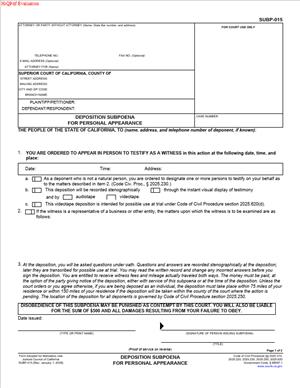
SUBP-015 – Disposition Subpoena for Personal Appearance
Fill out nowJurisdiction: Country: United States | Province or State: California
The SUBP-015 – Disposition Subpoena for Personal Appearance is a court form used in California to require a person to appear and give testimony. It is often used after a judgment has been entered in a case, especially when someone is trying to collect money that the court has already awarded.
If you are filling out the SUBP-015 – Disposition Subpoena for Personal Appearance, you are likely involved in a civil case where you need information from another person. That person may be a debtor, a witness, or someone who holds information about assets or finances.
This form matters because it is a formal court document. Once properly issued and served, it can legally require someone to come to court or another designated place to answer questions under oath.
If you are representing yourself, this document can feel technical. Understanding what it does and how to complete it helps you avoid delays and procedural issues.
What is SUBP-015 – Disposition Subpoena for Personal Appearance?
Clear definition
SUBP-015 – Disposition Subpoena for Personal Appearance is a California court form that commands a person to appear in person to provide testimony. It is commonly connected to post-judgment proceedings, where one party seeks information to enforce a court order.
A subpoena is a court-issued command. This specific form focuses on personal appearance. It does not demand documents by itself unless combined with other requests. Its main function is to require someone to show up and answer questions.
The document identifies the court, the case number, the parties involved, and the person being ordered to appear. It also states the date, time, and place of the required appearance.
Who typically uses this form?
This form is often used by a judgment creditor. That is the person or business who won a money judgment in court. They may use it to require the judgment debtor to appear and answer questions about income, bank accounts, property, or other assets.
Attorneys also use this form during enforcement proceedings. However, self-represented individuals frequently complete and file it in small claims or limited civil cases.
In some situations, a party may subpoena a third person. For example, someone who has knowledge of the debtor’s assets or business dealings may be required to appear and testify.
Court clerks and judges are involved in issuing or processing the form. The person named in the subpoena is required to respond once properly served.
Why might you need this form?
You might need this form if you have a court judgment and the other party has not paid. The subpoena allows you to question them under oath about their financial situation.
It can also be used when you need sworn testimony to clarify facts related to the enforcement of a judgment. For example, you may need to determine where assets are located or whether property has been transferred.
Sometimes, written information is not enough. Personal appearance gives you the opportunity to ask follow-up questions in real time.
The form creates a structured and enforceable process. Without it, the other party may ignore informal requests for information.
Typical real-life scenarios
- You won a small claims case for unpaid rent. The tenant has not paid the judgment. You use this form to require the tenant to appear and disclose employment and bank account details.
- A contractor wins a civil case for unpaid invoices. The customer has not satisfied the judgment. The contractor files this subpoena to question the customer about business income and assets.
- A business obtains a court award against a former partner. The partner has not complied. The business uses the form to require the partner to appear and provide sworn testimony about financial resources.
- A creditor believes a debtor transferred assets to a relative to avoid payment. The creditor subpoenas the relative to appear and answer questions about those transfers.
When would you use SUBP-015 – Disposition Subpoena for Personal Appearance?
You would generally use this form after a court has issued a judgment. It is most common in post-judgment proceedings, where the focus is on collecting or enforcing what the court has already ordered.
If voluntary payment has not occurred, and informal communication has failed, this form may be used to move the process forward. It creates a formal requirement to appear.
The form may also be used when other enforcement tools, such as wage garnishment or bank levies, require additional information. For example, you may need to know the name of an employer or the location of an account before taking further action.
In many cases, the person completing this form is the judgment creditor. The person being subpoenaed is often the judgment debtor. In some cases, it may be a third party with relevant information.
Timing can matter. The subpoena must provide reasonable notice of the appearance date. Courts typically expect that procedural requirements are followed carefully.
This form is not used to start a lawsuit. It is used within an existing case. The case number and court information must match the original action.
Legal characteristics of SUBP-015 – Disposition Subpoena for Personal Appearance
A subpoena is effective when it is properly completed, issued, and served. The document must clearly identify the court and the case. It must also clearly name the person required to appear.
Proper service is critical. Personal service is commonly required. If service is not completed correctly, the subpoena may not be enforceable.
The date, time, and location of the appearance must be clearly stated. Ambiguous or incomplete information can create problems. Courts may refuse to enforce a subpoena that lacks the required details.
The form does not automatically result in penalties. However, if a properly served subpoena is ignored, the court may take enforcement action. That could include orders to compel attendance or other consequences allowed by law.
Procedural requirements can vary depending on the type of case and the court level. Limited civil, unlimited civil, and small claims matters may have different processes for issuing or serving subpoenas.
This document does not create a new claim. It does not change the amount of a judgment. It is a tool to gather information or compel testimony within an existing case.
Is it legally binding?
A properly issued and served subpoena is generally legally binding. Once the named person receives it through correct service, they are required to comply with its terms.
Compliance typically means appearing at the specified date, time, and place, and providing truthful testimony under oath. Failure to comply can lead to further court proceedings.
However, the subpoena’s enforceability depends on following procedural rules. If the form is incomplete, issued incorrectly, or served improperly, it may not be binding.
The court ultimately determines whether a subpoena is valid and enforceable. If challenged, the court reviews whether legal requirements were met.
How to fill out SUBP-015 – Disposition Subpoena for Personal Appearance
Step 1 – Identify the court
Enter the full name of the court where the original case was filed. Include the branch name if applicable. Provide the court’s address exactly as it appears on other case documents.
This information must match the existing case record. Do not change the court or case type on this form.
Step 2 – Enter the case information
Fill in the case title exactly as it appears in prior filings. This usually includes the names of the plaintiff and defendant.
Enter the case number carefully. Even a small error can cause delays or rejection. Double-check that the number matches the court’s records.
Step 3 – Identify the person being subpoenaed
Write the full legal name of the person who is required to appear. If known, include additional identifying information such as an address.
Be specific. The court needs to know exactly who is being commanded to attend. Avoid nicknames or incomplete names.
Step 4 – Specify the appearance details
Enter the date, time, and location where the person must appear. This may be a courtroom, a specific department, or another approved location.
Make sure the date allows enough time for service before the scheduled appearance. The details must be clear and complete so the person understands where to go.
Step 5 – Review any additional sections or declarations
Read the remaining sections of the form carefully. Some parts may include statements about the authority of the court or the consequences of noncompliance.
If the form includes areas for clerk issuance or court signature, do not complete those sections yourself unless instructed. These areas are typically completed by court staff.
Step 6 – Sign where required
If the form requires your signature as the requesting party, sign in the designated space. Print your name clearly and include your contact information if requested.
Your signature confirms that the information provided is accurate to the best of your knowledge.
Step 7 – Submit the form for issuance
Take the completed document to the appropriate court office for processing. The court may review it and formally issue the subpoena.
Once issued, obtain filed or endorsed copies for service. Keep a copy for your records.
Step 8 – Arrange for proper service
Have the subpoena served according to applicable service rules. Personal service is commonly required for this type of document.
The server typically completes a proof of service form. File that proof with the court if required, so there is a record that the person was properly notified.
Legal terms you might encounter in SUBP-015 – Disposition Subpoena for Personal Appearance
- Subpoena: A court-issued command requiring a person to appear and testify. In this document, the subpoena orders someone to attend a deposition rather than appear in a courtroom trial. It carries legal force once properly issued and served.
- Deposition: A formal question-and-answer session conducted under oath before trial. The testimony is recorded, often by a court reporter. This form schedules the date, time, and location of that session.
- Personal Appearance: A requirement that the named individual physically attend the deposition. It means the person must show up in person unless the subpoena allows a remote appearance or the court orders otherwise.
- Issuing Officer: The person authorized to issue the subpoena. This may be a court clerk, an attorney of record, or another authorized official. The issuing officer’s signature gives the document its authority.
- Proof of Service: A written statement showing that the subpoena was properly delivered to the person named. Courts require this to confirm that the witness received notice. Without valid proof of service, enforcement becomes difficult.
- Witness Fees: Payments required by law to compensate a person for attending a deposition. These fees are typically provided at the time of service. If you fail to include them when required, the subpoena may not be enforceable.
- Time for Compliance: The date and time when the person must appear. This is clearly stated in the appearance section. The timeframe must allow reasonable notice so the witness can prepare and attend.
- Contempt of Court: A penalty for failing to obey a lawful subpoena. If the witness ignores the order without a valid excuse, the court may impose fines or other sanctions.
- Objections: Formal statements challenging the subpoena’s scope, timing, or legality. A witness or party may object if the request is unreasonable or improper. Objections do not automatically cancel the obligation to appear unless the court grants relief.
- Custodian of Records: A person responsible for maintaining business or organizational records. Although this form focuses on personal appearance, you may see this term if the deposition relates to recordkeeping or document testimony.
FAQs
What information must match the court file when completing this document?
You must copy the case name, case number, and court information exactly as they appear on the official court record. Even small differences in spelling, spacing, or numbering can cause confusion or rejection. Double-check the caption at the top of recent court papers and enter the same details without changes.
Who is allowed to sign this form as the issuing officer?
The issuing officer must have authority in the case. That may be the court clerk or an attorney of record, depending on the situation. If you are self-represented, confirm whether you are permitted to issue it yourself or if clerk issuance is required before service.
When does the obligation to appear actually begin?
The obligation begins once the document has been properly issued and legally served on the named person. Service must follow the required rules and include any required witness fees. The date and time listed in the appearance section control when the witness must attend.
Do I need to attach anything to this form?
You may need to attach additional pages if you include special instructions, remote appearance details, or clarifications about the location. If attachments are referenced in the body of the document, they must be included at the time of service. Missing attachments can make the notice incomplete.
What if the witness’s name is slightly different from how it appears elsewhere?
Use the person’s full legal name if possible. If you know variations or alternate spellings, verify which one is correct before issuance. A mismatch can create enforcement problems and allow the witness to argue improper notice.
Can the witness ignore SUBP-015 – Disposition Subpoena for Personal Appearance if they disagree with it?
No. A disagreement does not cancel the obligation to respond. The witness may file objections or request court relief, but they cannot simply ignore the document. Until a court changes or quashes it, compliance is required once properly served.
What happens if the court refuses to issue or process this form?
If issuance is required and the clerk identifies errors, you will need to correct them before the subpoena becomes valid. Common issues include incomplete case information or missing signatures. Do not attempt service until issuance is properly completed.
Will filing this document automatically change the court record?
This document does not change the claims or defenses in your case. It creates a record that a deposition has been formally required. The main effect is procedural: it compels attendance and may become part of the record if enforcement becomes necessary.
Checklist: Before, During, and After SUBP-015 – Disposition Subpoena for Personal Appearance
Before
- Confirm the exact case name and number from the most recent court filing.
- Verify the correct legal name and address of the person to be subpoenaed.
- Check whether clerk issuance is required before service.
- Select a deposition date that allows reasonable notice.
- Arrange for a qualified person to serve the subpoena.
- Prepare required witness fees if applicable.
- Decide whether the appearance will be in person or remote and confirm location details.
- Make at least two copies of the completed document.
During
- Obtain the issuing officer’s signature if required.
- Review every field for accuracy before service.
- Provide the witness fee at the time of service if required.
- Ensure personal service is completed according to legal standards.
- Have the server complete a proof of service form.
- Confirm the proof of service includes date, time, and method of delivery.
- Keep communication professional and limited to procedural matters.
After
- File proof of service with the court if required.
- Calendar the deposition date and reminder alerts.
- Confirm attendance arrangements with the court reporter or deposition officer.
- Monitor for any objections or motions filed by the witness.
- Prepare your questions and organize documents for the deposition.
- Bring copies of the subpoena to the deposition session.
- Keep all records together in your case file.
- Follow up promptly if the witness fails to appear.
Common mistakes to avoid with SUBP-015 – Disposition Subpoena for Personal Appearance
- Mistake: Entering the wrong case number because you copied it from memory; this happens when you rely on older paperwork, and it can lead to rejection or confusion in enforcement, so always confirm the number from the latest court document and do not forget to match it exactly.
- Mistake: Serving the subpoena without required witness fees; this often happens when people assume payment is optional, but it can invalidate service and delay your deposition, so do not forget to include the correct fee at the time of delivery if required.
- Mistake: Choosing a deposition date with too little notice; this occurs when scheduling is rushed, and it may result in objections or court intervention, so do not forget to allow reasonable time for preparation and attendance.
- Mistake: Forgetting to obtain proper issuance before service; this happens when self-represented parties skip the clerk step, and it can make the subpoena unenforceable, so do not forget to confirm whether issuance is required.
- Mistake: Failing to complete or file proof of service; this is common when focus stays on scheduling rather than documentation, and it weakens your ability to enforce attendance, so do not forget to secure a signed proof of service.
- Mistake: Using an incorrect or incomplete witness name; this happens when nicknames or assumptions are used, and it may allow the person to challenge the subpoena, so do not forget to verify the full legal name.
- Mistake: Leaving out location details for the appearance; this often occurs when arrangements are informal, and it can create confusion or disputes, so do not forget to clearly state the full address or remote access details.
- Mistake: Assuming objections cancel the deposition automatically; this misunderstanding can stall preparation and weaken your position, so do not forget that only a court order relieves compliance.
What to do after filling out SUBP-015 – Disposition Subpoena for Personal Appearance
Once you complete the document, pause before moving forward. Accuracy matters more than speed. Review every section carefully. Compare the case caption to the court’s most recent filing. Confirm spelling, dates, and addresses.
Next, focus on issuance. Some subpoenas require clerk issuance before they are valid. Others may be issued by an attorney of record. Make sure the issuing officer signs where required. Without that signature, the document may have no legal force.
- Step 1: Make at least two clean copies of the signed subpoena.
- Step 2: Arrange for proper service by someone who meets legal service requirements.
- Step 3: Prepare any required witness fees to be delivered at the time of service.
- Step 4: Ensure the server completes a proof of service form immediately after delivery.
- Step 5: Review the proof of service for accuracy, including date, time, and method.
- Step 6: File the proof of service with the court if filing is required in your situation.
- Step 7: Calendar the deposition date and set reminders at least one week and one day before.
- Step 8: Confirm logistical details such as room reservation or remote platform access.
- Step 9: Organize your deposition outline and any documents you plan to reference.
- Step 10: Keep all originals and filed copies together in your case file.
If the witness responds with objections, read them carefully. Determine whether you need to adjust scheduling or seek court clarification. Do not ignore written objections or communications.
If the witness fails to appear, document the nonappearance. Obtain confirmation from the deposition officer or court reporter that the witness did not attend. This record may be necessary if you later ask the court for enforcement or sanctions.
Keep your records organized. Store the issued subpoena, proof of service, correspondence, and deposition notes in one place. Clear documentation strengthens your position and reduces confusion as your case moves forward.
Disclaimer: This guide is provided for informational purposes only and is not intended as legal advice. You should consult a legal professional.