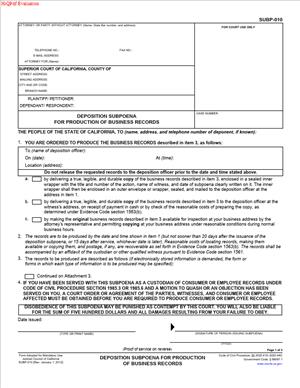
SUBP-010 – Disposition Subpoena for Production of Business Records
Fill out nowJurisdiction: Country: United States | Province or State: California
If you are trying to obtain business records after a lawsuit has moved toward resolution, the SUBP-010 – Disposition Subpoena for Production of Business Records is the form that allows you to do that in a formal, enforceable way. It is part of California’s court forms used to request documents from a business or organization that is not a party to your case.
This form is often used when you need records such as medical files, employment records, banking documents, or other business records that may support your claims or defenses. It is directed to a custodian of records at a business, not to an individual party in the case.
If you are representing yourself, the language on the form can feel technical. However, its purpose is straightforward. It tells a business that it must produce certain records by a specific date and in a specific way.
Understanding how this document works helps you avoid delays, objections, or rejected filings. When completed accurately, it becomes a powerful tool to obtain evidence that may be critical to your case.
What is SUBP-010 – Disposition Subpoena for Production of Business Records?
Clear definition
SUBP-010 – Disposition Subpoena for Production of Business Records is a California court form used to command a business to produce documents or records in connection with a legal proceeding. It is a type of subpoena, which means it is an official court order.
This form is specifically designed for business records. It is directed to the “Custodian of Records” or another authorized representative of a company, hospital, bank, employer, or other organization that maintains documents.
The word “disposition” in the title refers to the stage of the case. This form is commonly used when a case has been resolved or is near resolution, but certain records still need to be formally produced for the record.
When properly issued and served, the form requires the business to provide copies of the requested records. It may also require a declaration from the custodian confirming the authenticity of those records.
Who typically uses this form?
This form is commonly used by parties in civil cases. That includes plaintiffs and defendants, whether represented by an attorney or acting on their own.
Self-represented litigants may use it when they need records from a third-party business. For example, you might need medical bills, employment records, or transaction histories to clarify damages or verify claims.
Attorneys also use this form during or after litigation to complete the evidentiary record. In some situations, insurance companies or other interested parties involved in the case may initiate the process through counsel.
Court clerks process the form as part of the case file, but they do not complete it for you. The responsibility for accurate completion and service rests with the requesting party.
Why might you need this form?
You may need this form when the information you need is held by a business that is not directly involved in your case. Informal requests often do not carry legal force. A subpoena does.
This form creates a formal obligation to produce documents. Without it, a business may refuse to release records due to privacy rules or internal policies.
You might also use it when certified records are required. Courts often accept business records more easily when they are produced in response to a subpoena and accompanied by a custodian’s declaration.
In some cases, deadlines related to settlement, judgment enforcement, or final court review make timely access to records important. This form helps establish a clear production date.
Typical real-life scenarios
- You were injured in an accident and settled your case, but the court requires verified medical billing records before final approval. A subpoena to the hospital’s records department ensures proper documentation.
- You are disputing wage calculations in a resolved employment case. Payroll records from your former employer are needed to confirm amounts. A formal request through this form may secure those records.
- You need bank statements to confirm payment history related to a contract dispute. The bank may require a subpoena before releasing account information, even if the case has already concluded.
- You are finalizing a family law matter and need business valuation documents from a company that is not a direct party to the case. The custodian of records may only respond to an official court order.
When would you use SUBP-010 – Disposition Subpoena for Production of Business Records?
You would use this form when you need business records connected to a court case in California, and those records are held by a third party. It applies in civil matters, including personal injury, contract disputes, employment cases, and some family law proceedings.
This form is typically used after significant court activity has already occurred. For example, the case may have reached a settlement, judgment, or another stage where final documentation is required. It can also be used when preparing for a hearing that requires verified records.
You may use it if informal requests have not worked. Businesses often require a subpoena before releasing documents due to privacy concerns or liability risks.
The person issuing the subpoena is usually a party to the case or their attorney. The recipient is typically a records custodian. The form outlines what documents are required, where they must be sent, and when they must be produced.
Timing matters. The production date must allow sufficient time for service and for the business to respond. Although procedures can vary by court and case type, the overall purpose remains consistent: to formally obtain business records tied to a legal matter.
Legal characteristics of SUBP-010 – Disposition Subpoena for Production of Business Records
This document is a court-authorized subpoena. Its effectiveness depends on proper completion, issuance, and service. Each required field must be filled in accurately, including case information, court details, and the specific records requested.
Clarity is critical. Vague or overly broad descriptions of records may lead to objections or incomplete production. The business must be able to identify what you are asking for without guessing.
Proper service is also essential. A subpoena generally must be personally served on the records custodian or authorized agent. Failure to follow service requirements may make the subpoena unenforceable.
Privacy laws can affect how the form operates. Certain records, such as medical or financial information, may require additional notices to the consumer or employee whose records are being requested. Requirements may vary depending on the type of record involved.
Common problems include incorrect case numbers, incomplete addresses, missing signatures, and unrealistic production dates. Any of these issues may delay compliance or result in the need to reissue the subpoena.
It is important to understand what this form does not do. It does not automatically guarantee immediate access to records. It also does not resolve disputes about privileged or confidential information. If the recipient objects, additional court steps may be required.
Is it legally binding?
Yes, once properly issued and served, a subpoena of this type is generally legally binding. It operates as a court order directing the business to produce specified records.
The binding nature depends on compliance with procedural requirements. If the form is not correctly completed or not properly served, its enforceability may be weakened.
When valid, the recipient must respond by the stated date. That response may include producing the records, objecting in writing, or seeking court guidance. Failure to comply without a valid objection can lead to further court action.
At the same time, the subpoena’s power is limited to the records described. It does not authorize access beyond what is clearly requested. The scope of the request determines the extent of the obligation.
How to fill out SUBP-010 – Disposition Subpoena for Production of Business Records
Step 1 – Identify the court and case information
At the top of the form, enter the name of the court, its address, and the branch if applicable. Provide the full case title exactly as it appears in your court documents. Include the case number without errors. Accuracy here ensures the subpoena is tied to the correct legal proceeding.
Step 2 – Enter the name of the person or entity receiving the subpoena
Write the full legal name of the business or organization whose records you are requesting. Address it to the “Custodian of Records” unless you have a specific authorized person. Include the correct service address. This must be a physical address where service can be completed.
Step 3 – Specify the records to be produced
Describe the documents you want in clear, specific terms. Include date ranges and document types. For example, you might request billing statements from a certain period or payroll records for a defined timeframe. The clearer your description, the easier it is for the custodian to respond accurately.
Step 4 – State the method and date of production
Indicate when the records must be produced and where they should be sent. The date must allow time for service and processing. Make sure the location for delivery is accurate and complete. Some productions may be sent by mail, while others may require personal delivery or appearance.
Step 5 – Include any required consumer or employee notice information
If the records relate to a specific individual’s medical, employment, or financial information, the form may require confirmation that notice has been given to that person. Complete any sections that reference notice requirements. This step connects to privacy protections and affects whether the subpoena can proceed.
Step 6 – Sign and issue the subpoena
Sign the form in the space provided. Depending on the case type and court procedures, the subpoena may need to be issued by the clerk or an attorney of record. Ensure that all signature lines are properly completed before arranging for service.
Step 7 – Arrange for proper service
Have a qualified adult who is not a party to the case personally serve the subpoena on the records custodian or authorized agent. Service details are typically documented separately. Without proper service, the business is not obligated to respond.
Step 8 – File proof of service and retain copies
After service is completed, ensure that proof of service is prepared and filed with the court if required. Keep copies of the completed SUBP-010 – Disposition Subpoena for Production of Business Records and all related documents for your records. Proper documentation supports enforcement if issues arise.
Legal terms you might encounter in SUBP-010 – Disposition Subpoena for Production of Business Records
- Disposition of Records: This refers to what happens to the records after they are produced. The form asks whether the records will be returned to the witness or destroyed. You must clearly indicate the chosen disposition so the custodian of records knows what to expect once the case or hearing is complete.
- Custodian of Records: This is the person at a business or organization who is responsible for maintaining records. On this form, you direct the subpoena to the custodian of records rather than a specific employee. Make sure the business name and address match the entity that actually holds the documents.
- Business Records: These are documents created and kept in the regular course of business. The form is limited to this type of record, not personal notes or unrelated materials. You must describe the records in a way that shows they are maintained as part of routine operations.
- Personal Appearance Not Required: This phrase means the custodian does not need to come to court in person. Instead, they can provide copies of the records by the stated deadline and method. If you check or indicate this option, be sure your production instructions are complete and accurate.
- Production Date: This is the deadline by which the records must be delivered. It appears clearly on the document and controls timing. You must choose a date that allows enough time for service and any required notice periods.
- Proof of Service: This is written confirmation that the subpoena was properly delivered. It is usually completed by the person who served the documents. Courts rely on proof of service to confirm that the business was officially notified.
- Consumer Notice: If the records involve a person’s personal information, that person may need to be notified before the records are produced. This notice gives them an opportunity to object. You must complete and serve this notice correctly when required.
- Objection: This is a formal written statement opposing the production of records. A consumer or the business may object within a specific timeframe. If an objection is filed, you may not receive the records unless the court orders production.
- Reasonable Particularity: This means you must describe the requested records clearly and specifically. Vague requests can be challenged or ignored. The form gives you space to detail the documents by type, date range, and subject matter.
- Witness Fees: In some situations, a business is entitled to certain fees for copying or producing records. You are responsible for understanding what fees apply and how they must be paid. If the required fees are not handled properly, the records may not be released.
FAQs
Do I need to file SUBP-010 – Disposition Subpoena for Production of Business Records with the court before serving it?
In most cases, you prepare this document, have it issued if required, and then arrange for service on the business. Some courts require the subpoena to be signed or issued by the clerk or an attorney of record before service. Check the signature section carefully to confirm who must sign it before it becomes valid.
What information must match exactly on this form?
The court name, case number, and party names must match the complaint or petition already on file. The business name and address must match the legal name of the entity holding the records. Even small differences can cause confusion or delay, so copy these details directly from official documents.
How specific do I need to be when describing the records?
You should list document types, date ranges, and subjects clearly. For example, instead of asking for “all files,” specify account statements from January 1, 2023, to December 31, 2023. The more precise you are, the easier it is for the custodian to locate and produce the correct materials.
What happens if the consumer objects to the subpoena?
If a required notice is given and the consumer files a timely objection, the business may not release the records. You may need a court order to move forward. Keep track of notice dates so you know whether the objection period has passed before expecting production.
Can I change the production date after I’ve served the form?
If you need to change the date, you generally must issue a new subpoena or obtain agreement from the business. Simply crossing out the date on your copy is not enough. Any change should be formally documented so there is no confusion about the deadline.
Does the custodian have to appear in court with the records?
This document is designed so that the custodian usually does not have to appear in person. They can send certified copies along with a declaration. Make sure you clearly state the method of delivery so they know where and how to send the documents.
What if the business ignores the subpoena?
If there is no response by the production date, review your proof of service first. Confirm that the service was completed correctly and on time. If it were, you may need to request court assistance to enforce the subpoena.
Do I need to attach anything to SUBP-010 – Disposition Subpoena for Production of Business Records?
You may need to attach a detailed description of documents if the space on the form is not enough. If consumer or employee records are involved, you may also need a separate notice form. Make sure all attachments are referenced clearly in the document and served together.
Checklist: Before, During, and After SUBP-010 – Disposition Subpoena for Production of Business Records
Before
- Confirm the court name, case number, and party names exactly match your filed case.
- Identify the correct legal name and address of the business holding the records.
- Determine whether consumer or employee notice is required.
- Calculate notice periods and choose a production date that complies with timing rules.
- Draft a clear, specific description of the requested records.
- Check who must sign or issue the subpoena before service.
- Prepare copies of the subpoena and any required attachments.
During
- Arrange for proper service by an eligible adult who is not a party to the case.
- Ensure all required documents, including notices, are served together.
- Record the exact date and method of service.
- Confirm that witness or copying fees are addressed if required.
- Track objection deadlines on your calendar.
- Communicate professionally with the records custodian if clarification is needed.
After
- Review proof of service for completeness and accuracy.
- Wait until the objection period has expired before expecting records.
- Confirm receipt of records by the stated production date.
- Check that the records received match what you requested.
- Safely store the records and maintain confidentiality.
- Follow through on any court steps if there is noncompliance.
Common mistakes to avoid with SUBP-010 – Disposition Subpoena for Production of Business Records
- Mistake: Using an incorrect business name because you relied on a website listing; this happens often and can result in invalid service and no records being produced, so do not forget to verify the entity’s full legal name and address.
- Mistake: Choosing a production date that is too soon; people rush the timeline and ignore notice periods, which can lead to objections or unenforceable service, so do not forget to calculate deadlines carefully.
- Mistake: Describing records too broadly; this happens when you are unsure what exists, and it can trigger objections or incomplete responses, so do not forget to narrow requests by type and date.
- Mistake: Failing to serve the required consumer notice; many self-represented parties overlook this step, which can block the release of records, so do not forget to determine whether personal records are involved.
- Mistake: Forgetting to attach additional pages referenced in the form; this happens when you draft a list separately, and the custodian may ignore unstated attachments, so do not forget to include and label every page served.
- Mistake: Not keeping proof of service; people assume service is enough, but without written proof, you cannot enforce compliance, so do not forget to obtain and store the signed proof.
- Mistake: Ignoring copying fees or payment requirements; this can delay production because the business will wait for payment, so do not forget to clarify and handle any required fees promptly.
- Mistake: Altering the form after it has been issued; this sometimes occurs when correcting small errors, but changes can invalidate the document, so do not forget to reissue a corrected version if needed.
What to do after filling out SUBP-010 – Disposition Subpoena for Production of Business Records
Once you complete the form, slow down and review every section. Accuracy at this stage prevents delays later. Check names, dates, and descriptions one more time before moving forward.
- Step 1: Make at least two copies of the completed subpoena and all attachments.
- Step 2: Obtain any required signature or issuance from the clerk or authorized person.
- Step 3: Arrange for proper service by someone who is legally allowed to serve documents.
- Step 4: Ensure any required consumer or employee notice is served within the correct timeframe.
- Step 5: Calendar the objection deadline and the production date.
- Step 6: Confirm that proof of service is completed and signed by the server.
- Step 7: File proof of service with the court if required in your case.
- Step 8: Monitor for objections or communications from the business.
- Step 9: Receive and review the produced records for completeness.
- Step 10: Store the records securely and use them appropriately in your case.
Keep all copies together in a dedicated folder for your case. Label each document clearly so you can find it quickly if the court asks for confirmation. If you receive electronic records, save backup copies in a secure location.
If the records are incomplete or late, act promptly. Review your service documents first. Then decide whether follow-up communication or a court request is necessary. Staying organized and proactive will help you use the subpoena effectively and avoid unnecessary setbacks.
Disclaimer: This guide is provided for informational purposes only and is not intended as legal advice. You should consult a legal professional.