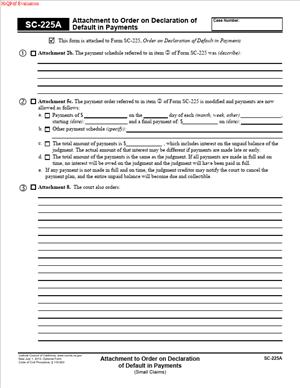
SC-225A – Attachment to Order on Declaration of Default in Payments
Fill out nowJurisdiction: Country: United States | Province or State: California
SC-225A – Attachment to Order on Declaration of Default in Payments is a California small claims court form used when someone has failed to follow a court-ordered payment plan. It works as an attachment to a judge’s order after a missed payment or other default.
If you are dealing with unpaid small claims judgment payments, this form becomes part of the court’s official record. It helps clarify what happened and what the court is ordering next.
You may be the person owed money, or the person who was ordered to make payments. Either way, this document matters because it can affect how the judgment is enforced.
When a payment plan breaks down, the court needs a clear written record. This form provides that detail and supports the court’s decision about the remaining balance.
What is SC-225A – Attachment to Order on Declaration of Default in Payments?
Clear definition
SC-225A – Attachment to Order on Declaration of Default in Payments is a supporting document attached to a court’s order after a declaration of default in a small claims payment plan. It outlines details about missed payments and the remaining amount owed under a judgment.
In small claims cases, a judge may allow the debtor to pay a judgment in installments. If those payments stop or fall behind, the creditor can file a declaration stating that the debtor is in default. This attachment gives structure to the order that follows.
The form becomes part of the court’s official ruling. It does not stand alone. It is connected to an order that addresses the consequences of missed payments.
Who typically uses this form?
This form is typically used by people involved in a California small claims case where the court allowed installment payments. Most often, it involves a judgment creditor who claims the debtor missed required payments.
Court staff and judges also rely on this form to document what the order says about the default. It helps keep the case file organized and complete.
If you are the judgment debtor, you may not fill out this form yourself. However, it directly affects your payment obligations and enforcement risk.
Why might you need this form?
You may encounter this form if a payment plan approved by the court has not been followed. When a scheduled payment is missed, the creditor may file a declaration of default.
If the court agrees that a default occurred, it may issue an order stating that the entire remaining balance is now due. SC-225A – Attachment to Order on Declaration of Default in Payments explains the terms of that order.
The form helps clarify how much is still owed, including any costs or interest allowed under the judgment. It reduces confusion about the next steps in enforcing the judgment.
Typical real-life scenarios
- A small business owner wins a small claims judgment for unpaid services. The court allows the customer to pay in monthly installments. After several months, the customer stops paying. The business owner files a declaration of default, and the court issues an order with this attachment.
- An individual wins a case over property damage from a car accident. The defendant is ordered to pay in set monthly amounts. One payment is skipped and not corrected. The court reviews the declaration and attaches this form to its order about the default.
- Two former roommates resolve a dispute in small claims court. The losing party agrees to a structured payment schedule. After missing multiple payments, the winning party asks the court to confirm the default. The judge’s order includes this attachment to show the remaining balance.
- A contractor sues for unpaid work and wins. The court sets a payment plan. The homeowner makes partial payments but fails to complete them as required. The court issues an order confirming default, and the attachment details how much is still owed.
When would you use SC-225A – Attachment to Order on Declaration of Default in Payments?
Use SC-225A after a judgment has been entered, the court has authorized payment by installments, and the judgment debtor has failed to make the payments as ordered. This attachment is not used to establish an installment plan. It supports a court order addressing a default under an existing payment schedule.
The process generally begins when the judgment creditor files a declaration stating that the debtor has missed one or more required payments. The declaration should identify the judgment, describe the approved payment terms, specify the payments that were due and not made, and calculate the remaining unpaid balance. The court reviews the declaration and determines whether a default has occurred and whether further relief is appropriate.
If the court finds that the debtor defaulted, it may order the entire unpaid portion of the judgment to become immediately due. SC-225A, Attachment to Order on Declaration of Default in Payments, records the financial details supporting that decision. These may include the original judgment amount, payments received, applicable interest or authorized costs, credits, and the balance remaining.
The judgment creditor generally benefits from the order because ending the installment arrangement may allow the creditor to pursue enforcement remedies for the full unpaid balance, subject to applicable law and court procedures. The debtor is directly affected because the protection or benefit of paying according to the existing schedule may end.
The attachment does not independently establish a default, cancel the payment plan, or authorize enforcement. It forms part of the court’s order and should accurately reflect the judge’s decision and the financial information accepted by the court. Any payment received or credit applied after the declaration was prepared should be disclosed so the balance is not overstated.
Use SC-225A only when an installment-payment order already exists, and the court is acting on an alleged default. Do not use it to request an initial payment plan, voluntarily revise payment terms, or report an ordinary payment that was made on time.
Legal characteristics of SC-225A – Attachment to Order on Declaration of Default in Payments
This form is effective only when signed or issued as part of a court order. It does not create a judgment by itself. The underlying judgment must already exist.
For the attachment to function properly, it must accurately reflect the case number, names of the parties, and the financial details. Incomplete or inconsistent information can cause delays or confusion in enforcement.
Courts generally require that the declaration of default be properly filed before issuing the related order. If notice requirements or procedural steps are not followed, the court may decline to issue the order.
The document reflects the court’s decision about default. It may state that the full remaining balance is now due. It may also confirm the total owed, including interest and allowable costs.
This form does not change the original judgment amount unless the court specifically adjusts it according to the law. It also does not automatically collect money. Separate enforcement actions may still be required.
Small claims procedures are designed to be simpler than other civil courts. Even so, accuracy matters. Errors in names, dates, or amounts can complicate collection efforts.
Is it legally binding?
Yes, when issued and signed as part of a court order, it becomes legally binding. Its authority comes from the judge’s order, not from the form itself.
Once the court confirms a default and orders the remaining balance due, that order can be enforced like other small claims judgments. This may allow the creditor to pursue lawful collection methods.
If the form is not properly issued by the court, it has no independent legal effect. It must be attached to and incorporated into a valid court order.
The binding nature of the document depends on proper filing, accurate information, and court approval. Without those elements, it does not carry legal weight.
How to fill out SC-225A – Attachment to Order on Declaration of Default in Payments
Step 1 – Enter the court and case information
Write the name and address of the small claims court at the top of the form. Enter the case number exactly as it appears on previous court documents. List the full legal names of the plaintiff and defendant as shown in the original judgment.
Accuracy here is critical because the form must match the court’s existing records.
Step 2 – Identify the judgment and payment order
Provide details about the original judgment. This usually includes the date the judgment was entered and the total amount awarded.
If the court previously approved installment payments, include the terms of that order. State the amount of each payment and how often payments were due.
This section connects the default to a specific court order.
Step 3 – State the default information
Indicate that the judgment debtor failed to make payments as ordered. Include the date of the missed payment or the period during which payments were not made.
Be clear and factual. The information should match what was stated in the declaration of default filed with the court.
This section explains why the court is issuing the order.
Step 4 – List the remaining balance
Calculate and enter the total unpaid balance of the judgment. Include any interest or court-approved costs that apply under the judgment.
Ensure that the numbers are consistent with prior filings and court records. The court relies on this information to confirm the total amount now due.
This part shows the financial impact of the default.
Step 5 – Reflect the court’s order regarding default
Complete the section that states what the court is ordering as a result of the default. This often includes that the entire remaining balance is immediately due and payable.
Leave any signature lines or areas reserved for the judge or court clerk blank unless instructed otherwise. The court will complete those sections.
Once issued and signed by the court, the form becomes part of the official order in the case.
Legal terms you might encounter in SC-225A – Attachment to Order on Declaration of Default in Payments
- Declaration of Default: A written statement filed by the judgment creditor saying the judgment debtor did not follow the court’s payment order. In this document, the declaration explains how the debtor missed payments and triggers the court’s review. The attachment supports the judge’s decision about what happens next.
- Judgment Creditor: The person or business that won the small claims case and is owed money. This form usually relates to the creditor’s claim that the debtor failed to make required payments. The creditor’s name must match the court’s original judgment exactly.
- Judgment Debtor: The person or business ordered to pay money under the judgment. This document refers to the debtor’s payment obligations and whether they complied. Accurate identification of the debtor is critical because enforcement actions affect this party directly.
- Installment Payments: The court allowed the debtor to make scheduled payments over time instead of paying the full judgment at once. The attachment often lists the payment schedule that was ordered and describes how it was violated. It ties the missed installments to the remaining balance.
- Acceleration of Judgment: A court decision that makes the entire unpaid balance due immediately after a default. This attachment may reflect whether the court lifted the installment plan and restored full collection rights. Once accelerated, the creditor can pursue broader enforcement methods.
- Remaining Balance: The amount still owed after credits for payments received. This figure should be clearly stated and supported by accurate math. The attachment may break down principal, costs, and any additional allowable amounts.
- Order on Default: The court’s written decision responding to the claimed missed payments. This attachment becomes part of that order and explains the factual basis for it. It documents what the judge decided and what changes are going forward.
- Service: The formal delivery of court documents to the other party. Even though this form reflects a court order, service rules may apply to ensure the debtor is notified. Proper service affects enforceability.
- Enforcement of Judgment: The legal process used to collect unpaid money after a judgment. If the court finds a default, enforcement options may expand. This attachment can signal that the creditor may now pursue collection remedies allowed by law.
FAQs
What exactly does SC-225A – Attachment to Order on Declaration of Default in Payments record?
This document records the court’s findings after someone claims the payment plan was not followed. It typically summarizes the original installment order, identifies the missed payments, and states what the judge decided. You should read it closely to see whether the full balance is now due or whether the payment plan continues with changes.
How do I confirm the remaining balance listed is correct?
Start by comparing the balance on this document with your own payment records. Check the original judgment amount, any court-approved costs, and every payment made. Make sure all payments are credited and that the math is accurate before accepting the figure shown.
Does this document change the original judgment amount?
It does not replace the original judgment. Instead, it addresses compliance with the payment order. It may state that the unpaid balance is now immediately due, but it does not create a new judgment.
When does the court’s decision in this form become effective?
The effective date is typically the date the judge signs the order. Look for the signature line and date on the order page. That date controls when enforcement rights may expand and when new obligations apply.
Do I need to file anything else after this attachment is issued?
That depends on your role. If you are the creditor, you may use the updated order to begin or continue collection steps. If you are the debtor, you may need to act quickly to avoid enforcement, such as reviewing payment options or confirming amounts owed.
What if my name or the other party’s name is misspelled on this document?
Names must match the court’s official case record. If you notice an error, check the case caption against the original judgment. Mismatched names can cause problems with enforcement or record searches, so correction may be necessary before taking further action.
Will this document appear in the public court record?
Yes. Once signed and entered, it becomes part of the case file. Anyone reviewing the case docket will see that a default in payments was declared and how the court ruled on it.
Can I challenge the court’s decision shown in SC-225A – Attachment to Order on Declaration of Default in Payments?
If you believe the court relied on incorrect information, review the case file and any notices you received. Check whether you had an opportunity to respond to the declaration of default. Any challenge must focus on factual errors, such as payments that were not credited or misunderstandings about the schedule.
Checklist: Before, During, and After SC-225A – Attachment to Order on Declaration of Default in Payments
Before
- Review the original judgment and installment payment order.
- Gather proof of all payments made, including dates and amounts.
- Confirm the case number and party names exactly as shown on court records.
- Check whether any payments were returned or disputed.
- Calculate the remaining balance yourself.
- Review any notices about a declaration of default.
During
- Compare each missed payment listed with your records.
- Verify that all credited payments are correctly applied.
- Confirm the total remaining balance is mathematically accurate.
- Check the judge’s signature and date.
- Make sure the case number matches every page.
- Note whether the order accelerates the full balance.
- Confirm whether any new deadlines are stated.
After
- Keep a complete copy of the signed order in your records.
- Update your personal or business accounting records.
- Calendar any deadlines mentioned in the order.
- If you are the creditor, prepare for lawful enforcement steps if allowed.
- If you are the debtor, assess your ability to pay the updated amount.
- Monitor the court docket for any additional filings.
- Store proof of delivery or service if required.
Common mistakes to avoid with SC-225A – Attachment to Order on Declaration of Default in Payments
- Mistake: Assuming the full balance is due without checking the order details, which happens when you skim the document; this can lead to overpayment or unnecessary panic, so do not forget to read the judge’s specific ruling.
- Mistake: Ignoring credited payments because you rely only on the creditor’s numbers; this happens when records are not organized, and it can inflate the balance, so do not forget to compare every payment with your receipts.
- Mistake: Overlooking the signature date, which often happens when focusing only on dollar amounts; this can affect enforcement timing, so do not forget to confirm when the order became effective.
- Mistake: Using a different spelling of a party’s name in follow-up documents; this happens due to informal recordkeeping and can delay enforcement, so do not forget to match the court caption exactly.
- Mistake: Failing to keep a filed copy, which occurs when you assume the court will maintain everything; this can create proof problems later, so do not forget to store your own complete copy.
- Mistake: Waiting too long to respond after a default is declared, often due to confusion about next steps; this can lead to wage garnishment or other enforcement actions, so do not forget to act promptly once you review the order.
- Mistake: Miscalculating interest or costs when updating your records, which happens if you guess instead of verifying figures; this can distort the true balance, so do not forget to double-check calculations.
- Mistake: Assuming the installment plan continues automatically, which happens when you rely on the old order; this can result in missed lump-sum obligations, so do not forget to confirm whether the court accelerated the debt.
What to do after filling out SC-225A – Attachment to Order on Declaration of Default in Payments
Once this document is completed and signed by the court, your focus shifts from filling it out to acting on it. What you do next depends on whether you are the person owed money or the person ordered to pay.
Start by carefully reviewing the signed order. Do not rely on memory. Confirm the amount now due, the date of the order, and whether the installment plan still exists. These details control your next move.
- Step 1: Obtain a file-stamped copy of the signed order for your records.
- Step 2: Read the order line by line and highlight the court’s specific findings.
- Step 3: Verify that the remaining balance matches your calculations.
- Step 4: Update your accounting records to reflect the court’s ruling.
- Step 5: Calendar any deadlines or time-sensitive enforcement options.
- Step 6: If you are the creditor, determine which enforcement tools are now available under the order.
- Step 7: If you are the debtor, evaluate whether you can pay the full balance or need to explore available procedural options.
- Step 8: Keep proof of any payments made after the order date.
- Step 9: Monitor the case docket to confirm the order is officially entered.
- Step 10: Maintain a dedicated file (paper or digital) with the judgment, payment history, and this attachment together.
If you are the creditor, you may now be able to pursue broader collection efforts if the court accelerates the debt. Stay organized. Enforcement requires accurate case information and precise amounts.
If you are the debtor, act quickly if the order requires immediate payment. Waiting can increase costs and limit your options. Keep communication records and proof of any payments you make.
In either role, treat this order as a turning point in the case. It reflects the court’s response to missed payments. Your next steps should be deliberate, documented, and consistent with what the signed order states.
Disclaimer: This guide is provided for informational purposes only and is not intended as legal advice. You should consult a legal professional.