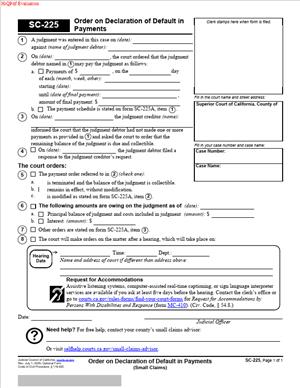
SC-225 – Order on Declaration of Default in Payments
Fill out nowJurisdiction: Country: United States | Province or State: California
SC-225 – Order on Declaration of Default in Payments is a court form used in California small claims cases. It documents a judge’s order after a payment plan has not been followed. The form records that a default in payments has occurred and explains what the court orders as a result.
You usually encounter this form after a judgment already exists. A payment schedule was set. One side reports that payments stopped or were not made as ordered. The court then reviews a declaration and issues this order.
For self-represented people, this form often appears without much explanation. You may receive it by mail from the court. You may also be asked to review it before it is submitted. Understanding what it does helps you read it carefully and avoid confusion.
This document matters because it can change how a judgment is enforced. It may affect the amount due, timing, or next steps allowed under the judgment. Reading it closely helps you understand what the court has decided.
Although the form looks brief, each section carries meaning. Names, dates, and amounts must match the existing judgment. Errors can create delays or misunderstandings later.
What is SC-225 – Order on Declaration of Default in Payments?
Clear definition
SC-225 – Order on Declaration of Default in Payments is a written court order. It follows a declaration stating that a party failed to make payments as required under a small claims judgment. The judge signs this form to confirm whether a default occurred and what the court orders next.
The form does not create a new judgment. It relates back to an existing judgment that included installment payments. The order reflects the court’s decision after reviewing the declaration of default.
This document becomes part of the court record. Once signed, it shows how the court addressed the reported payment problem.
Who typically uses this form/document?
This form is typically used by the court after a declaration of default is submitted. The declaration usually comes from the party owed money under the judgment. That party reports missed or incomplete payments.
Court clerks process the paperwork. A judge reviews the declaration and signs the order. The parties then receive copies of the completed form.
Self-represented judgment creditors and judgment debtors often encounter this document. It is common in small claims cases where installment payments were allowed.
Why you might need this form/document
You might need this form if payments under a judgment are not being made as ordered. The form records the court’s response to that situation. It clarifies whether the payment plan continues or whether different enforcement options apply.
If you are owed money, this document shows that the court reviewed the payment history. If you owe money, it shows what the court concluded about the alleged default.
The form helps prevent uncertainty. Without it, parties may disagree about whether a default occurred or what consequences apply.
Typical real-life scenarios
- A small business wins a small claims case and agrees to accept monthly payments. After several months, payments stop. A declaration of default is filed, and the court issues this order.
- An individual loses a case and is allowed to pay in installments. One payment is late. The court reviews the situation and issues an order confirming whether that delay counts as a default.
- A judgment creditor claims no payments were made at all. The court checks the declaration and enters an order addressing the claimed nonpayment.
- A judgment debtor believes payments were made, but still receives this order. The form explains what the court determined based on the information provided.
When would you use SC-225 – Order on Declaration of Default in Payments?
This form is used after a judgment with installment payments is already in place. It comes into play only if a default in those payments is reported. It is not used at the beginning of a case.
The timing is usually tied to missed payments. Once a declaration of default is submitted, the court reviews it and issues this order. The form reflects that review.
Judgment creditors commonly see this form after asking the court to address nonpayment. Judgment debtors usually see it when the court responds to an allegation of default.
The form may also be used when the court needs to clarify the status of a payment plan. It documents whether the plan continues or whether the judgment becomes enforceable in a different way.
Legal characteristics of SC-225 – Order on Declaration of Default in Payments
This document is effective once signed by a judge and entered by the court. Its authority comes from the existing judgment and the court’s power to enforce it. Accuracy matters because the order relies on the details provided in the declaration.
Common problems include mismatched case numbers, incorrect party names, or payment amounts that do not align with the judgment. Missing signatures or incomplete sections can also cause delays.
Practices can vary by court location. Some courts process these orders quickly. Others may take more time or require additional review. The general purpose remains consistent across California.
This form does not determine liability for the original case. It does not retry the dispute or change who won. It focuses only on compliance with the payment terms already ordered.
Is it legally binding?
Yes, this order is legally binding once issued by the court. It reflects a judicial decision based on the declaration submitted. The order becomes part of the official case record.
Its binding effect comes from the court’s authority over the judgment. The order explains how the court treats the reported default. Parties are expected to follow what the order states.
The order’s scope is limited. It binds the parties only regarding payment compliance and related enforcement under the judgment.
How to fill out SC-225 – Order on Declaration of Default in Payments
Step 1 – Review the case information
This step involves confirming the case name and number. These details must match the existing small claims judgment exactly. The court uses this information to link the order to the correct case.
Step 2 – Identify the parties
The form lists the judgment creditor and judgment debtor. Names should appear as they did in the judgment. Consistency avoids confusion about who the order applies to.
Step 3 – Reference the existing judgment
The order refers back to a judgment that allowed installment payments. This section connects the order to that prior decision. It provides context for the court’s action.
Step 4 – Address the declaration of default
This part reflects that a declaration was submitted claiming a default in payments. The judge reviews that declaration. The order shows the court’s response to the claim.
Step 5 – Note the court’s determination
The form states whether the court finds a default occurred. This determination is based on the declaration and court review. It clarifies the status of the payment plan.
Step 6 – Record the court’s order
This section explains what the court orders as a result of the determination. It may address enforcement or payment status. The wording here defines the practical effect of the order.
Step 7 – Judge’s signature and date
The judge signs and dates the form. This signature makes the order effective. Without it, the document has no legal effect.
Step 8 – Distribution of the order
After signing, the court provides copies to the parties. This step ensures everyone receives the same information about the court’s decision.
Legal terms you might encounter in SC-225 – Order on Declaration of Default in Payments
- Declaration of Default: This is the statement that a required payment plan has been broken. In this document, it refers to the court formally recognizing that scheduled payments were not made as ordered. The declaration is based on information already in the case file, not new testimony.
- Installment Judgment: This means the original judgment allowed payments over time instead of one lump sum. The form relies on the existence of this type of judgment. Without an installment judgment, this document usually would not apply.
- Judgment Creditor: This is the person or entity owed money under the judgment. Their name must match exactly how it appears in the original judgment. The order affects their right to enforce the full balance.
- Judgment Debtor: This is the person ordered to pay. The form records that the debtor did not follow the payment schedule. Accuracy matters because the order directly affects enforcement against this party.
- Balance Due: This is the amount still unpaid at the time of default. The court may rely on this number when deciding what enforcement options become available. It must be consistent with the payment history in the file.
- Order: An order is a formal decision by the judge. In this document, the order confirms the default and changes how the judgment can be enforced. Once signed, it becomes part of the court record.
- Court Determination: This refers to the judge’s conclusion after reviewing the declaration of default. The judge does not retry the case. The determination is limited to whether the payment terms were violated.
- Effective Date: This is the date the order takes effect. It is usually the date the judge signs it. This date matters for tracking enforcement timelines and recordkeeping.
- Clerk: The clerk is the court staff member who files and processes the order. The clerk’s handling of the document affects when it appears in the official docket. Filing with the clerk makes the order part of the public case file.
FAQs
What does this document actually change in my case?
This document records that the payment plan set by the court was not followed. Once entered, the case moves from a payment-plan status to a default status. That change affects what actions may happen next under the judgment.
Do I need to file SC-225 – Order on Declaration of Default in Payments myself?
Often, this document is prepared for the judge to sign after a declaration is submitted. Whether you physically file it depends on how your court handles paperwork. You should focus on confirming whether the signed order appears in the case record.
How do I know the names and case number are correct?
You match them exactly to the original judgment paperwork. Check spelling, middle initials, and punctuation. Even small differences can cause confusion in the court record.
What date should I look for on this form?
You look for the judge’s signature date. That date is usually the effective date of the order. It helps you track when the default was officially recognized.
Can this document be changed after the judge signs it?
Once signed and filed, this document is part of the record. Changes usually require another court order or a correction process. You should review it carefully before and after filing to catch errors early.
Does this form include payment amounts or just the default finding?
It typically references the failure to pay and may note the balance due. It does not recalculate the entire judgment from scratch. The numbers should align with the existing payment history.
Will this order show up on the public case docket?
Yes, once filed by the clerk, this document becomes part of the public court file. Anyone reviewing the docket can see that a default in payments was declared.
What should I do if the information on the signed order is wrong?
You act quickly to flag the issue. Compare the signed document to the judgment and payment records. If something does not match, you need to address it through the court’s correction process.
Checklist: Before, During, and After SC-225 – Order on Declaration of Default in Payments
Before
- Review the original judgment and installment payment order.
- Confirm the full legal names of all parties.
- Verify the case number exactly as assigned.
- Check the payment history and dates of missed payments.
- Confirm the remaining balance shown in the court file.
- Read the entire form so you know what information it records.
- Prepare copies of relevant payment records for reference.
During
- Enter the case number exactly as it appears on prior documents.
- Match party names to the original judgment line by line.
- Review the default description for accuracy and clarity.
- Confirm the judge’s name and court location are correct.
- Watch for blank fields that should be completed by the court.
- Avoid adding information not requested by the form.
- Keep a clean copy ready for filing or records.
After
- Check that the judge signed and dated the order.
- Confirm the clerk filed the document into the case docket.
- Obtain copies for your records.
- Review the filed version for errors or omissions.
- Update your personal case file with the new order.
- Track any next steps triggered by the default status.
- Store the document where you keep other judgment papers.
Common mistakes to avoid with SC-225 – Order on Declaration of Default in Payments
- Mistake: Using a nickname or shortened name, because people copy from memory, which can cause enforcement confusion, so always match the original judgment exactly.
- Mistake: Listing the wrong case number, because similar cases exist, which can misfile the order, so always double-check the docket number.
- Mistake: Assuming the order is effective before it is signed, because people act too early, which can lead to premature actions, so always wait for the signature date.
- Mistake: Ignoring the filed copy, because people trust the draft, which can hide clerk or signature errors, so always review the stamped version.
- Mistake: Forgetting to keep copies, because paperwork feels routine, which can leave you without proof later, so always save multiple copies.
- Mistake: Adding extra explanations on the form, because people want to tell their story, which can clutter the record, so only include what the form requires.
- Mistake: Not checking payment figures, because numbers are assumed correct, which can affect enforcement amounts, so always confirm the balance.
- Mistake: Waiting too long to correct errors, because people hope issues resolve themselves, which can lock in mistakes, so address problems promptly.
What to do after filling out SC-225 – Order on Declaration of Default in Payments
Once the form is completed and signed, your focus shifts to making sure it is properly recorded and stored. This document affects the status of the judgment, so accuracy and follow-through matter. Treat it as a permanent part of the case history.
- Step 1: Confirm the judge has signed and dated the order.
- Step 2: Make sure the clerk has filed it and added it to the docket.
- Step 3: Request or download a file-stamped copy for your records.
- Step 4: Compare the filed copy against the original judgment and payment plan.
- Step 5: Check that names, case number, and dates all match.
- Step 6: Organize the order with your other judgment documents.
- Step 7: Update any personal tracking notes about the case status.
- Step 8: Note the effective date so you know when the default was recognized.
- Step 9: Monitor the case docket for any follow-up actions or notices.
- Step 10: Keep the document accessible in case you need to reference it later.
Staying organized after this step helps you understand what the court record shows at any point. It also makes it easier to respond if questions come up about the payment history or enforcement status.
Disclaimer: This guide is provided for informational purposes only and is not intended as legal advice. You should consult a legal professional.