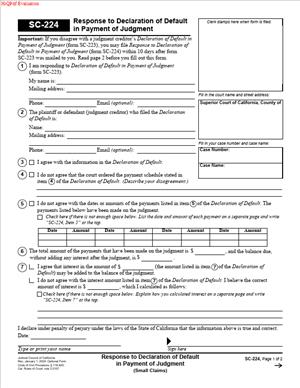
SC-224 – Response to Declaration of Default in Payment of Judgment
Fill out nowJurisdiction: Country: United States | Province or State: California
The SC-224 – Response to Declaration of Default in Payment of Judgment is a court form used in California small claims cases. It lets you respond when the other side says you failed to make the required judgment payments.
This document matters when there is already a judgment and a payment plan. It focuses only on whether a default happened, not on rearguing the original case.
People often encounter this form unexpectedly. It usually appears after payments were missed, delayed, disputed, or misunderstood.
The form gives you a structured way to explain your position to the court. It creates a written record of your response.
Understanding this document before filling it out helps you avoid confusion. It also helps you focus on the narrow issue the court is reviewing.
What is SC-224 – Response to Declaration of Default in Payment of Judgment?
Clear definition
SC-224 – Response to Declaration of Default in Payment of Judgment is a written response filed after a Declaration of Default in Payment of Judgment has been submitted. The declaration claims that a judgment debtor did not follow the court-ordered payment terms.
This response form allows you to state whether you agree or disagree with that claim. It also provides space to explain payments made, timing issues, or other relevant facts.
The form does not reopen the underlying judgment. It addresses only the question of default under an existing payment order.
In California small claims matters, this document becomes part of the court’s review of enforcement issues.
Who typically uses this form/document?
This form is commonly used by judgment debtors. That is the person ordered to pay money under a small claims judgment.
It may also be used by individuals who share responsibility for a judgment, depending on how the original order was written.
Self-represented parties use this document frequently. Small claims cases often do not involve attorneys.
The responding party typically files this after receiving notice that a default has been declared or alleged.
Why you might need this form/document
You might need this form when the other party claims you did not pay as required. The court may rely on that claim unless you respond.
This document gives you a way to clarify what actually happened. That might include payments made, partial payments, or reasons for timing differences.
Without a response, the court may move forward based only on the declaration of default. That can affect enforcement steps.
Filing a response creates a clearer record. It helps the court understand your position before taking further action.
Typical real-life scenarios
- A common situation involves payments sent close to the due date. The receiving party may file a default declaration before the payment is processed or credited.
- Another scenario involves confusion about payment amounts. One side may believe a smaller payment was acceptable, while the other expected the full amount.
- Some cases involve temporary disruptions. For example, a payment may have been delayed because of banking issues or mailing delays.
- There are also situations where payments were made but not acknowledged. Records may exist, but the other party claims nonpayment.
- In other cases, the judgment debtor believes the payment plan changed informally. The other party may not agree that any change occurred.
When would you use SC-224 – Response to Declaration of Default in Payment of Judgment?
This form is used after a Declaration of Default in Payment of Judgment has been filed in a small claims case. It comes into play only after a judgment already exists.
You would use it when you want the court to consider your explanation before deciding what happens next. The timing often depends on when you receive notice of the declaration.
The roles are usually clear. One party claims a default. The other responds using this form.
This document is not used at the beginning of a case. It appears later, during enforcement of an existing judgment.
People commonly encounter this form when payment plans are spread over time. The longer the payment schedule, the more room there is for disagreement or misunderstanding.
Legal characteristics of SC-224 – Response to Declaration of Default in Payment of Judgment
This form is part of the court record once submitted. Its effectiveness depends on being completed accurately and signed as required.
Courts typically look for clear information. Incomplete sections, missing signatures, or unclear statements can cause problems.
Common issues include inconsistent dates, unclear payment descriptions, or missing attachments referenced in the response.
Procedures may vary slightly by court location. However, the core purpose of the form remains consistent across California small claims courts.
This document does not cancel a judgment. It does not change the amount owed or the original terms by itself.
It also does not automatically stop enforcement. It provides information the court may consider when reviewing the alleged default.
Is it legally binding?
The response itself is not a contract or agreement. It does not create new obligations.
However, the statements made on the form are part of a court proceeding. They are treated as representations made to the court.
Once filed, the information may influence court decisions related to enforcement or compliance. Accuracy and clarity matter for that reason.
The form becomes binding in the sense that it is an official court submission. It is not informal correspondence.
How to fill out SC-224 – Response to Declaration of Default in Payment of Judgment
Step 1 – Case caption and court information
This section identifies the court and the case. You enter the same court name and address used in earlier filings. The case number links your response to the correct judgment.
Step 2 – Party identification
You identify yourself and the other party using the names already on file. Consistency matters so the court can match parties correctly.
Step 3 – Reference to the declaration of default
This part acknowledges that a Declaration of Default in Payment of Judgment was filed. It frames your response as addressing that specific filing.
Step 4 – Statement of agreement or disagreement
Here you indicate whether you agree or disagree with the claim of default. This is the core position of your response.
Step 5 – Explanation of payments or circumstances
This section allows you to explain payment history or relevant events. You may describe dates, amounts, and how payments were made.
Step 6 – Clarifying timing or processing issues
If timing is part of the dispute, this section is used to explain delays or processing gaps. The goal is to give context to the court.
Step 7 – Additional factual details
This space is for other facts directly related to the alleged default. It is not for arguments about the original judgment.
Step 8 – Attachments referenced
If you mention documents, this section notes that attachments exist. The form itself points the court to supporting materials without detailing them.
Step 9 – Declaration and signature
You sign and date the form. This confirms that the information is presented as accurate to the best of your knowledge.
Step 10 – Final review before submission
This step involves reviewing the completed form for clarity and completeness. Consistent information helps avoid delays or confusion.
Legal terms you might encounter in SC-224 – Response to Declaration of Default in Payment of Judgment
- Declaration of Default: This is a written statement claiming that required payments on a judgment were not made as ordered. In this document, you respond directly to what that declaration says. You either explain why it is incorrect or provide context about payments or timing.
- Judgment Debtor: This is the person who owes money under the judgment. If you are completing this form, you are usually the judgment debtor responding to a claim of missed or late payment.
- Judgment Creditor: This is the person who is owed money under the judgment. Their declaration of default is what triggered your need to complete this document.
- Installment Payments: These are scheduled payments ordered by the court instead of a single lump sum. This form often focuses on whether installment payments were made, delayed, or misunderstood.
- Default: Default means a claimed failure to follow the payment terms in the judgment. Your response explains whether a default actually occurred and, if not, why the claim is inaccurate.
- Payment Date: This is the date a payment was due or made. The dates you list must match receipts, bank records, or other proof you rely on.
- Declaration Under Penalty of Perjury: This means you are stating that everything you write is true to the best of your knowledge. Signing the form makes it a sworn statement.
- Proof of Payment: These are documents showing that you paid, such as receipts or transaction records. You may reference these in the form or attach them if appropriate.
- Court Record: This is the official file for your case. Once submitted, your response becomes part of that record and may affect how the court views enforcement actions.
FAQs
What is the main purpose of SC-224 – Response to Declaration of Default in Payment of Judgment?
This document lets you respond in writing when the other party claims you did not make required payments. It records your explanation, your position, and any payment details you want the court to consider.
Do I use this form if I agree that I missed a payment?
Yes. This form allows you to explain why the payment was missed, whether it was late rather than unpaid, or whether there were circumstances affecting timing. You are not limited to simply agreeing or disagreeing.
Where do I find the information I need to complete this document?
You pull details from the judgment, the payment schedule, and your own payment records. Dates, amounts, and names must match what already appears in the court file.
What if my payment was made but not processed yet?
You can explain that timing issue directly in this document. Be clear about when you sent or authorized the payment and how it was made.
Do I need to attach proof of payment?
This form itself does not require attachments, but you may reference proof you have. If you include attachments, they must clearly match the payments you describe.
Who signs this document?
The person responding to the declaration signs it. If you are the judgment debtor, you sign in your own name and confirm that the information is true.
Will filing this form stop collection actions automatically?
This document records your response in the case file. It does not by itself guarantee that enforcement actions stop, but it ensures your explanation is officially noted.
What happens after the court receives this form?
Once accepted, it becomes part of the court record. The judge may review it when deciding the next steps related to payment or enforcement.
Checklist: Before, During, and After SC-224 – Response to Declaration of Default in Payment of Judgment
Before
- Gather the judgment and any payment schedule.
- Collect receipts, bank statements, or confirmation numbers.
- Review the declaration of default carefully.
- Confirm the case number and party names.
- Check due dates against actual payment dates.
- Decide whether you agree, disagree, or partially agree.
- Set aside time to complete the form without rushing.
During
- Write names exactly as they appear in the case.
- Use specific dates and amounts for each payment.
- Keep explanations factual and brief.
- Make sure your statements match your records.
- Reference any proof you rely on.
- Review each section before moving on.
- Sign and date the declaration section.
After
- Make at least one copy for your records.
- Submit the original as required by the court.
- Confirm the form was accepted for filing.
- Organize copies with your payment records.
- Track any response or notice from the court.
- Update your personal case timeline.
- Keep proof of when and how you submitted the form.
Common mistakes to avoid with SC-224 – Response to Declaration of Default in Payment of Judgment
- Mistake: Using approximate dates or amounts because records are incomplete, which happens when paperwork is not gathered first, leading to credibility issues, so do not forget to verify every figure.
- Mistake: Leaving sections blank because they seem optional, which occurs from rushing, causing the court to lack context, so do not forget to address every relevant part.
- Mistake: Writing emotional explanations instead of facts, which happens under stress, weakening your response, so do not forget to keep statements factual.
- Mistake: Signing without reviewing the declaration language, which happens when people skim, risking false statements, so do not forget to re-read before signing.
- Mistake: Mismatching names or case numbers, which happens when copying from memory, causing filing delays, so do not forget to copy directly from court documents.
- Mistake: Assuming attachments speak for themselves, which happens when explanations are skipped, leaving gaps, so do not forget to reference each attachment clearly.
- Mistake: Missing submission deadlines, which happens due to unclear timing, leading to enforcement actions, so do not forget to track dates.
- Mistake: Not keeping copies, which happens after filing relief, leaving you without proof, so do not forget to retain a full set.
What to do after filling out SC-224 – Response to Declaration of Default in Payment of Judgment
Once the form is complete, your next actions matter just as much as what you wrote. You are creating a paper trail that shows you responded promptly and clearly.
- Step 1: Make clean copies of the signed form for yourself and any required recipients.
- Step 2: Review the form one last time to confirm names, dates, and amounts match your records.
- Step 3: Submit the original to the court using the accepted filing method for your case.
- Step 4: Note the date and method of submission in your personal records.
- Step 5: Watch for confirmation that the filing was accepted or entered into the court record.
- Step 6: Organize all related documents together, including proof of payment and correspondence.
- Step 7: Continue making payments as ordered, if payments are ongoing.
- Step 8: Check your mail or case notifications for any court response or hearing notice.
- Step 9: Update your payment log to reflect that a response was filed.
- Step 10: Be prepared to explain the same facts consistently if asked later.
If you receive notice of a hearing, bring copies of everything you referenced in the response, organized in the same order. Being able to point to the same facts you wrote down helps maintain consistency.
Keep a dated log of all payments made after filing the response. This ongoing record can be useful if enforcement issues continue or if the court asks for an update on compliance.
After filing, keep track of any communication from the judgment creditor as well as from the court. If the creditor acknowledges receipt of a disputed payment after you file SC-224, keep that record, as it may become relevant later.
If enforcement actions begin despite your response, note the dates and types of actions taken. While SC-224 does not automatically stop enforcement, having a clear timeline helps if the court later reviews whether enforcement was appropriate.
Finally, consider setting reminders for future due dates if payments are ongoing. Demonstrating consistent compliance after filing can reinforce your position that any alleged default was limited, temporary, or based on a misunderstanding.
Disclaimer: This guide is provided for informational purposes only and is not intended as legal advice. You should consult a legal professional.