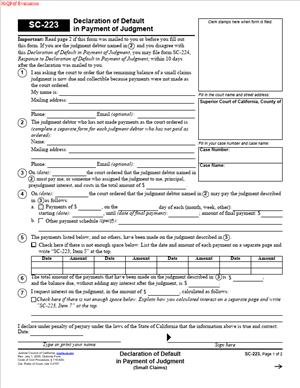
SC-223 – Declaration of Default in Payment of Judgment
Fill out nowJurisdiction: Country: United States | Province or State: California
The SC-223 – Declaration of Default in Payment of Judgment is a court form used after a small claims judgment has already been entered. It focuses on what happens next when payments do not arrive as expected. This document records that a payment obligation tied to a judgment has not been met.
You encounter this form when money was ordered to be paid in installments or by a set date, and that payment did not occur. It helps the court understand that the payment terms in the judgment are no longer being followed. The form does not decide the case again. It addresses compliance with an existing judgment.
This document matters because courts rely on written declarations to track payment status. Without a clear record, the court may not know that a payment problem exists. This form creates a formal notice within the case file.
People often see this form at a stressful moment. You may feel uncertain about timing, amounts, or what details matter. Understanding the purpose and structure of SC-223 – Declaration of Default in Payment of Judgment can make the completion process more manageable.
The form is designed for self-represented people. It uses structured fields rather than open-ended writing. Each section connects directly to the original judgment and the payment terms set by the court.
What is SC-223 – Declaration of Default in Payment of Judgment?
Clear definition
SC-223 – Declaration of Default in Payment of Judgment is a written statement filed in a small claims case to declare that a judgment debtor has failed to make a required payment. The declaration is tied to an existing judgment that ordered payment, often through installments or by a specific deadline.
The form does not create a new judgment. It does not change who won or lost the case. Instead, it documents that the payment terms in the judgment were not followed. The court uses this information to update the status of the case.
This document is formatted as a declaration, meaning it is signed under penalty of perjury. The information provided is expected to be accurate to the best of the signer’s knowledge. The structure is focused on dates, amounts, and payment history.
Who typically uses this form/document?
This form is commonly used by a judgment creditor. That is the person or entity the court ordered to receive payment. The creditor completes the form when expected payments stop or never begin.
In some situations, an attorney may prepare the document, but many people complete it on their own. Small claims procedures are designed for self-represented parties, and this form reflects that approach.
Court staff do not fill out this form for you. The responsibility for providing the information rests with the person declaring the default. The signer is usually the creditor or an authorized representative.
Why you might need this form/document
You might need this document when a judgment includes installment payments and one or more payments are missed. The court cannot track private payment arrangements without being told. This form serves that communication role.
The form may also be needed when a judgment allowed payment by a certain date, and that date passed without payment. Filing a declaration creates a record that the payment obligation was not met.
Without this filing, the court may treat the judgment as still being paid according to plan. The declaration alerts the court that the situation has changed and that the payment terms are no longer being followed.
Typical real-life scenarios
- A common situation involves a small claims judgment that allowed monthly payments. The first few payments arrive, then one month passes with no payment. The creditor uses the form to state the missed payment and the date it was due.
- Another scenario involves a judgment requiring full payment by a specific future date. That date passes, and no payment is received. The declaration is used to document that the deadline has been missed.
- Sometimes a partial payment is made, but it does not match the amount ordered by the court. The form can reflect the amount due versus the amount actually received, showing a shortfall.
- There are also cases where no payment is ever made after judgment. The creditor may wait a period of time, then file the declaration to formally note the lack of compliance with the judgment.
When would you use SC-223 – Declaration of Default in Payment of Judgment?
This form is used after a judgment is already final and includes specific payment terms. It is not used during the trial or before the court decides the case. Timing matters because the declaration relies on an existing order.
You typically use the form when a payment is late or missing based on the schedule set in the judgment. The schedule may involve installments, a lump sum, or a combination. The key factor is that the ordered payment did not occur as required.
The roles involved are usually straightforward. One party is the judgment creditor, who is expecting payment. The other party is the judgment debtor, who was ordered to pay. The form focuses on the debtor’s payment status, not on new disputes.
This document is not used to renegotiate payment terms. It is also not used to request a new trial. Its purpose is limited to reporting nonpayment under the existing judgment.
Legal characteristics of SC-223 – Declaration of Default in Payment of Judgment
This document is effective when it is completed fully, signed, and filed in the correct case. It relies on accurate identification of the case, the judgment date, and the payment terms. Courts generally look for consistency between the declaration and the original judgment.
Common problems arise when dates or amounts do not match the judgment. Missing case numbers or incorrect party names can also cause delays. Because the form is a declaration, unsigned forms are typically not accepted.
Although procedures vary, this form is part of the small claims process in California. Other jurisdictions may use different forms or terminology. Even within the same state, court handling may differ slightly based on local practices.
This document does not enforce payment by itself. It does not collect money or freeze assets. It records a default in payment, which may allow other steps to occur within the case.
Is it legally binding?
The declaration itself is a legally significant statement because it is signed under penalty of perjury. The signer is affirming that the information provided is true and correct based on their knowledge.
The form does not bind the other party to new obligations. It does not modify the judgment. Its binding nature relates to the truthfulness of the statements made, not to creating new payment duties.
Its legal effect comes from being part of the court record. Once filed, it becomes an official statement within the case, and the court may rely on it when reviewing payment compliance.
How to fill out SC-223 – Declaration of Default in Payment of Judgment
Step 1 – Case identification
Begin by entering the case name and case number exactly as they appear on the judgment. This connects the declaration to the correct court file. Accuracy here avoids confusion with other cases involving similar names.
Step 2 – Court information
Provide the name and location of the court where the judgment was entered. This is usually the same court that handled the small claims case. The form uses this information to route the filing properly.
Step 3 – Party names
List the names of the judgment creditor and judgment debtor as they appear in the judgment. Do not shorten or alter names. Consistent naming helps the court confirm the relationship between the declaration and the judgment.
Step 4 – Judgment details
Enter the date the judgment was entered and summarize the payment terms ordered by the court. This may include installment amounts, due dates, or a lump-sum deadline. This section sets the baseline for identifying the default.
Step 5 – Payment history
State what payments, if any, have been received. Include dates and amounts to show how payments compare to what was ordered. This section explains how the default occurred.
Step 6 – Description of the default
Identify the specific payment that was missed or not fully paid. Reference the due date and the amount that was expected. This focuses the declaration on the exact point of nonpayment.
Step 7 – Amount currently due
Provide the amount that remains unpaid as of the date of the declaration. This figure is based on the judgment terms and the payments already received. Clarity here helps the court understand the current status.
Step 8 – Declaration and signature
Read the declaration language carefully before signing. By signing, you are stating that the information is true and correct. Add the date and your signature in the designated area, completing the form.
Legal terms you might encounter in SC-223 – Declaration of Default in Payment of Judgment
- Judgment: The court’s final decision that sets out who owes money and how much. In this document, you identify the judgment so the court can link the default to the correct case. You copy key details exactly as they appear in the court record.
- Judgment debtor: The person or business ordered to pay money. You list the debtor’s name as it appears on the judgment because name matching affects filing and enforcement. Even small differences can cause processing delays.
- Judgment creditor: The person or business entitled to receive payment. You sign this document as the creditor or authorized representative to declare that a payment obligation was not met. Your role matters because the declaration is made under penalty of perjury.
- Installment payment order: A court-approved schedule that allows payments over time. This document is used when the debtor misses a required installment or pays less than ordered. You must reference the schedule to show what was due and when.
- Default: A failure to pay as ordered. In this form, default is tied to a specific missed payment, late payment, or short payment. You describe the default clearly so the court understands the basis of your declaration.
- Balance due: The amount still owed after accounting for all payments received. You calculate and state this figure to show the current status of the judgment. Accuracy here affects what the court records going forward.
- Declaration: A written statement made under penalty of perjury. When you sign, you are confirming that the information is true and complete to the best of your knowledge. This gives the document evidentiary weight in the case file.
- Court clerk: The court staff who accepts filings and updates the case record. The clerk checks for completeness and proper case identification. Acceptance by the clerk places your declaration into the public record.
- Case number: The unique identifier assigned by the court. You must enter it exactly as issued so the declaration attaches to the correct case. A wrong number can send the document to the wrong file.
FAQs
What problem does this document solve?
It creates a clear record that a required payment was not made. You use it to tell the court which payment failed and how much is now owed. This updates the case file with the current payment status.
Do I file this only after a missed installment?
You use it when a payment required by a judgment or payment order is not made as directed. That can include a missed due date, a partial payment, or no payment at all. You describe the specific failure so the court understands the default.
What date should I use as the default date?
Use the date the payment was due and not paid as ordered. If the order allowed a grace period, use the date the grace period ended. Consistency with the payment order matters for clarity.
Who is allowed to sign this form?
The person entitled to receive payment signs. If a business is the creditor, an authorized representative signs using their own name and title. The signer must have personal knowledge of the payment history.
Do names have to match the judgment exactly?
Yes. You copy names exactly as they appear on the judgment, including punctuation and business endings. Matching names helps the clerk file the document correctly and avoids confusion in the record.
Should I attach proof of nonpayment?
Attachments are not required by the document itself. If you choose to attach records, make sure they are easy to read and clearly labeled. Keep originals for your own files.
What happens after the clerk accepts this filing?
The case record reflects that a default was declared. This can affect how the case proceeds and what options are available next. You should check the case status to confirm acceptance.
How often can I file SC-223 – Declaration of Default in Payment of Judgment?
You file it when a new default occurs. Each filing should correspond to a specific missed or insufficient payment. Avoid duplicating filings for the same default.
Checklist: Before, During, and After SC-223 – Declaration of Default in Payment of Judgment
Before
- Confirm the case number and court location from the judgment.
- Review the payment order to identify the exact due date and amount.
- Calculate all payments received to date and the remaining balance.
- Verify the correct legal names of all parties.
- Decide who will sign and confirm their authority.
- Gather your payment records for reference.
- Check that you have the most recent version of the form.
During
- Enter the case number exactly as shown on court papers.
- Fill in court and party information without abbreviations.
- Describe the missed payment clearly and briefly.
- State the amount due with accurate math.
- Sign and date the declaration using the correct signer name.
- Review every field for completeness before submission.
After
- Make copies for your records.
- Submit the document using the court’s accepted filing method.
- Confirm the clerk accepted the filing.
- Note the filing date in your case notes.
- Monitor the case record for updates.
- Store proof of filing with your judgment paperwork.
- Update your payment tracking log.
Common mistakes to avoid with SC-223 – Declaration of Default in Payment of Judgment
- Mistake: Using a nickname or shortened business name, which happens when copying from memory, leads to filing delays, and you should not forget to copy names exactly from the judgment.
- Mistake: Listing the wrong default date because the due date was misread, which can confuse the record, and you should not forget to check the payment order carefully.
- Mistake: Incorrect balance calculations due to missed credits, which can overstate or understate what is owed, and you should not forget to subtract all payments received.
- Mistake: Forgetting to sign the declaration, which occurs during rushed filing, results in rejection, and you should not forget to sign and date.
- Mistake: Filing under the wrong case number, which happens when multiple cases exist, misfiles the document, and you should not forget to verify the number.
- Mistake: Submitting without keeping copies, which occurs when filing quickly, leaves you without proof, and you should not forget to retain a complete copy.
- Mistake: Describing the default vaguely, which happens when details are skipped, reduces clarity, and you should not forget to specify what payment failed.
- Mistake: Assuming attachments are required, which can slow filing, adds confusion, and you should not forget they are optional.
What to do after filling out SC-223 – Declaration of Default in Payment of Judgment
Once the form is complete, your next steps focus on filing, confirmation, and recordkeeping. Stay organized. Clear records help you track what the court has on file and what actions occurred next.
- Step 1: Make at least two copies of the completed document for your records.
- Step 2: Review the form one last time to confirm names, dates, and amounts.
- Step 3: Submit the original using the court’s accepted filing method.
- Step 4: Ask for or check for confirmation that the clerk accepted the filing.
- Step 5: Record the filing date and method in your case notes.
- Step 6: Place the stamped or accepted copy with your judgment documents.
- Step 7: Update your payment log to reflect the declared default.
- Step 8: Monitor the case record for any updates or notices.
- Step 9: Keep all related correspondence together in one file.
- Step 10: Review your internal checklist to ensure nothing is outstanding.
Disclaimer: This guide is provided for informational purposes only and is not intended as legal advice. You should consult a legal professional.