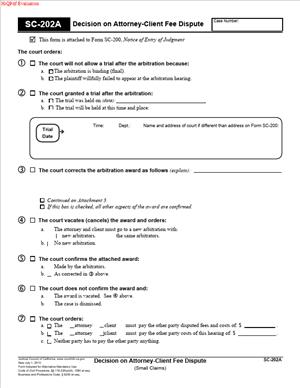
SC-202A- Decision on Attorney-Client Fee Dispute
Fill out nowJurisdiction: Country: United States | Province or State: California
The SC-202A- Decision on Attorney-Client Fee Dispute is a court-issued document that records the outcome of a disagreement over legal fees. It reflects a decision made after a fee dispute process, not a request you are making.
You usually encounter this form after a dispute between a lawyer and a client has already been reviewed. It summarizes what was decided about the amount owed, if anything, and how that decision applies to both sides.
If you are about to read or complete this form, you are likely trying to understand the result of a fee dispute. You may be checking whether the decision matches what happened at the hearing.
This document matters because it captures the official resolution of a fee disagreement. It can affect payment expectations, enforcement steps, or next procedural actions.
Understanding each section before filling it out helps you avoid confusion. It also helps you see what the form does and does not cover.
What is SC-202A- Decision on Attorney-Client Fee Dispute?
Clear definition
The SC-202A- Decision on Attorney-Client Fee Dispute is a written decision that states how a legal fee dispute was resolved. It records the determination made by a neutral decision-maker after reviewing the dispute.
The form typically includes the names of the parties, the case information, and the outcome. It may state whether fees are owed, reduced, or refunded.
This document is not a contract or a complaint. It is a record of a decision already reached in a fee dispute process.
Who typically uses this form/document?
This form is commonly used by courts or arbitration programs handling attorney-client fee disputes. It is completed after the dispute has been reviewed and decided.
Clients who challenged a legal bill may receive this form as notice of the decision. Attorneys involved in the dispute are also required to understand the outcome.
Court staff may use the form to enter the decision into the case record. Self-represented individuals often review it to understand what the decision means for them.
Why you might need this form/document
You may need this form to confirm the result of a fee dispute you participated in. It shows what was decided and how it applies to the parties involved.
The document can be important for recordkeeping. It may be used to explain why a certain amount is owed or no longer owed.
In some situations, the form helps clarify the next procedural steps. It can show whether the dispute process is complete or if further action is allowed.
Typical real-life scenarios
- A client disputes a lawyer’s invoice, claiming the charges were higher than agreed. After a fee dispute process, this form records the final decision on the amount.
- An attorney and former client disagree about unpaid fees after representation ends. The dispute is reviewed, and the outcome is written on this form.
- A self-represented client reviews the decision to understand whether a refund is required. The form explains the conclusion reached by the decision-maker.
- Court staff prepare the document to close out the fee dispute portion of a case. The completed form becomes part of the official file.
When would you use SC-202A- Decision on Attorney-Client Fee Dispute?
You encounter the SC-202A- Decision on Attorney-Client Fee Dispute after a fee dispute has already been heard or reviewed. It is not used to start the dispute process.
This document comes into play once evidence and arguments have been considered. It reflects the result rather than the discussion leading up to it.
Clients may review the form to understand how the decision affects their financial obligations. Attorneys review it to see how the decision applies to their billing.
In small claims or similar settings, this form often appears near the end of the process. It signals that the fee dispute portion has reached a conclusion.
Legal Characteristics of SC-202A- Decision on Attorney-Client Fee Dispute
The SC-202A- Decision on Attorney-Client Fee Dispute is effective when it accurately reflects the decision made in the fee dispute process. Completeness and clarity are important for it to function as an official record.
Problems can arise if names, amounts, or case numbers are incorrect. Missing information may cause confusion about what was decided.
Procedures for fee disputes can vary by jurisdiction. In California, this form aligns with small claims and attorney-client fee dispute practices.
This document does not reopen the dispute or renegotiate fees. It records the outcome and does not create new obligations beyond what was decided.
Is it legally binding?
This form generally reflects a binding decision within the fee dispute process. Its effect comes from the authority of the body that issued the decision.
Whether and how it can be enforced depends on the broader case context. The form itself records the decision rather than enforcing it.
The binding nature usually applies to the fee issue addressed. It does not resolve unrelated legal matters between the parties.
How to fill out SC-202A- Decision on Attorney-Client Fee Dispute
A practical way to review the form is to trace how the decision-maker described the scope of the dispute. Some SC-202A decisions expressly limit review to certain services, dates, or invoices. If the scope section is narrow, fees outside that description are usually not affected, even if they were discussed informally during the process.
Understanding this boundary helps set expectations. It explains why some charges may remain unchanged and clarifies what the decision does—and does not—resolve.
Step 1 – Review the title and case information
Start by confirming the title matches the SC-202A- Decision on Attorney-Client Fee Dispute. Check the case number and party names for accuracy.
Step 2 – Identify the parties
Ensure the client and attorney names are listed correctly. This helps avoid confusion about who the decision applies to.
Step 3 – Confirm the dispute description
Read the section describing the fee dispute. Make sure it aligns with the issue that was reviewed.
Step 4 – Record the decision outcome
Enter the decision exactly as it was determined. This may include amounts owed, reduced, or refunded.
Step 5 – Check dates and signatures
Verify that the decision date is correct. Confirm any required signatures or authorizations are included.
Step 6 – Final review
Read the completed form carefully. Look for errors or missing information before the document is finalized.
Legal terms you might encounter in SC-202A- Decision on Attorney-Client Fee Dispute
- Attorney-Client Fee Dispute: This is the disagreement about legal fees charged by a lawyer to a client. In this document, the dispute is summarized so that the decision clearly addresses what amounts or billing practices were challenged. You will see this phrasing tied to the scope of what was reviewed and decided.
- Arbitration: Arbitration is a process where a neutral decision-maker reviews evidence and makes a determination. On this form, arbitration explains how the fee dispute was resolved rather than through a full trial. The decision section reflects the outcome of that process.
- Award: An award is the result of the decision, including any amount owed or denied. In this document, the award states what the arbitrator decided regarding fees or refunds. It is written in clear numbers or outcomes that can be enforced.
- Respondent: The respondent is the party responding to the dispute, often the attorney. This label appears next to names and signatures, so it is clear who participated and who is bound by the decision.
- Petitioner: The petitioner is the person who requested the fee dispute review, often the client. The form uses this term to identify who initiated the process and who receives or owes money under the decision.
- Binding Decision: A binding decision means the outcome must be followed by the parties. In this document, language about binding effect signals whether the decision can be enforced or appealed. You should read this part closely to understand what happens next.
- Nonbinding Decision: A nonbinding decision means the parties may have options to reject or seek further action. If this appears on the form, it explains whether additional steps are available after the decision is issued.
- Effective Date: The effective date is when the decision becomes active. On the form, this date matters for deadlines, payments, or enforcement. It is often tied to when the decision was signed or served.
- Service: Service means delivering the decision to the parties. This document may note how and when the service occurred, which affects timelines for any next steps.
FAQs
Where do I find the case or reference number on this document?
You usually find the case or reference number near the top of the form. It often appears next to the court name or the dispute title. Make sure the number matches what appears on any earlier notices so the decision is linked to the correct record.
Who should be listed as the parties on this form?
The parties are the client and the attorney involved in the fee dispute. Check that names are spelled exactly as they appeared in earlier paperwork. Consistent naming helps avoid confusion if the decision is later enforced or reviewed.
What if the amounts listed in the decision look different from what I expected?
Look closely at the section that explains the award or denial. The decision may adjust amounts based on evidence or rules discussed during the dispute. Compare the numbers to the dispute description to see how the final outcome was calculated.
Does this document change what is publicly recorded about my case?
This document adds the decision outcome to the case record. It does not usually change earlier filings, but it becomes part of the official file. That means the result can be referenced later if enforcement or follow-up action happens.
How do I know when the decision takes effect?
Check for the effective date or signature date on the form. That date often controls when obligations start, such as payment or compliance. Write it down so you can track any deadlines tied to it.
What signatures should appear on this document?
Look for the signature of the arbitrator or authorized decision-maker. Some versions may also show acknowledgment or service information rather than party signatures. A missing required signature can delay acceptance of the decision.
Do I need to attach anything to this document before it is filed or shared?
This document usually stands on its own, but confirm whether any referenced attachments are included. If the decision mentions exhibits or schedules, make sure they are present when copies are made or shared.
How many copies should I keep once the SC-202A- Decision on Attorney-Client Fee Dispute is complete?
Keep at least one clean copy for your records and one for each party involved. Extra copies are helpful if you later need to show proof of the decision to a court clerk or another office. Store them together with earlier dispute paperwork.
Checklist: Before, During, and After SC-202A- Decision on Attorney-Client Fee Dispute
Before
- Review the full document to understand what sections are informational versus outcome-related.
- Confirm the case number matches all prior dispute documents.
- Verify the spelling of all party names.
- Locate the section that explains whether the decision is binding or nonbinding.
- Gather earlier notices or submissions for comparison.
- Note any dates that appear important, such as hearing or submission dates.
During
- Read the decision outcome line by line.
- Check the amounts awarded or denied for clarity.
- Identify the effective date and write it down.
- Confirm that the decision-maker’s name and signature are present.
- Look for any instructions about service or delivery.
- Ensure all pages are included and in order.
After
- Make copies for yourself and the other party.
- Store the original in a safe, labeled place.
- Calendar any deadlines mentioned in the decision.
- Update your personal records with the outcome.
- Watch for confirmation that the decision was accepted or served.
- Refer back to this document if questions arise about payment or compliance.
Common Mistakes to Avoid with SC-202A- Decision on Attorney-Client Fee Dispute
- Mistake: Skimming the decision, which happens because the language feels formal, leading to missed details about amounts or dates, and you should not forget to read every line.
- Mistake: Ignoring name spelling errors, which occur when you assume earlier documents control, causing confusion later, and you should not forget to check each name carefully.
- Mistake: Overlooking the effective date, which happens when you focus only on the award, leading to missed deadlines, and you should not forget to mark the date clearly.
- Mistake: Misunderstanding whether the decision is binding, which happens due to unfamiliar terms, causing incorrect next steps, and you should not forget to read the binding language.
- Mistake: Failing to keep copies, which happens when you rely on memory or digital access, causing problems if proof is needed, and you should not forget to save multiple copies.
- Mistake: Assuming no further action is required, which happens when the decision feels final, leading to inaction, and you should not forget to check for follow-up instructions.
- Mistake: Detaching referenced pages, which happens during copying, causes incomplete records, and you should not forget to keep the document intact.
- Mistake: Confusing service with filing, which happens because both involve delivery, causing missed confirmation, and you should not forget to note how the service occurred.
What to do after filling out SC-202A- Decision on Attorney-Client Fee Dispute
Once the decision is complete, your focus shifts to organization and follow-through. This document reflects an outcome, so your job is to make sure it is properly handled and easy to reference later. Clear records now save time and stress later.
Start by confirming you have the final version. Check that all pages are present, the decision is readable, and signatures are visible. If something looks off, note it immediately so you can ask about corrections if needed.
- Step 1: Make clean copies of the full document.
- Step 2: Label each copy with the case number and date.
- Step 3: Place the original in a dedicated folder with earlier dispute papers.
- Step 4: Share copies with the other party if required or expected.
- Step 5: Record the effective date on your calendar.
- Step 6: Track any amounts owed or denied in your personal records.
- Step 7: Watch for confirmation that the decision was served or accepted.
- Step 8: Update any notes or summaries you keep about the dispute outcome.
- Step 9: Refer back to the decision if questions arise about compliance.
- Step 10: Keep the document accessible in case enforcement or follow-up is needed.
Staying organized helps you stay confident. This decision may not require immediate action, but it becomes important if disagreements continue or if proof of the outcome is requested later. Treat it as a key part of your case history.
After the decision is finalized, consider how long you should retain it. Fee dispute decisions are often kept longer than routine correspondence because they can be relevant to future billing questions, audits, or professional responsibility inquiries. Storing both paper and digital copies reduces the risk of loss.
If you later change addresses or contact information, keep a note with the decision indicating how you can be reached. This can matter if follow-up notices or enforcement-related communications are sent well after the original dispute concluded.
Disclaimer: This guide is provided for informational purposes only and is not intended as legal advice. You should consult a legal professional.