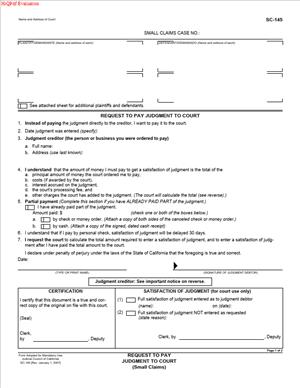
SC-145 – Request to Pay Judgment to Court
Fill out nowJurisdiction: Country: United States | Province or State: California
The SC-145 – Request to Pay Judgment to Court is a court form used after a small claims judgment has been entered. It focuses on how a judgment payment is made. Instead of paying another party directly, this document relates to paying the court.
You usually encounter this form at the end of a small claims case. A judge has already decided who owes money. The remaining issue is how that money is delivered and recorded.
This form matters because payment handling affects the court record. When money is paid through the court, the court tracks the payment and applies it to the judgment. That record can later affect enforcement, interest, and proof of satisfaction.
People filling out this form are often doing it without a lawyer. The form is designed to be practical. Each section ties directly to information already in the case file.
Using the correct document and completing it carefully helps avoid delays. It also reduces confusion about whether a judgment has been paid, partially paid, or remains unpaid.
What is SC-145 – Request to Pay Judgment to Court?
Clear definition
This document is a written request asking the court to accept payment for a small claims judgment. The payment is made to the court instead of directly to the other party.
The form creates a formal record that money is being tendered toward a judgment. It connects the payment to a specific case number and judgment amount.
The court then processes the payment and credits it toward the judgment balance. That process happens within the court’s administrative system.
Who typically uses this form/document?
This form is commonly used by the person ordered to pay money in a small claims case. That person may be called the judgment debtor.
It can also be used by someone paying on behalf of the judgment debtor. For example, a business owner may pay for a business entity involved in the case.
Court staff rely on this form to identify which case the payment belongs to. Without it, payments may be delayed or misapplied.
Why you might need this form/document
You may need this form when the court has directed that payment be made to the court. This can happen in specific procedural situations.
It can also be used when direct payment to the other party is not practical. The court acts as an intermediary for receiving and recording the money.
The form helps ensure the payment is officially recognized. That recognition can matter later if questions arise about whether payment was made.
Typical real-life scenarios
A small claims judge enters a judgment and states that payment is to be made through the court clerk. The paying party uses this form to submit the money.
A judgment debtor wants a clear court record showing payment was made on a certain date. Paying through the court creates that record.
The winning party has moved or is difficult to contact. The court is used as the payment channel to avoid uncertainty.
A partial payment is being made while other issues are pending. The form allows the court to credit the payment without closing the judgment.
When would you use SC-145 – Request to Pay Judgment to Court?
- This form is used after a judgment exists. It is not part of starting a case or responding to a claim.
- You use it when payment is being routed through the court system. That timing often follows a hearing or a written judgment.
- In many situations, the person who owes money completes the form. The court then matches the payment to the case.
- Sometimes the form is used when there is disagreement or uncertainty about payment logistics. The court’s involvement provides structure and documentation.
Legal characteristics of SC-145 – Request to Pay Judgment to Court
This form is procedural rather than argumentative. It does not ask the court to change the judgment.
Its effectiveness depends on accurate case information and correct payment details. Errors can delay processing or result in the payment being returned.
Common problems include incorrect case numbers, mismatched party names, or payment amounts that do not match the judgment balance.
Practices can vary slightly by court location. Filing methods and payment handling may differ, even within the same state.
This document does not resolve disputes about the judgment. It does not cancel the judgment or stop enforcement by itself.
Is it legally binding?
The form itself is not a contract between the parties. It is a request and instruction to the court.
Once accepted, the payment processed through the court has legal effect. It is credited toward the judgment as part of the official record.
The binding effect comes from the judgment and the court’s authority. The form functions as a mechanism to carry out that authority.
How to fill out SC-145 – Request to Pay Judgment to Court
Step 1 – Case identification
This section asks for the case name and case number. The information must match the court’s records exactly.
The case name usually includes the names of both parties as they appear on the judgment. Even small differences can cause confusion.
The case number links the payment to the correct file. Court staff rely on this number when processing the submission.
Step 2 – Party information
Here you identify the person or entity making the payment. This may be the judgment debtor or someone acting on their behalf.
Names are typically entered as they appear in the case. Consistency helps the court confirm the connection.
Contact information may be requested so the court can address questions or issues with the payment.
Step 3 – Judgment details
This part references the judgment being paid. It may include the judgment date and total amount.
Providing clear judgment details helps the court determine how the payment applies. This is especially important when there are multiple judgments.
If interest or additional amounts exist, the form creates space to reflect that context.
Step 4 – Payment amount
This section states how much money is being submitted with the form. The amount may be the full balance or a partial payment.
The court uses this figure to update the judgment ledger. Accuracy prevents mismatches and processing delays.
The payment amount should correspond to the actual funds being delivered with the form.
Step 5 – Method of payment
This step identifies how the payment is being made. Courts typically accept specific payment types.
The form allows court staff to confirm that the payment method aligns with court procedures.
Clear identification of the payment method helps avoid rejection at the clerk’s counter.
Step 6 – Acknowledgments and statements
This section includes statements about the purpose of the payment. It clarifies that the funds are intended for the judgment.
By completing this part, the person submitting the form confirms the connection between the payment and the case.
The language is standardized to support consistent processing by the court.
Step 7 – Signature and date
The form is signed by the person submitting it. The signature confirms the accuracy of the information provided.
Dating the form establishes when the request was made. That timing can matter for recordkeeping.
Unsigned forms are often returned without processing, which delays crediting the payment.
Step 8 – Submission to the court
After completion, the form is delivered to the appropriate court location along with the payment.
Submission methods can include in-person delivery or other court-accepted channels.
Once received, court staff review the form and apply the payment according to the case record.
Legal terms you might encounter in SC-145 – Request to Pay Judgment to Court
- Judgment: This is the court’s final decision about who owes money and how much. On this form, the judgment information ties your payment to a specific case and amount. The court uses it to make sure the money is credited correctly.
- Judgment debtor: This is the person or business that owes the money under the judgment. If you are filing this form, you are usually the judgment debtor asking the court to accept payment. The name must match the judgment exactly.
- Judgment creditor: This is the person or business that is owed the money. The court uses this name to determine who ultimately receives the funds after processing. Any mismatch can delay the release of payment.
- Accrued interest: This is interest that has built up on the judgment amount since the judgment date. Some judgments grow over time. This form may require you to calculate or confirm the total, including interest, as of the payment date.
- Court registry: This is the court’s internal system for holding money. When you ask to pay the court instead of the other party, the funds are deposited here. The court then records the payment and applies it to the case.
- Case number: This is the unique identifier assigned by the court. It connects your payment to the correct file. Even a small error can send your payment to the wrong account.
- Partial payment: This means you are paying less than the full amount owed. The form allows this in some situations, but the balance remains until fully paid. The court record will reflect that the judgment is not yet satisfied.
- Satisfaction of judgment: This is the official record that a judgment has been fully paid. Filing this form does not automatically mean the judgment is satisfied. It only records that payment was made to the court.
- Declaration: This is a written statement you sign under penalty of perjury. On this form, it confirms that the information you provided is true and complete. The court relies on this when accepting your request.
FAQs
When should I use SC-145 – Request to Pay Judgment to Court?
You use this document when you want the court to accept your payment instead of paying the other party directly. This often happens when there is a dispute about payment, trouble locating the creditor, or a need for a clear court record. The timing matters because interest may continue to accrue until payment is accepted.
Do I have to pay the full amount listed in the judgment?
Not always. This form can be used for full or partial payment. You must clearly state the amount you are paying and understand that any unpaid balance remains due and may continue to accrue interest.
How do I calculate the correct payment amount?
You start with the judgment amount and then check whether interest has accrued since the judgment date. You enter the total you are paying as of the date you submit this document. If the amount is off, the court may reject or question the payment.
What names should I use on this form?
Use the exact legal names as they appear on the judgment. This applies to both you and the other party. Even small differences, like missing initials or business suffixes, can cause processing delays.
What happens after the court accepts my payment?
Once accepted, the payment is recorded in the case file. The court holds the money and updates the public record to show that payment was made. This does not automatically close the case or mark the judgment as fully paid.
Will this stop enforcement actions right away?
Filing this form does not instantly stop all enforcement. It creates a record that a payment was requested and made to the court. You should confirm when the payment is officially accepted and credited.
Can someone else sign and submit this document for me?
Yes, if that person has the authority to act for you, such as an authorized representative. The signer’s role must be clear, and the signature confirms responsibility for the accuracy of the information. Missing or unclear authority can cause rejection.
Will this change what shows up on my court record?
Yes. Once processed, the docket will show that a payment was made to the court. Until the full amount is paid and a satisfaction is filed, the judgment will still appear as unpaid or partially unpaid.
Checklist: Before, During, and After SC-145 – Request to Pay Judgment to Court
Before
- Confirm the exact case number from the court papers.
- Review the judgment to verify the original amount and date.
- Check whether interest has accrued since the judgment.
- Gather accurate legal names for all parties.
- Decide whether you are making a full or partial payment.
- Confirm the acceptable payment methods with the court.
- Prepare copies for your personal records.
During
- Write the case number exactly as it appears on court documents.
- Enter names without abbreviations or spelling changes.
- Clearly state the payment amount you are submitting.
- Select or note the payment method accurately.
- Read the declaration carefully before signing.
- Sign and date the form using the correct name.
- Attach any required payment or supporting documents.
After
- Submit the form and payment using the approved method.
- Ask how you will know the court accepted the payment.
- Keep stamped or confirmed copies in a safe place.
- Monitor the case record for payment entry.
- Track any remaining balance if the payment was partial.
- Follow up if the record does not update within the expected time.
- Keep proof of payment for future reference.
Common mistakes to avoid with SC-145 – Request to Pay Judgment to Court
- Mistake: Using the wrong case number because you relied on memory, which can misapply your payment and delay credit, so do not forget to double-check it against the judgment.
- Mistake: Misspelling a party’s name due to copying from informal notes, which can cause rejection or confusion, so do not forget to match the judgment exactly.
- Mistake: Paying the judgment amount without adding accrued interest, which can leave a balance owed, so do not forget to calculate the total as of the payment date.
- Mistake: Assuming payment equals satisfaction, which can leave the judgment appearing unpaid, so do not forget that a separate satisfaction may be required later.
- Mistake: Submitting a partial payment without noting it clearly, which can distort the court record, so do not forget to state the amount and intent.
- Mistake: Forgetting to sign the declaration because you focused on the payment, which makes the form invalid, so do not forget to review the signature section.
- Mistake: Using an unapproved payment method out of convenience, which can lead to rejection, so do not forget to confirm accepted methods.
- Mistake: Failing to keep copies because you expect the court to track everything, which leaves you without proof, so do not forget your own records.
What to do after filling out SC-145 – Request to Pay Judgment to Court
After you complete the form, slow down and review every field one more time. Accuracy matters more than speed. The court uses what you wrote to decide how to process the money and update the case record.
Make copies of the completed form before you submit it. Keep one copy for yourself and, if possible, an extra backup. These copies are your proof of what you asked the court to do and when.
Submit the form and payment using the method accepted by the court handling your case. This might be in person, by mail, or another approved process. Make sure the payment is properly labeled or attached so it stays with the form.
Ask how you will know the submission was accepted. Some courts provide a stamped copy, receipt, or electronic confirmation. This confirmation is important if questions come up later.
Check the case record after a reasonable period. Look for an entry showing that payment was received by the court. This tells you the request was processed, not just submitted.
If you made a partial payment, update your own records to reflect the remaining balance. Track interest if it continues to accrue. This helps you avoid surprises later.
If the judgment is eventually paid in full, watch for the next step that clears the judgment from the record. Paying the court is one part of the process, not always the last one.
Store all paperwork together. Keep the judgment, this form, proof of payment, and any court confirmations in one place. These documents may be needed if there is a dispute or credit reporting issue.
- Step 1: Review the completed form for accuracy and completeness.
- Step 2: Make at least two copies for your records.
- Step 3: Submit the form and payment using the court’s accepted method.
- Step 4: Obtain proof of submission or payment receipt.
- Step 5: Calendar a date to check the case record.
- Step 6: Confirm the payment appears in the court file.
- Step 7: Track any remaining balance if not fully paid.
- Step 8: Keep all documents together for long-term records.
Disclaimer: This guide is provided for informational purposes only and is not intended as legal advice. You should consult a legal professional.