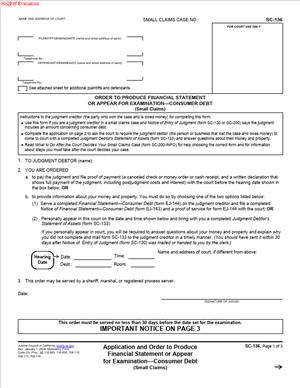
SC-136 – Application and Order to Produce Financial Statement or Appear for Examination—Consumer Debt (Small Claims)
Fill out nowJurisdiction: Country: United States | Province or State: California
The SC-136 – Application and Order to Produce Financial Statement or Appear for Examination—Consumer Debt (Small Claims) is a court form used after a small claims judgment. It comes into play when a money judgment exists, but payment has not been made.
This document is about information. It gives one party a formal way to request financial details from the other party, or to require them to appear in court to answer questions about assets, income, and debts.
People often encounter this form at a frustrating stage. The case is over, the judgment is entered, but the money has not been collected. This filing addresses that gap.
The form matters because it connects a judgment to real-world financial facts. Without accurate financial information, it can be difficult to understand what payment options exist.
If you are preparing to complete this form, you are likely asking practical questions. What does the court want? What information is being requested? What happens after it is filed? This guide walks through those questions step by step.
What is SC-136 – Application and Order to Produce Financial Statement or Appear for Examination—Consumer Debt (Small Claims)?
Clear definition
SC-136 – Application and Order to Produce Financial Statement or Appear for Examination—Consumer Debt (Small Claims) is a California small claims court document used to request financial disclosure or a court appearance from a judgment debtor. A judgment debtor is the person or business that owes money under a small claims judgment.
The form combines two related actions. One part is an application asking the court to issue an order. The other part is the court’s order itself, once signed.
The order can require the debtor to complete a financial statement, to appear in court for an examination, or both. The purpose is to gather accurate information about finances.
This form does not decide who wins the case. That decision already happened. It focuses only on post-judgment financial disclosure.
Who typically uses this form/document?
This form is commonly used by a judgment creditor. That is the party that won money in a small claims case.
Individuals use it often in consumer debt cases. These may involve unpaid loans, credit accounts, or personal obligations that were reduced to judgment.
Small businesses also use the document. When a business wins a small claims case and does not receive payment, this form may be part of the next step.
On the other side, judgment debtors are involved because they receive the order. They are required to respond according to what the court orders on the form.
Why you might need this form/document
You might need this form when a judgment exists, and payment has not been made. The court has already said money is owed, but the situation has stalled.
Without financial information, it can be unclear whether the debtor has income or assets. This form creates a structured way to obtain that information.
The document may also be used when earlier informal requests for payment did not work. It brings the issue back into the court process.
In some cases, the form helps clarify misunderstandings. A debtor may not have the ability to pay right away, and the financial statement explains why.
Typical real-life scenarios
- A person wins a small claims case over an unpaid personal loan. Months pass with no payment or communication. The person turns to this form to learn whether the debtor has income or assets.
- A small business obtains a judgment for unpaid services. The customer does not respond to invoices or messages after the court date. The business files this document to request a financial examination.
- A judgment debtor claims they cannot pay anything. The creditor uses the form to request a sworn financial statement to understand the debtor’s situation.
- A consumer debt judgment involves multiple attempts to collect voluntarily. When those attempts fail, this filing is used to bring the matter back before a judge for disclosure.
When would you use SC-136 – Application and Order to Produce Financial Statement or Appear for Examination—Consumer Debt (Small Claims)?
This form is typically used after a small claims judgment has been entered. It is not part of starting a case or proving a claim.
Timing often matters. The judgment must already exist, and the debtor must not have fully paid it.
The document is commonly used when communication has broken down. Calls, messages, or letters may have gone unanswered.
It may also be used when partial payments have stopped. A creditor might want updated financial information to understand what changed.
In many situations, the form is used by individuals rather than attorneys, since small claims court is designed for self-represented parties.
Legal characteristics of SC-136 – Application and Order to Produce Financial Statement or Appear for Examination—Consumer Debt (Small Claims)
This form becomes effective when the court reviews it and issues an order. The judge’s signature is what gives the document authority.
Accuracy is critical. Incomplete names, incorrect case numbers, or missing judgment details commonly cause delays or rejection.
The form usually requires proper service on the judgment debtor. If service rules are not followed, the order may not be enforceable.
Practices can vary by court location. Scheduling, appearance requirements, and formatting expectations may differ slightly within California.
This document does not create a new judgment. It does not increase the amount owed. It is limited to financial disclosure and examination.
Is it legally binding?
Once the court signs and issues the order portion of the form, it carries legal effect. The debtor is required to comply with what the order states.
The binding nature comes from the court’s authority, not from the application alone. Filing the request does not impose duties until the order is issued.
The obligations depend on the specific terms. The order may require appearing at a certain time, producing documents, or completing a financial statement.
Failure to comply can have consequences set by the court process. The form itself does not list penalties; those arise from court enforcement mechanisms.
How to fill out SC-136 – Application and Order to Produce Financial Statement or Appear for Examination—Consumer Debt (Small Claims)
Step 1 – Review the case information at the top
Start by locating the case name and case number. This information must match the original small claims judgment exactly.
Check spelling of all party names. Even small differences can cause confusion or processing issues.
Confirm the court location listed on the form. It should be the same court that entered the judgment.
This section ties the document to a specific case. Accuracy here anchors everything that follows.
Step 2 – Identify the judgment creditor
The form asks for the name of the judgment creditor. This is the party who is owed money under the judgment.
Use the same name format that appears on the judgment. Consistency matters for court records.
If the creditor is a business, include the full business name as used in the case.
This section establishes who is requesting the order and who will receive the financial information.
Step 3 – Identify the judgment debtor
Next, enter the name of the judgment debtor. This is the person or entity ordered to provide financial information or appear.
Again, match the judgment exactly. Nicknames or shortened names can create service problems.
If there is more than one debtor, pay close attention to how the form handles multiple names.
The court relies on this section to determine who must comply with the order.
Step 4 – Reference the existing judgment
The form asks for details about the judgment, including the date it was entered and the amount owed.
This information shows that the request is post-judgment, not part of the original case.
Enter the figures carefully. Transposed numbers or incorrect dates are common errors.
The judgment details connect the financial examination to a specific obligation.
Step 5 – Specify the type of order requested
This section addresses whether the request is for a financial statement, an appearance for examination, or both.
Read the options carefully. Each choice leads to different requirements for the debtor.
The selection guides the court in drafting the order portion of the document.
This is a key section because it defines what information or action is being requested.
Step 6 – Complete the application portion
The application portion is where the request is formally made to the court.
It typically includes a declaration that the judgment remains unpaid.
By completing this section, the filer is asking the judge to issue the order described.
Clarity and completeness here help the court process the request without delay.
Step 7 – Leave the order section for the court
Part of the form is reserved for the judge’s order. This area is not completed by the requesting party.
Do not write in sections labeled for court use or judicial signature.
The judge will fill in dates, times, and specific instructions if the order is granted.
Understanding which sections to leave blank helps avoid rejection or confusion.
Step 8 – Review service and notice details
The form includes information about how the order must be delivered to the judgment debtor.
This section often references service requirements without detailing every step.
Accurate addresses and contact details support proper delivery of the order.
Service connects the court’s order to the person required to respond.
Step 9 – Sign and date where indicated
The application portion usually requires a signature and date from the person requesting the order.
Signing confirms that the information provided is complete and accurate to the best of the signer’s knowledge.
Use the same name format as listed earlier on the form.
The signature finalizes the request before submission to the court.
Step 10 – Prepare the form for submission
Before submission, review the entire document from top to bottom.
Look for blank fields that should be completed and fields that should remain empty.
Check that all names, numbers, and dates are consistent throughout the form.
A careful review at this stage can prevent processing delays.
Legal terms you might encounter in SC-136 – Application and Order to Produce Financial Statement or Appear for Examination—Consumer Debt (Small Claims)
- Judgment: A judgment is the court’s final decision stating that money is owed. In this document, you reference an existing judgment so the court knows there is already a debt established. You must match the judgment details exactly as they appear in the case record.
- Judgment Creditor: This is the person or entity that won the judgment and is owed money. On this form, the judgment creditor is the one asking the court to require financial disclosure or an examination. Your name must appear exactly as it does on the judgment.
- Judgment Debtor: This is the person or entity that owes the money under the judgment. The order portion of the form is directed to the judgment debtor. Accurate identification matters because the court order must be enforceable against the right person.
- Order for Examination: This is a court order requiring the judgment debtor to appear and answer questions under oath about income, assets, and debts. In this document, you request that the court issue this order. The order helps you learn whether the debtor has the ability to pay.
- Financial Statement: A financial statement is a written disclosure of income, expenses, assets, and liabilities. This form can require the judgment debtor to complete and bring this statement. The information supports collection efforts after judgment.
- Service of Process: Service means officially delivering court papers to the other party. This document cannot take effect unless it is properly served. The court relies on proof of service to show the debtor had notice.
- Hearing Date: The hearing date is when the judgment debtor must appear in court, if an examination is ordered. The judge sets this date in the order section. You should not fill in the date unless the form specifically allows it.
- Declaration: A declaration is a written statement made under penalty of perjury. When you sign the application portion, you are declaring that the information you provided is true. This gives the court confidence to issue the order.
- Enforcement of Judgment: Enforcement refers to the legal steps taken to collect money after a judgment is entered. This document is one enforcement tool. It does not collect money by itself but can lead to collection actions.
FAQs
What is SC-136 – Application and Order to Produce Financial Statement or Appear for Examination—Consumer Debt (Small Claims) used for?
This form asks the court to order a judgment debtor to either provide financial information, appear in court, or both. You use it after a money judgment already exists and has not been paid. The goal is to learn about income and assets so you can decide what collection steps make sense.
Do I need a new case number to use this document?
No. You use the same case number as the original small claims case. The form ties directly to that judgment, so the case number must match exactly.
What information must match the judgment exactly?
The names of the parties, the case number, and the judgment amount must all match the court’s records. If you shorten a name, leave out a middle initial, or use a nickname, the court may reject the application. Always copy from the judgment paperwork.
Who fills out the order section of this form?
You complete the application portion only. The judge or court staff completes the order section. Leave any area marked “Order” or “For Court Use Only” blank.
Can I ask for both a financial statement and an in-court examination?
Yes, if the form gives you that option. Check the boxes carefully to show what you are requesting. The judge decides whether to grant one or both requests.
What happens if the judgment debtor ignores the order?
If the court issues the order and it is properly served, the debtor is legally required to comply. Failure to appear or provide the information can lead to additional court consequences. Those consequences are separate from the original judgment amount.
Do I need to attach any documents to this form?
Usually you do not attach evidence, but you should confirm whether a copy of the judgment is required. Keep a copy of the judgment handy because you must accurately reference it. Do not attach documents unless the form or clerk instructions say to do so.
Does filing this document change the public record?
It adds a new filing to the existing case. It does not change the judgment itself. The court record will show that you requested an examination or financial statement order.
Checklist: Before, During, and After SC-136 – Application and Order to Produce Financial Statement or Appear for Examination—Consumer Debt (Small Claims)
Before
- Confirm there is a final judgment and it remains unpaid
- Locate the exact case number and judgment date
- Verify the full legal names used in the judgment
- Decide whether you are requesting a financial statement, an appearance, or both
- Review the form to see which sections are for you versus the court
- Plan how the papers will be served if the order is issued
- Make extra copies for your records
During
- Write neatly or type to avoid reading errors
- Enter the case number exactly as shown on the judgment
- Identify yourself correctly as the judgment creditor
- Identify the other party correctly as the judgment debtor
- Check the correct boxes for the order you are requesting
- Leave the order section blank for the judge
- Sign and date only where indicated
After
- Make copies of the completed application
- Submit the form to the correct court clerk
- Ask how you will receive notice of the judge’s decision
- Review the signed order carefully once issued
- Arrange proper service of the order on the debtor
- Track deadlines for appearance or document production
- Keep proof of service with your case records
Common mistakes to avoid with SC-136 – Application and Order to Produce Financial Statement or Appear for Examination—Consumer Debt (Small Claims)
- Mistake: Using a nickname or shortened business name because it seems easier, which happens when copying from memory, leads to service problems and delays, and you should not forget to copy names exactly from the judgment.
- Mistake: Filling in the judge’s order section because it looks incomplete, which happens when the form is unfamiliar, can cause rejection by the clerk, and you should not forget to leave court-only sections blank.
- Mistake: Requesting this order before a judgment exists because you want information quickly, which results in denial, and you should not forget this form is only for post-judgment use.
- Mistake: Forgetting to sign and date the application due to focusing on the debtor’s information, which makes the form invalid, and you should not forget your declaration is required.
- Mistake: Writing the wrong case number because multiple cases are open, which causes misfiling, and you should not forget to double-check against the judgment.
- Mistake: Assuming the court will serve the debtor automatically, which happens due to confusion about service, leads to unenforceable orders, and you should not forget to confirm service responsibilities.
- Mistake: Asking for relief not listed on the form because you want broader authority, which the court cannot grant here, and you should not forget to stay within the form’s options.
- Mistake: Not keeping copies after filing because you trust the court file, which creates problems later, and you should not forget to keep a complete set for yourself.
What to do after filling out SC-136 – Application and Order to Produce Financial Statement or Appear for Examination—Consumer Debt (Small Claims)
Once you complete the application, your focus shifts to filing, follow-up, and enforcement. This document starts a process, not an immediate result. Staying organized will save you time later.
- Step 1: Make at least two copies of the completed application, keeping the original for filing.
- Step 2: File the original with the same small claims court that issued the judgment, using the accepted filing method.
- Step 3: Ask the clerk how you will be notified if the judge signs the order.
- Step 4: Calendar a reminder to check the case status if you do not receive notice promptly.
- Step 5: Review the signed order carefully once it is issued to confirm dates, requirements, and the debtor’s name.
- Step 6: Arrange for proper service of the signed order on the judgment debtor as required.
- Step 7: Obtain and keep proof of service showing when and how the debtor was served.
- Step 8: Prepare questions or review the financial statement form in advance of any scheduled examination.
- Step 9: Attend the examination hearing on time and bring your copies and notes.
- Step 10: Update your collection records based on the information obtained.
- Step 11: Decide on next enforcement steps based on what you learned.
- Step 12: Store all paperwork together so you can reference it easily later.
Disclaimer: This guide is provided for informational purposes only and is not intended as legal advice. You should consult a legal professional.