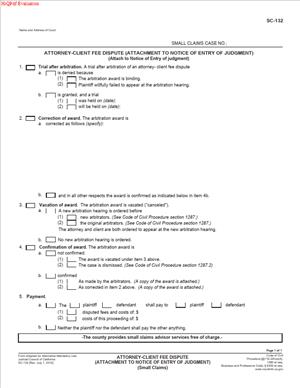
SC-132 – Attorney-Client Fee Dispute (Attachment to Notice of Entry of Judgment)
Fill out nowJurisdiction: Country: United States | Province or State: California
SC-132 – Attorney-Client Fee Dispute (Attachment to Notice of Entry of Judgment) is a court form used in a very specific moment. It appears after a decision has already been made in a fee dispute between a lawyer and a client. This document attaches to the court’s notice that judgment has been entered.
If you are holding this form, you are not starting a dispute. You are dealing with the paperwork that records how a fee dispute was resolved. The form helps document what the judgment means for attorney fees and related obligations.
People often encounter this form unexpectedly. It may arrive by mail from the court or be handed to you after a hearing. Understanding what it is helps you avoid confusion about whether more action is required.
This form matters because it becomes part of the official court record. It can affect how the judgment is interpreted, enforced, or referenced later. Reading it carefully helps you understand what the court decided and how it applies to the attorney-client relationship involved.
SC-132 – Attorney-Client Fee Dispute (Attachment to Notice of Entry of Judgment) is not a general-purpose small claims form. It serves a narrow role tied to attorney-client fee arbitration or dispute resolution within the small claims system.
What is SC-132 – Attorney-Client Fee Dispute (Attachment to Notice of Entry of Judgment)?
Clear definition
SC-132 – Attorney-Client Fee Dispute (Attachment to Notice of Entry of Judgment) is an attachment that accompanies a court’s notice that judgment has been entered in an attorney-client fee dispute. It records details specific to the fee dispute and clarifies how the judgment applies to attorney fees.
The document does not announce the judgment on its own. Instead, it supplements the main notice of entry of judgment by adding information unique to attorney-client fee matters.
It is part of the case file. Once completed and issued, it becomes an official reflection of the court’s decision as it relates to fees.
Who typically uses this form/document?
This form is commonly used by courts in small claims matters involving attorney-client fee disputes. It may be prepared or completed as part of the court’s judgment process.
Attorneys and former clients involved in a fee dispute are the parties most directly affected. Both sides may receive a copy as part of the judgment paperwork.
Self-represented clients often encounter this form when they have challenged legal fees and the court has reached a decision. Lawyers may see it when a fee dispute case concludes.
Why you might need this form/document
You may need this document to understand how much was awarded or denied in a fee dispute. It provides context that may not appear in a standard judgment notice.
The form can help clarify whether fees were approved, reduced, or rejected. It may also reflect specific findings related to the attorney-client relationship.
Having this attachment can be important if questions arise later about what the judgment covered. It helps show how the court addressed the fee dispute itself.
Typical real-life scenarios
- A former client disputes a lawyer’s bill in small claims court, arguing the charges were excessive. After the hearing, the court enters judgment and includes this attachment to reflect how the fee issue was resolved.
- An attorney sues a client for unpaid fees in small claims. The court decides that only part of the amount is owed. SC-132 accompanies the notice of judgment to document the outcome tied to attorney fees.
- A client files a claim seeking a refund of fees already paid. The court issues a judgment awarding a partial refund. This form appears as an attachment explaining the fee-related decision.
- Both parties agree to submit a fee dispute for resolution, and the court formalizes the result. The notice of entry of judgment includes this attachment to clearly record the decision on fees.
When would you use SC-132 – Attorney-Client Fee Dispute (Attachment to Notice of Entry of Judgment)?
This form is used after a court has made a decision in an attorney-client fee dispute. It is not used at the beginning of a case or to request a hearing.
You encounter it when judgment has already been entered and the court is notifying the parties of that fact. The timing is tied to the conclusion of the dispute, not the filing of claims.
Typically, the court includes this attachment when the dispute specifically concerns legal fees between a lawyer and a client. It helps distinguish these cases from other small claims judgments.
Both plaintiffs and defendants in a fee dispute may receive this form. It serves as a shared record of how the court resolved the issue.
Legal characteristics of SC-132 – Attorney-Client Fee Dispute (Attachment to Notice of Entry of Judgment)
This document is effective as part of the judgment record when it is properly completed and issued by the court. Its validity depends on its connection to an actual judgment in a fee dispute case.
Problems can arise if the attachment is missing, incomplete, or mismatched with the main notice of entry of judgment. Confusion may occur if parties rely on it without reviewing the full judgment.
While this form is used in California small claims matters, procedures and terminology can vary in other jurisdictions. The structure and effect described here are tied to California practice.
SC-132 does not reopen the dispute or change the judgment. It does not function as a request, appeal, or enforcement tool. Its role is descriptive and record-focused.
Is it legally binding?
The form itself does not create a new obligation. Its binding effect comes from the judgment it attaches to.
Once judgment is entered, the decisions reflected in the attachment are part of the court’s ruling. In that sense, the information recorded carries legal weight as part of the judgment record.
If the underlying judgment is enforceable, the fee-related details documented here are treated as part of that enforceable decision. The attachment does not stand alone without the judgment.
How to fill out SC-132 – Attorney-Client Fee Dispute (Attachment to Notice of Entry of Judgment)
Step 1 – Case and court information
This section identifies the court, case number, and parties. Review it to confirm it matches the fee dispute case. Accuracy here ensures the attachment is clearly linked to the correct judgment.
Step 2 – Identification of the attorney-client fee dispute
This part specifies that the judgment involves an attorney-client fee dispute. It distinguishes the case from other types of small claims matters and frames the context for the information that follows.
Step 3 – Summary of the fee dispute outcome
Here, the form reflects how the court resolved the fee issue. This may include whether fees were awarded, denied, or adjusted. Read this section carefully to understand what the judgment says about the fees.
Step 4 – Relationship to the notice of entry of judgment
This step ties the attachment directly to the notice of entry of judgment. It shows that the information provided is meant to be read together with the main judgment notice, not separately.
Legal terms you might encounter in SC-132 – Attorney-Client Fee Dispute (Attachment to Notice of Entry of Judgment)
- Notice of Entry of Judgment: This is the court’s formal notice that a judgment has been entered in the case. This document attaches to that notice to clarify that the judgment involves an attorney-client fee dispute. You will see this term where the form connects itself to the main judgment notice.
- Attorney-Client Fee Dispute: This refers to a disagreement between a lawyer and a client about fees charged or owed. In this document, the phrase identifies the type of dispute resolved by the judgment. It signals that the case outcome relates specifically to legal fees, not other claims.
- Judgment: A judgment is the court’s final decision in the case. This form does not create the judgment; it records information about it. You use it to reflect how the fee dispute was resolved once the judgment is entered.
- Prevailing Party: The prevailing party is the person or entity that the court decided in favor of. This term may appear in relation to who won the fee dispute. It matters because it can affect payment obligations and recordkeeping.
- Court Clerk: The court clerk processes filings and enters judgments into the court record. This document is handled by the clerk as an attachment to the notice. Understanding the clerk’s role helps you know where the form goes and who records it.
- Case Number: The case number uniquely identifies your small claims case. You must match this number exactly to the notice of entry of judgment. Any mismatch can cause confusion or rejection in the court record.
- Parties: Parties are the people or entities involved in the case, typically the attorney and the client. Their names must match the judgment and notice exactly. This document repeats those names to tie everything together.
- Entry Date: The entry date is the date the judgment is officially entered by the court. This date controls timelines and records. This document, it confirms when the judgment became part of the official record.
- Attachment: An attachment is an additional page that supplements a main court form. This document functions as an attachment rather than a standalone filing. It provides extra detail without changing the underlying judgment.
FAQs
Do I file SC-132 – Attorney-Client Fee Dispute (Attachment to Notice of Entry of Judgment) by itself?
No. This form is designed to be attached to the notice of entry of judgment. You complete it to accompany that notice so the court record clearly reflects the type of dispute resolved.
Who fills out this document, the attorney or the client?
Either side may prepare it, depending on who is responsible for submitting the notice of entry of judgment. What matters is that the information matches the judgment exactly. You should confirm who is handling filing before completing it.
Where do I find the information I need to complete this form?
You pull almost all details from the judgment and the notice of entry of judgment. That includes the case number, party names, and the date the judgment was entered. This document does not introduce new facts.
Does this form change the outcome of the case?
No. This document records what the court already decided. It does not add, subtract, or modify any part of the judgment.
What happens if the names on this form do not match the judgment?
The court record may become unclear or inconsistent. This can cause delays or require corrections. Always check spelling, punctuation, and order of names against the judgment.
Is there a deadline to submit this attachment?
The timing follows the filing of the notice of entry of judgment. This document should be submitted at the same time as that notice. Delays can affect how quickly the judgment is properly recorded.
Do I need to sign this form?
Signature requirements depend on how the notice of entry of judgment is submitted. Often, the person submitting the notice completes and attaches this document without a separate signature. Check the notice you are attaching it to.
Will this form become part of the public court record?
Yes. Once filed, this document becomes part of the case file. It reflects that the judgment involved an attorney-client fee dispute and can be viewed as part of the court record.
Checklist: Before, During, and After SC-132 – Attorney-Client Fee Dispute (Attachment to Notice of Entry of Judgment)
Before
- Confirm the judgment has already been entered by the court.
- Obtain a copy of the notice of entry of judgment.
- Verify the case number from the court paperwork.
- Check the exact spelling of all party names.
- Identify the judgment entry date.
- Decide who will submit the notice and attachment.
- Review the form to understand where each detail goes.
During
- Enter the case number exactly as shown on the judgment.
- List the parties in the same order as the case caption.
- Clearly identify the matter as an attorney-client fee dispute.
- Attach the form to the notice of entry of judgment.
- Double-check dates for accuracy.
- Review for missing fields before submission.
- Keep formatting clean and readable.
After
- Make copies for your personal records.
- Confirm the court accepted the filing.
- Note the filing date for your timeline.
- Store the filed copy with the judgment paperwork.
- Update any internal records referencing the dispute.
- Monitor for any notice from the court requesting corrections.
- Use the filed copy when referencing the judgment later.
Common mistakes to avoid with SC-132 – Attorney-Client Fee Dispute (Attachment to Notice of Entry of Judgment)
- Mistake: Filing the form alone because it seems complete, which happens when people overlook its attachment purpose, leading to rejection or misfiling, so do not forget to submit it with the notice of entry of judgment.
- Mistake: Using a different case number from another document, often caused by juggling multiple cases, which can mislink the record, so do not forget to verify the number against the judgment.
- Mistake: Misspelling a party’s name due to copying from memory, which creates inconsistencies in the court file, so do not forget to copy names exactly as shown.
- Mistake: Listing the wrong judgment date because the hearing date is mistaken for the entry date, which can confuse timelines, so do not forget to confirm the official entry date.
- Mistake: Assuming the form changes the judgment, which happens when its role is misunderstood, leading to incorrect expectations, so do not forget it is only a record attachment.
- Mistake: Forgetting to keep a copy after filing, which occurs when people rely on the court file alone, making future reference harder, so do not forget to retain your own copy.
- Mistake: Submitting incomplete fields due to rushing, which can delay processing, so do not forget to review every section before filing.
- Mistake: Attaching the form to the wrong case paperwork, which happens when documents look similar, causing filing errors, so do not forget to match it to the correct notice.
What to do after filling out SC-132 – Attorney-Client Fee Dispute (Attachment to Notice of Entry of Judgment)
Once you complete the form, focus on proper submission and recordkeeping. This document works only when it is correctly attached and accepted by the court. Treat it as part of the judgment record, not as a standalone piece of paperwork.
- Step 1: Make at least two copies of the completed form, one for your records and one to attach to the notice.
- Step 2: Attach the form to the notice of entry of judgment in the correct order.
- Step 3: Submit the combined paperwork using the same method as the notice, such as in person or by mail.
- Step 4: Ask the clerk or check your receipt to confirm the filing was accepted.
- Step 5: Note the filing date on your personal case timeline.
- Step 6: Store the filed copy with your judgment and related case documents.
- Step 7: Update any notes or summaries you keep about the dispute outcome.
- Step 8: Watch for any follow-up notices from the court requesting clarification.
- Step 9: Use the filed attachment when explaining or documenting the judgment later.
- Step 10: Keep all paperwork together in case questions arise in the future.
Disclaimer: This guide is provided for informational purposes only and is not intended as legal advice. You should consult a legal professional.