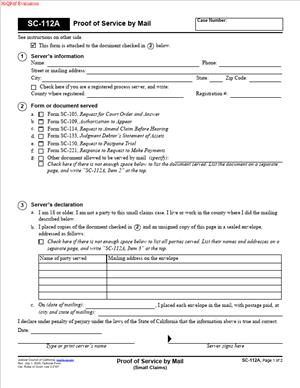
SC-112A – Proof of Service by Mail (Small Claims)
Fill out nowJurisdiction: Country: United States | Province or State: California
SC-112A – Proof of Service by Mail is a court form used to show that certain legal papers were mailed to another party. It documents when and how the mailing happened. Courts rely on this record to confirm that notice was given.
You usually encounter SC-112A – Proof of Service by Mail right before or right after you file papers in a small claims case. It is not the document you are serving. It is the document that proves service occurred.
This form matters because courts generally do not act unless they know the other side was notified. Filing paperwork alone is often not enough. The proof of service connects your filing to proper notice.
For self-represented people, this form can feel technical. Each line has a purpose. Understanding what the court expects helps avoid delays or rejected filings.
This document belongs to the California Small Claims Court process. It is commonly used alongside claims, motions, or other filings that require notice by mail.
What is SC-112A – Proof of Service by Mail?
Clear definition
SC-112A – Proof of Service by Mail is a written declaration that states specific legal documents were mailed to a person or business. It records who mailed them, who received them, what was mailed, and when the mailing occurred.
The form is completed and signed by the person who did the mailing. That person is usually not one of the main parties in the case. The signature confirms the information is true.
Courts use this form as evidence of service by mail. It does not prove that the papers were read. It shows they were sent in a recognized way.
Who typically uses this form/document?
This form is commonly used by individuals involved in a small claims case who need to document service by mail. That includes plaintiffs, defendants, and sometimes third parties involved in the case.
People assisting with mailing, such as a friend, relative, or colleague, often complete the form. The key factor is that the person mailing is separate from the party who filed the papers.
Court clerks and judges review this document when checking whether notice requirements were met. It becomes part of the case record once filed.
Why you might need this form/document
You might need this form when the rules allow service by mail for a particular document. The court generally needs proof that the mailing occurred within a certain time frame.
Without a completed proof of service, the court may not process your filing. Hearings may be continued, or filings may be rejected until service is shown.
This form creates a clear paper trail. It helps avoid disputes about whether notice was provided.
Typical real-life scenarios
- You file a claim in small claims court and need to notify the other party by mail. After mailing the claim, someone completes this form to document that mailing.
- You receive a notice from the court requiring you to send a copy of a filed document to another party. The mailing is completed, and this form is used to show compliance.
- A defendant files a response or request that must be mailed to the plaintiff. The person who handles the mailing fills out this form and signs it.
- A party is required to mail a declaration or evidence summary before a hearing. The proof of service by mail shows the other side was notified.
When would you use SC-112A – Proof of Service by Mail?
This form is used when service by mail is an accepted method for the document involved. That timing often aligns with filing or shortly afterward.
It is commonly used before hearings, deadlines, or court reviews. The proof of service allows the court to confirm notice before moving forward.
Both sides in a case may use this form at different stages. Each mailing that requires proof may have its own completed form.
The roles involved are usually the filing party, the receiving party, and the person who mails the documents. The form ties those roles together in a clear record.
Legal characteristics of SC-112A – Proof of Service by Mail
This document is effective when it is completed accurately and signed by the person who mailed the papers. Courts typically look for complete names, addresses, dates, and a clear description of what was mailed.
Common problems include missing signatures, incomplete addresses, or listing documents that do not match what was filed. Any inconsistency can raise questions about service.
Mail service rules can differ by court and by document type. Some documents require personal service, while others allow mail service. This form only addresses service by mail.
This form does not start a case, resolve a dispute, or grant rights. It only records the act of mailing.
Is it legally binding?
The form functions as a sworn statement. By signing it, the person mailing declares the information is true.
Its legal effect comes from that declaration. Courts rely on it unless it is challenged or clearly incorrect.
The form does not bind the receiving party to agree with anything in the case. It only binds the signer to the truth of the mailing details.
How to fill out SC-112A – Proof of Service by Mail
Step 1 – Identify the case
Begin by entering the case name and case number exactly as they appear on other filed documents. This links the proof of service to the correct court file.
Step 2 – List the documents mailed
State the names of each document that was mailed. Use the same titles used in the court filing so the court can easily match them.
Step 3 – Provide the mailing date and location
Enter the date the documents were placed in the mail. Include the city and state where the mailing occurred to show where service took place.
Step 4 – Identify the recipient
Write the full name and mailing address of the person or business that received the documents. Accuracy matters because the court checks whether the address matches the case record.
Step 5 – Identify the person who mailed the documents
Provide the name and address of the person who actually mailed the papers. This person is the one making the declaration on the form.
Step 6 – Confirm the method of mailing
Indicate that the documents were mailed. This step clarifies that service was completed by mail rather than another method.
Step 7 – Sign and date the form
The person who mailed the documents signs and dates the form. The signature confirms the information is true and complete.
Legal terms you might encounter in SC-112A – Proof of Service by Mail
- Proof of Service: This is the written record showing that case documents were sent to the other party. On this form, it confirms mailing details rather than personal delivery. Courts rely on it to track notice, not to decide the case merits.
- Service by Mail: This means documents are sent through postal mail instead of being hand-delivered. The form records when and where the mailing happened. It also captures the mailing method used.
- Declarant: The declarant is the person who mailed the documents and signed the form. This person states the facts about the mailing. The declarant must have personal knowledge of what was mailed and when.
- Mailing Address: This is the address where the documents were sent. It must be complete and readable. The court uses it to assess whether notice was reasonably directed to the recipient.
- Date of Mailing: This is the exact calendar date the documents were placed in the mail. It matters because deadlines often run from service dates. On the form, accuracy is critical.
- Place of Mailing: This identifies the city and state where the documents were mailed. It helps confirm the mailing occurred within the stated jurisdiction. It also ties the act to the declarant.
- Documents Served: This section lists each document that was mailed. The list tells the court what the recipient should have received. Missing items can create disputes about notice.
- Recipient: The recipient is the person or entity the documents were mailed to. The name must match the case caption. Consistency helps avoid confusion in the court record.
- Signature: The signature affirms that the information is true and correct. It completes the declaration. Without it, the form is usually treated as incomplete.
FAQs
Do I file SC-112A – Proof of Service by Mail with the court or just keep it?
You usually submit this form to the court so it becomes part of the case file. The court uses it to confirm that notice was sent. You should also keep a copy for your records.
Who is allowed to complete and sign this form?
The person who actually mailed the documents completes and signs it. That person must know what was mailed and when. You should not sign for a mailing you did not personally handle.
What if the recipient’s name or address changes after mailing?
This document records what happened at the time of mailing. Do not alter past facts. If a new mailing is needed, it is recorded separately.
Does this form prove the other party received the documents?
This form proves mailing, not receipt. It shows that documents were sent to a listed address on a specific date. Courts understand the difference between sending and receiving.
How specific should I be when listing the documents served?
List each document by its full name. Avoid vague descriptions. A clear listing helps the court confirm proper notice.
What date should I use if I mailed the documents after business hours?
Use the actual calendar date you placed the documents in the mail. Do not adjust the date to match business hours. Accuracy matters more than timing details.
Can I fix a mistake after the form is filed?
You do not change the original facts. If something was wrong, a corrected form or additional filing may be needed. Keep the original as part of the record.
Will the information in this document become part of the public record?
Yes, the form typically becomes part of the case file. Names and addresses you write may be viewable. Write only what is required and ensure it is accurate.
Checklist: Before, During, and After SC-112A – Proof of Service by Mail
Before
- Confirm that you are the person who will mail the documents
- Gather all documents that need to be mailed
- Check the case number and party names for accuracy
- Verify the recipient’s mailing address
- Choose the mailing method you will use
- Prepare copies for your own records
- Review the form sections so you know what information is required
During
- Mail all listed documents together
- Note the exact date of mailing
- Record the city and state where the mailing occurred
- Write the recipient’s name exactly as in the case
- List each document clearly and completely
- Complete the declarant information
- Sign and date the form after mailing
After
- Make a copy of the completed form
- Submit the form as required for your case
- Confirm the court accepted the filing
- Store your copy with other case papers
- Track deadlines that may run from the mailing date
- Update your case notes to reflect the service
Common Mistakes to Avoid with SC-112A – Proof of Service by Mail
- Mistake: Listing documents you intended to mail but did not, which happens when you fill out the form before mailing, leading to inaccurate records, and you must not forget to complete the form after mailing.
- Mistake: Using an incomplete address because you copied it from memory, causing notice disputes, and you must not forget to verify the full mailing address.
- Mistake: Signing as the declarant when someone else mailed the documents, which happens in shared households, leading to credibility issues, and you must not forget that the signer must be the mailer.
- Mistake: Leaving out the place of mailing because it seems minor, which can create questions about service validity, and you must not forget to include the city and state.
- Mistake: Writing an estimated mailing date instead of the actual date, which happens when forms are filled out later, causing deadline confusion, and you must not forget to use the exact date.
- Mistake: Failing to list all documents mailed, which happens when attachments are overlooked, leading to claims of incomplete notice, and you must not forget every item.
- Mistake: Submitting an unsigned form because of rushing, which results in rejection, and you must not forget to sign before filing.
- Mistake: Mixing personal delivery details into a mail service form, which happens from using the wrong template, causing inconsistencies, and you must not forget this form is for mail only.
What to do after filling out SC-112A – Proof of Service by Mail
Once the form is complete, your focus shifts to preserving the record and making sure it is properly included in the case file. Treat it as a timeline document. It shows what you did and when you did it. Keep everything organized.
Make copies right away. One copy stays with you. Another may be used for filing or follow-up. Clear copies help if questions come up later.
Check how the form is submitted in your case. Some cases involve filing it with the court clerk. Others may require attaching it to another filing. Follow the process used for your other case documents.
- Step 1: Review the completed form for accuracy and legibility.
- Step 2: Make at least one copy for your personal records.
- Step 3: Submit the original form as required for your case.
- Step 4: Confirm the filing was accepted or recorded.
- Step 5: Note the mailing date in your case calendar.
- Step 6: Store the copy with related service documents.
- Step 7: Monitor any deadlines that depend on service by mail.
- Step 8: Update your case checklist to show service is complete.
- Step 9: Be prepared to reference the form if questions arise.
Keep the form accessible. You may need to reference it in hearings or filings. Having it organized reduces stress and saves time.
Disclaimer: This guide is provided for informational purposes only and is not intended as legal advice. You should consult a legal professional.