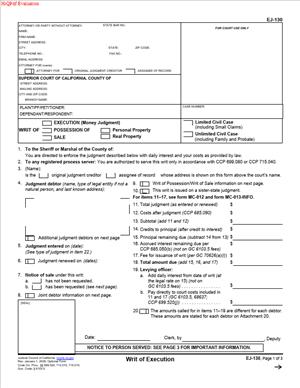
EJ-130 – Writ of Execution
Fill out nowJurisdiction: Country: United States | Province or State: California
The EJ-130 – Writ of Execution is a court form used to enforce a money judgment in California. If you have already won a case and the court has entered a judgment in your favor, this document allows you to start the collection process.
Winning a judgment does not automatically result in payment. The EJ-130 – Writ of Execution is the tool that authorizes law enforcement to collect the amount owed. It turns a court decision into an enforceable action.
This form is commonly used in small claims cases, civil lawsuits, and other matters where one party owes money under a court judgment. It is not used to start a lawsuit. It is used after judgment has already been entered.
If you are representing yourself, this form can feel technical. Understanding what it does and how it works helps you complete it correctly and avoid delays in processing.
What is EJ-130 – Writ of Execution?
Clear definition
The EJ-130 – Writ of Execution is a court-issued order that directs a levying officer, typically a sheriff or marshal, to enforce a money judgment. It authorizes that officer to take specific steps to collect the amount owed to the judgment creditor.
The form itself is a request to the court. Once the court clerk issues the writ, it becomes an official order. The levying officer can then use it to collect from the debtor’s wages, bank accounts, rental income, or personal property, depending on the instructions provided.
It includes key details such as the case number, court information, names of the parties, total amount owed, and accrued interest and costs. Accuracy is critical because the writ must match the court’s judgment record.
Who typically uses this form?
This form is usually completed by a judgment creditor. That is the person or business that won the case and is owed money.
In small claims cases, self-represented individuals often use this form. It is also used by businesses collecting unpaid debts after a court decision.
Attorneys may prepare the form on behalf of clients in larger civil cases. However, many people complete it without legal representation, especially in small claims matters.
Court clerks issue the writ after reviewing the completed form. A levying officer then acts on it to carry out enforcement.
Why might you need this form?
You may need this form if the other party has not voluntarily paid the judgment. A court decision alone does not guarantee payment.
The writ allows you to move from a paper judgment to actual collection efforts. Without it, law enforcement cannot legally seize assets or garnish wages.
If the judgment includes interest and allowable costs, the writ reflects those updated totals. This helps ensure the amount collected matches what is legally owed at the time of enforcement.
The form is also used when you want to direct collection toward specific assets, such as a known bank account or employer.
Typical real-life scenarios
- You win a small claims case for unpaid rent. The tenant does not pay within the time allowed. You file for a writ so a levying officer can garnish wages or levy a bank account.
- You obtain a judgment after a car accident lawsuit. The other driver does not pay the damages ordered by the court. You use the writ to begin wage garnishment through the driver’s employer.
- You lend money to someone and sue when they fail to repay it. After winning the case, you request a writ to collect from the debtor’s checking account.
- A contractor wins a judgment for unpaid work. The client refuses to pay. The contractor uses the writ to place a levy on business equipment or accounts receivable.
- In each situation, the writ does not create a new debt. It enforces an existing court-ordered obligation.
- When would you use EJ-130 – Writ of Execution?
You would use this form after the court has entered a final money judgment in your favor. The judgment must be enforceable. In many cases, there is a waiting period before enforcement begins, especially if the debtor has time to appeal.
The form is used when voluntary payment has not occurred. Some debtors pay soon after judgment. Others delay or refuse. The writ becomes relevant when informal collection efforts fail.
You might also use it when partial payments have been made, but a balance remains. The writ can reflect the updated amount still owed, including interest that has accrued.
In some situations, you know where the debtor works or banks. The writ allows you to direct collection efforts toward those specific sources. In other cases, you may combine it with other enforcement tools to locate assets before deciding where to levy.
If the debtor owns property in a different county, you may need a writ issued for that county. Enforcement is often tied to the location of the assets.
This form is not used to change the terms of the judgment. It does not modify the amount originally awarded except to add allowable costs and interest as permitted by law.
Legal characteristics of EJ-130 – Writ of Execution
The EJ-130 – Writ of Execution becomes effective only after the court clerk issues it. Completing the form alone does not create authority. The clerk’s issuance makes it an enforceable court order.
For the writ to be valid, the information must match the court’s judgment record. This includes party names, case number, and judgment amounts. Errors in these details can lead to rejection or delays.
The total amount claimed must be calculated correctly. This often includes the original judgment, accrued interest, and certain court-approved costs. Miscalculations can create complications during enforcement.
The writ is typically valid for a limited period. After that period expires, a new writ may be required to continue collection efforts.
Common issues that cause problems include listing the wrong debtor name, failing to account for prior payments, or requesting amounts not supported by the court record. Inaccurate information can delay enforcement or require correction filings.
While procedures are generally similar throughout California, practical steps may vary slightly by county, especially regarding how you submit the form and how levying officers process it. The underlying authority of the writ remains statewide.
The writ does not allow unlimited action. Certain property may be exempt from collection under California law. The levying officer follows specific rules about what can and cannot be taken.
The writ also does not resolve disputes about exemptions or ownership. If the debtor claims property is exempt, separate procedures address that issue.
Is it legally binding?
Yes. Once issued by the court, the writ is a legally binding order directed to a levying officer. It authorizes that officer to carry out enforcement actions consistent with California law.
The binding effect comes from the underlying judgment and the court’s authority. The writ does not create a new legal obligation. It enforces one that already exists.
Its enforceability depends on proper issuance. If the writ contains significant errors or is issued in violation of required procedures, enforcement may be challenged.
As long as it is issued based on a valid judgment and used within the allowed time frame, it carries the full authority of a court order.
How to fill out EJ-130 – Writ of Execution
Step 1 – Identify the court and case information
At the top of the form, enter the name and address of the court that issued the judgment. This must match the court listed on your judgment. Include the case number exactly as it appears in the court record.
Provide the names of the judgment creditor and judgment debtor as shown in the judgment. Do not shorten or alter names. Consistency is important for enforcement.
Step 2 – Provide your contact information
Complete the section that asks for the name, address, and contact details of the person requesting the writ. If you are self-represented, you list your own information. If an attorney is involved, the attorney’s details are entered.
This information allows the court and levying officer to contact the correct person regarding processing or enforcement questions.
Step 3 – State the date of entry of judgment
Enter the date the court entered the judgment. This is typically found on the Notice of Entry of Judgment or the judgment form itself.
Accuracy here matters because enforcement timing is tied to the judgment date. The court uses this information to confirm the judgment is eligible for enforcement.
Step 4 – Enter the total amount of the judgment
List the original amount awarded by the court. Include principal, court costs, and any other amounts specifically stated in the judgment.
If there have been partial payments, reflect those accurately. The form typically requires you to show credits for payments already received.
Step 5 – Calculate and include accrued interest
If interest has accrued since the judgment was entered, calculate the amount according to the applicable rate. Enter the interest separately if the form provides space for it.
Be precise in your calculation. The total amount claimed should reflect principal plus allowable interest minus any payments received.
Step 6 – Add allowable costs after judgment
If you have incurred additional costs related to enforcing the judgment, such as filing fees for enforcement documents, include them if the form allows and if they are authorized.
These costs must be documented and consistent with court rules. The total should reflect only those amounts permitted under the law.
Step 7 – State the total amount to be collected
Add together the judgment amount, accrued interest, and any allowable costs. Subtract any credits for payments received. Enter the final total clearly in the designated space.
This figure represents the maximum amount the levying officer is authorized to collect under this writ.
Step 8 – Specify where the writ will be enforced
Indicate the county where you want the writ enforced. Enforcement usually occurs in the county where the debtor’s assets are located.
Make sure the county listed matches the location of wages, bank accounts, or property you intend to pursue.
Step 9 – Sign and date the form
Sign and date the form in the space provided. Your signature confirms that the information is accurate to the best of your knowledge and reflects the current balance owed.
Review all entries before signing. Check names, numbers, and calculations carefully.
Step 10 – Submit the form to the court clerk
File the completed form with the court clerk who issued the judgment. The clerk reviews the form and, if complete, issues the writ by signing and sealing it.
Once issued, the writ can be delivered to the appropriate levying officer for enforcement within the stated time period.
Legal terms you might encounter in EJ-130 – Writ of Execution
- Judgment Creditor: This is the person or business that won the court case and is owed money. On this form, the judgment creditor is the party asking the court to issue the writ so they can collect what they are owed. You must list the name exactly as it appears on the judgment.
- Judgment Debtor: This is the person or business that owes the money under the court’s judgment. The name must match the judgment precisely. Even small differences in spelling or initials can create problems when enforcing the writ.
- Levy: A levy is the legal process of taking property or funds to satisfy a judgment. The writ allows a levying officer to carry out a levy, such as taking money from a bank account or wages. The writ itself does not take property; it authorizes the levy.
- Levying Officer: This is typically the sheriff or marshal in the county where enforcement will occur. The writ directs this officer to enforce the judgment. You must identify the correct county for enforcement because the officer’s authority is limited by location.
- Accrued Interest: After a judgment is entered, interest usually continues to grow until the debt is paid. On the form, you must calculate and include the amount of interest that has built up since the judgment date. This increases the total amount the levying officer will try to collect.
- Memorandum of Costs After Judgment: This refers to certain additional costs you may have incurred after the judgment was entered, such as filing fees for enforcement. If allowed, these costs can be added to the total owed. They must be properly calculated and, in many cases, filed with the court before being included in the writ.
- Issuance Date: This is the date the court clerk signs and issues the writ. It is important because a writ is only valid for a limited period of time from that date. You cannot enforce the writ before it is officially issued.
- Return of Writ: After attempting enforcement, the levying officer completes a return showing what actions were taken and whether any money or property was collected. This becomes part of the court record. It helps document what has been done to enforce the judgment.
- Partial Satisfaction: If the debtor has already paid part of the judgment, that amount must be reflected in your calculations. The writ should request only the remaining unpaid balance. Failing to account for prior payments can lead to over-collection and court complications.
- Property Subject to Levy: This refers to assets that may legally be taken to satisfy the judgment, such as wages, bank accounts, or certain personal property. Not all property can be levied. The writ authorizes enforcement, but exemptions may limit what can actually be taken.
FAQs
Do I need a new EJ-130 – Writ of Execution each time I try to collect?
Yes. This document is valid for a limited period after it is issued. If it expires or if you want to attempt enforcement in a different county, you generally need to request a new writ. Always check the issuance date and confirm whether the current writ is still valid before asking a levying officer to act.
What date should I use for calculating interest on this form?
Use the date the judgment was entered, not the date you received a copy. Calculate interest from that entry date up to the date you prepare this document. Make sure your math is clear and based on the correct principal amount after any payments.
What if the debtor has already made partial payments?
You must subtract any payments already received from the total judgment before completing this form. List only the remaining balance, plus accrued interest and allowable costs. Keep records of each payment in case the court or levying officer asks for proof.
Can I correct mistakes after the writ is issued?
Minor clerical errors may require you to request a corrected writ from the court. If key information is wrong, such as the debtor’s name or amount owed, enforcement may fail. Review every entry carefully before submission to avoid delays.
What happens after the levying officer receives this document?
The officer reviews the writ to confirm it is properly issued and within the valid time period. The officer then carries out the type of levy you requested, such as serving a bank or employer. Afterward, the officer files a return explaining what was done and whether funds were collected.
Does this form change the public record of the judgment?
No. The judgment itself remains as originally entered. This document authorizes enforcement but does not change the judgment amount unless you have properly added post-judgment costs or interest. Any payments collected may later result in a filed acknowledgment of satisfaction.
What if the debtor’s name is slightly different from what appears on the judgment?
You must use the name exactly as it appears on the judgment. Even small differences can cause a bank or employer to reject a levy. If the judgment contains an error, you may need to correct the judgment before requesting enforcement.
Do I need to attach anything when I submit this form?
In many situations, you do not attach evidence of the judgment because the court already has it on file. However, you may need to ensure that any memorandum of costs has been filed and accepted before including those amounts. Confirm that all supporting filings are reflected in the court record before submitting this document.
Checklist: Before, During, and After EJ-130 – Writ of Execution
Before
- Confirm the judgment is final and enforceable.
- Verify the exact spelling of all party names as shown on the judgment.
- Calculate the remaining principal balance after any payments.
- Compute accrued interest from the date of entry of judgment.
- Determine whether you have allowable post-judgment costs to add.
- Confirm the correct county where enforcement will occur.
- Gather case number and court information exactly as listed on the judgment.
- Review time limits to ensure enforcement is still permitted.
During
- Enter the court name and case number accurately.
- List your contact information clearly and completely.
- State the original judgment amount.
- Add accrued interest and allowable costs carefully.
- Double-check your total calculation before writing the final amount.
- Identify the county where the levying officer will act.
- Review all names for exact matches to the judgment.
- Sign and date the form where required.
- Make copies before submitting to the court clerk.
After
- Obtain a file-stamped copy from the court clerk.
- Confirm the issuance date and expiration period.
- Deliver the issued writ to the appropriate levying officer.
- Provide clear written instructions to the levying officer about the type of levy requested.
- Track any deadlines related to the enforcement process.
- Monitor communications from the levying officer.
- Record any funds collected and update your balance calculation.
- File an acknowledgment of satisfaction once the judgment is fully paid.
Common mistakes to avoid with EJ-130 – Writ of Execution
- Mistake: Using a different spelling of the debtor’s name than what appears on the judgment, which happens when you rely on memory instead of the official record, leading to rejected levies and delays—do not forget to copy the name exactly as written in the court file.
- Mistake: Miscalculating accrued interest because you use the wrong start date or incorrect rate, which can result in overstating the amount owed and court challenges—do not forget to calculate from the judgment entry date and review your math.
- Mistake: Failing to subtract prior payments, often because records are not organized, which can cause over-collection and disputes—do not forget to confirm the current unpaid balance before listing the total.
- Mistake: Requesting enforcement in the wrong county due to confusion about where assets are located, which delays action by the levying officer—do not forget to verify the correct county for the debtor’s wages, bank, or property.
- Mistake: Letting the writ expire before taking action, usually because the issuance date is overlooked, which forces you to restart the process—do not forget to check the validity period immediately after issuance.
- Mistake: Including post-judgment costs that were never properly filed or approved, often due to misunderstanding allowable costs, which can lead to rejection by the clerk—do not forget to ensure any added costs are reflected in the court record.
- Mistake: Submitting incomplete contact information, which happens when you rush through the top section, causing communication problems—do not forget to provide accurate and current details.
- Mistake: Forgetting to keep copies of the signed and issued writ, which creates confusion later about what was authorized—do not forget to maintain organized records of every version submitted and issued.
What to do after filling out EJ-130 – Writ of Execution
Once you complete the form, pause and review it line by line. Check names, numbers, and totals. Make sure your calculations are clear and consistent with the court’s judgment and your records.
- Step 1: Make at least two copies of the completed form before submitting it to the court.
- Step 2: Submit the original to the court clerk for issuance, following the court’s filing procedures.
- Step 3: Pay any required issuance fee and obtain confirmation that the clerk has issued the writ.
- Step 4: Verify the issuance date stamped or entered by the clerk, and note the expiration period in your calendar.
- Step 5: Obtain certified copies if required for enforcement purposes.
- Step 6: Deliver the issued writ to the appropriate levying officer in the county where enforcement will take place.
- Step 7: Provide written instructions to the levying officer describing the property or source of funds you want levied.
- Step 8: Track all communications and keep copies of any instructions or receipts.
- Step 9: Record any amounts collected and adjust your internal balance sheet to reflect payments received.
- Step 10: If the judgment is fully satisfied, promptly file the appropriate acknowledgment with the court to update the official record.
Stay organized throughout the enforcement process. Keep a dedicated file with the judgment, issued writs, payment records, interest calculations, and any correspondence. Clear records protect you if the debtor disputes the amount or if the court requests clarification. Consistent follow-up increases the chances of successful collection and ensures the court file accurately reflects the status of the judgment.
Disclaimer: This guide is provided for informational purposes only and is not intended as legal advice. You should consult a legal professional.