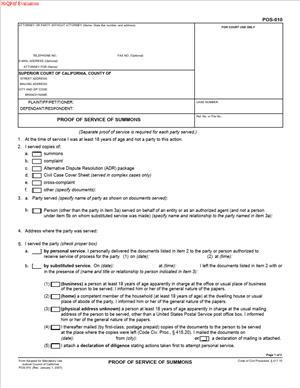
POS-010 – Proof of Service of Summons
Fill out nowJurisdiction: Country: United States | Province or State: California
If you are starting a court case, filing the POS-010 – Proof of Service of Summons is a key step. It shows the court that the other party received the legal papers that began the case. Without this form, the court has no formal record that service happened.
This document is not about your claims or defenses. It is about procedure. It confirms how, when, and where the summons and complaint were delivered.
You may be filling this out because you arranged for someone to serve the papers. Or you may be reviewing it to make sure it was completed correctly before filing. Either way, understanding each section helps prevent delays.
This form belongs to the Superior Court of California. It is used after the summons and complaint have been served. The information must match what actually occurred during service.
The court relies on this filing to move the case forward. If the proof of service is missing or incorrect, your case can stall early in the process.
What is POS-010 – Proof of Service of Summons?
Clear definition
POS-010 – Proof of Service of Summons is a court form used to confirm that a summons and complaint were delivered to the defendant. It records the details of service in a standardized format.
In simple terms, it tells the court: who was served, who served them, when it happened, where it happened, and how it was done. It becomes part of the official case file once filed.
The form does not start the case. The summons and complaint do that. This document only proves that those papers were properly delivered.
Who typically uses this form?
The person who serves the papers usually completes and signs the form. In many cases, this is a process server, a sheriff’s deputy, or another adult who is not involved in the case.
If you are the plaintiff, you do not personally serve the summons in most situations. Another adult handles the service, then fills out the form to describe what they did.
Court clerks, judges, and the opposing party may later review the form. It becomes important if there is any question about whether the service was valid.
Why might you need this form?
You need this form to show the court that the defendant received official notice of the lawsuit. Courts require proof of service before taking further steps, such as entering a default.
If the defendant does not respond, the court will look at this document to confirm they were properly served. Without it, the court may refuse to move forward.
It also creates a record in case the defendant later argues that they were never notified. The form provides specific facts about how the service occurred.
Typical real-life scenarios
- You file a lawsuit for unpaid rent. A registered process server personally hands the summons and complaint to the tenant. The server completes POS-010 – Proof of Service of Summons to confirm the delivery.
- You sue for property damage after a car accident. The defendant is served at their home by substituted service, meaning the papers are left with another adult at the residence and mailed as required. The server records those details on the form.
- You file a business dispute against a corporation. The summons is delivered to the company’s registered agent for service of process. The server documents the name of the agent and the address where the service took place.
- You bring a small civil claim that requires formal service. The sheriff’s office serves the papers and provides a completed proof of service form for filing with the court.
- In each of these examples, the case cannot proceed properly without a completed proof of service on file.
When would you use POS-010 – Proof of Service of Summons?
You use this form after the summons and complaint have been served, but before the court takes further action that depends on service. It is typically filed soon after service is completed.
In most civil cases in the Superior Court of California, formal service of a summons is required at the beginning. This includes many contract disputes, personal injury claims, and other general civil matters.
If you are the plaintiff, you arrange for service. Once the server completes service, they fill out the form and sign it. You then file it with the court clerk.
If the defendant files a motion challenging service, this form becomes central. The court may review it to decide whether the service met legal requirements.
The form is generally not used for serving later documents in the case, such as motions or discovery papers. Those filings often use a different proof of service form.
Legal characteristics of POS-010 – Proof of Service of Summons
This document is effective when it accurately reflects how the service occurred and is signed by a qualified server. The details must be consistent with the rules governing service of process.
A valid proof of service usually includes the server’s name, address, and a statement that they are over 18 and not a party to the case. It also identifies the person served and the method of service used.
Common problems include missing dates, incorrect addresses, or failing to specify the method of service. Inconsistent information between the summons and the proof of service can also raise issues.
If substituted service is used, the form must describe both the delivery to another adult and the follow-up mailing, if required. Leaving out part of that sequence can lead to questions about validity.
The form does not prove that the claims in the complaint are true. It does not resolve the dispute. It only addresses whether proper notice was given.
Courts may differ in how strictly they review service details. However, accuracy and completeness are always important. Even small errors can delay the case if they create doubt about whether the service was properly completed.
Is it legally binding?
POS-010 – Proof of Service of Summons is not a contract. It is a sworn statement by the server. When signed, it typically includes a declaration under penalty of perjury.
That declaration gives the form legal weight. Providing false information can carry serious consequences. The court relies on the truthfulness of the server’s statement.
Once filed, the form becomes part of the official court record. Judges may rely on it to determine deadlines for the defendant’s response or whether a default may be entered.
Its legal effect depends on accurate completion and proper filing. If the information is incorrect or incomplete, the court may find that service was not valid.
How to fill out POS-010 – Proof of Service of Summons
Step 1 – Caption and Court Information
At the top of the form, enter the name of the court, which is the Superior Court of California, along with the branch name and address. Fill in the case title exactly as it appears on the summons and complaint. Include the case number assigned by the court. This information must match the existing filings.
Step 2 – Server’s Information
Provide the name, address, and contact information of the person who served the documents. The server confirms they are at least 18 years old and not a party to the case. This section establishes that the server meets basic eligibility requirements.
Step 3 – Documents Served
Identify the documents that were delivered. This usually includes the summons and complaint. If other documents were served at the same time, list them clearly. The titles must match the filed versions.
Step 4 – Party Served
Enter the full name of the person or entity served. If serving a business or organization, include the name of the individual who accepted service and their role, if applicable. Accuracy here is critical because it shows that the correct party received notice.
Step 5 – Address Where Service Occurred
State the complete address where the documents were delivered. This includes street address, city, state, and zip code. The location should reflect where service actually took place, whether at a home, workplace, or other site.
Step 6 – Method of Service
Indicate how the service was completed. This may be personal service, substituted service, or another legally recognized method. Provide the date and time of delivery. If substituted service was used, describe the person with whom the documents were left and confirm any required follow-up mailing.
Step 7 – Declaration and Signature
The server reads the declaration stating that the information is true and correct. The server then signs and dates the form. The signature confirms the statement is made under penalty of perjury. Once signed, the completed form is ready for filing with the court.
Legal terms you might encounter in POS-010 – Proof of Service of Summons
- Proof of Service: A written statement that confirms legal documents were delivered to the correct person in the required way. On this form, it is the server’s sworn declaration describing when, where, and how the summons and complaint were served. The court relies on this proof to move the case forward.
- Summons: An official court notice that tells a defendant they are being sued and must respond within a specific time. This form confirms that the summons was actually delivered. Without proof of delivery, the court cannot enforce deadlines.
- Complaint: The document that starts a civil case and explains what the plaintiff is asking for. The server lists the complaint as one of the documents served. The description must match the document filed with the court.
- Personal Service: A method of service where the server hands the documents directly to the person named in the lawsuit. If this method is used, the server must record the exact date, time, and address. Courts often prefer this method because it is the most direct.
- Substituted Service: A method used when the defendant is not personally available. The server leaves the documents with a responsible adult at the defendant’s home or workplace and follows up by mailing copies. The form requires both the delivery details and the mailing information.
- Service by Mail: A method where documents are sent through the postal system instead of being hand-delivered. If allowed, the server must state when and where the mailing occurred. The mailing date can affect the defendant’s response deadline.
- Registered Process Server: A professional who is authorized and registered to serve legal documents for others. If the server is registered, they must provide their registration number and county of registration. This information appears in the server information section.
- Declaration Under Penalty of Perjury: A statement signed by the server confirming the information is true. By signing, the server accepts legal responsibility for accuracy. False information can lead to serious consequences.
- Party Served: The individual or entity that received the documents. The name written here must match the defendant’s name exactly as it appears in the case caption. Errors in spelling or identity can delay your case.
- Date of Service: The calendar date when the documents were delivered. This date starts the clock for the defendant’s deadline to respond. It must be precise and consistent throughout the form.
FAQs
What date should be listed as the date of service?
You must enter the exact calendar date when the documents were actually handed over or, for substituted service, the date they were left with the responsible adult. If mailing is required as a follow-up step, you will also list the mailing date in the appropriate section. The service date you record controls when the defendant’s response time begins, so confirm it matches the server’s notes.
Who is allowed to sign this document?
The person who physically served the papers must sign. It cannot be you if you are a party to the case. The signer must be at least 18 years old and not involved in the lawsuit. The signature appears under a declaration under penalty of perjury, so it must be the actual server’s name, not yours.
Do I need to attach anything to this form?
You may need to attach additional pages if there is not enough space to list all documents served or all parties served. Any attachment should be clearly labeled and referenced in the correct section. Make sure attachments are consistent with the case number and party names so the clerk can match them to your file.
What if the defendant’s name is slightly different from what appears in the caption?
The name listed under the party served must match the caption exactly as filed in your case. If the server delivered documents to someone using a different variation of the name, the form should clarify that the person served is the same individual named in the lawsuit. Consistency prevents rejection or questions from the court.
When do I file POS-010 – Proof of Service of Summons with the court?
You file it after service has been completed and the server has signed the declaration. The court needs this document on record before it can proceed with default or other next steps. File it as soon as possible so deadlines are clear and documented.
How do I confirm the court accepted this form?
After filing, check the case docket or obtain a file-stamped copy showing the clerk’s acceptance. Review the stamped copy to confirm the filing date and that all pages were included. If something is missing, you may need to correct and refile promptly.
What happens if the service method box is marked incorrectly?
If the wrong service method is selected, the court may question whether service was valid. This can delay hearings or prevent the entry of default. Review the server’s actual actions and confirm the method checked in this document matches what truly occurred before filing.
Will this document become part of the public record?
Yes. Once filed, this document becomes part of the court’s case file. It shows when and how the defendant was notified and may be viewed by others. Double-check personal information for accuracy because it will be preserved in the official record.
Checklist: Before, During, and After POS-010 – Proof of Service of Summons
Before
- Confirm the summons and complaint have been issued and are ready for service.
- Verify the defendant’s full legal name and address.
- Choose a qualified server who is at least 18 and not a party to the case.
- Review which method of service will be used.
- Prepare copies of all documents to be served.
- Check that the case number is correct on every document.
- Make sure the server understands they must complete and sign the proof form.
During
- Ensure the server delivers all required documents together.
- Confirm the exact date, time, and address of service are recorded.
- Verify the identity of the person served.
- If using substituted service, confirm the recipient’s relationship or role.
- Complete any required follow-up mailing promptly.
- Record mailing details, including city and state.
- Review each checkbox and section for accuracy before signing.
- Have the server sign under penalty of perjury.
After
- Make copies of the signed form for your records.
- File the original with the court clerk.
- Obtain a file-stamped copy as confirmation.
- Check the case docket to ensure it appears.
- Calendar the defendant’s response deadline based on the service date.
- Store the proof in your case file with related documents.
- Update any internal case tracking notes.
Common mistakes to avoid with POS-010 – Proof of Service of Summons
- Mistake: Letting a party to the case serve the documents, which happens when you try to save time or money, leading to invalid service and possible dismissal, so do not forget that the server must be independent and at least 18 years old.
- Mistake: Listing the wrong service date because the server relies on memory instead of notes, which can shift response deadlines and create disputes, so do not forget to confirm the exact calendar date before filing.
- Mistake: Checking personal service when substituted service was actually used, often due to confusion about definitions, which may cause the court to reject the proof, so do not forget to match the box to the real method used.
- Mistake: Misspelling the defendant’s name or using a nickname, which happens when copying from informal documents, resulting in delays or challenges to service, so do not forget to match the caption exactly.
- Mistake: Forgetting to include mailing details after substituted service, which occurs when the follow-up step is overlooked, making service incomplete, so do not forget that both delivery and mailing must be documented.
- Mistake: Filing an unsigned form because you assume a typed name is enough, which can cause the clerk to reject it, so do not forget that the server must physically sign under penalty of perjury.
- Mistake: Leaving out attachments that list additional documents served, which happens when space runs out on the main page, leading to an incomplete record, so do not forget to attach and label extra pages clearly.
What to do after filling out POS-010 – Proof of Service of Summons
Once the server completes and signs the form, your job is to make sure it is properly filed and tracked. The court cannot act on your case until proof of service is in the file. Treat this step as critical, not administrative.
- Step 1: Review the entire form line by line for accuracy and completeness.
- Step 2: Confirm the case number and party names match the court’s records exactly.
- Step 3: Make at least two copies of the signed form for your records.
- Step 4: File the original with the Superior Court of California in the county where your case is pending.
- Step 5: Request or download a file-stamped copy showing the filing date.
- Step 6: Check the court’s case summary to confirm the filing appears in the docket.
- Step 7: Calculate the defendant’s response deadline based on the recorded service date.
- Step 8: Mark that deadline clearly in your calendar.
- Step 9: Store the stamped copy in your case file with the summons and complaint.
- Step 10: Update any case management notes so you can track whether a response is filed on time.
If the defendant files a response, keep your proof of service as part of your ongoing record. If the defendant does not respond by the deadline, the filed proof of service will be required if you request a default. Accuracy at this stage prevents delays later.
Stay organized. Keep copies in both paper and digital form if possible. A clear record of service strengthens your position and keeps your case moving forward.
Disclaimer: This guide is provided for informational purposes only and is not intended as legal advice. You should consult a legal professional.