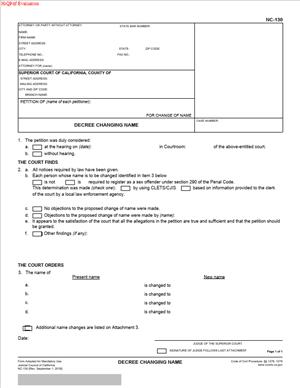
NC-130 – Decree Changing Name
Fill out nowJurisdiction: Country: United States | Province or State: California
The NC-130 – Decree Changing Name is the court order that officially approves a name change in California. It is the document a judge signs after reviewing your request to change a name. Once signed and filed, it becomes your legal proof of the new name.
If you are about to complete this form, you are likely at the final stage of the court name change process. This document is not the initial request. Instead, it confirms the court’s decision.
The NC-130 – Decree Changing Name matters because many agencies require a certified copy of the signed decree before they update records. This can include government identification, financial accounts, and employment records.
Understanding what goes into this form helps you avoid delays. Small errors in names, dates, or case numbers can slow down the court’s processing. When you know what each section means, you can prepare the document clearly and confidently.
What is NC-130 – Decree Changing Name?
Clear definition
NC-130 – Decree Changing Name is a California court order that legally changes a person’s name. It is signed by a judge after the court grants a name change petition.
This form states the original name and the new legal name. It also includes the case number and court information. Once entered by the court clerk, it becomes part of the official court record.
It is different from the petition that starts the process. The petition asks the court for approval. The decree confirms that approval.
Who typically uses this form?
Individuals who have filed a name change petition in California use this form. This includes adults seeking to change their own name and parents requesting a name change for a child.
Guardians may also be involved if the person whose name is being changed is under legal guardianship. In those cases, the guardian may participate in the court process.
Self-represented individuals commonly prepare this document. Some people work with an attorney, but many complete the filing on their own.
Court clerks and judges also interact with this form. The judge signs it. The clerk files and stamps it, making it part of the official record.
Why might you need this form?
You need this form to complete a legal name change in California. Without a signed decree, the name change is not officially recognized.
A court order is often required before updating identification documents. Agencies usually ask for a certified copy of the decree as proof of the change.
This form also provides consistency. It creates a clear, court-approved record linking the old name and the new name.
If you are changing your name for personal, family, or gender-related reasons, this document formalizes that decision in a legal setting.
Typical real-life scenarios
- You may use this form after deciding to change your name for personal reasons. For example, you may prefer a name that better reflects your identity. After filing a petition and completing the required steps, the decree confirms the change.
- Parents sometimes request a name change for a minor child. This may happen after a family transition or when correcting a name that was recorded incorrectly. The court reviews the request, and if granted, the decree finalizes the child’s new legal name.
- An adult may also change their name as part of aligning legal documents with a chosen name. Once the court approves the petition, the signed decree becomes the document used to update records across institutions.
- In some cases, individuals seek a name change to simplify spelling or correct long-standing inconsistencies. After the court hearing or review, the decree provides formal recognition of the corrected name.
When would you use NC-130 – Decree Changing Name?
You use this form after the court has reviewed your name change request and is ready to issue a decision. It is typically prepared before or at the time of the hearing, depending on court procedures.
In many cases, you bring the completed decree form to the hearing. If the judge grants the petition, the judge signs the decree. The clerk then processes and files it.
If the court approves the name change without a hearing, the decree may still need to be submitted for signature. The process varies by county, but the decree is always required for the change to take legal effect.
Adults changing their own name use it at the conclusion of their case. Parents or guardians use it when the court approves a minor’s name change. In each situation, the form serves the same function: it records the court’s final decision.
Legal characteristics of NC-130 – Decree Changing Name
This document becomes effective when a judge signs it and the court files it. The signature shows judicial approval. The filing date marks when the order becomes part of the official court record.
Accuracy is essential. Courts commonly reject or delay decrees that contain mismatched names, incorrect case numbers, or incomplete information. Even small spelling differences between the petition and the decree can cause problems.
The form must match the details in your original petition and any amended documents. The names, dates of birth, and case information must be consistent throughout the file.
California has standardized judicial council forms for name changes. Using the correct form for your situation helps ensure proper processing. Other states use different forms and procedures. A decree issued in California reflects California court authority.
This document does not automatically update your records with other agencies. It authorizes the change, but you still need to present it to organizations to update identification and accounts.
The decree also does not erase past records under the former name. Instead, it creates a legal link between the old name and the new name.
Is it legally binding?
Yes, once signed by a judge and filed by the court, it is a legally binding court order. It formally changes the person’s name as stated in the decree.
The order carries the authority of the court. Government agencies and private institutions generally rely on it as proof of the name change.
However, it is binding only after proper completion and filing. An unsigned form or a draft copy has no legal effect. The judge’s signature and the clerk’s filing are what give it legal force.
The decree applies within the legal framework of California courts. Other jurisdictions typically recognize valid court orders from California, but their procedures for updating records may vary.
How to fill out NC-130 – Decree Changing Name
Step 1 – Complete the caption section
At the top of the form, enter your name and contact information in the space provided for the petitioner. Then fill in the court’s name and address exactly as it appears on your other filed documents. Write the case number exactly as assigned by the court. This information must match your petition and all prior filings.
Step 2 – Identify the person whose name is being changed
In the section that states the current name, enter the full legal name exactly as it appears on the petition. Then, provide the proposed new name exactly as approved or requested in the case. Check spelling carefully. The court expects the old and new names to be clear and consistent.
Step 3 – Confirm court findings
The form includes statements that the court makes about the petition. Review these carefully. They typically confirm that proper notice was given and that the request meets legal requirements. You generally do not rewrite these findings. Instead, ensure the case information is correct and complete before submission.
Step 4 – Provide details for each person if more than one name is changing
If the case involves more than one person, such as siblings, the decree may list each individual separately. Enter each person’s current name and new name in the designated spaces. Make sure each entry matches the information filed earlier in the case.
Step 5 – Leave the signature lines for the court
Do not sign the judge’s signature line. Leave the date and signature area blank for the court to complete. The judge will sign and date the form if the name change is granted.
Step 6 – Review the entire document for consistency
Before submitting the form, read it from top to bottom. Confirm that names, case numbers, and court information match your petition and any related documents. Check for spelling errors and incomplete fields. Clear and accurate completion helps prevent processing delays.
Step 7 – Submit the form to the court for signature and filing
Provide the completed decree to the court as part of your name change process, following the filing procedures used in your case. After the judge signs it and the clerk files it, request certified copies if you need official proof of the name change for other records.
Legal terms you might encounter in NC-130 – Decree Changing Name
- Decree: A decree is a formal court order. In this document, the decree is the judge’s written decision granting the name change. Once signed and filed, it becomes the official record that your name has been legally changed.
- Petitioner: The petitioner is the person who asked the court for the name change. If you filed the request for yourself, you are the petitioner. If you filed for a minor, you are the petitioner acting on the child’s behalf.
- Minor: A minor is someone under the age of 18. If the name change is for a minor, the decree will reflect that status and may include findings about parental consent or notice.
- Court Order: A court order is a directive issued by a judge. The decree in this form functions as a court order instructing that the person’s name is changed from the former name to the new legal name.
- Former Name: This is the person’s current legal name before the change. It must match what appears in official records. Accuracy matters because this is the name being replaced.
- Proposed Name: The proposed name is the new name you asked the court to approve. The decree confirms this name as the person’s new legal name once signed.
- Hearing: A hearing is a scheduled court appearance where the judge reviews the request. If a hearing was required, the decree may reference that it took place and that the court considered the evidence.
- Findings: Findings are statements by the court explaining what it determined to be true. In this document, findings may confirm that the required notice was given and that the name change is not for improper purposes.
- Order to Show Cause: This is a prior court notice directing anyone who objects to appear and explain why the name change should not be granted. The decree may indicate that no objections were made or that objections were resolved.
- Clerk: The clerk is a court official who processes filings and enters the signed decree into the court record. The clerk’s file stamp shows the order is officially recorded.
FAQs
When does my name legally change?
Your name legally changes on the date the judge signs the decree, and it is filed by the court clerk. Look at the signature line and the file stamp date. The effective date is not when you filled out the paperwork or attended the hearing. It is the date the court signs and enters the order.
Do I sign NC-130 – Decree Changing Name?
You do not sign the order section where the judge signs. Your role is to complete the identifying information accurately and submit it to the court. The judge reviews it and signs the decree. Make sure your name and the proposed new name are spelled correctly before submitting them, because the signed version becomes the official record.
What if the spelling of my new name is wrong on this document?
You must correct any spelling errors before the judge signs it. Check every letter of your former name and proposed name. If you notice an error after filing but before signing, ask the clerk how to submit a corrected version. If the judge has already signed it, you may need to request a corrected order so that government agencies will accept it.
Do I need attachments with this form?
This document usually follows earlier filings in your case. You typically do not attach evidence to the decree itself. However, make sure the case number and party names match the original petition and any prior orders. The court relies on consistency across the file.
What does the court confirm in this decree?
The court confirms that the required steps were completed. That can include proper notice, any required publication, and that no valid objections prevent the change. The decree states the former name and the new legal name. It records the court’s approval in clear terms.
Will this form automatically update my birth certificate or ID?
No. This document proves your legal name change, but you must contact each agency separately. Use a certified copy of the signed order to update identification, financial records, and other documents. Agencies will compare the names on your records to the names listed in the decree.
What if more than one person’s name is changing?
The decree can list more than one person if the petition included multiple individuals. Each person’s former and new names must be clearly stated. Check that every name is correctly entered and aligned with the original request before submitting it for signature.
How do I know the court accepted and filed NC-130 – Decree Changing Name?
You will see a file stamp from the clerk showing the date it was entered into the court record. You can request certified copies once it is filed. The file stamp confirms the order is official and can be used with other institutions.
Checklist: Before, During, and After NC-130 – Decree Changing Name
Before
- Review your original petition to confirm the exact spelling of all names.
- Confirm the case number and court location are correct.
- Make sure the proposed new name matches what you requested earlier.
- Check whether a hearing was held and whether the date is reflected properly.
- Verify that all required notices or publications were completed.
- Prepare clean, legible copies of the draft decree.
- Bring identification if you are attending a hearing.
- Confirm whether the court requires a specific format or number of copies.
During
- Present the completed decree to the clerk or judge as instructed.
- Double-check the spelling of names one last time before submission.
- Ensure the judge’s signature line is left blank for the court.
- Listen carefully if the judge makes corrections or gives instructions.
- Note the date the judge signs the order.
- Ask how many certified copies you can request.
- Confirm any next steps required by the clerk.
After
- Obtain at least one certified copy of the signed decree.
- Store the original or certified copy in a safe place.
- Update your Social Security record with a certified copy.
- Update your driver’s license or state ID.
- Notify banks and financial institutions.
- Update your employer and payroll records.
- Change your name on insurance policies and medical records.
- Keep a checklist of agencies you have notified.
- Retain extra certified copies for future use.
Common mistakes to avoid with NC-130 – Decree Changing Name
- Mistake: Misspelling the former or new name because you typed it quickly; this happens when copying from memory, and it can cause agencies to reject your update, so do not forget to match the spelling exactly to your petition and identification.
- Mistake: Entering the wrong case number because you reused another document as a template; this can delay filing or misfile your order, so do not forget to verify the number against your court paperwork.
- Mistake: Signing on the judge’s signature line because you assumed all forms require your signature; this can invalidate the document, so do not forget that the judge signs the order section.
- Mistake: Submitting the decree before completing the required notice or publication steps; this happens when you rush the process, and the court may refuse to sign it, so do not forget to complete all earlier requirements first.
- Mistake: Failing to request certified copies after filing because you think a regular copy is enough; many agencies require certified copies, so do not forget to obtain them while you are at the courthouse.
- Mistake: Waiting too long to update your records because you assume the change is automatic; this can create mismatched records and identification issues, so do not forget to notify each institution directly.
What to do after filling out NC-130 – Decree Changing Name
Once you complete the form, your focus shifts to getting it signed, filed, and used properly. The document has no legal effect until the judge signs it and the clerk enters it into the court record.
- Step 1: Review the entire document line by line. Confirm the spelling of every former and new name. Check the case number and court information.
- Step 2: Make at least two copies of the unsigned decree for your records before submitting it.
- Step 3: Submit the original to the court as directed, either at your hearing or by filing it with the clerk if a hearing is not required.
- Step 4: Wait for the judge to review and sign the order. If you attend a hearing, bring your copies so they can be conformed after signing.
- Step 5: Confirm that the clerk has filed the signed decree and placed a file stamp on it. The file stamp shows it is officially entered.
- Step 6: Request certified copies from the clerk. Ask how many you should obtain based on your needs. Many agencies will require a certified copy, not a regular photocopy.
- Step 7: Store one certified copy in a secure place. Keep another accessible for updating records.
- Step 8: Contact government agencies to update your name. Start with your Social Security record, then your driver’s license or state ID. Follow each agency’s instructions and provide a certified copy when required.
- Step 9: Update your name with financial institutions, employers, schools, insurance providers, and medical offices. Provide copies as needed.
- Step 10: Review your personal records over the next few months to ensure your new name appears consistently across accounts and identification.
Keep a simple tracking list of who you have notified and when. This helps you avoid missing important records. Over time, your new legal name will fully replace your former name in official systems, supported by the signed court decree.
Disclaimer: This guide is provided for informational purposes only and is not intended as legal advice. You should consult a legal professional.