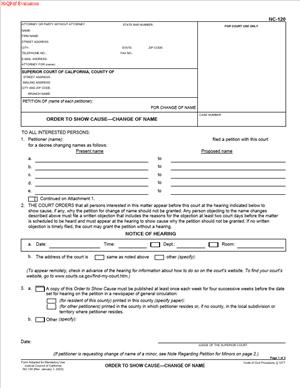
NC-120 – Order to Show Cause – Change of Name
Fill out nowJurisdiction: Country: United States | Province or State: California
The NC-120 – Order to Show Cause – Change of Name is a court document used in California name change cases. It is part of the formal process that happens after you file a petition to change your name. This form is issued by the court, not created from scratch by you.
When you start a name change case, you file a petition with the superior court. After reviewing that petition, the court prepares the NC-120 – Order to Show Cause – Change of Name. This document sets a court hearing date and explains how the public will be notified about your request.
If you are representing yourself, this form can feel confusing. It includes court details, hearing information, and publication instructions. Understanding what it does makes the process easier to follow.
This document matters because it gives legal notice of your proposed name change. It helps protect the public by allowing anyone with a valid objection to come forward before the court approves the change.
What is NC-120 – Order to Show Cause – Change of Name?
Clear definition
NC-120 – Order to Show Cause – Change of Name is a court order issued in a California name change case. It directs you to appear at a scheduled hearing and explains how notice of your name change request must be published.
An “order to show cause” means the court is giving others an opportunity to object. It does not mean something is wrong. It simply opens a period where objections can be raised before the judge makes a final decision.
This form usually includes the case number, the name of the court, the current legal name, the proposed new name, and the hearing date. It also states whether publication in a newspaper is required.
Who typically uses this form?
People who want to legally change their name in California encounter this form as part of the court process. This includes adults changing their own name and parents requesting a name change for a minor child.
You will see this form after filing a Petition for Change of Name. The court clerk or judge completes and signs it. You may be responsible for filing it and arranging publication, depending on court procedure.
Attorneys also work with this document when handling name change cases for clients. However, many people complete the process without a lawyer.
Why might you need this form?
You need this form because California law generally requires public notice of a proposed name change. The court uses this order to set that notice process in motion.
Without this document, there is no official hearing date. There is also no formal instruction about whether publication is required in your case.
The form serves as proof that the court has reviewed your petition and scheduled the next step. It connects your initial filing to the final hearing, where the judge decides whether to grant the request.
Typical real-life scenarios
- You have recently been married or divorced and want a legal name that is different from what appears on your identification. If you are not using a standard marital name change process, you may file a court petition and receive this order.
- You want to change your name for personal reasons, such as aligning with your gender identity. After filing the required petition, the court issues this order to move the case forward.
- You are a parent requesting a name change for your minor child. The court sets a hearing and may require notice to the other parent. This order outlines how that notice must happen.
- You have used a different name for many years and want your legal documents to match. Once your petition is filed, the court prepares this order to notify the public and set the hearing date.
When would you use NC-120 – Order to Show Cause – Change of Name?
You encounter this form after you file your Petition for Change of Name with the superior court in your county. It is not the first document in the process. It comes after the case has been opened and assigned a case number.
The form is used during the notice and hearing stage of the name change process. At this point, the court has accepted your filing and is ready to schedule a hearing.
If publication is required, the order explains how many times the notice must appear in an approved newspaper and within what time frame. This typically happens before the hearing date.
Parents seeking a child’s name change may see additional instructions related to notifying the other parent. In some cases, the court may make specific findings about publication requirements, depending on the circumstances.
If the court determines that publication is not required, the order may state that clearly. This can happen in certain situations, such as cases involving safety concerns.
Legal characteristics of NC-120 – Order to Show Cause – Change of Name
This form becomes effective when signed by a judge and filed with the court. It is an official court order, not a private agreement between individuals.
For the document to be valid, it must include accurate case information. The names, case number, and hearing date must match the court record. Missing or incorrect details can cause delays.
A common issue is failing to follow the publication instructions exactly as written. If publication is required and not completed properly, the court may continue the hearing or require you to restart the notice process.
Another frequent problem is incorrect service to interested parties. For example, in a minor’s case, the other parent may need formal notice. If this step is not handled correctly, the court may not move forward at the hearing.
This form does not change your name by itself. It does not grant approval. It only sets the procedure for notifying others and attending a hearing.
In California, name change procedures are handled by the superior court in each county. While the overall process is consistent statewide, local court practices may affect filing steps, scheduling, and clerk procedures.
Is it legally binding?
Yes, the order is legally binding once the judge signs it and it is filed. It sets mandatory requirements for publication and establishes the hearing date.
If the order requires publication, failing to complete it as directed can affect the outcome of your case. The court relies on proof that the notice requirement was satisfied before making a final decision.
However, the order does not legally change your name. That only happens if the judge signs a separate decree after the hearing. The order to show cause is a procedural step, not the final judgment.
How to fill out NC-120 – Order to Show Cause – Change of Name
Step 1 – Review the case caption
At the top of the form, confirm the court name, branch location, and case number. Make sure your current legal name and proposed new name match your original petition exactly. Any differences can cause confusion or delay.
Step 2 – Confirm the petitioner’s information
Check that your name appears correctly as the petitioner. If the case involves a minor, verify that the minor’s name and your role as parent or guardian are clearly identified. The information should match what you filed in your petition.
Step 3 – Review the hearing details
Locate the hearing date, time, and department listed on the form. Record this information carefully. This is the date you are expected to appear unless the court later notifies you of a change.
Step 4 – Read the publication section carefully
The form includes a section that states whether publication in a newspaper is required. If it is required, it usually specifies how many times the notice must be published and within what period before the hearing. Read this section closely, so you understand the timeline.
Step 5 – Arrange for publication if required
If the order requires publication, contact an approved newspaper in the county where the case is filed. Provide them with the exact wording from the order. Ensure the publication runs for the required number of weeks and within the correct time frame before the hearing.
Step 6 – Obtain proof of publication
After the final publication date, the newspaper typically provides proof that the notice was published. Confirm that this proof includes the correct names and case number. File this proof with the court as part of your case record.
Step 7 – Serve notice if additional parties must be informed
In cases involving a minor or other interested parties, the order may require notice to specific individuals. Make sure the method of service follows the instructions provided in the court paperwork. Keep documentation showing that the service was completed.
Step 8 – Prepare for the hearing
Before the hearing date, gather copies of your filed petition, the signed order, and proof of publication or service. Bring these documents to court. Be prepared to confirm basic information about your request when the judge calls your case.
Legal terms you might encounter in NC-120 – Order to Show Cause – Change of Name
- Order to Show Cause: A court order that requires anyone who objects to your requested name change to appear at a hearing and explain why it should not be granted. In this document, the judge sets the hearing date, time, and department. It also directs how notice must be given to the public.
- Petitioner: The person asking the court to change a name. This may be you, your child, or another person for whom you have authority. The petitioner’s name appears in the case caption at the top of the form.
- Case Number: The unique number assigned by the court when your name change case is filed. It appears on all documents in your case. You must use the exact same number on every related filing.
- Hearing: A scheduled court appearance where the judge reviews your request. The date, time, and courtroom are listed on this document. If someone objects, they must appear at this hearing to explain their reasons.
- Publication: The requirement to publish notice of your proposed name change in an approved newspaper. The court uses this to inform the public. This document often states whether publication is required and how long it must run.
- Proof of Publication: A written confirmation from the newspaper showing that the notice was published as ordered. You typically file this with the court before the hearing. Without it, the judge may not finalize the name change.
- Minor: A person under 18 years old. If the name change involves a minor, additional notice rules may apply. The court may require notice to both parents or guardians.
- Objection: A formal statement opposing the requested name change. Anyone with a valid reason may file or present an objection. If an objection is raised, the judge will consider it at the hearing.
- Decree: The final court order granting the name change. The decree is separate from this document. Once signed, it legally changes the name.
- Service: Delivering legal notice of the proceeding to the required parties. In some cases, you must formally serve a parent, guardian, or other interested person. Proof of service may need to be filed before the hearing.
FAQs
Do I need to sign NC-120 – Order to Show Cause – Change of Name?
In most cases, you do not sign this document because it is issued and signed by the judge. You should review it carefully to confirm that your name, the proposed new name, the case number, and the hearing details are correct. If you see an error, contact the court clerk promptly to ask how to correct it.
What if the hearing date listed on this form does not work for me?
You cannot ignore the date. If you have a serious conflict, you must ask the court about the process to request a continuance or rescheduling. Do this as soon as possible so the court has time to consider your request and issue an updated notice if needed.
How do I know if I must publish notice of my name change?
This document states whether publication is required and identifies the terms, such as how many consecutive weeks the notice must appear. Read the publication section carefully. If it requires publication, you must arrange it with an approved newspaper and ensure it runs for the full required period.
What happens if someone files an objection before the hearing?
If an objection is filed, the court will address it at the scheduled hearing. You should bring any documents that support your request and be ready to explain your reason for the name change. The judge will decide whether to grant or deny the request after hearing both sides.
Do I need to bring anything to the hearing?
Yes. Bring a filed copy of this document, your original petition, and proof of publication if required. Also, bring identification and any paperwork that supports your reason for the name change, such as birth certificates or custody orders if a minor is involved.
What if the information in this document does not match my petition?
Check the spelling of all names and the proposed new name. If there is a mismatch, contact the clerk right away to ask about correcting the error. Do not assume the judge will fix it at the hearing without a formal correction.
Does this document legally change my name?
No. This document schedules the hearing and gives public notice. Your name changes only when the judge signs the final decree after the hearing and all requirements are met.
What should I do if the court rejects or cancels this document?
Ask the clerk why it was rejected or vacated. The issue could involve missing information, incorrect publication, or incomplete service. Fix the problem promptly and follow the court’s instructions to obtain a new hearing date or updated order if required.
Checklist: Before, During, and After NC-120 – Order to Show Cause – Change of Name
Before
- Confirm the case number matches your petition exactly.
- Check that your current name and proposed new name are spelled correctly.
- Review the hearing date, time, and department.
- Read the publication instructions in full.
- Contact an approved newspaper if publication is required.
- Calendar all deadlines related to publication and proof filing.
- Determine whether any parent, guardian, or interested party must be served.
- Make multiple copies of the filed document for your records.
During
- Attend the hearing on time and check in with the courtroom staff.
- Bring filed copies of your petition and this document.
- Bring proof of publication if required.
- Bring proof of service if you have to notify someone.
- Be prepared to answer the judge’s questions clearly and briefly.
- Remain respectful and address the judge as instructed.
- Take notes if the judge gives additional instructions.
- Confirm whether the judge will sign the decree the same day.
After
- Obtain a certified copy of the signed decree if granted.
- Review the decree to confirm the new name is correct.
- Update your identification and legal records using the decree.
- Notify schools, employers, and financial institutions as needed.
- Keep certified copies in a safe place.
- Follow any additional instructions given by the court.
- Monitor mail for any post-hearing notices from the court.
- Correct any agency records that still show your old name.
Common mistakes to avoid with NC-120 – Order to Show Cause – Change of Name
- Mistake: Ignoring the publication requirement because it seems optional, which often happens when you skim the form; this can lead to the court denying your request, so do not forget to complete publication exactly as ordered.
- Mistake: Failing to check name spellings carefully, usually due to copying from memory; errors can carry into the final decree, so do not forget to match every name to your official documents.
- Mistake: Missing the hearing date because you relied on memory instead of calendaring it; this can delay your case or cause dismissal, so do not forget to set reminders immediately.
- Mistake: Not filing proof of publication on time, often because you assume the newspaper handles everything; the court may refuse to proceed, so do not forget to confirm filing requirements yourself.
- Mistake: Bringing incomplete paperwork to the hearing, which happens when you assume the court has everything; this can cause postponement, so do not forget to bring filed copies and supporting documents.
- Mistake: Assuming this document changes your name automatically, which can lead to updating records too early; agencies may reject your request, so do not forget that only the signed decree makes the change official.
- Mistake: Failing to serve a required parent or guardian in a minor’s case, often due to misunderstanding notice rules; this can invalidate the process, so do not forget to complete and document proper service.
What to do after filling out NC-120 – Order to Show Cause – Change of Name
Once this document is issued by the court, your focus shifts to compliance and preparation. Read every line carefully. Confirm that all details match your petition and your personal records. Small mistakes can create delays later.
Make a working file for your case. Keep copies of your petition, this document, and any related paperwork together. The organization saves time and reduces stress before the hearing.
- Step 1: Review the hearing information and mark the date, time, and courtroom on your calendar with reminders.
- Step 2: Carefully read the publication section and confirm whether it applies to you.
- Step 3: If publication is required, contact an approved newspaper promptly and provide exactly the information shown in the order.
- Step 4: Track the publication dates and confirm the notice runs for the full required period.
- Step 5: Obtain proof of publication from the newspaper and verify that your name and case number appear correctly.
- Step 6: File the proof of publication with the court if required, and keep a copy stamped “filed” for your records.
- Step 7: Complete service on any required party, such as a parent or guardian, and prepare proof of service documentation.
- Step 8: Assemble a hearing folder with filed copies, identification, and supporting documents.
- Step 9: Attend the hearing and follow the judge’s instructions carefully.
- Step 10: If the judge grants the name change, request certified copies of the signed decree before leaving or as directed by the clerk.
After you receive the signed decree, begin updating your records. Start with government identification and then move to financial accounts, employment records, educational records, and insurance documents. Provide certified copies when requested.
Keep at least one certified copy stored securely. You may need it years later for background checks, licensing, or official applications. Treat it as a permanent legal record of your name change.
Disclaimer: This guide is provided for informational purposes only and is not intended as legal advice. You should consult a legal professional.