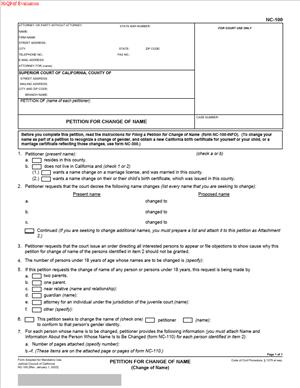
NC-100 – Petition for Change of Name
Fill out nowJurisdiction: Country: United States | Province or State: California
The NC-100 – Petition for Change of Name is the main court form used to ask a California court to legally change a person’s name. It starts the formal court process. When you file this document, you are asking a judge to issue an order recognizing your new name.
You use this form when you want your new name to be legally recognized for identification, records, and official purposes. This includes government IDs, school records, bank accounts, and other legal documents. The court does not automatically change your name without this petition.
This form is often used by adults changing their own name. It is also used by parents or guardians requesting a name change for a child. In some cases, a guardian may file on behalf of a person under their care.
Filing the NC-100 – Petition for Change of Name matters because a legal name change affects many parts of your life. Employers, financial institutions, and public agencies typically require a court order before updating your records. This form is the first step toward obtaining that order.
What is NC-100 – Petition for Change of Name?
Clear definition
The NC-100 – Petition for Change of Name is a formal written request submitted to a California superior court. It tells the court who you are, what name you currently use, and what new name you want.
The form includes identifying details about the person whose name will change. It may also require information about residence, relationships, and whether the request involves a minor. The petition becomes part of the court record once filed.
This document does not change your name by itself. It begins a legal process that may include publication, notice, and a hearing. The court reviews the information and, if approved, issues a separate order granting the name change.
Who typically uses this form?
Adults who want to change their legal name commonly use this form. This may include people returning to a previous name or choosing a completely new one.
Parents often use the form to request a name change for their minor child. In those cases, one or both parents may be involved, depending on custody and notice requirements.
Legal guardians may also file the petition for someone under their care. This can apply when the person cannot file on their own.
In some situations, multiple people in the same household file related petitions. For example, a parent and child may both request a change at the same time.
Why might you need this form?
You may need this form if you want your new name to be legally recognized across all official records. Without a court order, many institutions will not update your information.
A legal name change can help align your name with your identity. It can also help create consistency across documents such as licenses, passports, and school records.
In some cases, a name change supports family unity. For example, a parent may want a child’s last name to match the rest of the household.
You may also need a court-approved name change if your current name creates ongoing confusion or administrative problems. A formal order reduces disputes about your identity.
Typical real-life scenarios
- An adult decides to adopt a new last name after marriage, but did not change it at the time of the marriage. Years later, they want all records to match the name they use socially. They filed the petition to formalize the change.
- A parent with primary custody wants their child’s last name to match their own. The parent files the petition and follows the court process so the child’s school and medical records can be updated.
- An individual has used a nickname for many years and wants that name to appear on official documents. They use the petition to request that the nickname become their legal name.
- A family wants to simplify or shorten a surname that is frequently misspelled. They file the form so future legal and financial records reflect the corrected version.
- An adult who changed their name informally in the past now wants a court order to avoid problems with employment background checks and identification documents. The petition provides a clear legal record of the change.
When would you use NC-100 – Petition for Change of Name?
You would use this form when you want a court-recognized name change in California. The process generally begins by filing this petition with the superior court in the county where the person lives.
Adults use it when they want to change their first name, middle name, last name, or any combination of these. The form is not limited to a specific type of name change.
Parents or guardians use it when requesting a change for a minor. In these situations, the court may look closely at notice requirements and the interests of the child.
You may also use this form when you need formal documentation for government records. Agencies commonly require a certified court order before updating identification or benefit records.
The form is used at the start of the process. It is typically followed by additional forms and steps, such as publishing notice of the request and attending a court hearing, depending on the circumstances.
Legal characteristics of NC-100 – Petition for Change of Name
This petition is a formal court filing. It must be completed accurately and filed with the correct court to move forward. The information you provide becomes part of the court record.
For the petition to be effective, it must contain complete and consistent information. Names must match across related forms. Addresses and identifying details must be clear and legible.
Common issues that cause delays include missing signatures, incorrect case information, or incomplete sections. Inaccurate spelling of the current or proposed name can also create problems later when updating official records.
In many cases, the process involves giving notice of the proposed name change. This may include publishing information in a newspaper or providing notice to another parent. Failure to complete the required notice steps can delay or prevent approval.
High-level differences may exist depending on whether the request involves an adult or a minor. Courts often review minor name changes with additional care, especially if both parents do not agree.
It is important to understand what this form does not do. It does not automatically update your identification, financial accounts, or other records. It also does not change parental rights, custody arrangements, or legal responsibilities.
Is it legally binding?
The petition itself is not legally binding. It is a request. It asks the court to approve a change, but it does not create any legal effect on its own.
The legally binding document is the court’s order granting the name change. Once signed by a judge and entered into the court record, that order serves as official proof of your new name.
After the court issues the order, government agencies and private institutions generally accept certified copies as evidence of the legal change. The binding effect comes from the court’s authority, not from the petition alone.
If the court denies the request, no legal name change occurs. The petition remains part of the record, but it does not alter your legal identity without a signed order.
How to fill out NC-100 – Petition for Change of Name
Step 1 – Identify the court and case information
At the top of the form, fill in the name of the superior court and the branch where you are filing. Include the court’s address and any required contact information. If you already have a case number, enter it in the designated space. If not, the clerk typically assigns one when you file.
Step 2 – Provide the petitioner information
List the name of the person filing the petition. If you are changing your own name, you are the petitioner. If you are filing for a minor or another person, include your name and indicate your role, such as parent or guardian.
Step 3 – Identify the person whose name will change
Enter the current legal name of the person whose name will be changed. This must match their existing legal records. If the petition involves more than one person, ensure each name is clearly listed in the appropriate section.
Step 4 – State the proposed new name
Write the exact new name requested. Check spelling carefully. The new name entered here is the name that will appear on the court order if approved.
Step 5 – Provide details about the person
Complete the sections that ask for information such as date of birth, place of birth, and current residence. For minors, include information about parents or guardians as required by the form.
Step 6 – Address parental or guardian information for minors
If the request involves a child, provide the names and addresses of the parents. The form may ask whether both parents are living and whether one or both are filing. Ensure all required details are filled in clearly.
Step 7 – Declare reasons for the name change
State the reason for the requested change in the space provided. Keep the explanation clear and concise. The form generally asks for a brief description rather than a long statement.
Step 8 – Review for accuracy and consistency
Read the entire document from start to finish. Confirm that the current name and proposed name are spelled the same way throughout all related forms. Check dates, addresses, and identifying details for accuracy.
Step 9 – Sign and date the petition
Sign the form where indicated. By signing, you confirm that the information provided is true to the best of your knowledge. Enter the date of your signature in the appropriate space.
Step 10 – Prepare for filing
Make copies of the completed petition as required for filing. Keep a copy for your records. The original is typically submitted to the court clerk as part of the name change filing process.
Legal terms you might encounter in NC-100 – Petition for Change of Name
- Petitioner: The petitioner is the person who is asking the court for the name change. On this form, you are the petitioner if you are changing your own name. If you are changing a minor’s name, you are the petitioner as the parent or guardian filing on their behalf.
- Proposed Name: This is the exact new name you want the court to approve. You must write it clearly and consistently. The spelling, spacing, and order of names matter because this is the name that will appear in the court order.
- Minor: A minor is a person under 18 years old. If the name change is for a minor, the form requires additional details about parents or guardians and may require notice to the other parent.
- Guardian: A guardian is a person appointed to care for a minor or another person who cannot manage their own affairs. If you are a legal guardian filing for a name change, you must indicate your authority and may need to provide proof of guardianship.
- Jurisdiction: Jurisdiction refers to the court’s legal authority to decide your case. On this form, you confirm that you are filing in the correct county and that the person whose name is changing lives there.
- Order to Show Cause: This is a separate court document that may be issued after you file the petition. It sets a hearing date and may require public notice of the proposed name change. The petition triggers this next step in the process.
- Declaration: A declaration is a written statement made under penalty of perjury. When you sign the petition, you are declaring that everything in the document is true and correct to the best of your knowledge.
- Case Number: The case number is assigned by the court clerk when you file your paperwork. You will write this number on all related documents so the court can track your case.
- Notice: Notice means formally informing others about the requested name change. In some cases, you may need to notify another parent or publish notice of the hearing, depending on the situation.
- Decree or Order: This is the final court document that approves the name change. The petition is your request. The order is the judge’s official decision granting or denying it.
FAQs
When does my name legally change?
Your name does not change when you submit this document. It changes only after a judge signs the final order approving your request. The effective date is usually the date the judge signs that order. You should not start using the new name for official records until you have a signed court order.
Do I need to list every name I have ever used?
You must list the current legal name of the person whose name will change. If the form asks for other names used, include them exactly as they appear on official records. This helps the court match your identity with existing documents and avoids confusion or delays.
What if I am changing the name of my child, and the other parent disagrees?
When you file NC-100 – Petition for Change of Name for a minor, the other parent may need to be notified. If they object, the court may set a hearing so both sides can speak. You should carefully complete all parent information sections so the court knows who has legal rights related to the child.
Do I need to attach any other documents to this form?
In many situations, this form is filed together with other required documents, such as an attachment listing multiple people whose names will change or a proposed order. If you are a guardian, you may need to attach proof of your authority. Review the filing instructions carefully and confirm that all required attachments are included before you submit your paperwork.
Can I correct a mistake after I file?
If you notice a small clerical error before the hearing, you may be able to file an amended petition. If the mistake appears in the signed order, you may need to ask the court to correct it. Always check spelling, dates, and birth information before filing to avoid extra steps later.
Is there a hearing for every name change request?
Often, yes. After you file, the court may schedule a hearing date. The details will appear in a separate document issued by the court. You should attend unless the court specifically tells you that your appearance is not required.
What happens if the court denies my request?
If the judge does not approve your request, you will receive a court order explaining the decision. The order may describe what information was missing or what legal requirement was not met. You may be able to correct the issue and refile, depending on the reason for denial.
Will this form change my name on my birth certificate and other records automatically?
No. NC-100 – Petition for Change of Name asks the court to approve your new name, but it does not update your other records by itself. After you receive a signed court order, you must contact each agency or institution separately to update identification, financial accounts, and other documents.
Checklist: Before, During, and After NC-100 – Petition for Change of Name
Before
- Confirm you meet residency requirements for filing in the county.
- Gather identification documents showing your current legal name.
- Decide on the exact spelling and format of your proposed new name.
- Verify birth dates and places of birth for accuracy.
- Collect information about parents or guardians if filing for a minor.
- Review any prior court orders related to custody or guardianship.
- Prepare payment for filing fees or complete a fee waiver request if needed.
During
- Write your current legal name exactly as it appears on official records.
- Enter the proposed new name clearly and consistently.
- Complete all sections about residence and county.
- Fill in the parent or guardian information if the petition involves a minor.
- Double-check all dates, spellings, and identifying details.
- Sign and date the petition where required.
- Make copies of the completed form before filing.
After
- File the petition with the court clerk and obtain a case number.
- Keep stamped copies of all documents for your records.
- Review any notice or hearing date issued by the court.
- Complete any publication or notice requirements if ordered.
- Attend the scheduled hearing if required.
- Obtain certified copies of the signed court order once approved.
- Use the certified order to update identification and official records.
Common mistakes to avoid with NC-100 – Petition for Change of Name
- Mistake: Misspelling your proposed new name because you typed it quickly or changed your mind mid-form, which can lead to an incorrect court order and force you to file corrections later; do not forget to proofread every instance of the new name.
- Mistake: Leaving out information about a parent when changing a minor’s name because you assume it is not necessary, which can delay the case or cause the court to reject the filing; do not forget to include complete parent details.
- Mistake: Using a nickname instead of your full legal name because that is what you commonly go by, which creates mismatches with your identification documents; do not forget to match the exact name on your government ID.
- Mistake: Filing in the wrong county because you recently moved or use a mailing address elsewhere, which can result in dismissal for lack of jurisdiction; do not forget to confirm your current county of residence.
- Mistake: Forgetting to sign and date the petition because you focused on filling in the main sections, which makes the form incomplete and subject to rejection; do not forget your signature under penalty of perjury.
- Mistake: Failing to bring required copies to the clerk because you assumed the court would make them for you, which can slow down filing or increase costs; do not forget to prepare multiple copies in advance.
- Mistake: Ignoring notice or publication instructions because they seem separate from the petition, which can prevent the judge from granting the request; do not forget to complete every additional step ordered by the court.
- Mistake: Not reviewing the signed order for accuracy because you assume the court entered everything correctly, which can leave you with an order that contains errors; do not forget to check all details before leaving the courthouse.
What to do after filling out NC-100 – Petition for Change of Name
Once you complete the form, your next focus is proper filing and follow-through. Accuracy and organization will save you time.
- Step 1: Make at least two copies of the completed petition before you file it.
- Step 2: Assemble all required accompanying documents, including any attachments and a proposed order.
- Step 3: Submit the original and copies to the court clerk for filing and pay the required filing fee or submit a fee waiver request.
- Step 4: Receive your filed copies back from the clerk with a case number stamped on them.
- Step 5: Review any documents the clerk gives you, including a hearing date or instructions about notice or publication.
- Step 6: Complete any required notice steps, such as serving another parent or arranging publication, within the stated deadlines.
- Step 7: Prepare for your hearing by bringing filed copies and any required proof of notice.
- Step 8: Attend the hearing on time and answer the judge’s questions clearly and directly.
- Step 9: If the judge approves your request, obtain several certified copies of the signed order from the clerk.
- Step 10: Store one certified copy in a safe place and use the others to update your Social Security record, driver’s license, bank accounts, school records, and other official documents.
- Step 11: Keep a checklist of each agency you contact and note the date you submitted your updated information.
- Step 12: Confirm that each institution has processed the change and that your new name appears correctly in their records.
Careful follow-through ensures your new legal name is recognized everywhere it needs to be. Treat the court order as your key document and protect it accordingly.
Disclaimer: This guide is provided for informational purposes only and is not intended as legal advice. You should consult a legal professional.