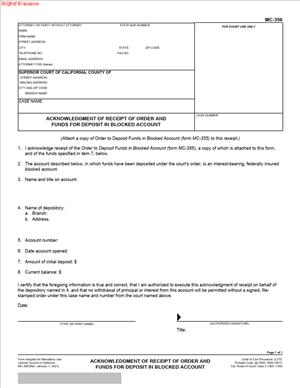
MC-356 – Acknowledgment of Receipt of Order and Funds for Deposit in Blocked Account
Fill out nowJurisdiction: Country: United States | Province or State: California
MC-356 – Acknowledgment of Receipt of Order and Funds for Deposit in Blocked Account is a court-related form used in California when money must be placed into a restricted bank account under a court order. It confirms that a financial institution has received both the court’s order and the funds and has deposited those funds into a blocked account.
You will usually see this form in cases involving minors or people who cannot manage their own finances. The court may require that settlement funds or other payments be protected in a blocked account. This form serves as written proof that the account was properly set up.
If you are handling a settlement, guardianship matter, or another court-supervised financial issue, this document helps close an important loop. It tells the court that the money is secured and cannot be withdrawn without further court approval.
When you are about to fill it out, you want to understand what information the bank must complete, what details must match the court order, and how the document becomes part of the court record.
What is MC-356 – Acknowledgment of Receipt of Order and Funds for Deposit in Blocked Account?
Clear definition
MC-356 – Acknowledgment of Receipt of Order and Funds for Deposit in Blocked Account is a confirmation form signed by a financial institution. It states that the bank has received a court order directing that money be placed in a blocked account and that the funds have been deposited accordingly.
A blocked account is a bank account with restrictions. Funds cannot be withdrawn without a specific court order. The purpose is to protect the money until a future event occurs, such as a minor turning 18 or a judge approving a withdrawal.
This form is not the order itself. It does not create the blocked account. Instead, it confirms that the order has been carried out.
Who typically uses this form?
This form is typically used by people involved in court cases where money must be protected. That often includes parents or guardians of minors, conservators, trustees, or individuals handling settlements.
Attorneys frequently prepare the paperwork, but self-represented individuals may also handle it. If you are managing a settlement for a minor without a lawyer, you may encounter this form during the process.
The financial institution plays a key role. A bank representative usually completes and signs the acknowledgment portion. Without the bank’s confirmation, the court may not consider the blocked account properly established.
Court clerks also review this document once it is filed. It becomes part of the official case record.
Why might you need this form?
You may need this form after a judge orders that certain funds be deposited into a blocked account. This often happens in cases involving personal injury settlements for minors or people under conservatorship.
Courts use blocked accounts to ensure the money is not spent without oversight. The acknowledgment provides evidence that the money is protected exactly as the judge required.
If you fail to submit proof that the funds were deposited, the court may not finalize or close part of your case. The form helps demonstrate compliance with the court’s instructions.
It also protects you. Once the bank signs and the form is filed, you have written proof that the funds were transferred and restricted as ordered.
Typical real-life scenarios
- A minor receives a settlement from a car accident claim. The court approves the settlement but orders that the funds be deposited into a blocked account until the child turns 18. After depositing the money, the bank completes this form to confirm that the account is properly restricted.
- A conservator is appointed to manage finances for an adult who cannot manage their own affairs. The court orders a portion of the person’s assets to be placed in a blocked account. The bank acknowledges receipt of both the order and the funds using this document.
- A lawsuit involving a minor resolves before trial. The settlement agreement requires court approval. The judge signs an order directing that net proceeds be deposited in a blocked account. This form is used to confirm that the deposit occurred under the court’s conditions.
- An estate matter involves funds designated for a minor beneficiary. The court orders the funds to remain inaccessible until a specified age. After the account is created and funded, the acknowledgment is completed and filed to show compliance.
- In each of these situations, the core issue is the same. The court wants proof that the money is secure and cannot be accessed without permission. This form provides that proof.
When would you use MC-356 – Acknowledgment of Receipt of Order and Funds for Deposit in Blocked Account?
You would use MC-356 – Acknowledgment of Receipt of Order and Funds for Deposit in Blocked Account after a judge signs an order requiring funds to be placed into a blocked account. It is not used before the order exists. The court’s directive comes first.
Typically, the sequence looks like this. A settlement or financial decision is approved. The court issues an order directing that specific funds be deposited into a blocked account. You then take the order and the funds to a financial institution. After the deposit, the bank completes and signs the acknowledgment form.
This form is commonly used in civil cases involving minors. It may also appear in probate or conservatorship proceedings. The key factor is that the court has required restricted handling of funds.
If you are self-represented, you may be responsible for delivering the order to the bank and ensuring the acknowledgment is completed. In some cases, an attorney coordinates the process. Regardless of who manages it, the court expects confirmation.
The form is used at a specific stage in the case. It usually follows approval of funds and precedes final confirmation that court conditions have been met. Timing matters because the court may require proof of deposit within a certain period after issuing the order.
Legal characteristics of MC-356 – Acknowledgment of Receipt of Order and Funds for Deposit in Blocked Account
This form functions as written confirmation from a financial institution. Its effectiveness depends on accurate information and proper completion. The names, case number, and deposit amount must match the court order exactly.
For the document to be valid in practice, it must be signed by an authorized representative of the financial institution. Courts generally expect clear identification of the bank and confirmation that the account is blocked according to the order’s terms.
Common problems include mismatched case numbers, incorrect deposit amounts, or missing signatures. If the amount listed on the form differs from the court’s order, the court may require clarification. If the account is not clearly identified as blocked, the court may question whether the funds are adequately protected.
The form does not replace the court order. It does not authorize withdrawals or changes. It only confirms receipt and deposit of funds under the existing order.
While the structure of blocked account requirements may vary in different states, this specific form is designed for use in California court proceedings. Other jurisdictions may use different forms or procedures for similar purposes.
Is it legally binding?
The acknowledgment itself is not a contract between you and the bank in the usual sense. It is a formal confirmation tied to a court order. Its legal effect comes from its role in documenting compliance with that order.
When the bank signs the form, it is representing that it has received the court’s directive and the funds and that the account is blocked as required. Courts rely on that representation.
The form becomes part of the official court file once submitted. In that context, it carries legal weight because it documents that the court’s instructions have been followed. If the information is inaccurate, it could create issues in the case record.
However, the authority to control the funds comes from the judge’s order, not from the acknowledgment itself. The form reflects compliance. It does not create new rights or permissions.
How to fill out MC-356 – Acknowledgment of Receipt of Order and Funds for Deposit in Blocked Account
Step 1 – Review the court order
Start by carefully reading the court order that requires the blocked account. Confirm the exact amount to be deposited, the name of the beneficiary, and any specific restrictions described in the order. The information on the form must match this order exactly.
Step 2 – Complete the case information section
Enter the court name, case title, and case number as they appear on the official documents. Use the same spelling and formatting shown in the court file. Inconsistent case details can delay processing or raise questions.
Step 3 – Provide the beneficiary’s information
Fill in the name of the person whose funds are being deposited. This is often a minor or a conservatee. Ensure the name matches the court order and other filed documents without variation.
Step 4 – Confirm the amount deposited
State the exact dollar amount that was placed into the blocked account. This figure must be identical to the amount required by the court, unless the order allows for a specific calculation, such as net proceeds after approved expenses. Double-check the numbers before submitting.
Step 5 – Identify the financial institution
Enter the name and address of the bank where the blocked account has been opened. The institution must be clearly identified so the court can verify where the funds are held. Accuracy here is important for recordkeeping and future reference.
Step 6 – Acknowledge receipt of the court order
The form includes language confirming that the financial institution has received a copy of the court’s order. Ensure that the bank representative understands that the account is subject to court restrictions and cannot be accessed without further order.
Step 7 – Bank representative signature
An authorized bank officer or employee must sign the acknowledgment. The signature confirms that the institution has accepted the funds under the specified restrictions. The representative typically prints their name and title along with the date of signing.
Step 8 – Review for consistency and completeness
Before filing, compare the completed form against the court order and any related settlement documents. Check names, case numbers, and amounts. Make sure all required fields are filled and the bank’s signature is present.
Step 9 – File the completed form with the court
Once signed, submit the completed acknowledgment to the appropriate court as part of your case record. After filing, retain a copy for your records so you can show that the funds were deposited and the blocked account was properly established.
Legal terms you might encounter in MC-356 – Acknowledgment of Receipt of Order and Funds for Deposit in Blocked Account
- Blocked Account: A bank account that restricts withdrawals without a court order. The funds cannot be accessed freely, even by the account holder. In this document, the bank confirms that the money is placed into this restricted account under court authority.
- Court Order: A written directive signed by a judge. It authorizes the deposit of funds into a blocked account and sets conditions for release. This form confirms that the bank received and is complying with that order.
- Beneficiary: The person whose money is being protected in the blocked account. Often, this is a minor or someone under a conservatorship. The beneficiary’s name must match exactly what appears in the court order and case caption.
- Conservator: A person appointed by the court to manage someone else’s financial affairs. If a conservatorship exists, the conservator may be involved in arranging the deposit. However, the funds remain restricted until the court allows withdrawal.
- Guardian: A court-appointed individual responsible for a minor’s personal or financial matters. In cases involving minors, a guardian may coordinate the deposit, but the bank still controls access based on the court’s restrictions.
- Principal Amount: The total sum deposited into the blocked account. This amount must match the figure listed in the court order. The form records this exact amount to avoid disputes later.
- Financial Institution: The bank or credit union where the blocked account is opened. An authorized representative from this institution signs the document to confirm receipt of both the funds and the court order.
- Case Number: The unique identifier assigned by the court to the legal matter. It ensures the acknowledgment is filed in the correct case. Any mismatch can delay court processing.
- Authorized Representative: A bank employee with authority to sign on behalf of the financial institution. This person certifies that the deposit complies with the court order. The court relies on this signature as confirmation.
- Restricted Withdrawal: A limitation preventing any withdrawal unless the court issues another order. The blocked account operates under this condition. The form indirectly confirms that this restriction is in place.
FAQs
Who is responsible for completing and signing this document?
The financial institution completes and signs it. You usually provide the court order and the funds to the bank, but a bank officer or authorized employee fills in the deposit details and signs to confirm receipt. Make sure the signer has authority to bind the institution, or the court may reject the filing.
What information must match exactly between the court order and this form?
The case number, beneficiary’s name, and deposit amount must match word for word and digit for digit. Even small spelling differences or number errors can cause the clerk to question the filing. Double-check the caption at the top of the order and compare it carefully before submission.
Does the effective date matter for this document?
Yes. The date the bank signs confirms when the funds were actually placed into the blocked account. Courts use that date to verify compliance with deadlines in the original order. Make sure the signing date reflects the real deposit date.
Do I need to attach a copy of the court order when filing this form?
In many situations, the court already has the order in the case file. However, you should confirm whether the clerk expects a copy attached for processing. If you include one, ensure it is a complete and legible copy so the court can easily verify compliance.
What happens if the beneficiary’s name is slightly different from other court documents?
The court may delay acceptance until the discrepancy is resolved. The name on this document should match the court order exactly, including middle initials or suffixes. If you notice an inconsistency, address it before filing to avoid extra steps later.
Can funds be withdrawn once MC-356 – Acknowledgment of Receipt of Order and Funds for Deposit in Blocked Account is filed?
No. Filing this document does not authorize withdrawal. It only confirms that the funds are safely deposited under restriction. A separate court order is required before any money can be released from the blocked account.
What if the bank refuses to sign or delays completion?
Without the bank’s acknowledgment, the court has no proof that the funds are protected. Speak with a branch manager or authorized officer who understands court-ordered blocked accounts. Ensure they review the court order carefully so they feel comfortable signing.
Will filing this document change the public record in my case?
Yes. Once filed and accepted, it becomes part of the official court file. It shows the judge that the deposit requirement has been satisfied. Anyone reviewing the case record will see confirmation that the funds are secured according to the order.
Checklist: Before, During, and After MC-356 – Acknowledgment of Receipt of Order and Funds for Deposit in Blocked Account
Before
- Obtain a certified copy of the court order directing the blocked deposit.
- Verify the exact deposit amount required.
- Confirm the correct spelling of the beneficiary’s full legal name.
- Check the case number and court location.
- Contact the financial institution to confirm that they handle blocked accounts.
- Ask what identification or documents the bank requires.
- Prepare the full deposit amount in the required form.
- Review any deadline stated in the court order.
During
- Provide the bank with a complete copy of the court order.
- Confirm the account is titled exactly as required by the order.
- Ensure the deposit amount matches the court’s instructions.
- Review the completed form before the bank signs it.
- Check that the authorized representative signs and dates the document.
- Verify that the bank includes its name and branch information.
- Confirm that no required fields are left blank.
- Request a copy immediately after signing.
After
- Make at least two copies of the signed document.
- File the original with the court clerk.
- Confirm the clerk stamps or endorses the filing.
- Keep a stamped copy for your records.
- Calendar any future review dates mentioned in the order.
- Store the court order and acknowledgment together.
- Inform any interested parties that the deposit has been confirmed.
- Monitor the case docket to ensure acceptance is recorded.
Common mistakes to avoid with MC-356 – Acknowledgment of Receipt of Order and Funds for Deposit in Blocked Account
- Mistake: Depositing the wrong amount because you estimated interest or fees, which happens when you do not follow the exact order, leading to rejection by the court; do not forget to match the principal amount exactly as written.
- Mistake: Using a nickname or shortened name for the beneficiary, which happens out of habit, causing filing delays; do not forget to copy the full legal name from the court order.
- Mistake: Allowing an unauthorized bank employee to sign, which occurs when staff are unfamiliar with court forms, resulting in court refusal; do not forget to confirm the signer’s authority.
- Mistake: Filing a copy without a signature, which happens when scanning too early, making the acknowledgment invalid; do not forget to check for an original signature and date.
- Mistake: Missing the court deadline, which often happens when waiting too long to schedule the bank appointment, risking compliance issues; do not forget to calendar deadlines immediately.
- Mistake: Forgetting to file the form after the bank signs it, which happens when you assume the bank submits it, leaving the court without proof; do not forget that you are usually responsible for filing.
- Mistake: Listing an incorrect case number, which occurs when you copy from memory instead of the order, causing misfiling in another case; do not forget to verify directly from official documents.
- Mistake: Failing to keep copies, which happens when you rely on the court’s file, making future verification harder; do not forget to store stamped copies securely.
What to do after filling out MC-356 – Acknowledgment of Receipt of Order and Funds for Deposit in Blocked Account
Once the financial institution signs the form, your job is not quite finished. You still need to make sure the court receives and accepts it. This step closes the loop and shows you complied with the judge’s order.
Start by reviewing the signed document carefully. Confirm that the case number, beneficiary’s name, deposit amount, bank information, signature, and date are all present and correct. Small errors can slow down processing.
- Step 1: Make at least two clear copies of the fully signed document.
- Step 2: Separate the original from your copies and keep them organized.
- Step 3: Submit the original to the court clerk for filing, following the court’s standard filing process.
- Step 4: Ask the clerk to stamp your copies as “filed” or “endorsed.”
- Step 5: Verify that the filing is entered into the court’s case record.
- Step 6: Store one stamped copy with your important legal papers.
- Step 7: Provide a copy to the conservator, guardian, or other required party if applicable.
- Step 8: Review the original court order for any future reporting or review dates.
- Step 9: Note that withdrawals require a new court order and plan accordingly.
- Step 10: Keep contact information for the financial institution in case the court requests clarification later.
Maintain a simple recordkeeping system. Keep the court order, the filed acknowledgment, and any related correspondence together. If the case continues for several years, organized records will save you time and stress.
If the court later schedules a hearing or requests proof of compliance, bring a stamped copy of the filed document. This shows you followed the judge’s instructions and protected the funds as required.
Finally, monitor the status of the blocked account. While you cannot access the funds without another court order, you remain responsible for understanding the account’s existence and purpose. Clear documentation now prevents confusion later.
Disclaimer: This guide is provided for informational purposes only and is not intended as legal advice. You should consult a legal professional.