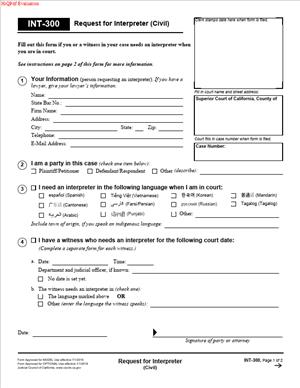
INT-300 – Request for Interpreter (Civil)
Fill out nowJurisdiction: Country: United States | Province or State: California
If you need language assistance in a California civil court case, INT-300 – Request for Interpreter (Civil) is the form used to ask the court to provide an interpreter. This document tells the court that you, or someone involved in your case, need help understanding or speaking English during court proceedings.
This form matters because court hearings move quickly. Judges, attorneys, and clerks use legal terms and formal procedures. If you cannot fully understand what is being said, you risk missing important information or deadlines.
INT-300 – Request for Interpreter (Civil) is used in civil cases. Civil cases include disputes between individuals or organizations, such as contract issues, property matters, restraining orders, and other non-criminal court proceedings.
The form is part of the California court system’s process for making court services accessible. Filing it properly helps the court plan ahead and arrange for a qualified interpreter for your hearing or trial.
Understanding how this document works will make the filing process smoother and reduce delays in your case.
What is INT-300 – Request for Interpreter (Civil)?
Clear definition
INT-300 – Request for Interpreter (Civil) is a court form used in California civil cases to formally ask the court to provide an interpreter for a hearing or other court event. It identifies the person who needs the interpreter, the language required, and the specific court date.
The form becomes part of your case record once submitted. It notifies court staff that language assistance is needed so they can schedule a qualified interpreter for your proceeding.
This document is administrative in nature. It does not argue your case or present evidence. Its purpose is limited to arranging language access services.
Who typically uses this form?
Self-represented individuals often use this form when they are involved in a civil case and do not speak or understand English well enough to participate fully.
Attorneys may also file this form on behalf of their clients. In some cases, a party may request an interpreter for a witness who will testify.
People who are involved in restraining order hearings, family law matters, small claims appeals, landlord-tenant disputes, or civil harassment cases may need to submit this document.
Court-appointed guardians, conservators, or representatives sometimes use the form if the person they represent needs language assistance.
Why might you need this form?
You may need this form if English is not your primary language and you are not comfortable speaking or understanding it in a legal setting.
Court proceedings involve specific terminology. Even if you can manage everyday English, you may find legal discussions difficult to follow.
You might also need an interpreter if you can understand some English but cannot confidently speak it in front of a judge. Clear communication is essential when answering questions or giving testimony.
Requesting an interpreter in advance helps prevent confusion during your hearing. It also reduces the risk of misunderstandings that could affect your case.
Typical real-life scenarios
- You filed a request for a civil restraining order and received a hearing date. You understand very little English. To explain your situation clearly to the judge, you submit this form asking for an interpreter in your primary language.
- You are being sued in a contract dispute. You received court papers in English but relied on someone else to explain them to you. For your upcoming court appearance, you want a professional interpreter present so you can respond directly to the judge.
- You are a witness in a landlord-tenant case. One of the parties asked you to testify, but you are not fluent in English. The party or their attorney may request an interpreter for you using this form.
- You are involved in a civil harassment case. You can speak basic English but struggle with complex questions. You request an interpreter to make sure you understand each question before answering.
- In each situation, the form serves the same purpose. It alerts the court that language assistance is needed for a specific person and a specific event.
When would you use INT-300 – Request for Interpreter (Civil)?
You use INT-300 – Request for Interpreter (Civil) when you have an upcoming court date in a California civil case and need an interpreter for that event.
Timing is important. Courts schedule interpreters based on advance notice. Filing the form as soon as you receive your hearing date helps the court make arrangements.
This form is generally used before hearings, trials, settlement conferences, or other court appearances where spoken communication will occur. It is not typically used for filing written documents.
If your case has multiple hearings, you may need to request an interpreter for each one, depending on court procedures and how the interpreter is scheduled.
Parties in the case, their attorneys, or sometimes court staff may identify the need for an interpreter. However, the request usually must be formally submitted so the court can confirm the language and the date.
If your language needs change, or if an interpreter is no longer required, you may need to update the court. The form focuses on specific events rather than creating a permanent designation for your entire case.
Legal characteristics of INT-300 – Request for Interpreter (Civil)
This form functions as a formal request within the court’s administrative system. It becomes effective once it is properly completed and submitted to the appropriate court handling your case.
For the request to be processed smoothly, the information must match your case exactly. This includes the case number, party names, and hearing date. Errors in these details can cause delays or confusion.
Courts generally require the language to be clearly identified. Vague descriptions may create problems when staff attempt to assign an interpreter. Accuracy helps ensure that the correct language professional is scheduled.
Common issues that may lead to delays include incomplete fields, missing signatures if required, or filing the form too close to the hearing date. Courts often need a reasonable time to arrange services.
This document does not change the substance of your case. It does not affect deadlines, claims, defenses, or court orders. Its role is limited to requesting language access.
Procedures may vary slightly between counties. Some courts may have specific filing methods, such as submitting the form in person, by mail, or electronically. The underlying purpose of the document remains consistent across California civil courts.
Is it legally binding?
INT-300 – Request for Interpreter (Civil) is not a contract between you and another party. It does not create legal obligations in the same way an agreement does.
However, once submitted and accepted, it becomes part of the official court record. The court may rely on the information you provide when arranging interpreter services.
Providing accurate information is important. If the court schedules an interpreter based on your request, the interpreter’s time is reserved for your hearing.
The form itself does not guarantee a specific outcome in your case. It also does not guarantee that a particular individual will serve as the interpreter. The court assigns interpreters according to its procedures and availability.
In short, the document is procedurally significant but not legally binding in the contractual sense. Its effect is administrative, focused on ensuring access to the court process.
How to fill out INT-300 – Request for Interpreter (Civil)
Step 1 – Identify the court and case information
At the top of the form, you will enter the name of the court where your civil case is filed. This includes the county and the court’s address.
You will also provide your case number exactly as it appears on other court documents. Accuracy here is critical. The court uses this number to connect your request to the correct file.
Next, list the names of the parties in the case. These names must match the official case caption. Do not shorten or alter them.
Step 2 – Provide your contact information
The form typically asks for the name, address, phone number, and other contact details of the person making the request.
If you are self-represented, you will enter your own information. If an attorney is submitting the form, the attorney’s details may be listed instead.
Make sure the contact information is current. The court may use it if there are questions about your request or changes to your hearing.
Step 3 – Identify the person who needs the interpreter
You will indicate who requires language assistance. This may be you, another party, or a witness.
Clearly state the person’s role in the case, such as plaintiff, defendant, petitioner, respondent, or witness. This helps the court understand how the interpreter will be used during the proceeding.
Only list individuals who actually need interpretation services for that specific hearing.
Step 4 – Specify the language needed
The form requires you to state the language for which you are requesting an interpreter.
Write the language clearly and completely. Avoid general descriptions. If the language has regional variations, provide the most accurate information you can.
This section is important because the court must assign a qualified interpreter in the correct language. Mistakes here can lead to scheduling problems.
Step 5 – Provide details about the hearing or court event
You will enter the date, time, and department or courtroom number for the hearing where the interpreter is needed.
Make sure this information matches your hearing notice exactly. Courts often have multiple departments operating on the same day.
If your case involves more than one scheduled event, complete the form with the details for the specific event requiring interpretation.
Step 6 – Indicate the type of case
The form may ask you to identify the general category of your civil case, such as family law, restraining order, small claims appeal, or other civil matter.
Select or write the category that best matches your case. This helps court staff prioritize and coordinate interpreter assignments based on case type.
Providing accurate information here ensures that the interpreter is scheduled in the correct courtroom and for the correct proceeding.
Step 7 – Review the form for completeness and accuracy
Before submitting the document, read through each section carefully.
Confirm that the case number, party names, language, and hearing details are correct. Small errors can delay processing.
Make sure all required fields are filled in. Incomplete forms may not be accepted or may require follow-up.
Step 8 – Sign and date the form if required
Some versions of the form require a signature. If a signature line is present, sign your name and enter the date.
By signing, you confirm that the information provided is true and correct to the best of your knowledge.
If an attorney or authorized representative is submitting the form, that person may sign instead.
Step 9 – Submit the form to the appropriate court
File the completed form with the court handling your civil case. Submission methods vary by court and may include in-person filing, mailing, or electronic filing.
Ensure that the form is submitted with enough time before your hearing to allow the court to arrange an interpreter.
After submission, keep a copy for your records. This helps you confirm what was requested and when it was filed.
Legal terms you might encounter in INT-300 – Request for Interpreter (Civil)
- Limited English Proficiency (LEP): This refers to a person’s limited ability to read, speak, write, or understand English. On this form, you are asking the court to recognize that someone involved in the case has limited English proficiency and needs language assistance. The court uses this information to decide whether to provide a qualified interpreter.
- Court Interpreter: A court interpreter is a person certified or registered to translate spoken language during court proceedings. In this document, you are requesting that the court assign a qualified interpreter for a specific language at a specific hearing. The interpreter must accurately translate everything said in court.
- Certified Interpreter: This is an interpreter who has passed state-required exams and meets official standards. In many courts, certified interpreters are required for certain languages. When you request an interpreter, the court will determine whether a certified interpreter is available and required for your situation.
- Court Proceeding: A court proceeding includes hearings, trials, conferences, and other scheduled events in your case. You must list the exact proceeding for which you need an interpreter. This ensures the interpreter is scheduled for the correct date, time, and courtroom.
- Case Number: The case number is the unique identifier assigned to your lawsuit. You must enter it exactly as it appears on your court documents. If the case number is wrong or incomplete, the court may not connect your request to the right file.
- Party: A party is a person or entity directly involved in the lawsuit, such as a plaintiff or defendant. On this form, you must identify whether the interpreter is needed for a party, a witness, or someone else. The court uses this to understand the person’s role in the case.
- Hearing Date: This is the scheduled date for your court event. You must provide the correct hearing date so the court can arrange for the interpreter to be present. If the hearing is continued or rescheduled, you may need to update your request.
- Language Dialect: Some languages have multiple dialects. If the person needing an interpreter speaks a specific dialect, you should clearly state it. This helps avoid misunderstandings and ensures accurate communication during the proceedings.
- Court Order: A court order is an official decision or directive from a judge. After you submit this form, the court may issue an order confirming that an interpreter will be provided. Always review any order carefully so you understand what has been approved.
FAQs
Do I need to file INT-300 – Request for Interpreter (Civil) for every court date?
You should request an interpreter for each specific hearing or proceeding listed on the form. If you already have future hearings scheduled, check whether you need to submit a separate request for each date. Always confirm that the hearing date and department you list match the official court notice.
What information must match my court documents exactly?
Your case number, case name, and court location must match exactly what appears on your other court papers. Even a small error in the case number can delay processing. Double-check spelling, spacing, and numbers before you submit this document.
Can I request an interpreter for a witness?
Yes, this form allows you to identify the person who needs language assistance, including a witness. Be clear about the person’s role in the case. The court needs this information to decide whether to approve and schedule the interpreter.
What if I do not know the exact courtroom or department yet?
Provide as much information as you have, including the hearing date and time. If the courtroom or department is missing from your notice, check your most recent scheduling document. If details change later, update the court promptly so your interpreter request stays accurate.
Is there a deadline to submit this form?
Courts expect interpreter requests to be filed as early as possible before the hearing date. Filing late can make it harder for the court to arrange a qualified interpreter. Look at your hearing notice and plan to submit this form well in advance.
Do I have to pay for the interpreter after filing this document?
In many civil cases, the court may provide a qualified interpreter without charging you. However, the court decides based on the type of case and the person requesting assistance. After filing INT-300 – Request for Interpreter (Civil), watch for confirmation from the court about whether an interpreter has been assigned.
What happens after I submit INT-300 – Request for Interpreter (Civil)?
The court reviews your request and checks interpreter availability for the language and date listed. You may receive a notice, minute order, or other confirmation that an interpreter will be provided. Keep a copy of that confirmation with your case records.
What if my hearing date changes after I file this form?
If the hearing is continued or rescheduled, you should not assume the interpreter will automatically be reassigned. Confirm with the court that language services are still scheduled for the new date. If necessary, submit an updated request with the correct hearing details.
Checklist: Before, During, and After INT-300 – Request for Interpreter (Civil)
Before
- Review your hearing notice and confirm the exact date, time, and department.
- Verify your case number and case name on recent court documents.
- Confirm the full and correct name of the person who needs the interpreter.
- Identify the exact language and dialect, if applicable.
- Check whether additional hearings are already scheduled.
- Gather contact information in case the court needs clarification.
- Read the entire form once before filling it out.
During
- Print clearly or type to avoid unreadable information.
- Enter the case number exactly as shown on court papers.
- List the correct hearing date and time.
- Clearly identify whether the person is a party, witness, or other participant.
- Specify the language without abbreviations.
- Review each section before moving to the next.
- Confirm that all required fields are completed.
After
- Make at least one copy of the completed form for your records.
- Submit the form to the correct court clerk’s office.
- Note the date you filed or delivered the form.
- Check your mail or online case portal for confirmation.
- Bring a copy of your request to the hearing.
- If the hearing is rescheduled, verify interpreter coverage.
- Keep all related court notices together in one file.
Common mistakes to avoid with INT-300 – Request for Interpreter (Civil)
- Mistake: Entering the wrong case number because you rely on memory, which can cause the court to misfile your request and delay approval, so do not forget to copy the number directly from your latest court document.
- Mistake: Listing the wrong hearing date because you confuse multiple scheduled events, which may result in no interpreter being present, so do not forget to confirm the exact date and time from the official notice.
- Mistake: Failing to specify the correct language or dialect because you assume the court will guess, which can lead to communication problems in court, so do not forget to clearly write the full language name.
- Mistake: Waiting until the last minute to submit the form because you underestimate scheduling needs, which may leave the court without time to assign an interpreter, so do not forget to file as early as possible.
- Mistake: Assuming the interpreter will automatically transfer to a new date after a continuance, which can result in no language support at the rescheduled hearing, so do not forget to confirm coverage if the date changes.
- Mistake: Forgetting to keep a copy of your completed form because you think the court will track everything, which can create confusion later, so do not forget to store a copy with your case records.
- Mistake: Leaving required sections blank because you are unsure about a detail, which may cause the clerk to reject or delay the request, so do not forget to review the entire form for completeness.
- Mistake: Misspelling the name of the person who needs the interpreter because you rush through the form, which can create identification issues, so do not forget to double-check spelling against official documents.
What to do after filling out INT-300 – Request for Interpreter (Civil)
Once you complete the form, pause and review every entry. Small errors can slow down processing. Make sure names, dates, and the case number match your official court papers exactly.
- Step 1: Make at least two copies of the completed form—one for your records and one in case you need a stamped copy.
- Step 2: Submit the original form to the clerk’s office for the court where your case is pending, following that court’s filing procedures.
- Step 3: If filing in person, ask the clerk to stamp your copy as “filed” so you have proof of submission.
- Step 4: If submitting by mail or electronically, keep proof of delivery or confirmation of receipt.
- Step 5: Check your mail, email, or online case portal for confirmation that the court received and processed your request.
- Step 6: Review any notice or court order carefully to confirm that an interpreter has been assigned for the correct language and hearing date.
- Step 7: If you do not receive confirmation within a reasonable time before your hearing, contact the clerk’s office to verify the status.
- Step 8: If your hearing date, time, or department changes, promptly confirm that interpreter services are still scheduled.
- Step 9: Bring a copy of your filed request and any confirmation with you to court.
- Step 10: Arrive early on the hearing date and inform court staff that an interpreter has been requested so they can direct you appropriately.
Keep all documents related to your interpreter request in the same folder as your case filings. This helps you stay organized and respond quickly if the court asks questions. Staying proactive ensures you or the person involved can fully understand and participate in the proceeding.
Disclaimer: This guide is provided for informational purposes only and is not intended as legal advice. You should consult a legal professional.