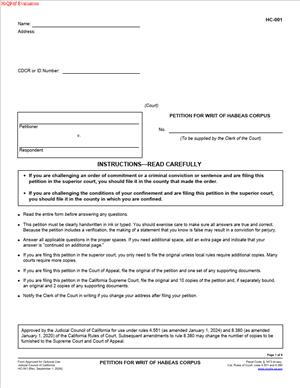
HC-001 – Petition for Writ of Habeas Corpus
Fill out nowJurisdiction: Country: United States | Province or State: California
The HC-001 – Petition for Writ of Habeas Corpus is a court form used in California to ask a judge to review whether someone is being lawfully held in custody. You use this document to challenge the legal basis for a detention, conviction, or sentence.
This form is often filed by people who are in jail, prison, or another form of custody. It may also be prepared by someone acting on their behalf. The goal is to explain why the custody violates constitutional or legal rights.
If you are about to complete the HC-001 – Petition for Writ of Habeas Corpus, you need to understand what the court expects. The form is structured to gather specific facts, procedural history, and legal claims. Clear and organized information matters.
This document is not a simple complaint. It is a formal request asking a court to examine whether a person’s confinement is lawful. Courts review these petitions carefully and require detailed information to move forward.
What is HC-001 – Petition for Writ of Habeas Corpus?
Clear definition
HC-001 – Petition for Writ of Habeas Corpus is a standardized California Superior Court form used to request a writ of habeas corpus. A writ of habeas corpus is a court order directing a custodian, such as a jail or prison official, to justify why a person is being held.
In plain terms, this form starts a legal proceeding that challenges custody. The petitioner argues that the detention is unlawful due to legal errors, constitutional violations, or other serious problems.
The form guides you through identifying the person in custody, the facility, the case details, and the specific reasons the custody is unlawful. It creates a written record for the court’s review.
Who typically uses this form?
This form is commonly used by individuals who are currently in custody in California. That includes people in county jail, state prison, or certain other detention settings.
It may also be used by someone on behalf of the detained person, such as a family member or legal representative, if the detained person cannot file on their own.
In many situations, the petitioner is self-represented. The form is designed to collect the information the court needs, even if no attorney is involved.
Why might you need this form?
You might need this form if you believe your custody violates your rights. That could involve claims about ineffective assistance of counsel, newly discovered evidence, sentencing errors, or constitutional violations during trial.
You may also use it to challenge the conditions or duration of confinement if those conditions directly affect the legality of the custody.
Another reason involves procedural issues. For example, if you believe deadlines, notice requirements, or due process standards were not followed, this form provides a structured way to raise those issues.
The form allows you to present facts and legal arguments together. The court then decides whether to order a response from the custodian or deny the petition.
Typical real-life scenarios
- A person convicted of a crime believes their trial attorney failed to investigate key evidence. After sentencing, they filed this petition arguing that the inadequate representation violated their constitutional rights.
- An incarcerated person discovers new evidence that was not available at trial and could affect the outcome. They use the form to explain how the new information changes the legal analysis of their conviction.
- A detainee claims that their sentence was calculated incorrectly, resulting in a longer period of confinement than authorized. The petition explains the alleged calculation error and requests correction.
- Someone held in custody after a parole decision may argue that the decision process did not follow the required procedures. The petition outlines how the process was flawed and why that affects the legality of the detention.
When would you use HC-001 – Petition for Writ of Habeas Corpus?
You use this form when you are challenging the legality of the current custody in a California state court. It is typically filed after other legal remedies, such as a direct appeal, have been completed or are not available.
In many cases, habeas corpus is used when new facts or constitutional claims arise outside the original trial record. If the issue cannot be resolved through a standard appeal alone, a habeas petition may be the procedural vehicle.
People often use it after conviction and sentencing. However, it may also be used in pretrial detention situations if there are serious legal defects affecting the custody.
The person filing is called the petitioner. The respondent is usually the warden, sheriff, or official in charge of the facility. The court reviewing the filing is typically the California Superior Court in the county connected to the custody or conviction.
Timing can matter. Courts may examine whether the petition was filed within a reasonable period after discovering the issue. Delays may require explanation within the form.
Legal characteristics of HC-001 – Petition for Writ of Habeas Corpus
This form initiates a special type of civil proceeding. It is not a new criminal trial. Instead, it asks the court to review whether the existing custody complies with constitutional and legal standards.
For the petition to move forward, it must state specific facts. General complaints or unsupported conclusions often lead to summary denial. Courts typically look for detailed descriptions of what happened, when it happened, and how it violated legal rights.
Supporting documentation strengthens the filing. That may include court records, transcripts, declarations, or other evidence referenced in the petition. The form usually asks whether supporting documents are attached.
Common problems include incomplete sections, missing case numbers, unclear claims, or failure to explain prior appeals or petitions. Courts often require you to disclose whether similar claims were raised before and how they were resolved.
Jurisdictional rules may vary depending on the level of court. Some petitions begin in the Superior Court, while others may proceed to higher courts after denial. The procedural path can differ based on the type of custody and the stage of the case.
This form does not automatically release someone from custody. Filing it starts a review process. The court may deny the petition without a hearing, request a response, or set further proceedings.
Is it legally binding?
The petition itself is not a binding agreement between the parties. It is a formal request for judicial action. Its legal effect comes from the court’s response, not from the filing alone.
Once properly filed, the document becomes part of the court record. Statements made in the petition are submitted under penalty of perjury if the form includes a verification section. That verification gives the factual claims legal weight.
If the court issues a writ or order to show cause, that order is legally binding on the respondent. The respondent must then justify the custody or comply with the court’s directions.
If the court grants relief, the resulting order can change custody status, require a new hearing, or direct other corrective action. The petition is the mechanism that begins that process.
How to fill out HC-001 – Petition for Writ of Habeas Corpus
Step 1 – Identify the petitioner
Enter the full legal name of the person in custody. Provide the identification number used by the facility, such as a booking or inmate number. List the current place of confinement and its address.
Make sure the name matches official records. Inconsistent names or numbers can delay review.
Step 2 – Identify the respondent
State the name and title of the person who has custody over the petitioner. This is often the warden, sheriff, or facility administrator. Use the official title as it appears in public records.
This identifies who must respond if the court issues an order.
Step 3 – Provide case information
List the court that entered the judgment or order being challenged. Include the case number, year, and type of case. Provide details about the conviction, sentence, or other custody-related order.
Accurate case information helps the court locate the correct file quickly.
Step 4 – Describe the custody being challenged
Explain whether you are challenging a conviction, sentence, parole decision, or other form of detention. State the date of the judgment or decision and the length or terms of custody.
Be precise about what part of the custody you claim is unlawful.
Step 5 – State the grounds for relief
Clearly describe each legal ground supporting the petition. Present one ground at a time. For each ground, explain the facts and how those facts violate constitutional or legal standards.
Avoid vague statements. Provide dates, names, and specific actions or omissions.
Step 6 – Explain prior proceedings
Indicate whether the issues were raised on direct appeal or in prior petitions. Summarize what happened in those proceedings, including outcomes and dates.
If a claim was not raised earlier, explain why. Courts often review this section carefully.
Step 7 – Attach supporting documents
Reference any documents that support your claims. Attach copies if available. Label them clearly so the court can connect each document to the related ground.
If documents are unavailable, explain what they are and why they are not attached.
Step 8 – Request relief
State what outcome you are asking the court to order. This may include release, a new hearing, resentencing, or another corrective action.
Be specific about the result you seek.
Step 9 – Sign and date the form
Complete the verification section. Sign and date the petition where indicated. By signing, you confirm that the information is true to the best of your knowledge.
Check that all sections are complete before submission. Ensure attachments are included and pages are properly organized.
Legal terms you might encounter in HC-001 – Petition for Writ of Habeas Corpus
- Petitioner: This is the person asking the court for relief. In this document, the petitioner is usually the person in custody. You must enter the full legal name exactly as it appears on court or custody records to avoid confusion or rejection.
- Respondent: This is the person or official who has custody over the petitioner. It is often a jail warden, prison superintendent, or other government official. The name and title must be accurate because the court directs the order to this person.
- Custody: Custody means physical detention or legal restraint. In this document, you must clearly describe where you are being held and under what authority. The court uses this information to confirm it has the power to review your situation.
- Grounds for Relief: These are the legal reasons you believe your custody is unlawful. You must state specific facts, not just conclusions. The court reviews these grounds to decide whether a hearing or response is required.
- Declaration: A declaration is a written statement signed under penalty of perjury. When you sign the form, you confirm that everything you wrote is true and correct. False statements can lead to penalties or dismissal.
- Perjury: Perjury means knowingly making false statements under oath or penalty of perjury. Because you sign this document under penalty of perjury, accuracy is critical. Even small exaggerations can damage your credibility.
- Exhibits: Exhibits are supporting documents attached to your petition. These may include court orders, transcripts, or disciplinary records. You must label and organize them so the court can easily match them to your claims.
- Verification: Verification is the act of confirming that the information provided is true. In this form, your signature serves as verification. Without it, the court may reject the filing.
- Relief Requested: This section explains what you want the court to do. You might request release, a new hearing, or correction of a legal error. Be clear and specific so the court understands the outcome you are seeking.
FAQs
What information must I include to properly complete HC-001 – Petition for Writ of Habeas Corpus?
You must provide your full legal name, current place of custody, the name and title of the person holding you, and the case details connected to your detention. Include the court name, case number, and dates of key orders. Clearly state the facts supporting your claim and sign the document under penalty of perjury.
How detailed do my grounds for relief need to be?
You should describe specific events, dates, and actions that show why your custody is unlawful. Avoid general statements like “my rights were violated.” Instead, explain what happened, who was involved, and how it affected your case. The court relies on these details to decide whether to request a response.
Do I need to attach copies of prior court decisions?
Yes. Attach copies of judgments, sentencing orders, appellate opinions, or other rulings related to your claims. Label each attachment and refer to it in your explanation. This helps the court verify your history without searching for the records.
What if I have filed other petitions before?
You must disclose prior petitions or appeals that raised similar issues. Include the court name, case number, and outcome. The court checks this information to determine whether your claims were already decided.
Who signs this document and where?
The petitioner signs the verification section at the end of the document. Use your legal name exactly as written at the top. If someone else prepares the paperwork for you, you still sign unless you are legally unable to do so.
What happens after I submit this form to the court?
The clerk reviews it for completeness and assigns or confirms a case number. A judge may issue an order to show cause, deny the petition, or request additional information. You will receive written notice of the court’s action.
Can I update the petition if I forgot something?
If you realize you left out key facts or documents, you may need to file an amended or supplemental petition. Clearly identify what you are adding or correcting. Keep copies of both versions for your records.
Does filing this form automatically stop my custody?
No. Filing this document does not automatically change your custody status. The court must review the petition and issue an order before any change occurs.
Checklist: Before, During, and After HC-001 – Petition for Writ of Habeas Corpus
Before
- Confirm your full legal name matches custody and court records.
- Gather case numbers, court names, and copies of judgments or orders.
- Identify the correct respondent with official title and spelling.
- Outline the key facts and dates supporting your claim.
- Collect supporting documents and organize them by issue.
- Review prior petitions or appeals you have filed.
- Check that you understand the relief you want the court to grant.
During
- Print or type clearly and legibly.
- Complete every required section without leaving blanks.
- State facts in chronological order.
- Reference exhibits directly in your explanation.
- Label each attachment clearly.
- Use consistent case numbers throughout the document.
- Sign and date the verification section.
- Review for spelling errors in names and case details.
After
- Make copies of the full petition and all attachments.
- Submit the original to the correct court clerk.
- Confirm receipt or obtain a file-stamped copy.
- Keep a complete copy for your records.
- Note the case number assigned to your petition.
- Watch for written notices or court orders.
- Respond promptly to any request for additional information.
- Store all related documents together for easy access.
Common mistakes to avoid with HC-001 – Petition for Writ of Habeas Corpus
- Mistake: Naming the wrong respondent because you assume any official will do, which can cause delays or dismissal; verify the exact custodian, and do not forget to include their official title.
- Mistake: Writing vague claims without facts because you feel frustrated, which makes it hard for the court to evaluate your case; include dates, actions, and supporting details, and do not forget to attach proof.
- Mistake: Leaving out prior petitions because you think they are irrelevant, which can harm credibility and lead to denial; disclose all previous filings, and do not forget case numbers and outcomes.
- Mistake: Failing to sign under penalty of perjury because you overlook the verification section, which results in rejection; always review the final page, and do not forget to date your signature.
- Mistake: Submitting incomplete attachments due to missing pages, which prevents the court from confirming your claims; check each exhibit carefully, and do not forget page numbers.
- Mistake: Using nicknames or different name formats, which can create record mismatches; use your full legal name consistently, and do not forget to match custody records.
- Mistake: Ignoring formatting or legibility because you are rushing, which may cause clerical rejection; write clearly and do not forget to review readability.
- Mistake: Assuming filing changes your custody immediately, which leads to confusion and missed deadlines; wait for a court order, and do not forget to monitor mail for updates.
What to do after filling out HC-001 – Petition for Writ of Habeas Corpus
Once you complete the document, slow down and review everything carefully. Accuracy at this stage prevents delays later. Check names, dates, and case numbers against official paperwork. Make sure every page is included and in the correct order.
- Step 1: Review the entire petition from start to finish for completeness and consistency.
- Step 2: Confirm that all attachments are labeled and referenced in the main document.
- Step 3: Sign and date the verification section under penalty of perjury.
- Step 4: Make at least one complete copy for your records.
- Step 5: Prepare the original packet in the order required by the court.
- Step 6: Submit the petition to the appropriate clerk’s office using the accepted filing method.
- Step 7: Obtain confirmation of filing, such as a file-stamped copy or receipt.
- Step 8: Record the assigned case number and keep it with your documents.
- Step 9: Monitor your mail or institutional correspondence system for court notices.
- Step 10: Respond promptly to any order requesting clarification, additional documents, or a reply.
Keep all documents related to your petition together in one folder. If the court issues an order to show cause or sets a hearing, review your original filing before responding. Stay organized. Track deadlines carefully. Clear records and timely responses improve your ability to manage the process effectively.
Disclaimer: This guide is provided for informational purposes only and is not intended as legal advice. You should consult a legal professional.