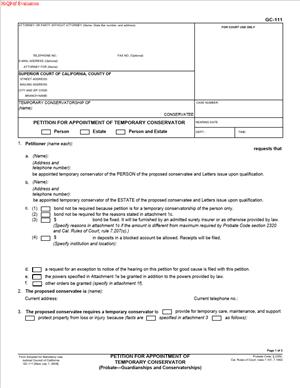
GC-111 – Petition For Appointment of Temporary Conservator
Fill out nowJurisdiction: Country: United States | Province or State: California
If you are preparing the GC-111 – Petition For Appointment of Temporary Conservator, you are asking a California court to step in quickly to protect an adult who cannot manage their own affairs. This form starts a request for temporary authority over someone’s personal care, finances, or both.
GC-111 – Petition for Appointment of Temporary Conservator is used in urgent situations. It is not for long-term planning alone. It focuses on immediate risk, harm, or loss that could happen before a regular conservatorship hearing takes place.
You complete this document as part of a court filing in the Superior Court of California. It is often filed alongside a general petition for appointment of a conservator. The temporary request addresses short-term needs while the full case moves forward.
If you are about to fill it out, you need to understand what temporary conservatorship means, what facts the court expects, and how detailed your explanation must be. Courts look closely at emergency requests. Clear and specific information matters.
What is GC-111 – Petition For Appointment of Temporary Conservator?
Clear definition
GC-111 – Petition For Appointment of Temporary Conservator is a court form used to request the appointment of a temporary conservator for an adult in California. A temporary conservator is someone given short-term authority to make decisions for a person who cannot manage their own personal care or financial matters.
This form tells the court who needs help, what kind of help is needed, and why the situation cannot wait for a regular hearing. It sets out the facts that support an urgent appointment.
The document is part of a conservatorship case. It does not, by itself, appoint anyone. A judge reviews the filing and decides whether to grant temporary powers.
Who typically uses this form?
Family members often complete this form. This may include adult children, spouses, parents, or siblings of the person who needs protection.
In some cases, a professional fiduciary or another interested person files it. The person filing the petition is called the petitioner. The person who may need a conservator is called the proposed conservatee.
You use this form when you are asking the court to give someone temporary authority over the proposed conservatee’s personal care, finances, or both.
Why might you need this form?
You may need this form when there is an immediate risk to the person’s health, safety, or financial security. The court generally requires a clear explanation of what could happen if no one is given the authority right away.
Temporary conservatorship can help prevent financial exploitation. It can also allow someone to arrange medical care, secure housing, or access funds to pay essential bills.
Without temporary authority, you may not be able to speak with doctors, access bank accounts, or make placement decisions. This form asks the court to bridge that gap until a full hearing is held.
Typical real-life scenarios
- An elderly parent with dementia may be living alone and refusing necessary medical care. They may forget to eat, take medication incorrectly, or leave the stove on. Family members may need legal authority immediately to arrange safe care.
- A person may be hospitalized after a serious injury and unable to communicate. Bills are due, and no one has access to their accounts. Temporary authority may be needed to manage urgent financial matters.
- An adult with cognitive impairment may be the target of financial scams. Large withdrawals or unusual transfers may already have occurred. A temporary conservator can seek to freeze accounts or prevent further losses.
- A landlord may be threatening eviction because rent has not been paid. The proposed conservatee may not understand the notices. A temporary conservator may need authority to address housing issues quickly.
- In each of these situations, waiting several weeks for a standard hearing could cause harm. The form explains why immediate court action is necessary.
When would you use GC-111 – Petition For Appointment of Temporary Conservator?
You use this form when there is urgency. The key factor is timing. The court considers whether harm is likely to occur before the regular conservatorship hearing can be held.
This may involve medical emergencies. For example, consent may be required for surgery or treatment. If the person lacks capacity and no valid power of attorney exists, a temporary conservator may be needed to give consent.
Financial emergencies are also common. Accounts may need to be protected. Property may need to be secured. Insurance may need to be maintained to prevent lapse.
You may also use this form when the proposed conservatee is at risk of abuse, neglect, or exploitation. Temporary authority can allow someone to intervene and arrange safer living conditions.
Typically, the petitioner is also asking to be appointed as the permanent conservator in a separate filing. The temporary request does not replace the general petition. It addresses the period before the full court review.
The roles involved often include the petitioner, the proposed conservatee, close relatives, and sometimes a court investigator. Each has a defined role in the broader conservatorship process.
Legal characteristics of GC-111 – Petition For Appointment of Temporary Conservator
This form is a formal court pleading. It becomes effective only if a judge signs an order granting the requested temporary powers. Simply completing or submitting it does not create authority.
For the court to consider it valid, the form must be completed accurately and filed with the appropriate court. Required attachments and related documents are often part of the same submission. Missing information can delay review.
Clarity is critical. Courts typically look for specific facts rather than general statements. Vague claims such as “they cannot manage their affairs” may not be enough without examples or recent events that show urgency.
Common issues that cause problems include incomplete identification information, inconsistent dates, and failure to explain why the situation cannot wait. If the urgency is not clearly described, the court may deny the temporary request and proceed only with the standard process.
Temporary conservatorship laws can vary between states. In California, the Superior Court oversees conservatorship matters, and the process follows state probate rules. Procedures, notice requirements, and timelines may differ elsewhere.
This form does not grant permanent control. It does not resolve long-term disputes among family members. It does not remove a person’s rights beyond what the court specifically authorizes for a limited period.
Is it legally binding?
The GC-111 – Petition For Appointment of Temporary Conservator itself is not legally binding. It is a request. It becomes meaningful only if the court issues an order appointing a temporary conservator.
If the judge signs the order, the temporary conservator gains legal authority defined by that order. The authority is limited in scope and duration. It typically lasts until a set date or until the court makes a further decision.
Once appointed, the temporary conservator is legally responsible for acting within the powers granted. Acting beyond those powers can create legal consequences. The binding effect comes from the court’s order, not from the petition alone.
How to fill out GC-111 – Petition For Appointment of Temporary Conservator
Step 1 – Identify the court and case information
Start by entering the name of the Superior Court and the county where the case is filed. Include the court’s address and branch location if required. If a case number has already been assigned in a related conservatorship petition, enter it exactly as shown. If not, leave that space for the court clerk.
Step 2 – Provide the petitioner information
Fill in your full legal name, address, and contact information in the section for the petitioner. Make sure the spelling matches other documents in the case. If more than one person is filing, list each petitioner as directed on the form.
Step 3 – Identify the proposed conservatee
Enter the full legal name, age, and residence information of the proposed conservatee. Accuracy is important. Use the person’s legal name as it appears on identification or prior court records. This ensures the court’s order clearly applies to the correct individual.
Step 4 – State the type of temporary conservatorship requested
Indicate whether you are asking for a temporary conservator of the person, of the estate, or both. A conservator of the person handles personal and medical decisions. A conservator of the estate manages financial matters. Choose the option that matches the urgent needs described in your filing.
Step 5 – Explain the emergency and the need for immediate action
Describe in detail the facts that show urgency. Focus on recent events and specific risks. Include dates, actions taken, and what could happen if no temporary conservator is appointed. Avoid general statements. The court needs clear examples that demonstrate immediate danger or loss.
Step 6 – Describe the powers requested
List the specific powers you are asking the court to grant. These may include access to bank accounts, authority to consent to medical treatment, or the ability to arrange housing. Make sure the powers requested connect directly to the emergency described earlier in the form.
Step 7 – Provide information about the notice
Complete the section that addresses notice to relatives and interested persons. Indicate who has been informed about the temporary request or who will be notified. Follow the structure of the form carefully so the court can see that the required parties are identified.
Step 8 – Sign and date the petition
Review the entire document for accuracy and completeness. Sign and date the petition where indicated. Your signature confirms that the information provided is true to the best of your knowledge. Once signed, the form is ready to be submitted to the court as part of your temporary conservatorship filing.
Legal terms you might encounter in GC-111 – Petition For Appointment of Temporary Conservator
- Temporary Conservator: A person the court appoints for a short period to manage the personal care, finances, or both, of someone who cannot manage on their own. In this form, you identify who you want appointed and what authority they should have. The appointment lasts only until a full hearing or further court order.
- Proposed Conservatee: The adult who needs immediate protection. You must clearly state this person’s full legal name and identifying details exactly as they appear in court records. This ensures the order applies to the correct individual.
- Emergency Circumstances: The urgent facts that justify temporary action. The form requires you to explain what immediate harm may occur without court intervention. This section is critical because temporary conservatorships are granted only when delay would cause serious problems.
- Powers Requested: The specific legal authority you want the temporary conservator to have. You must check or describe each power carefully, such as managing bank accounts or making medical decisions. The court will limit its authority to what you request and justify.
- Ex Parte Request: A request for the court to act quickly, sometimes without full advance notice to all parties. In this context, you may be asking the court to appoint a temporary conservator before a regular hearing. You must explain why standard notice procedures are not enough.
- Notice of Hearing: The formal way you inform relatives and interested parties that a temporary conservatorship is being requested. The form asks you to confirm who has been notified and how. Proper notice affects whether the court will consider your request.
- Conservatorship of the Person: Authority over personal and medical decisions. If you request this type, you must show why the proposed conservatee cannot handle daily living or healthcare decisions. The form distinguishes this from financial control.
- Conservatorship of the Estate: Authority over financial matters. This may include paying bills, managing assets, or protecting property. You must describe why immediate financial oversight is necessary.
- Declaration: A written statement you sign under penalty of perjury. Parts of this form function as a declaration, meaning you are swearing that the information is true. False statements can have serious legal consequences.
- Court Order: The official document signed by a judge after reviewing your petition. The petition itself does not grant authority. Only a signed order gives the temporary conservator legal power to act.
FAQs
Do I need to file GC-111 – Petition For Appointment of Temporary Conservator at the same time as a regular conservatorship petition?
In most cases, yes. This document usually supports a pending general conservatorship case. When you complete it, check that the case number matches the main conservatorship filing. If there is no existing case number, you must confirm whether one needs to be opened before the court can process your request.
What specific emergency details should I include in this form?
You should describe immediate risks, not general concerns. State what is happening now, what could happen in the next few days or weeks, and why waiting for a regular hearing would cause harm. Include dates, recent events, financial losses, medical neglect, or unsafe living conditions so the court can see the urgency clearly in this document.
How do I know which powers to request for the temporary conservator?
Review each category of authority listed in the form and select only what is necessary to address the emergency. For example, if bills are unpaid and utilities are at risk of being shut off, you may need financial powers. If there is a medical crisis, you may need authority over healthcare decisions. The court will look at whether the requested powers match the emergency you describe.
What happens if I leave a section blank?
Leaving required sections blank can delay review or result in rejection. Court staff may return the filing for correction. If a section does not apply, confirm whether you should mark it as not applicable rather than skipping it. Make sure names, dates, and requested powers are complete before submitting.
Who must receive notice of this request?
You typically must notify close relatives and other legally interested parties. This document asks you to state who was notified and how. If you request reduced notice due to urgency, you must explain why giving full notice is not practical and what steps you took instead.
When does the temporary conservator’s authority actually begin?
Authority begins only after the judge signs an order appointing the temporary conservator. Filing the petition does not create any power. After approval, confirm the effective date written in the signed order and keep certified copies available for banks, healthcare providers, or other institutions.
Do I need to attach additional documents to support my request?
Yes, you may need supporting declarations or evidence that explains the emergency in more detail. Attach any documents referenced in your explanation, such as medical statements or financial records. Make sure attachments are clearly labeled and referenced in the petition so the court can connect them to your claims.
What if the proposed conservatee disagrees with the temporary appointment?
The proposed conservatee has the right to object. The court may schedule a hearing and review your written statements and any objections. Be sure your information in the GC-111 – Petition For Appointment of Temporary Conservator is accurate, specific, and supported by facts, because the judge will rely heavily on what you submit in writing.
Checklist: Before, During, and After GC-111 – Petition For Appointment of Temporary Conservator
Before
- Confirm that a general conservatorship case is filed or ready to be filed.
- Gather full legal names, addresses, and contact details for all parties.
- Collect documents that show the emergency, such as unpaid bills or medical reports.
- Decide whether you are requesting conservatorship of the person, estate, or both.
- Review which specific powers are truly necessary for immediate protection.
- Identify relatives and interested persons who must receive notice.
- Check that you have the correct case number and court location.
- Prepare a clear timeline of recent events showing urgency.
During
- Complete every required field legibly and accurately.
- Match the proposed conservatee’s name exactly to other court filings.
- Clearly describe emergency circumstances with dates and details.
- Select only the powers that relate directly to the emergency.
- Confirm that your contact information is current and complete.
- Sign and date the petition where required.
- Attach supporting declarations and label them properly.
- Review the entire packet for missing pages or unchecked boxes.
After
- Make the required number of copies for filing and service.
- File the original with the court clerk using the approved method.
- Pay any required filing fees or submit a fee waiver if eligible.
- Obtain stamped copies for your records.
- Arrange for proper notice or service on required individuals.
- Calendar the hearing date and any response deadlines.
- Bring certified copies of the signed order to financial or medical institutions.
- Keep a secure file with all filed documents and proof of service.
- Monitor the expiration date of the temporary appointment.
Common mistakes to avoid with GC-111 – Petition For Appointment of Temporary Conservator
- Mistake: Requesting broad powers without explaining the emergency, which happens when you copy standard language, leading the court to deny or limit authority; do not forget to connect each power directly to a specific urgent fact.
- Mistake: Using inconsistent names or misspellings, often caused by rushing or copying from memory, which can create confusion in court records; do not forget to match the exact legal name across all filings.
- Mistake: Failing to describe immediate harm, because you assume the situation is obvious, which may result in the judge refusing temporary relief; do not forget to include dates, recent incidents, and specific risks.
- Mistake: Skipping notice details, usually due to uncertainty about who must be informed, which can delay the hearing; do not forget to clearly state who was notified and how.
- Mistake: Submitting incomplete attachments, often because supporting documents were not organized in advance, which weakens your request; do not forget to label and reference each attachment in the petition.
- Mistake: Believing that filing the petition grants authority automatically, which happens when you misunderstand the process, potentially causing unauthorized actions; do not forget that only a signed court order creates legal power.
- Mistake: Waiting too long to file despite urgent circumstances, often due to hesitation, which may increase harm to the proposed conservatee; do not forget that temporary conservatorship is designed for immediate protection.
- Mistake: Not tracking the temporary order’s expiration date, which happens when focus shifts to the general case, possibly leaving you without authority; do not forget to monitor timelines and prepare for the next hearing.
What to do after filling out GC-111 – Petition For Appointment of Temporary Conservator
Once you finish completing the petition, pause before filing. Read every page slowly. Check spelling, dates, and selected powers. Make sure your explanation of the emergency is clear and specific. Confirm that all attachments are included and labeled.
You are responsible for making sure the court receives a complete packet. An incomplete filing can delay urgent protection.
- Step 1: Make at least two copies of the entire signed petition, including attachments.
- Step 2: Organize the documents in the correct order, with the petition on top and supporting declarations behind it.
- Step 3: File the original with the clerk of the appropriate Superior Court location handling conservatorships.
- Step 4: Pay the filing fee or submit any required fee waiver forms at the time of filing.
- Step 5: Obtain stamped copies showing the filing date for your records.
- Step 6: Follow court instructions for giving notice to required individuals, and prepare proof of service forms.
- Step 7: Calendar the hearing date and set reminders for service deadlines.
- Step 8: Prepare for the hearing by organizing your evidence and reviewing your written statements.
- Step 9: If the court signs a temporary order, request certified copies from the clerk.
- Step 10: Provide certified copies to banks, healthcare providers, or other institutions that require proof of authority.
- Step 11: Keep detailed records of any actions taken under the temporary authority.
- Step 12: Prepare for the general conservatorship hearing, since the temporary appointment will expire unless extended or replaced.
Stay organized. Keep a dedicated folder for court documents, proof of service, and certified orders. Record key dates, including expiration of the temporary appointment and the next hearing. Acting carefully and promptly helps protect the proposed conservatee and keeps you in compliance with court requirements.
Disclaimer: This guide is provided for informational purposes only and is not intended as legal advice. You should consult a legal professional.