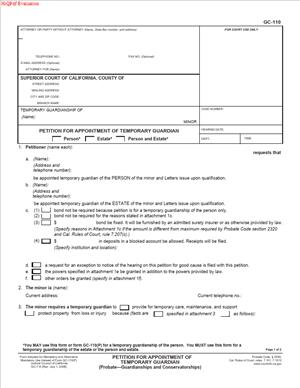
GC-110 – Petition for Appointment of Temporary Guardian (Probate – Guardianship and Conservatorships)
Fill out nowJurisdiction: Country: United States | Province or State: California
The GC-110 – Petition for Appointment of Temporary Guardian (Probate – Guardianship and Conservatorships) is a court form used when a child needs immediate protection, and someone must step in right away. It is part of the probate court guardianship process in California.
This form is not for long-term planning alone. It is for urgent situations where waiting for a regular guardianship hearing could put a child at risk. The court reviews it quickly because it involves a minor’s safety and well-being.
You may be filling this out because something unexpected happened. A parent may be hospitalized. A caregiver may have been arrested. A child may be left without proper supervision. In those moments, the court needs clear and specific information.
Understanding what this document asks for makes the process less overwhelming. When you know what the court is looking for, you can provide focused details instead of general statements.
This guide explains what the form does, when it is used, and how to complete it step by step in a clear and organized way.
What is GC-110 – Petition for Appointment of Temporary Guardian (Probate – Guardianship and Conservatorships)?
Clear definition
GC-110 – Petition for Appointment of Temporary Guardian (Probate – Guardianship and Conservatorships) is a formal written request asking the probate court to appoint a temporary guardian for a minor child.
A temporary guardian is someone the court authorizes to care for the child for a short period. This may include making decisions about housing, medical care, and schooling. The authority lasts only until the court ends it or appoints a general guardian.
This form starts the temporary guardianship portion of a case. It is often filed together with a petition for general guardianship, which is a longer-term arrangement.
Who typically uses this form?
This form is commonly used by relatives. Grandparents, aunts, uncles, adult siblings, or other family members may file it when a child’s parents cannot provide care.
Non-relatives may also use it if they have been caring for the child and need legal authority. For example, a close family friend who has been acting as a caregiver may need court approval to enroll the child in school or consent to medical treatment.
In some cases, a proposed general guardian files this form while waiting for a full guardianship hearing. The temporary appointment bridges the gap during an emergency.
Why might you need this form?
You might need this form when there is an immediate risk to a child’s health, safety, or welfare. Probate courts treat these requests seriously because they affect a child’s living situation and legal rights.
Temporary guardianship allows someone to make decisions without delay. Schools, doctors, and other institutions often require formal legal authority before accepting instructions from someone who is not a parent.
The form also creates a clear court record. It explains why emergency action is necessary and who is asking for authority. That record matters if questions arise later.
Typical real-life scenarios
- A parent is suddenly hospitalized after a serious accident. No other legal caregiver is available, and the child needs someone authorized to make medical decisions. A relative files for temporary guardianship so they can step in immediately.
- A single parent is detained and cannot arrange care. The child is staying with a family member, but that person cannot enroll the child in school without legal authority. A temporary guardian appointment provides that authority while the situation is sorted out.
- A child has been living in unsafe conditions. Another adult takes the child in and seeks emergency court approval to ensure stability and access to services. The court reviews whether immediate intervention is justified.
- A parent struggles with a crisis that prevents safe supervision. A trusted adult requests temporary guardianship so the child has structured care while longer-term arrangements are considered.
- In each of these situations, the key factor is urgency. The court looks for clear facts showing why waiting for a regular hearing is not practical or safe.
When would you use GC-110 – Petition for Appointment of Temporary Guardian (Probate – Guardianship and Conservatorships)?
You use this form when a child cannot safely remain without immediate legal oversight, and there is no existing guardian with authority to act.
It is commonly filed at the same time as a petition for appointment of a general guardian. The temporary request addresses the short-term emergency. The general petition addresses long-term care and custody.
Timing matters. This form is typically used when there is an urgent change in circumstances. That could include sudden illness, absence, incarceration, or another event that leaves the child without proper supervision.
The court may review the petition quickly, sometimes within days. Because of that, the information must clearly explain the emergency. Vague statements about inconvenience are usually not enough. The court focuses on safety, stability, and immediate need.
Temporary guardianship may also be used when there is a risk of harm if no adult has legal authority. For example, if the child needs medical treatment that cannot wait, the court may consider that an urgent situation.
You would not generally use this form for routine childcare arrangements or planned travel. It is intended for circumstances that require court intervention on short notice.
Legal characteristics of GC-110 – Petition for Appointment of Temporary Guardian (Probate – Guardianship and Conservatorships)
This document is a formal court filing. It becomes effective only if a judge signs an order appointing the temporary guardian. Filing the petition alone does not create legal authority.
The court reviews whether the requested appointment is necessary and in the child’s best interest. The judge may look at the relationship between the child and the proposed guardian, the facts of the emergency, and whether parents have been notified.
Accuracy and completeness are critical. Missing information, inconsistent dates, or unclear explanations can delay review. If the emergency is not clearly described, the court may deny or limit the request.
Temporary guardianship is limited in scope and duration. It does not automatically decide long-term custody rights. It also does not terminate parental rights. Parents typically retain certain rights unless the court orders otherwise.
There may be procedural requirements tied to notice. In many cases, parents and other interested parties must be informed, even in urgent matters. Courts balance urgency with fairness.
This form does not resolve disputes between adults about custody. If there is a conflict between parents or between a parent and another adult, the court may require further proceedings beyond a temporary order.
Is it legally binding?
The GC-110 – Petition for Appointment of Temporary Guardian (Probate – Guardianship and Conservatorships) becomes legally binding only after the court issues and signs an order granting temporary guardianship.
Once appointed, the temporary guardian has the authority described in the court’s order. That authority can include decisions about residence, medical care, and education. Third parties generally rely on the signed court order, not just the petition.
The authority is limited to what the court approves. If the order restricts certain powers, the guardian must follow those limits. The appointment usually lasts until a specific date, until a hearing on general guardianship, or until the court ends it.
Without a signed order, the petition itself has no binding effect. It is simply a request for the court to act.
How to fill out GC-110 – Petition for Appointment of Temporary Guardian (Probate – Guardianship and Conservatorships)
Step 1 – Identify the court and case information
At the top of the form, enter the name of the county and the specific superior court handling the guardianship matter. Include the court’s address as requested on the document. If a case number already exists from a general guardianship filing, enter it exactly as shown. If not, the clerk may assign one when you file.
Step 2 – Provide your information as the petitioner
Fill in your full legal name, address, and contact details in the section labeled for the petitioner. This tells the court who is asking for the temporary guardianship. Make sure your name is consistent with any related guardianship petition you have filed.
Step 3 – Identify the minor
Enter the child’s full legal name, date of birth, and current address. Accuracy is important because the court’s order will use this information. If there is more than one child, the form may require listing each child clearly or attaching additional pages.
Step 4 – State the requested temporary guardian
Write the full legal name of the person you want appointed as a temporary guardian. This may be you or another adult. Provide their relationship to the child and confirm their contact details if requested. The court considers the connection between the proposed guardian and the minor.
Step 5 – Explain the emergency and immediate need
Describe the facts that create urgency. Focus on specific events and dates. Explain why the child needs immediate protection or decision-making authority from a temporary guardian. Avoid general statements. The court looks for concrete details that show why waiting for a regular hearing could cause harm or instability.
Step 6 – Describe the powers requested
Indicate whether you are requesting guardianship of the person, the estate, or both. Guardianship of the person involves care and custody decisions. Guardianship of the estate involves managing the child’s money or property. The form may ask you to clarify which powers are necessary on a temporary basis.
Step 7 – Address notice and parental information
Provide information about the child’s parents, including names and addresses if known. The form may ask whether parents have been notified or whether you are requesting shortened notice due to urgency. Answer each question directly and completely, using additional pages if needed.
Step 8 – Review, sign, and date the petition
Carefully review every section before signing. Check names, dates, and factual statements for accuracy. Sign and date the form where indicated. Your signature confirms that the information provided is true to the best of your knowledge. After signing, the document is ready for filing with the probate court clerk.
Legal terms you might encounter in GC-110 – Petition for Appointment of Temporary Guardian (Probate – Guardianship and Conservatorships)
- Temporary Guardian: A person the court appoints for a short period to care for a minor or manage the minor’s property. On this form, you identify who you want the court to appoint and what powers that person should have. The authority is limited in time and scope. It ends automatically unless the court extends it.
- Ex Parte Application: A request for court action without waiting for a full hearing with all parties present. Temporary guardianship requests are often made this way because of urgency. When you complete this document, you will explain why immediate action is necessary. The judge may review it quickly based on what you write.
- Immediate and Irreparable Harm: Serious harm that could happen right away and cannot be fixed later. The form asks you to describe facts that show this risk. General concerns are not enough. You must connect the risk directly to the child’s safety, health, or stability.
- Minor: A person under 18 years old. You must provide the minor’s full legal name and other identifying details. The name must match any related guardianship filings exactly. Inconsistent spelling can delay processing.
- Proposed Guardian: The person you want the court to appoint temporarily. This may be you or someone else. The court reviews this person’s relationship to the minor and ability to act responsibly. You must clearly state their role and requested powers.
- Letters of Temporary Guardianship: Official court documents issued after approval. These letters prove the temporary guardian’s authority. Schools, doctors, and financial institutions often require them. The petition itself does not grant authority.
- Notice: Formal information is given to parents and other required individuals about the request. The form addresses whether notice was provided or why it should be excused. Failure to handle notice properly can delay or block approval. You must explain your efforts clearly.
- Jurisdiction: The court’s legal authority over the minor and the case. The petition assumes the court has proper authority based on residence or presence. If the minor recently moved, you should make sure the information you provide supports the court’s involvement.
- Temporary Guardianship of the Person: Authority to make decisions about the minor’s daily care, education, and medical treatment. If you are asking for this type, you must state it clearly. The court may limit or define the scope of decision-making.
- Temporary Guardianship of the Estate: Authority to manage the minor’s finances or property. This includes bank accounts, settlements, or other assets. If you request this, you must specify what property is involved. The court expects more detail when finances are at issue.
FAQs
How long does the temporary guardianship last once the judge signs it?
Temporary guardianship is limited in duration. The exact end date appears in the court’s order, not just in your petition. You should review the signed order carefully to confirm the expiration date and any conditions. If you need more time, you must request an extension before it expires.
Do I need to file other documents with GC-110 – Petition for Appointment of Temporary Guardian (Probate – Guardianship and Conservatorships)?
In most cases, this form is filed along with a standard guardianship petition or related paperwork. Check that the case number matches across all documents. Attach any required declarations that explain the emergency in detail. Missing attachments are a common reason clerks reject filings.
What if I cannot give notice to one of the parents?
This document asks you to explain what efforts you made to locate and notify the parent. Be specific about dates, methods, and results. If you are requesting that notice be excused, you must clearly state why giving notice would create risk or is not possible. The judge will review this section closely before granting relief.
When does the temporary guardian’s authority actually begin?
Authority begins only after the judge signs the order and the clerk issues the Letters of Temporary Guardianship. Filing the petition alone does not create authority. You should confirm the date on the signed order. That date controls when the temporary guardian may act.
What information must match exactly across all guardianship documents?
The minor’s full legal name, date of birth, and the proposed guardian’s name must be consistent everywhere. Even small differences in spelling can cause delays. The case number must also be identical on every page after it is assigned. Double-check these details before filing.
Can I change the requested powers after I file this form?
If you need to change the authority you are requesting, you may need to file an amended document or a new request. You cannot simply cross out language after filing. Any change must be clearly presented to the court for review. Make sure your written request reflects exactly what you want the judge to authorize.
What happens if the clerk rejects my filing?
The clerk may return the document with a note explaining the issue. Common reasons include missing signatures, incomplete sections, or incorrect filing fees. Review the rejection reason carefully and correct the problem exactly as described. Then resubmit promptly to avoid delay in urgent situations.
Does this form become part of the public court record?
Yes. Once filed, this document is generally part of the court file. That means the information you include may be accessible to certain members of the public. Write clearly and truthfully, and avoid including unnecessary sensitive details that are not required to support your request.
Checklist: Before, During, and After GC-110 – Petition for Appointment of Temporary Guardian (Probate – Guardianship and Conservatorships)
Before
- Confirm the minor’s full legal name and date of birth.
- Verify the correct court location and case number, if already assigned.
- Gather facts that show immediate risk or urgency.
- Identify the exact powers you want the temporary guardian to have.
- Collect contact information for both parents and close relatives.
- Prepare any supporting declarations that explain the emergency.
- Check that the proposed guardian is willing and available to serve.
- Review related guardianship filings for consistent information.
During
- Complete every section of the form without leaving blanks unless instructed.
- Clearly explain the emergency using specific dates and events.
- State whether you are requesting guardianship of the person, the estate, or both.
- Provide detailed information about notice given or reasons for no notice.
- Sign and date the petition in the correct place.
- Make sure all names are spelled consistently throughout.
- Attach all required supporting documents.
- Prepare the correct number of copies for filing.
After
- File the petition with the clerk and obtain a filed-stamped copy.
- Pay any required filing fees or submit a fee waiver request if eligible.
- Calendar the hearing date, if one is set.
- Serve required parties with copies as directed by the court.
- Keep copies of all filed documents in a secure folder.
- Review the signed order carefully for limits and expiration date.
- Obtain certified copies of the Letters of Temporary Guardianship.
- Provide copies of the letters to schools, medical providers, or banks as needed.
Common mistakes to avoid with GC-110 – Petition for Appointment of Temporary Guardian (Probate – Guardianship and Conservatorships)
- Mistake: Giving vague reasons for urgency because you assume the court understands your situation, which can lead to denial since the judge relies only on written facts, so do not forget to include specific dates, events, and risks.
- Mistake: Leaving sections about notice incomplete because contacting a parent feels difficult, which can delay approval or require another hearing, so do not forget to document every attempt to provide notice.
- Mistake: Requesting broad powers without explanation because you want flexibility, which may cause the judge to limit or question your request, so do not forget to match each requested power to a clear need.
- Mistake: Filing without checking name consistency because the differences seem minor, which can result in clerk rejection or confusion in the court record, so do not forget to verify spelling and dates across all documents.
- Mistake: Assuming authority starts when you file because the situation feels urgent, which can expose you to legal problems if you act too soon, so do not forget that authority begins only after the order and letters are issued.
- Mistake: Failing to keep copies because you are focused on the emergency, which creates problems when institutions request proof, so do not forget to obtain and store certified copies of the letters.
What to do after filling out GC-110 – Petition for Appointment of Temporary Guardian (Probate – Guardianship and Conservatorships)
Once you complete the petition, pause and review it slowly. Make sure every required field is filled in. Confirm that your explanation of urgency is clear and detailed. Check that all attachments are included and properly labeled.
- Step 1: Make at least two copies of the signed petition and all attachments.
- Step 2: File the original with the court clerk, either in person or through the court’s accepted filing method.
- Step 3: Pay the filing fee or submit a completed fee waiver request if you qualify.
- Step 4: Obtain filed-stamped copies from the clerk for your records.
- Step 5: Confirm whether a hearing date has been scheduled or if the judge will review the request without a hearing.
- Step 6: Serve notice and copies on required individuals as directed, and complete any proof of service forms.
- Step 7: Prepare for the hearing, if one is set, by organizing your documents and reviewing your written statements.
- Step 8: After the judge signs the order, request certified copies of the Letters of Temporary Guardianship.
- Step 9: Provide copies of the letters to any school, medical provider, or financial institution that needs proof of authority.
- Step 10: Track the expiration date of the temporary guardianship and calendar reminders well in advance.
Keep a dedicated folder for everything related to the guardianship. Include filed copies, proof of service, the signed order, and certified letters. Update your contact information with the court if it changes. If the situation stabilizes or circumstances change, be prepared to inform the court through the appropriate filing. Staying organized protects both you and the minor.
Disclaimer: This guide is provided for informational purposes only and is not intended as legal advice. You should consult a legal professional.