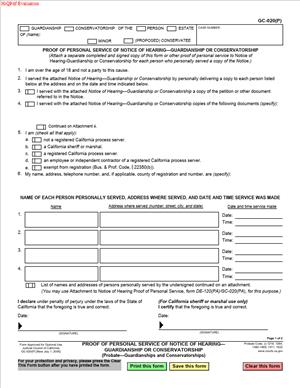
GC-020(P) – Proof of Personal Service of Notice of Hearing – Guardianship or Conservatorship
Fill out nowJurisdiction: Country: United States | Province or State: California
If you are involved in a guardianship or conservatorship case in California, you will likely encounter GC-020(P) – Proof of Personal Service of Notice of Hearing – Guardianship or Conservatorship. This form is not about asking the court for something new. It is about proving that you properly notified someone about an upcoming court hearing.
In guardianship and conservatorship cases, notice is critical. Certain people must be personally handed a copy of the Notice of Hearing and related papers. The court requires written confirmation that this happened. That confirmation is provided through GC-020(P) – Proof of Personal Service of Notice of Hearing – Guardianship or Conservatorship.
This document is usually completed by the person who physically delivered the paperwork. It tells the court who was served, when they were served, where it happened, and what documents were handed over.
If you are preparing for a hearing, this form helps show the court that procedural steps were followed. Without it, the court may not move forward with your request.
Understanding how this form works can help you avoid delays and make sure your filing is complete.
What is GC-020(P) – Proof of Personal Service of Notice of Hearing – Guardianship or Conservatorship?
Clear definition
GC-020(P) – Proof of Personal Service of Notice of Hearing – Guardianship or Conservatorship is a court form used in California probate matters. It confirms that the required individuals were personally served with notice of a guardianship or conservatorship hearing.
“Personal service” means that the documents were physically handed to the person being served. It does not mean mailing them. The form records the details of that in-person delivery.
This filing becomes part of the court record. It shows the judge that proper notice was given in the way the law requires for certain people in these cases.
Who typically uses this form?
This form is commonly used in probate cases involving the care or financial management of another person. That includes guardianships for minors and conservatorships for adults.
The person who completes and signs the form is the server. This is often an adult who is not a party to the case. In many situations, it may be a friend, relative, or professional process server.
The petitioner, meaning the person who started the case, is usually responsible for arranging service. However, the petitioner generally does not complete the proof of service if they are also a party to the case.
Court staff and judges rely on this document to confirm that the required notice was properly given before the hearing takes place.
Why might you need this form?
You may need this form because California probate courts require strict notice procedures. Before a hearing on a guardianship or conservatorship petition, specific individuals must receive personal service of the Notice of Hearing.
The court will not assume service happened. It requires written proof. GC-020(P) serves as that proof.
If you do not file a proper proof of personal service, the court may postpone the hearing. In some cases, the court may require you to serve the documents again.
Filing this form helps demonstrate that due process was respected. It shows that affected individuals were informed and given an opportunity to participate.
Typical real-life scenarios
- A parent files for guardianship of a minor whose current caregivers are unable to continue care. The other parent must be personally served with notice of the hearing. The person who delivers those papers completes this form to confirm service.
- An adult child petitions for conservatorship of an elderly parent who can no longer manage finances. The proposed conservatee must be personally served with the Notice of Hearing. The server documents that delivery using this form.
- A temporary guardianship is requested due to urgent circumstances. Even in time-sensitive situations, required individuals must receive notice. The proof of personal service documents that the hearing notice was handed to them directly.
- A relative files for conservatorship of an adult with developmental disabilities. Certain family members are entitled to notice. After personal delivery of the documents, the server completes and signs this form for court submission.
When would you use GC-020(P) – Proof of Personal Service of Notice of Hearing – Guardianship or Conservatorship?
You use this form after personal service has been completed and before or at the time of filing proof with the court. It is typically prepared once the Notice of Hearing and any related petition have been handed directly to the required person.
This form is often used when the law requires personal service rather than service by mail. In guardianship and conservatorship matters, personal service is commonly required for the proposed ward or proposed conservatee and, in some cases, close relatives.
The server fills out the form after delivering the documents. The completed form is then filed with the probate court handling the case.
If there are multiple individuals who must be personally served, separate proofs may be completed for each person. The court file should clearly reflect who was served and how.
This form is generally used before the scheduled hearing date. Courts often expect proof of service to be filed within a specific timeframe before the hearing, so the judge can confirm that notice requirements were met.
Legal characteristics of GC-020(P) – Proof of Personal Service of Notice of Hearing – Guardianship or Conservatorship
This document is a sworn statement. The server signs it under penalty of perjury. That means the information provided must be accurate and truthful.
For the form to be effective, it typically must include complete information about the person served, the date and time of service, the address where service occurred, and the documents delivered. Missing or inconsistent details can create problems.
The person who serves the documents must generally meet eligibility requirements. In many cases, the server must be at least 18 years old and not a party to the action. If the wrong person performs the service, the court may question its validity.
The court may reject or question the proof if dates are unclear, if the form is not signed, or if required attachments are missing. Illegible handwriting can also lead to delays.
This form does not start a case. It does not request any court order. It does not grant guardianship or conservatorship. Its sole function is to document the personal delivery of a hearing notice.
Procedures can vary slightly between counties in how documents are reviewed or processed, but the core requirement of personal service and proof under penalty of perjury remains consistent throughout California probate courts.
Is it legally binding?
GC-020(P) – Proof of Personal Service of Notice of Hearing – Guardianship or Conservatorship is legally significant because it is signed under penalty of perjury. The server is declaring that the facts stated are true.
It does not create rights or obligations between parties in the same way a contract does. Instead, it serves as evidence that required notice was given.
If the information is false, there may be legal consequences because the statement is made under oath. Courts rely on this document when deciding whether to proceed with a hearing.
Once filed, it becomes part of the official court record. Judges use it to determine whether procedural requirements have been satisfied.
How to fill out GC-020(P) – Proof of Personal Service of Notice of Hearing – Guardianship or Conservatorship
Step 1 – Identify the court and case information
At the top of the form, enter the name of the court, the courthouse address, and the case number exactly as they appear on your other guardianship or conservatorship documents. Make sure the case title matches the petition and Notice of Hearing. Consistency across documents helps the court link everything to the correct file.
Step 2 – Identify the person served
Provide the full legal name of the person who was personally served. Use the same name that appears in the petition or Notice of Hearing. If more than one person was served, confirm whether the form allows multiple entries or whether separate forms are needed.
Step 3 – List the documents delivered
Indicate the specific documents that were handed to the person. This usually includes the Notice of Hearing and may include the petition or related filings. The description should match the exact titles of the documents as filed with the court.
Step 4 – Enter the date, time, and place of service
State the exact date when the documents were personally delivered. Include the time of day. Provide the address or clear location where the service occurred, such as a residence or workplace. Accurate details help show that the service was completed properly and on time.
Step 5 – Provide information about the server
The server must enter their name, address, and contact information as required by the form. This identifies who performed the personal service. The information should be current and legible.
Step 6 – Confirm the eligibility of the server
The form typically includes a statement that the server is over 18 years old and not a party to the case. The server reviews this statement before signing. This confirms that the service was carried out by an eligible individual.
Step 7 – Sign under penalty of perjury
The server signs and dates the form where indicated. By signing, the server declares under penalty of perjury that the information provided is true and correct. The signature must be original if filing on paper, unless the court permits another method.
Step 8 – File the completed form with the court
After signing, the completed form is submitted to the probate court handling the case. Filing may occur at the clerk’s office or through an approved filing method. Once accepted, the proof of personal service becomes part of the case record and supports the scheduled hearing proceeding as planned.
Legal terms you might encounter in GC-020(P) – Proof of Personal Service of Notice of Hearing – Guardianship or Conservatorship
- Personal Service: This means the documents were physically handed to the person who must receive notice. On this form, the server confirms that they delivered the papers directly to the individual. It does not include mailing, emailing, or leaving the documents with someone else.
- Notice of Hearing: This is the document that tells someone when and where the court hearing will take place. The proof of service confirms that this notice was delivered. The hearing date listed on the notice must match what appears in the case information.
- Proposed Conservatee or Ward: This is the person who may be placed under conservatorship or guardianship. The law often requires that this person be personally served. The form records whether this specific individual received the documents.
- Server: The server is the person who actually delivers the papers. The server cannot be a party to the case and must meet age requirements. The form requires the server’s name, address, and signature.
- Penalty of Perjury: This is a legal statement that the information provided is true. When the server signs the form, they declare under penalty of perjury that the service details are accurate. False statements can result in serious consequences.
- Hearing Date: This is the scheduled court date when the judge will consider the guardianship or conservatorship matter. The proof of service supports that the required parties were notified before this date. Timing is critical because the service must happen within the required deadlines.
- Case Number: This is the unique number assigned to your court case. It must be written exactly as it appears on other filed documents. A mismatch can cause delays or rejection.
- Petitioner: This is the person who filed the request for guardianship or conservatorship. The petitioner is usually responsible for making sure the service is completed, but someone else must actually perform the service.
- Declaration: The form contains a declaration section where the server confirms the facts of service. This written statement becomes part of the court record. The judge relies on this declaration to confirm that legal notice requirements were met.
- Court Clerk: The clerk is the court official who receives and processes filed documents. After the form is completed and signed, it must be filed with the clerk. Filing makes it part of the official case file.
FAQs
Who is allowed to complete and sign this form?
Only the person who actually handed the documents to the recipient may complete and sign this document. That person must be at least 18 years old and not a party to the case. You, as the petitioner, cannot serve the papers yourself. The server must personally fill in the service details and sign under penalty of perjury.
What exact documents should be listed as served?
You must list every document that was physically handed to the recipient. This usually includes the Notice of Hearing and any related petitions or attachments that were served at the same time. The titles must match the documents filed with the court. If something was handed over but not listed, the record may be incomplete.
What if the person refuses to take the papers?
If the server identifies the person and clearly tells them the papers are for them, personal service can still be valid even if the person refuses to accept the documents. The server should note the circumstances carefully before completing the GC-020(P) – Proof of Personal Service of Notice of Hearing – Guardianship or Conservatorship. Accuracy in describing what happened protects the integrity of the filing.
Does the time of service really matter?
Yes. This form requires the exact date, time, and location of service. Courts often have minimum notice periods before a hearing. If the service occurred too late, the hearing may need to be rescheduled.
Can I correct the form if I notice a mistake after it is signed?
If the server made an error before filing, they should complete a new, corrected version rather than altering the signed one. If it has already been filed, you may need to file a corrected proof of service. Do not cross out information after signing, because changes can raise questions about accuracy.
What happens if the names on this document do not exactly match the court papers?
Names must match exactly as they appear in the petition and other filed documents. Even small differences can create confusion in the court record. Before filing GC-020(P) – Proof of Personal Service of Notice of Hearing – Guardianship or Conservatorship, compare every name and the case number carefully.
Is mailing the notice enough instead of personal delivery?
No. This form is specifically for personal service, which means in-person delivery. If the law requires personal service for a particular individual, mailing alone does not satisfy that requirement. You would need a different proof of service form for service by mail.
What does filing this form change in the court record?
Once filed, this document becomes official evidence that notice was given. The judge reviews it to confirm that all the required people were informed before the hearing. Without a properly completed proof of service, the court may refuse to proceed with the guardianship or conservatorship hearing.
Checklist: Before, During, and After GC-020(P) – Proof of Personal Service of Notice of Hearing – Guardianship or Conservatorship
Before
- Confirm the hearing date, time, and department listed on the Notice of Hearing.
- Identify every person who must be personally served.
- Verify the correct spelling of names as they appear on court documents.
- Choose a qualified server who is at least 18 and not involved in the case.
- Prepare complete copies of all documents to be served.
- Check service deadlines to ensure timely delivery.
- Write down the case number exactly as shown on filed papers.
During
- Ensure the server personally hands the documents to the correct individual.
- Confirm the identity of the person being served.
- Note the exact date of delivery.
- Record the precise time of delivery.
- Write down the full address or clear location of service.
- Observe and document if the person refuses the papers.
- Keep all served documents together for reference.
After
- Have the server complete every required section of the form.
- Review the form for missing dates, signatures, or addresses.
- Confirm that all served documents are listed accurately.
- Make copies of the signed proof of service.
- File the original with the court clerk.
- Keep a stamped copy for your records.
- Bring a copy to the hearing in case the judge asks for it.
Common mistakes to avoid with GC-020(P) – Proof of Personal Service of Notice of Hearing – Guardianship or Conservatorship
- Mistake: Letting the petitioner serve the papers because it seems easier, which happens due to convenience, but this can invalidate service and delay your hearing; do not forget that the server must be a neutral adult.
- Mistake: Leaving out the exact time of service because it feels unimportant, which often leads to rejection by the clerk; do not forget that date and time are mandatory fields.
- Mistake: Misspelling the proposed conservatee’s or ward’s name due to copying errors, which can cause confusion in the court record; do not forget to match the spelling exactly as filed.
- Mistake: Forgetting to list every document delivered, which happens when multiple attachments are involved and may result in incomplete proof; do not forget to review the full packet before signing.
- Mistake: Altering the form after signing under penalty of perjury, which can undermine credibility and lead to filing issues; do not forget to prepare a clean, corrected version instead.
- Mistake: Filing the form too late because service was done close to the hearing date, which may force the court to continue the matter; do not forget to check deadlines well in advance.
- Mistake: Using the wrong case number copied from another matter, which can misfile the document and delay processing; do not forget to verify the number directly from your case paperwork.
- Mistake: Forgetting the server’s signature or address, which makes the declaration incomplete and may cause the clerk to reject it; do not forget that the server must fully complete their section.
What to do after filling out GC-020(P) – Proof of Personal Service of Notice of Hearing – Guardianship or Conservatorship
Once the server has completed and signed the form, your job is to make sure it is properly filed and tracked. This step is not just administrative. The court cannot move forward confidently without written proof that notice requirements were satisfied.
Start by reviewing the entire document slowly. Confirm the case number, court name, and hearing date. Check that the person served is clearly identified and that the address, date, and time of service are complete. Make sure the server’s signature is present and dated.
- Step 1: Make at least two copies of the signed form.
- Step 2: Keep one copy in your personal case file.
- Step 3: Prepare the original for filing with the court clerk.
- Step 4: Submit the original using the court’s accepted filing method.
- Step 5: Request confirmation that the document has been filed.
- Step 6: Obtain a stamped copy showing the filing date.
- Step 7: Store the stamped copy with your other court papers.
- Step 8: Bring a copy with you to the hearing.
- Step 9: Review your case checklist to confirm all required parties were served.
- Step 10: Monitor your case status to ensure the hearing remains on the calendar.
After filing, stay organized. Keep all proofs of service together in a dedicated section of your file. If multiple people must be served, verify that you have a separate completed proof for each required personal service.
If the court clerk notifies you of a defect, address it immediately. This may require completing a new proof of service or arranging new service if something was done incorrectly. Acting quickly prevents delays.
Before the hearing, review your filed proof of service so you can confidently answer questions if the judge asks when and how service occurred. Being prepared demonstrates that you followed the required procedures carefully.
Disclaimer: This guide is provided for informational purposes only and is not intended as legal advice. You should consult a legal professional.