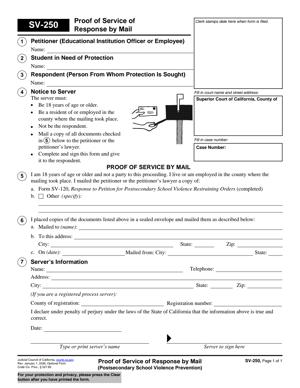
SV-250 – Proof of Service of Response by Mail
Fill out nowJurisdiction: Country: United States | Province or State: California
If you are responding to a restraining order case, you may come across SV-250 – Proof of Service of Response by Mail. This form is used to show the court that your response papers were properly mailed to the other party.
SV-250 – Proof of Service of Response by Mail does not start the case. It does not argue your side. Instead, it confirms that you followed the required process for delivering your response documents.
In court matters, especially those involving protective orders, proper service is critical. Judges rely on proof of service forms to confirm that both sides received the required paperwork. Without proof of service, your filing may not move forward as expected.
This form is usually completed by the person who mailed your response papers. That person must meet certain requirements and cannot be you if you are the responding party. Understanding how this document works helps you avoid delays and rejected filings.
What is SV-250 – Proof of Service of Response by Mail?
Clear definition
SV-250 – Proof of Service of Response by Mail is a court form used in California civil harassment or related restraining order cases. It documents that a response to a restraining order request was mailed to the other party.
The form serves as written confirmation that service by mail occurred. It identifies who mailed the documents, what was mailed, to whom it was sent, and when it was placed in the mail.
Courts require proof that the other party received proper notice of your response. This form creates a record of that notice. It becomes part of the court file once submitted.
It focuses only on service by mail. If documents were delivered in person, a different proof of service form would typically be used.
Who typically uses this form?
This form is commonly used by a respondent in a restraining order case. The respondent is the person against whom protection was requested.
After preparing a written response, the respondent must ensure a copy is delivered to the petitioner. Someone else, often a friend, relative, or adult assistant, may mail the documents.
The person who actually mails the documents completes and signs SV-250. That individual confirms under penalty of perjury that the mailing occurred as stated.
Court clerks also rely on this form when reviewing the filing. It helps them confirm that service requirements were met before the hearing.
Why might you need this form?
You may need this form if you filed a Response to Request for Civil Harassment Restraining Orders and chose to serve it by mail.
Courts generally require that the other party receive a copy of anything you file that relates to the case. Filing alone is not enough. The other party must be notified.
If you fail to submit proof of service, the court may not consider your response. In some situations, the judge may proceed without reviewing your side.
Submitting a properly completed proof of service reduces the risk of delay. It shows that you followed procedural rules for mailing your documents.
Typical real-life scenarios
- You were served with a temporary restraining order and a hearing date. You prepared a written response explaining your side. You asked a friend over 18 to mail a copy to the petitioner. That friend completes SV-250 to confirm the mailing.
- You are representing yourself and want to make sure the petitioner receives your declaration and the attached evidence. You arrange for someone else to mail the documents before the deadline. The mailing is documented on this form.
- You initially planned personal delivery but switched to mailing due to scheduling issues. Since service occurred by mail, the correct proof of service form is required to reflect that method.
- You are filing additional documents along with your response, such as witness statements. All of those items are mailed together. The form lists each document included in the envelope to create a complete record.
When would you use SV-250 – Proof of Service of Response by Mail?
Use Form CH-250, Proof of Service by Mail, after response documents or other permitted papers have been mailed in a California civil harassment restraining order case. The form is completed after the mailing because it records service that has already occurred.
A respondent commonly uses this form when serving Form CH-120, Response to Request for Civil Harassment Restraining Orders, and any supporting declarations or attachments. The response should generally be filed with the court before a copy is mailed to the petitioner or the petitioner’s attorney.
The respondent cannot personally mail the documents. Another adult who is at least 18 years old and is not a party to the case must complete the mailing. This may be a friend, relative, coworker, professional process server, or another qualified adult. The server places copies of the documents in a sealed, properly addressed envelope, pays the required postage, and deposits the envelope in the mail.
After mailing the papers, the server completes and signs Form CH-250 under penalty of perjury. The form identifies the documents mailed, the recipient and mailing address, the date and place of mailing, and the server’s contact information. The completed proof of service is then filed with the court, while a copy should be retained for the hearing.
Timing is important. The documents must be mailed early enough to satisfy the applicable service deadline before the hearing. Filing the response with the court does not automatically serve it on the other party, and completing Form CH-250 without actually mailing the listed documents does not constitute valid service.
Form CH-250 is appropriate only when service by mail is permitted. It generally cannot replace personal service for documents that the law or a court order requires to be delivered personally, such as the initial restraining-order papers served on the respondent. If the court orders a different method of service, follow that order and use the corresponding proof-of-service form.
Although other protective-order proceedings may use similar forms, each case type has its own form series. CH-250 is specifically designed for civil harassment proceedings; domestic violence, elder abuse, workplace violence, school violence, and gun violence cases use different proof-of-service forms.
Legal characteristics of SV-250 – Proof of Service of Response by Mail
This form operates as a sworn statement. The person who signs it declares, under penalty of perjury, that the information is true and correct.
For the form to be effective, it must accurately identify the case number, the parties, and the documents served. The mailing date and address must also be clearly stated.
Common issues that cause problems include missing signatures, incorrect case numbers, or incomplete addresses. If the server forgets to list all documents that were mailed, the record may not fully reflect what was sent.
Legally, the form does not prove that the other party actually read the documents. It proves that the documents were mailed in a way that complies with procedural rules.
Service by mail is generally considered complete once the documents are properly deposited in the mail, with postage prepaid. However, timing rules may vary depending on the type of case and hearing date.
The form does not change the substance of your response. It does not argue facts or legal positions. Its role is procedural, not persuasive.
Because it is signed under penalty of perjury, knowingly providing false information can have serious consequences. Accuracy is essential.
Is it legally binding?
SV-250 – Proof of Service of Response by Mail is legally binding in the sense that it is a sworn declaration. The person signing it is making a formal statement to the court.
By signing, the server confirms that the mailing occurred as described. This statement carries legal weight because it is made under penalty of perjury.
The form does not create a contract between the parties. It does not resolve the case. Instead, it supports the procedural validity of your filing.
If the information is accurate and the form is properly completed, courts generally accept it as sufficient proof that service by mail occurred. If the information is false or incomplete, the court may question the validity of service.
How to fill out SV-250 – Proof of Service of Response by Mail
Step 1 – Fill in the court and case information
At the top of the form, enter the name of the court, its address, and the case number exactly as they appear on your other case documents. Write the full names of the petitioner and respondent in the designated spaces. This information must match the existing court file.
Step 2 – Identify the server
The person who mailed the documents fills in their name, address, and contact information. This person must be at least 18 years old and not a party to the case. The server is the one making the declaration, not you if you are the respondent.
Step 3 – Confirm eligibility to serve
The form includes statements confirming that the server is over 18 and not involved in the case. The server reads these statements carefully before proceeding. By completing this section, the server confirms they meet the basic qualifications to perform service by mail.
Step 4 – List the documents served
In the section that asks what documents were served, the server lists each document included in the mailing. This may include the response form, declarations, and any attachments. The titles should match the documents exactly as filed.
If additional space is needed, an attachment may be referenced. The goal is to clearly identify everything placed in the envelope.
Step 5 – Provide the name and address of the person served
The server writes the full name of the person to whom the documents were mailed. This is usually the petitioner or their attorney, if one is listed. The mailing address must be complete, including street address, city, state, and zip code.
Accuracy here is important. An incorrect address can raise questions about whether the service was valid.
Step 6 – Enter the date and place of mailing
The server records the exact date the documents were placed in the mail. The city and state from which the documents were mailed are also entered.
This date helps the court determine whether service occurred within the required timeframe before the hearing.
Step 7 – Describe the mailing process
The form includes language stating that the documents were placed in a sealed envelope with postage fully prepaid. The server confirms that the envelope was deposited in the mail according to standard mailing practices.
By completing this section, the server affirms that the mailing followed ordinary procedures for outgoing mail.
Step 8 – Sign under penalty of perjury
At the end of the form, the server prints their name, signs the form, and enters the date of signing. The signature confirms that all information provided is true and correct.
Once signed, the form is ready to be filed with the court along with your response documents, or shortly after service if required by the filing process.
Legal terms you might encounter in SV-250 – Proof of Service of Response by Mail
- Proof of Service: A written statement showing that court papers were properly delivered to the other party. On this form, it confirms that your response was mailed. It tells the court when, how, and to whom the documents were sent. Without proof of service, the judge may not consider your response.
- Response: Your formal written reply to the original request or petition filed against you. This form does not contain your response itself. Instead, it proves that a copy of your response was mailed to the other party as required.
- Declarant: The person who completes and signs the proof of service. This person is the one who actually mailed the documents. The declarant must be someone other than you if you are a party to the case.
- Party: A person directly involved in the case, such as the petitioner or respondent. If you are a party, you cannot serve the documents yourself. Another adult must complete the mailing and sign the proof of service.
- Penalty of Perjury: A legal statement at the end of the form where the declarant swears the information is true. Signing under penalty of perjury means the person understands that lying can lead to legal consequences. The court relies on this declaration as truthful evidence.
- Service by Mail: A method of delivering court documents through postal mail. This form records that the documents were placed in the mail with proper postage. It also requires the mailing date and location.
- Business Address or Residence Address: The address of the person who mailed the documents. The declarant must list their own address. This helps the court identify who performed the service.
- Date of Service: The exact date the documents were placed in the mail. This date is critical because deadlines are often calculated from it. An incorrect date can affect whether your response is considered timely.
- Name and Address of Person Served: The full name and mailing address of the person receiving the documents. This must match the information used in your case. If it is wrong or incomplete, the service may be invalid.
- Attachment: An extra page is used if there is not enough space to list all documents served or all recipients. Attachments must clearly reference the case and be included when filing. Missing attachments can create confusion or delay.
FAQs
Can I mail my response myself and sign this document?
No. If you are a party in the case, you cannot serve your own papers. Another adult who is not involved in the case must place the documents in the mail and complete this document. The server must list their own name and address and sign under penalty of perjury.
What exact date should be listed as the date of service?
You must enter the date the documents were actually placed in the mail, not the date you signed your response, and not the date you fill out the proof of service. Deadlines are often measured from the mailing date. Double-check that the date matches when the envelope was deposited in the mail.
What if I do not know the other party’s current address?
You must use the most recent address you have that is reasonably believed to be correct. This document records the address where the papers were mailed. If the address is wrong, the other party may claim they did not receive notice, which can delay the case.
Do I need to attach a copy of my response to this form when I file it?
You file your response according to court procedures, and this form is filed to show it was served. You do not attach another copy of the response to the proof of service unless instructed. Make sure the list of documents served clearly names the exact titles of the papers that were mailed.
What happens if the court rejects my SV-250 – Proof of Service of Response by Mail?
If the court rejects it, you will usually receive a notice explaining what is missing or incorrect. Common reasons include missing signatures, incomplete addresses, or blank sections. Correct the issue promptly and resubmit it so your service is properly recorded.
Can one proof of service cover multiple documents?
Yes, as long as all the documents were mailed at the same time to the same person. List each document clearly by its full title. If there is not enough space, use an attachment and make sure it references this form and your case number.
What changes in the public court record after this document is filed?
Once filed, the court record will show that your response was served on the other party by mail on a specific date. This establishes notice. It does not change the claims in your case, but it confirms you followed the required service steps.
Does the person who mailed the documents need to appear in court?
In most cases, no. The signed declaration under penalty of perjury is usually sufficient proof. However, if the service is challenged, the court may ask the declarant to confirm the details of how the documents were mailed.
Checklist: Before, During, and After SV-250 – Proof of Service by Mail
Before
- Confirm you have completed and signed your response documents.
- Choose a server who is at least 18 years old and not a party to the case.
- Verify the other party’s full legal name and current mailing address.
- Make complete copies of everything that will be mailed.
- Check that the case number and court name are correct on all documents.
- Review filing deadlines to ensure timely mailing.
- Prepare properly addressed envelopes with sufficient postage.
During
- Have the server place all listed documents into the envelope.
- Confirm that the correct address is written clearly on the envelope.
- Ensure proper postage is attached before mailing.
- Deposit the envelope in the mail on the stated date.
- Complete every section of the proof of service form.
- List each document served by its exact title.
- Enter the city and state where the mailing occurred.
- Have the server sign and date the form under penalty of perjury.
After
- Make copies of the signed proof of service for your records.
- File the original proof of service with the court.
- Confirm the filing was accepted and stamped.
- Keep a copy of the filed document in your case folder.
- Track any deadlines that run from the mailing date.
- Update your personal case timeline with the service date.
- Monitor the case docket to ensure the filing appears.
- Bring copies to your next hearing if required.
Common mistakes to avoid with SV-250 – Proof of Service by Mail
- Mistake: Letting a party to the case mail the documents because it feels faster, which happens when you overlook service rules; this can invalidate service and delay your case, so do not forget that the server must be a non-party adult.
- Mistake: Entering the wrong mailing date because you confuse it with the signing date, which can affect deadline calculations; this may lead to disputes about timeliness, so do not forget to use the actual date of mailing.
- Mistake: Listing incomplete document titles because you assume the court knows what you filed; this creates uncertainty about what was served, so do not forget to write each document’s full and correct name.
- Mistake: Using an outdated address because you rely on old paperwork; this can result in claims of improper notice, so do not forget to verify the most current mailing address available.
- Mistake: Forgetting the server’s signature under penalty of perjury because you focus only on the mailing; unsigned forms are often rejected, so do not forget the final signature and date.
- Mistake: Failing to file the proof of service after mailing the documents because you assume mailing is enough; without filing, the court has no record of service, so do not forget to submit the completed form.
- Mistake: Leaving sections blank because they seem minor or repetitive; incomplete forms may be rejected, so do not forget to review every line before filing.
- Mistake: Not keeping a copy of the filed proof of service because you think the court keeps everything; this can cause problems if records are misplaced, so do not forget to store your own stamped copy.
What to do after filling out SV-250 – Proof of Service of Response by Mail
Once the server signs the completed form, pause and review it carefully. Check names, addresses, the case number, and the mailing date. Make sure nothing is blank and that the signature is present.
Next, prepare the form for filing. Courts generally require the original signed proof of service. You should also make at least two copies. One copy is for your records. Another may be for your working case file or to bring to court.
Follow these practical steps:
- Step 1: Make two copies of the signed proof of service.
- Step 2: Assemble the original for filing and keep copies separate.
- Step 3: Submit the original to the court clerk according to filing procedures.
- Step 4: Confirm the clerk stamps your copy as filed.
- Step 5: Check that the case number on the stamp matches your case.
- Step 6: Review the filed copy to ensure all pages were accepted.
- Step 7: Place the stamped copy in your organized case folder.
- Step 8: Mark the service date on your calendar and calculate any related deadlines.
- Step 9: Monitor your case status to ensure the filing appears in the court record.
- Step 10: Bring your filed copy to any upcoming hearing in case proof of service is questioned.
Keep your documents organized. Store your response, the proof of service, and any related correspondence together. If questions arise later about whether you properly served the other party, your filed copy will be your reference.
If you discover an error after filing, address it quickly. You may need to complete a corrected proof of service or reserve the documents properly. Acting promptly helps prevent delays and keeps your case moving forward.
Treat this step as essential, not optional. Proper service and accurate proof of service protect your right to be heard and demonstrate that you followed required procedures.
Disclaimer: This guide is provided for informational purposes only and is not intended as legal advice. You should consult a legal professional.