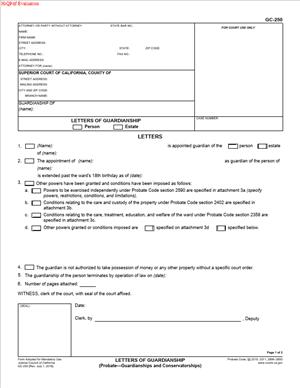
GC-250 – Letters of Guardianship (Probate—Guardianships and Conservatorships)
Fill out nowJurisdiction: Country: United States | Province or State: California
GC-250 – Letters of Guardianship is the court document that officially confirms someone has been appointed as a guardian. It is issued after a judge approves a guardianship case. This form is not a request for guardianship. It is the proof that the guardianship exists.
If you are about to handle responsibilities for a minor or a conservatee, this document matters. Schools, doctors, banks, and government agencies often ask to see it. They rely on it to confirm you have legal authority.
You may already have attended a hearing and received a court order appointing you as guardian. GC-250 – Letters of Guardianship turns that order into a formal, usable document. It shows your authority in a clear and standardized format.
Understanding this form helps you avoid delays. Small errors can prevent it from being issued or accepted. Knowing what the court expects makes the process smoother.
This form belongs to the Superior Court of California and relates to guardianship proceedings handled through that court system.
What is GC-250 – Letters of Guardianship (Probate—Guardianships and Conservatorships)?
Clear definition
GC-250 – Letters of Guardianship is an official court certificate. It states that a guardian has been appointed and lists the powers granted to that guardian. The clerk signs and seals it after the judge’s appointment order.
The document serves as written proof of authority. It identifies the guardian, the person under guardianship, and the type of guardianship granted. It may also include limits placed on the guardian’s powers.
These “letters” are not personal letters. In court language, “letters” means a formal document issued under court authority. Once issued, the letters can be presented to third parties to show legal status.
Who typically uses this form?
This form is typically used by individuals appointed as guardians of a minor. It may also be used in certain cases involving guardianship of the person or estate, depending on the court’s order.
Parents who are unable to care for a child may have another adult appointed as guardian. That adult then uses these letters to act on the child’s behalf.
In some cases, relatives such as grandparents, aunts, or adult siblings become guardians. They rely on this document to enroll a child in school, authorize medical care, or manage property.
Professionals appointed as guardians may also use it. Although less common in minor guardianship cases, a court-appointed guardian may need certified copies to manage financial or personal matters.
Why might you need this form?
You need this form to prove your authority. A court order alone may not be enough for everyday transactions. Institutions often request certified Letters of Guardianship.
Without this document, you may not be able to access records or make decisions. For example, a medical provider may refuse to discuss treatment without proof of guardianship.
Financial institutions often require formal letters before allowing a guardian to manage funds. Schools may ask for it before recognizing your authority to make educational decisions.
The document also protects the person under guardianship. It shows that authority comes from a court, not from an informal agreement.
Typical real-life scenarios
- A grandparent is appointed guardian after the parents become unable to care for the child. The grandparent uses the letters to enroll the child in a new school district. The school requests certified proof of guardianship before changing records.
- An aunt becomes the guardian of her niece. The child needs surgery. The hospital requires current Letters of Guardianship before accepting consent for the procedure.
- A guardian of the estate must manage settlement funds awarded to a minor. A bank asks for certified letters before opening a blocked account in the minor’s name.
- A relative takes over the care of a child whose parents are incarcerated. Government agencies require proof of legal authority before issuing benefits or allowing changes to existing records.
- A guardian needs to travel internationally with the child. Border officials may request documentation confirming the guardian’s legal authority to make decisions for the minor.
- In each situation, the letters function as evidence. They confirm that a judge has granted specific powers.
When would you use GC-250 – Letters of Guardianship (Probate—Guardianships and Conservatorships)?
You use this form after the court appoints a guardian. It is not filed to start a case. It is prepared and issued once the appointment is approved.
Typically, the process begins with a petition for guardianship. After notice, investigation, and a hearing, the judge signs an order appointing the guardian. Only then are the letters issued.
You may use the letters whenever a third party requests confirmation of your authority. This often includes schools, doctors, insurance providers, financial institutions, and public agencies.
Guardians of the person use the letters when making decisions about education, health care, and living arrangements. Guardians of the estate use them when managing property or finances.
If your powers are limited by the court, the letters reflect those limits. You use them within the scope granted. For example, if the court restricts access to certain funds, the letters may state that restriction.
Certified copies are commonly requested. An original may remain in your records, while certified copies are presented as needed.
You may also use updated letters if your authority changes. For example, if the court modifies your powers, new letters may be issued to reflect that change.
Legal characteristics of GC-250 – Letters of Guardianship (Probate—Guardianships and Conservatorships)
This document becomes effective once issued by the court clerk following the judge’s order. It carries the court seal and signature. That seal signals authenticity.
The letters reflect the court’s authority, not your personal decision. They are tied directly to a case number and court file. This connection allows others to verify the guardianship.
Accuracy is essential. Names must match the court order exactly. Dates, case numbers, and the type of guardianship must be correct. Even small discrepancies can cause rejection by institutions.
Courts may require certain conditions before issuing letters. For example, a guardian of the estate may need to post a bond. If the required steps are incomplete, the clerk may delay issuing the letters.
The document may specify whether the guardianship is of the person, the estate, or both. This distinction matters. Authority over personal decisions is different from authority over property.
High-level differences can exist across jurisdictions, but in California, the Superior Court oversees guardianship cases and issues these letters once conditions are met. Other states may use similar terminology but different forms.
GC-250 – Letters of Guardianship does not create guardianship on its own. The judge’s appointment order creates the legal relationship. The letters serve as proof of that appointment.
It also does not override court-imposed limits. If the court restricts certain actions, the letters do not expand those powers. They only confirm what has been granted.
If the guardianship ends, the authority reflected in the letters ends as well. For example, when a minor turns 18, guardianship of the person usually terminates. The letters no longer provide authority after termination.
Is it legally binding?
Yes, the letters are legally binding in the sense that they officially confirm court-granted authority. They represent a formal act of the court.
Their binding effect comes from the underlying court order. Without that order, the letters have no foundation. When properly issued, they are recognized as valid proof of guardianship.
They are binding on third parties to the extent that they show valid authority. Institutions typically rely on certified copies. If the document appears altered or expired, they may refuse to accept it.
The letters remain effective until the court changes or ends the guardianship. If a successor guardian is appointed, new letters are issued. The prior letters no longer represent the current authority.
How to fill out GC-250 – Letters of Guardianship (Probate—Guardianships and Conservatorships)
Step 1 – Review the court’s appointment order
Before completing the form, read the signed order appointing the guardian. Confirm the exact spelling of names, the case number, and the type of guardianship granted. The letters must match the order exactly.
Check whether the court imposed conditions. For example, there may be a bond requirement or specific limitations on authority. The letters must reflect those details accurately.
Step 2 – Enter the court information
At the top of the form, fill in the name of the Superior Court handling the case. Include the branch name and address if required. This information identifies the issuing court.
Make sure the county listed matches the county where the case was filed. The case number must be written exactly as it appears in the court record.
Step 3 – Identify the guardian
Enter the full legal name of the appointed guardian. Use the same name format that appears in the court order. Avoid nicknames or shortened versions.
If more than one guardian was appointed, list each name as directed by the form. The letters must reflect joint appointments clearly if applicable.
Step 4 – Identify the person under guardianship
Provide the full legal name of the minor or conservatee as shown in the case caption. Accuracy is critical. Even small spelling differences can cause confusion when presenting the letters to third parties.
Confirm the date of birth if the form requests it. This detail helps distinguish individuals with similar names.
Step 5 – Specify the type of guardianship
Indicate whether the guardianship is of the person, the estate, or both. This section defines the scope of authority.
If the court limits certain powers, ensure those limits are properly noted. The letters must mirror the judge’s order and not expand beyond it.
Step 6 – Address bond requirements if applicable
If the court required a bond for a guardian of the estate, confirm that the bond has been filed and approved. The clerk may not issue the letters until this condition is satisfied.
Record any bond information requested on the form. This may include the amount of the bond or confirmation that it has been filed.
Step 7 – Leave signature lines for the clerk and seal
Do not sign on behalf of the clerk. The issuing authority completes the signature and affixes the court seal.
Review the form to ensure all required fields are completed before submission. Incomplete forms may delay issuance.
Step 8 – Submit the form for issuance
File the completed form with the court clerk handling the guardianship case. Follow the court’s process for submission.
Once approved, the clerk signs and seals the letters. After issuance, request certified copies if you anticipate needing proof for multiple institutions.
Legal terms you might encounter in GC-250 – Letters of Guardianship (Probate—Guardianships and Conservatorships)
- Letters of Guardianship: This is the official court-issued document that proves you have been appointed as a guardian. It summarizes the court’s authority granted to you. You show these letters to schools, banks, doctors, and other institutions to demonstrate your legal power to act for the child.
- Guardian of the Person: This refers to a guardian who has authority over the child’s personal care. This document indicates you can make decisions about health care, education, and living arrangements. The letters will reflect this role if the court grants it.
- Guardian of the Estate: This term applies when you are authorized to manage the child’s money or property. The document will specify this authority separately from personal care powers. If you are appointed over the estate, your financial responsibilities are clearly stated.
- Ward: The ward is the child under guardianship. The form lists the ward’s full legal name. It is critical that the name matches the court order exactly.
- Bond: A bond is a type of insurance that protects the ward’s assets. If required, the letters will state that you must file a bond before the document becomes effective. Without meeting bond requirements, you may not have full authority.
- Limited Authority: Sometimes the court limits what a guardian can do. The letters will reflect any restrictions. You must review the document carefully to understand the boundaries of your power.
- Court Seal: The seal confirms the document is officially issued by the court. Without the seal, most institutions will not accept it. Always check that the seal appears clearly on each certified copy.
- Clerk of the Court: The clerk prepares and issues the letters after the judge signs the appointment order. The clerk’s signature validates the document. You do not sign this portion yourself.
- Effective Date: This is the date your authority begins. It typically matches the appointment date shown on the court order. You should confirm this date before presenting the document to third parties.
- Certified Copy: A certified copy is an official duplicate issued by the court. It includes a stamp or seal verifying it is a true copy. Many organizations require a certified copy instead of a regular photocopy.
FAQs
When does my authority actually begin?
Your authority begins on the effective date listed on this document, which usually matches the judge’s appointment date. Review the date printed on the letters carefully. Do not assume you can act before that date. If a bond is required, your authority may not be fully active until the bond is filed and approved.
Do I need to sign GC-250 – Letters of Guardianship?
You do not sign this document as the issuing authority. The clerk signs and places the court seal on it. You may need to sign other guardianship paperwork, but these letters are issued by the court after your appointment.
Why does the name have to match exactly?
Institutions compare the name on this document with identification records. If the ward’s or guardian’s name is spelled differently, includes or omits a middle name, or uses a nickname, the document may be rejected. Always check the spelling against the court’s appointment order before requesting certified copies.
What if the bond requirement section is marked?
If the document states that a bond is required, you must complete that step before acting on financial matters. The letters may note that powers over the estate are subject to a bond. Confirm with the clerk that the bond has been filed and approved before presenting the document to banks or financial institutions.
How many certified copies should I request?
Request enough certified copies to cover each institution that will need proof of your authority. Banks, schools, insurance providers, and medical offices often want to see a certified copy. Ask each organization whether they will keep a copy or simply review it.
What should I check before showing this form to a bank or school?
Confirm that the court seal is visible, the clerk’s signature is present, and the effective date is clear. Make sure any bond language is satisfied. Review the document to ensure it reflects the exact type of guardianship granted.
What if information changes after the letters are issued?
If there is a change, such as a new address or a modification of your authority, the original letters do not automatically update. The court must issue revised letters if the guardianship terms change. Do not alter the document yourself.
Do the GC-250 – Letters of Guardianship expire?
These letters generally remain valid until the court terminates or modifies the guardianship. However, some institutions may ask for recently issued certified copies. If requested, you can obtain updated certified copies from the court clerk.
Checklist: Before, During, and After GC-250 – Letters of Guardianship (Probate—Guardianships and Conservatorships)
Before
- Confirm the judge has signed the guardianship appointment order.
- Verify whether a bond is required for estate authority.
- Double-check the spelling of the guardian’s and ward’s full legal names.
- Review any limitations stated in the appointment order.
- Prepare payment for certified copies if needed.
- Gather identification for court processing.
- Make a list of institutions that will require proof of guardianship.
During
- Submit the completed document to the clerk for issuance.
- Confirm the effective date matches the court order.
- Ensure the clerk signs and affixes the court seal.
- Request the number of certified copies you anticipate needing.
- Review each certified copy for clarity and completeness.
- Ask the clerk about any bond confirmation requirements.
- Keep receipts for certified copies.
After
- Store the original and certified copies in a secure location.
- Provide certified copies to schools, banks, and healthcare providers as needed.
- Track which institutions received a copy.
- Confirm each institution accepts the document without issue.
- Calendar any required future court reporting deadlines.
- Monitor whether updated letters are needed after court changes.
- Return to court if the authority is modified or expanded.
Common mistakes to avoid with GC-250 – Letters of Guardianship (Probate—Guardianships and Conservatorships)
- Mistake: Assuming your authority starts immediately after the hearing; this happens because the court appearance feels final, but acting before the effective date or bond approval can lead to rejected transactions and delays—do not forget to confirm the issuance date and any bond filing.
- Mistake: Requesting only one certified copy to save money; this often happens when you underestimate how many institutions require proof, and it can slow down school enrollment or account access—do not forget to ask each organization what they require.
- Mistake: Ignoring name discrepancies; small spelling differences occur easily, but they can cause banks or agencies to refuse the document—do not forget to match every name exactly to the court order and identification records.
- Mistake: Overlooking limitations on authority; some guardians assume they have full control, but restricted powers can invalidate certain decisions—do not forget to read the letters carefully for any limits.
- Mistake: Altering the document by writing notes or corrections on it; this usually happens when trying to fix a minor error quickly, but it can void acceptance—do not forget to request corrected or amended letters from the court instead.
- Mistake: Failing to secure the letters properly; because the document feels replaceable, some people misplace it, which can delay urgent decisions—do not forget to store certified copies in a safe, accessible place.
What to do after filling out GC-250 – Letters of Guardianship (Probate—Guardianships and Conservatorships)
Once the court issues your letters, your focus shifts to using them correctly and protecting them. These documents are your proof of authority. Treat them as official records.
- Step 1: Obtain certified copies from the court clerk immediately after issuance.
- Step 2: Review each certified copy for the clerk’s signature and court seal.
- Step 3: Confirm the effective date and any bond language are clearly stated.
- Step 4: Create a simple distribution plan listing every school, medical provider, bank, or agency that needs proof.
- Step 5: Contact each institution to ask whether they will keep a certified copy or just review it.
- Step 6: Present the certified copy in person when possible to avoid mailing delays.
- Step 7: Keep a written record of when and where you provided copies.
- Step 8: Store unused certified copies in a secure but accessible location.
- Step 9: Monitor any deadlines related to financial reporting or court reviews if you are a guardian of the estate.
- Step 10: Return to court promptly if your authority changes and request updated letters.
Stay organized. Keep all guardianship paperwork together, including the appointment order and any bond documentation. When your authority ends or changes, stop using the old letters. If you are unsure whether an institution will accept an older certified copy, request a newly issued one from the clerk to avoid delays.
Disclaimer: This guide is provided for informational purposes only and is not intended as legal advice. You should consult a legal professional.