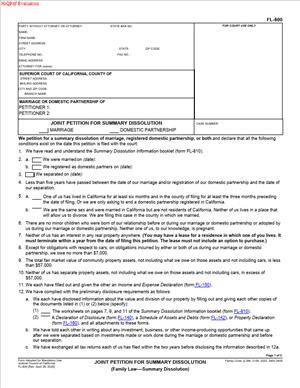
FL-800 – Joint Petition for Summary Dissolution (Family Law – Summary Dissolution)
Fill out nowJurisdiction: Country: United States | Province or State: California
If you are looking at the FL-800 – Joint Petition for Summary Dissolution (Family Law – Summary Dissolution), you are likely considering ending your marriage in a simplified way. This form is used in California when both spouses agree that they qualify for a streamlined divorce process called summary dissolution.
FL-800 – Joint Petition for Summary Dissolution (Family Law – Summary Dissolution) is not a standard divorce petition. It is a joint filing. That means both spouses complete and sign the same document together. There is no petitioner and no respondent in the usual sense.
This form matters because it starts the legal process to end your marriage without many of the steps required in a regular divorce. When used correctly, it can reduce paperwork, court appearances, and delays.
However, it is only available if you meet strict eligibility requirements. Before you begin filling it out, it helps to understand what the form does, who can use it, and how the court treats it after submission.
What is FL-800 – Joint Petition for Summary Dissolution (Family Law – Summary Dissolution)?
Clear definition
FL-800 – Joint Petition for Summary Dissolution (Family Law – Summary Dissolution) is a court document filed in California to request a summary dissolution of marriage. A summary dissolution is a simplified procedure to end a marriage or registered domestic partnership when both parties agree on all key issues and meet specific legal criteria.
Unlike a standard divorce petition, this document is signed by both spouses together. It tells the court that you qualify for summary dissolution and that you both agree to the terms for dividing property and debts.
The form includes statements about your marriage, assets, debts, and agreement. By signing it, each of you confirms that the information is true and that you want the court to dissolve your marriage under the summary process.
Who typically uses this form?
This form is typically used by spouses who have been married for a short time and have limited property and debt. It is designed for couples with relatively simple financial situations.
It is often used by couples who do not have children together. In general, summary dissolution is not available if there are minor children born or adopted during the marriage.
People who use this form usually agree on how to divide their property and who will be responsible for which debts. They are not asking the court to decide disputes. Instead, they present a complete agreement and ask the court to approve it.
Why might you need this form?
You might need this form if you and your spouse want to end your marriage and qualify for the summary dissolution process. It is the required starting document for that procedure in California.
If you meet the eligibility requirements, this form allows you to avoid some of the steps in a standard divorce. There is usually no need for formal service of papers between spouses because you file jointly.
The form also acts as a written confirmation that both of you waive certain rights. For example, summary dissolution generally involves waiving the right to appeal and the right to request spousal support in the future. Those waivers are part of what makes the process simpler.
Typical real-life scenarios
- You were married less than five years ago. During that time, you and your spouse did not buy a home, and you do not have significant shared assets. You both agree it is best to separate and divide what you have without conflict. Summary dissolution may fit that situation.
- You and your spouse rented an apartment and kept separate bank accounts. You acquired only modest personal property, such as furniture and a vehicle. You agree on who will keep each item and who will pay certain credit card balances. A joint petition can reflect that agreement.
- You married young, have no children, and now both agree the marriage should end. There are no retirement accounts with large balances and no real estate. You want a straightforward legal process with minimal court involvement.
- You and your spouse have already discussed your finances in detail and created a written agreement dividing everything. You are comfortable signing a joint filing and waiting the required period before the divorce becomes final. In this situation, this form may be the appropriate starting point.
When would you use FL-800 – Joint Petition for Summary Dissolution (Family Law – Summary Dissolution)?
You would use this form at the beginning of the summary dissolution process. It is not filed after a separation agreement is approved. It is the document that initiates the case in court.
The form is used when both spouses agree to file together rather than one spouse filing and serving the other. In a regular divorce, one spouse files a petition and the other files a response. With summary dissolution, both parties sign the same petition and submit it jointly.
You may use this form after confirming that you meet the legal qualifications. These often include limits on the length of the marriage, limits on real estate ownership, limits on the amount of community property and separate property, and limits on debts. The form itself contains declarations that you meet these criteria.
This form is commonly used by couples who want a lower-conflict process. Because it is a joint filing, there is usually no dispute about the basic facts of the marriage or the division of property. Both spouses act together as filers.
You would not use this form if you and your spouse disagree about property division, debt responsibility, or support. It is also not appropriate if you have minor children together or if one spouse wants ongoing spousal support. In those situations, a standard dissolution process is generally required.
Legal characteristics of FL-800 – Joint Petition for Summary Dissolution (Family Law – Summary Dissolution)
This document has specific legal characteristics that make it different from a typical divorce petition. First, it is a joint petition. That means both spouses are legally requesting the court to dissolve the marriage together. There is no adversarial structure at the start.
Second, it includes declarations under penalty of perjury. When you sign the form, you are confirming that the statements about your marriage, property, and debts are true. Providing incorrect information can cause serious legal problems, including rejection of the filing or later challenges.
Third, it operates within a simplified statutory framework. Summary dissolution has strict eligibility rules. If the court determines that you do not meet those requirements, your filing may be rejected, or you may need to convert the case into a regular dissolution.
The form is effective only if it is properly completed, signed by both parties, and filed with the correct court. Missing signatures, incomplete financial disclosures, or inconsistencies between your agreement and your declarations can delay processing.
There are also mandatory waiting periods. Even after you file, the marriage is not dissolved immediately. The law requires a minimum waiting period before the dissolution becomes final. Filing the form does not shorten that statutory period.
This document does not resolve disputes for you. The court does not review evidence in detail or hold hearings in most summary dissolutions. The process relies heavily on the accuracy and completeness of your joint declarations.
Is it legally binding?
Once properly filed and accepted, the statements you make in the form are legally binding. By signing, each spouse declares that the information is accurate and that they agree to the terms outlined in your written agreement.
After the required waiting period passes and the court processes the case, the summary dissolution becomes final without a traditional judgment hearing. At that point, the marriage is legally terminated.
The waivers included in the process are also binding. In summary dissolution, spouses typically waive the right to spousal support and the right to appeal. Once the dissolution is final, reversing or modifying those waivers can be difficult and limited to specific circumstances.
However, the document itself does not instantly end the marriage. It becomes part of the court record and supports the final dissolution. The legal effect depends on proper filing, qualification, and the passage of the statutory waiting period.
How to fill out FL-800 – Joint Petition for Summary Dissolution (Family Law – Summary Dissolution)
Step 1 – Provide court and case information
At the top of the form, enter the name of the superior court in the county where you are filing. Include the court’s address as required. If you already have a case number, write it in the designated space. If not, the clerk typically assigns one after filing.
Step 2 – Identify both spouses
Fill in the full legal names of both spouses exactly as they appear on official records. Use consistent spelling throughout the document. This section confirms that you are filing jointly and that both of you are parties to the same petition.
Step 3 – Confirm eligibility requirements
The form includes a series of statements about your marriage. These address the length of the marriage, whether you have children together, and whether either of you owns real estate. Read each statement carefully and confirm that it applies to your situation before marking or initialing as required.
Step 4 – Declare property limits
You will be asked to confirm that your community property and separate property fall within certain value limits set by law. Gather accurate financial information before completing this section. Use reasonable estimates if exact amounts are not available, but keep them consistent with your financial disclosures.
Step 5 – Declare debt limits
The form also asks you to confirm that your total unpaid debts meet the summary dissolution limits. List and calculate debts carefully. Include credit cards, loans, and other obligations as required by the form’s instructions.
Step 6 – Confirm agreement on property division
Summary dissolution requires a written agreement dividing all community property and debts. Indicate on the form that such an agreement exists. Ensure that the terms of your agreement match the financial information you provide elsewhere in the filing.
Step 7 – Waive rights as stated in the form
Review the sections where both spouses waive certain rights, such as the right to appeal and, typically, the right to spousal support. Read these provisions in full before signing. By completing this section, you acknowledge and accept those waivers as part of the process.
Step 8 – Review declarations under penalty of perjury
Before signing, read the declaration language carefully. The form states that the information provided is true and correct. Take time to verify names, dates, asset values, and debt amounts so the document is internally consistent.
Step 9 – Sign and date the form
Both spouses must sign and date the petition in the spaces provided. Signatures confirm that you are filing jointly and that you agree with all statements in the document. Unsigned forms are typically rejected by the court.
Step 10 – Prepare for submission to the court
After completing and signing the form, make copies as needed for filing. Submit the original to the appropriate superior court clerk. Once filed, keep a stamped copy for your records and monitor the case until the required waiting period has passed and the dissolution becomes final.
Legal terms you might encounter in FL-800 – Joint Petition for Summary Dissolution (Family Law – Summary Dissolution)
- Summary Dissolution: A simplified court process that ends a marriage or registered domestic partnership without a traditional court trial. In this form, you and your spouse confirm that you meet strict eligibility rules. The court relies on your written declarations instead of hearings.
- Petitioner and Respondent: In many divorces, one spouse files and the other responds. In a joint petition, both of you act together. This form reflects that shared role, meaning you both sign and submit the same document.
- Community Property: Property acquired during the marriage while living together. This form asks you to list and divide community property according to your written agreement. You confirm that the total value falls within the allowed limits.
- Separate Property: Property owned before the marriage or received individually by gift or inheritance. You disclose this in your property disclosures. Even though separate property is not divided, it still must be identified.
- Marital Settlement Agreement: Your written agreement that explains how you divide assets and debts. In a summary dissolution, you must have a signed agreement before filing. The court expects that the agreement will match the statements made in the petition.
- Waiver of Rights: By signing, you give up certain rights, including the right to appeal and the right to request spousal support in the future. The form clearly states these waivers. You must read them carefully before signing.
- Waiting Period: A mandatory period before your marital status officially ends. Even after filing, your dissolution does not become final immediately. The effective date is tied to statutory timing rules, not the filing date alone.
- Declaration Under Penalty of Perjury: A sworn statement that the information you provide is true. When you sign, you confirm accuracy. False information can lead to serious legal consequences.
- Jurisdiction: The court’s authority to hear your case. You confirm residency requirements to show the court has power over your dissolution. If you do not meet residency rules, the court cannot grant it.
- Effective Date of Dissolution: The exact date your marital status ends. This date is critical for taxes, benefits, and property rights. It is determined by law and reflected in the court’s final action.
FAQs
When does my marriage officially end after filing this form?
Your marital status does not end on the day you file. There is a required waiting period. The effective date is calculated from the date the court receives the completed FL-800 – Joint Petition for Summary Dissolution (Family Law – Summary Dissolution), not from the date you signed it. You should check the filed stamp date because that date starts the clock. The court’s confirmation will show when your status changes in the public record.
Do both of us have to sign the same document?
Yes. This is a joint petition, so both spouses must sign the same form. Each signature must appear where indicated, and both of you must date your signatures. If one signature is missing, the court will reject the filing. Make sure the names printed match your identification and prior court records exactly.
What attachments do we need to include with this document?
You must attach your written agreement dividing property and debts. If the form requires schedules or additional declarations, include them at the time of filing. Missing attachments often cause rejection. Before submitting, compare the checklist on the first page of the FL-800 – Joint Petition for Summary Dissolution (Family Law – Summary Dissolution) with your packet to confirm nothing is left out.
What happens if the court rejects our filing?
If the clerk finds errors, the court may return your documents with a notice explaining what needs correction. Common issues include incomplete sections, missing signatures, or inconsistent information. You will need to fix the specific items listed and resubmit. The waiting period generally begins only once the court accepts a complete filing.
Can we change our agreement after we file?
You can revise your agreement before the dissolution becomes final, but both of you must agree to any changes. If you submit an updated agreement, it must be signed and consistent with the statements in the petition. Changes after the effective date are much more complicated, so review everything carefully before filing.
What if our names are spelled differently on other documents?
The names on this form must match your legal names and prior court records. If your name changed during the marriage, confirm how it appears on identification and any previous filings. Inconsistent names can delay processing. Check spelling, middle names, and suffixes before signing.
Will this document automatically change my name back?
No. This document records the dissolution but does not automatically update your name on identification, bank accounts, or other records. If you are requesting a name restoration, make sure that the request is clearly stated where required. After the dissolution is effective, you must update your name separately with each agency or institution.
Do we need to go to court in person?
In many summary dissolutions, there is no hearing if everything is complete and uncontested. The court reviews your paperwork and processes it administratively. However, if information is missing or unclear, the court may request additional documents. Watch for written notices so you can respond promptly.
Checklist: Before, During, and After FL-800 – Joint Petition for Summary Dissolution (Family Law – Summary Dissolution)
Before
- Confirm you meet all eligibility requirements for summary dissolution.
- Prepare a complete written agreement dividing property and debts.
- Gather accurate values for all assets and balances for all debts.
- Verify residency requirements are satisfied.
- Review prior names used during the marriage.
- Check that neither spouse is requesting spousal support.
- Make copies of identification and relevant financial summaries.
- Read all waivers and confirm you understand them.
During
- Complete every section of the form without leaving blanks.
- Print names exactly as they appear on legal identification.
- Double-check property and debt totals for accuracy.
- Attach the signed marital settlement agreement.
- Review declarations under penalty of perjury carefully.
- Sign and date in all required signature spaces.
- Make at least two complete copies of the entire packet.
- Confirm filing fees or fee waiver paperwork if applicable.
After
- Obtain a filed-stamped copy for your records.
- Mark your calendar with the projected effective date.
- Store your agreement and filed documents in a safe place.
- Monitor mail for any court notices or rejections.
- Update financial institutions after the dissolution is final.
- Revise beneficiary designations if appropriate.
- Keep proof of the effective date for tax purposes.
- Confirm that the public record reflects the change in marital status.
Common mistakes to avoid with FL-800 – Joint Petition for Summary Dissolution (Family Law – Summary Dissolution)
- Mistake: Leaving sections blank because you think they do not apply, which happens when couples assume silence is acceptable; this can cause court rejection, so do not forget to mark boxes clearly or write “none” where required.
- Mistake: Listing incorrect asset values due to rough estimates, which happens when you do not verify statements; this can invalidate eligibility, so do not forget to use recent and accurate figures.
- Mistake: Forgetting to attach the written property agreement, which happens when documents are prepared separately; this leads to delays, so do not forget to staple or include it in the same packet.
- Mistake: Missing one spouse’s signature, which happens when forms are signed at different times; this results in rejection, so do not forget to confirm that both signatures and dates appear.
- Mistake: Using inconsistent names across documents, which happens after a name change; this can create record mismatches, so do not forget to verify spelling and order of names.
- Mistake: Misunderstanding the waiting period, which happens when couples assume filing equals final; this can affect taxes or benefits, so do not forget to calculate the effective date correctly.
- Mistake: Overlooking debt disclosures, which happens when small balances seem unimportant; this can create future disputes, so do not forget to list all liabilities clearly.
- Mistake: Failing to keep copies, which happens when relying on the court file alone; this can cause problems later, so do not forget to store stamped copies securely.
What to do after filling out FL-800 – Joint Petition for Summary Dissolution (Family Law – Summary Dissolution)
Once you complete the form and sign it, slow down before submitting. A careful final review prevents delays. Compare every statement in the petition to your written agreement. The information must match exactly.
- Step 1: Make at least two complete copies of everything, including attachments.
- Step 2: Assemble the packet in the correct order, with the petition on top and the agreement behind it.
- Step 3: Confirm both signatures and dates are present wherever required.
- Step 4: Submit the original packet to the appropriate court clerk for filing.
- Step 5: Pay the required filing fee or submit an approved fee waiver request.
- Step 6: Obtain filed-stamped copies from the clerk before leaving or through returned mail.
- Step 7: Record the filing date shown on the stamp; this date affects the waiting period.
- Step 8: Calendar the expected date your marital status will terminate based on statutory timing.
- Step 9: Watch for written confirmation or any notice requesting corrections.
- Step 10: After the effective date, update tax records, insurance policies, and financial accounts.
- Step 11: Review beneficiary designations on retirement accounts and life insurance.
- Step 12: Store your final documents in a secure location for future reference.
Keep your filed copy accessible. You may need it to prove the date your marriage ended. This can matter for refinancing, purchasing property, filing taxes, or updating government records.
If you move before the dissolution becomes final, make sure the court has your current mailing address. Missed notices can delay completion. Stay organized. A summary dissolution works smoothly when your paperwork is complete, consistent, and accurate.
Disclaimer: This guide is provided for informational purposes only and is not intended as legal advice. You should consult a legal professional.