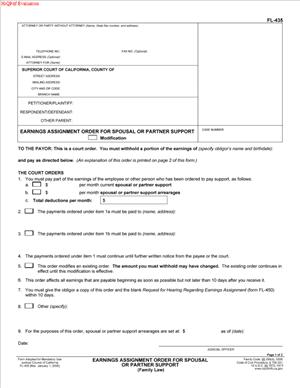
FL-435 – Earnings Assignment Order for Spousal or Partner Support (Family Law)
Fill out nowJurisdiction: Country: United States | Province or State: California
The FL-435 – Earnings Assignment Order for Spousal or Partner Support (Family Law) is a court form used in California family law cases. It directs an employer to take support payments directly from a person’s wages. The money is then sent to the appropriate agency or individual, depending on the case setup.
If you are about to complete this form, you are likely involved in a divorce, legal separation, or domestic partnership case. The court has ordered spousal or partner support. This document helps enforce that order through wage withholding.
This form matters because it creates a direct payment process. Instead of relying on one party to send payments each month, the employer deducts the amount from earnings. That structure can reduce missed payments and disputes about whether support was paid.
You may see this form referred to by its short identifier, FL-435. It works alongside other family law documents in your case. It does not create a new support obligation. It carries out an order that already exists.
Understanding how this document works makes it easier to complete it correctly. Small errors can delay processing or cause confusion for employers. Clear and accurate information helps avoid those issues.
What is FL-435 – Earnings Assignment Order for Spousal or Partner Support (Family Law)?
Clear definition
FL-435 – Earnings Assignment Order for Spousal or Partner Support (Family Law) is a court order that tells an employer to withhold a specific amount of money from an employee’s earnings for spousal or domestic partner support. The withheld funds are then sent according to the instructions in the order.
It is not a request. It is an order signed by a judge or authorized court officer. Once issued and properly served, the employer must follow it, subject to legal limits on how much can be taken from wages.
The form includes details about the paying party, the receiving party, the court case number, and the amount to be withheld. It may also include information about arrears, which are past-due amounts.
Who typically uses this form?
This form is commonly used by the party who is entitled to receive spousal or partner support. It may also be prepared by a local child support agency if that agency is involved in the case.
In some situations, the person ordered to pay support may complete the form as part of complying with a court process. Court clerks and judicial officers also handle the form as part of issuing and signing the order.
Employers do not fill out this form initially. They receive it after it has been issued and served. However, they are required to follow the instructions once it is effective.
Why might you need this form?
You may need this form if the court has already ordered spousal or partner support, and payment needs to be collected through wage withholding. This is common when regular monthly payments are required.
It may also be used when there have been missed payments. Wage withholding can help ensure steady payment and reduce further arrears.
In many cases, wage assignment is routine. Courts often require support orders to include an earnings assignment unless there is a specific reason not to. The form formalizes that process.
Typical real-life scenarios
- You and your spouse are going through a divorce. The court orders one spouse to pay monthly support. To ensure payments are made on time, an earnings assignment order is issued so the employer deducts the amount directly from wages.
- You are receiving partner support after ending a registered domestic partnership. Payments were inconsistent. The court issues an earnings assignment to stabilize the payment process and reduce future disputes.
- A support order was made months ago, but payments stopped. The receiving party asks the court to issue an earnings assignment order to collect both current support and part of the past-due amount from wages.
- Both parties agree that direct wage withholding is the simplest way to handle support. They submit the necessary documents so the court can issue the earnings assignment without waiting for missed payments.
When would you use FL-435 – Earnings Assignment Order for Spousal or Partner Support (Family Law)?
You would use this form after a court has made an order for spousal or domestic partner support. It is part of enforcing or implementing that order. Without an existing support order, this document has no function.
It is commonly used at the same time the support order is entered. In many family law cases, courts process the earnings assignment automatically unless the parties agree to an alternative arrangement and the court allows it.
You might also use it later in case circumstances change. For example, if voluntary payments stop, the receiving party may request that the court issue an earnings assignment to collect support directly from wages.
If the paying party changes jobs, a new earnings assignment may be needed for the new employer. The order must be directed to the correct employer to be effective.
In cases where arrears have built up, the form may reflect both current monthly support and an additional amount toward past-due support. The structure of the order can address both at the same time, within legal withholding limits.
Legal characteristics of FL-435 – Earnings Assignment Order for Spousal or Partner Support (Family Law)
This document becomes effective once it is properly issued and signed by the court, and then served on the employer. The employer’s obligation begins after service, not before.
The order must clearly identify the employee, the employer, and the case details. Missing or incorrect information can delay processing. Employers need accurate data to match the order to the correct employee.
There are legal limits on how much of a person’s disposable earnings can be withheld. These limits are set by law and apply regardless of the support amount ordered. The employer is responsible for calculating withholding within those limits.
The form does not change the amount of support ordered by the court. It enforces an existing order. If someone wants to modify the support amount, that requires a separate court process and different documents.
Problems often arise when the employer is not properly served, the employee’s name is misspelled, or the case number is incorrect. In those situations, withholding may be delayed or applied incorrectly.
Although this form is specific to California family law, wage withholding orders are common across the United States. The structure may vary by state, but the basic concept is similar: a court order directs an employer to withhold wages for support.
Is it legally binding?
Yes, once signed by the court and properly served, this order is legally binding on the employer. The employer must comply with its terms, subject to statutory withholding limits.
It is also binding in the sense that it enforces the underlying support order. The paying party cannot simply opt out because the deduction happens through payroll processing.
However, the document itself does not create a new support obligation. The legal duty to pay support comes from the original support order. This form is a tool for collection.
If there is an error in the form or a dispute about the amount, that issue is addressed through court procedures. Until changed or terminated by the court, the order remains in effect.
How to fill out FL-435 – Earnings Assignment Order for Spousal or Partner Support (Family Law)
Step 1 – Review the existing support order
Start by carefully reviewing the court’s spousal or partner support order. Confirm the exact monthly amount, the start date, and whether there are any arrears. The information in this form must match the existing order. Differences can cause rejection or delay.
Step 2 – Identify the parties and case details
Enter the full legal names of both parties exactly as they appear in the case. Include the court name, branch, and case number. Double-check spelling and numbers. Even a small error can prevent the employer from processing the order correctly.
Step 3 – Provide the employee’s employment information
Fill in the name and address of the employer who will receive the order. Make sure the employer information is current. If the paying party recently changed jobs, confirm the correct business name and address before completing this section.
Step 4 – State the support amounts clearly
Enter the amount of current monthly support as ordered by the court. If there are past-due amounts, include the arrears and any additional amount ordered to reduce them. Use the same figures that appear in the court’s support order or related documents.
Step 5 – Review withholding limits and calculations
Ensure that the total withholding requested does not exceed legal limits on disposable earnings. The employer ultimately applies these limits, but the amounts listed must reflect the court’s order accurately. Avoid estimating or rounding unless the original order does so.
Step 6 – Complete any required additional sections
Some sections may address when withholding begins, how payments are to be sent, and identifying codes or numbers linked to the case. Provide complete information where required. Leave sections blank only if they clearly do not apply.
Step 7 – Sign and submit for court issuance
After completing the form, sign where required. Submit it to the court for review and signature by a judge or authorized officer. The document does not become an enforceable order until the court signs it.
Step 8 – Arrange for proper service with the employer
Once issued, the order must be served on the employer according to court procedures. Service is what activates the employer’s duty to withhold earnings. Keep a copy for your records and confirm the date of service for tracking purposes.
Legal terms you might encounter in FL-435 – Earnings Assignment Order for Spousal or Partner Support (Family Law)
- Earnings Assignment Order: This is the court order that directs an employer to withhold support payments directly from an employee’s wages. This document, it applies specifically to spousal or partner support. Once issued and served, the employer must follow its terms.
- Obligor: The person who is ordered to pay support. On this form, the obligor is the employee whose wages will be withheld. You must make sure the obligor’s name matches the court’s support order exactly.
- Obligee: The person who receives the support payments. The obligee’s information must match the existing court order. This ensures payments are credited to the correct person and case.
- Spousal or Partner Support: Ongoing financial support ordered by the court after separation, divorce, or termination of a domestic partnership. This form enforces payment of that support through wage withholding.
- Arrears: Past-due support that has not been paid. If arrears exist, the order may include an additional amount to be withheld each pay period to reduce the balance. The form typically separates current support from arrears payments.
- Pay Period: The frequency at which the employee is paid, such as weekly, biweekly, or monthly. The withholding amount must align with the pay period to avoid over- or under-collection.
- Disposable Earnings: The portion of wages left after legally required deductions, such as taxes. Withholding limits are based on disposable earnings, not gross pay. Employers use this figure to calculate how much they can legally deduct.
- Income Withholding Limits: Legal caps on how much of an employee’s disposable earnings can be withheld for support. These limits protect the employee from excessive deductions. The employer must apply these limits when processing the order.
- Service of Process: The formal delivery of the order to the employer. Proper service triggers the employer’s legal obligation to begin withholding. Without a valid service, the employer may not act.
- Issuing Court: The court that signs and authorizes the order. The court’s signature or seal confirms that the document is enforceable. Employers rely on this to verify authenticity.
FAQs
When does withholding start after the FL-435 – Earnings Assignment Order for Spousal or Partner Support (Family Law) is served?
Withholding typically begins with the first pay period that occurs after the employer receives the order. You should confirm the date of service and identify the employee’s next regular pay date. The employer needs enough time to process payroll changes, so check that the order was delivered properly and that proof of service is completed and filed if required.
Do I need the judge’s signature before giving this document to the employer?
Yes. This document must be issued by the court before it is enforceable. Look for the court clerk’s stamp or the judge’s signature that shows it has been officially entered. If you serve an unsigned or unissued copy, the employer may reject it and delay withholding.
What information must match exactly with the original support order?
The names of both parties, the case number, and the support amounts must match the existing court order. Even small differences in spelling or middle initials can cause confusion in payroll systems. Before submitting this form, compare it line by line with your most recent support order to ensure consistency.
How do I calculate the correct amount per pay period?
Start with the monthly support amount listed in the court’s support order. Then convert it to match the employee’s pay frequency, such as weekly or biweekly. Make sure the total of current support plus any arrears payment does not exceed withholding limits based on disposable earnings.
What if the employee has more than one support order?
Employers must follow priority rules when multiple withholding orders exist. You should clearly state the case number and confirm whether other orders are already in place. This document does not automatically override other valid orders, so payroll may divide available disposable earnings according to legal limits.
Can the employer charge a fee for processing the withholding?
Some employers are allowed to deduct a small administrative fee from the employee’s wages for processing. This fee does not reduce the support amount owed. When reviewing pay stubs, check that the support amount ordered is still being sent in full.
What changes become part of the public court record?
Once issued, this document becomes part of the court file for your case. The support amount, arrears balance, and employer details included in the filed order are reflected in the record. If any of that information changes later, you may need a modified order to update the record.
What should I do if the employer says the form is incomplete?
Ask the employer which specific section is missing or unclear. Review the case number, party names, support amounts, and court issuance details. If necessary, correct the information and obtain a newly issued copy before serving it again to avoid further delay.
Checklist: Before, During, and After FL-435 – Earnings Assignment Order for Spousal or Partner Support (Family Law)
Before
- Review your most recent court order for spousal or partner support.
- Confirm the exact monthly support amount and any arrears owed.
- Verify the correct legal names of both parties as listed in the case.
- Confirm the obligor’s current employer and payroll address.
- Determine the employee’s pay frequency (weekly, biweekly, or monthly).
- Gather the case number and court location information.
- Check whether other income withholding orders already exist.
- Prepare a clean, legible draft without handwritten corrections.
During
- Enter the case number exactly as it appears on prior orders.
- Fill in both parties’ names without abbreviations or nicknames.
- Clearly separate current support and arrears amounts.
- Convert monthly support into the correct per-pay-period amount.
- Double-check all math before submitting the form.
- Ensure the court issues or signs the order as required.
- Make enough copies for your records and for service.
- Confirm that all required sections are complete and readable.
After
- Arrange for proper service of the issued order to the employer.
- Complete and file proof of service if required in your case.
- Mark your calendar for the expected first withholding date.
- Review pay stubs to confirm the correct amount is deducted.
- Keep copies of the issued order and proof of service.
- Monitor payments to ensure they are credited to the correct case.
- Follow up promptly if withholding does not begin on time.
- Update your records if the employee changes jobs.
Common mistakes to avoid with FL-435 – Earnings Assignment Order for Spousal or Partner Support (Family Law)
- Mistake: Using outdated support amounts because you rely on memory instead of the latest court order, which happens after modifications; this can lead to incorrect withholding and disputes, so always verify the most recent signed order before completing the form.
- Mistake: Forgetting to convert the monthly amount into the correct per-pay-period figure, which often occurs when you do quick math; this may cause over-withholding or underpayment, so carefully calculate based on the employee’s actual pay schedule.
- Mistake: Misspelling a party’s name or listing the wrong case number due to copying errors; employers may reject the order or misapply payments, so double-check spelling and numbers against official court documents.
- Mistake: Serving the employer before the order is properly issued by the court, which can happen when you rush the process; the employer may ignore the document, so confirm it is signed or stamped before service.
- Mistake: Ignoring withholding limits on disposable earnings because you focus only on the support total; this can create payroll conflicts, so do not forget that the employer must follow legal caps.
- Mistake: Failing to keep proof of service or copies of the issued order; this makes it hard to prove when withholding should have started, so always store stamped copies in your records.
- Mistake: Not updating the order when the employee changes jobs, which happens frequently; withholding will stop if the employer changes, so do not forget to act promptly with the new employer information.
- Mistake: Overlooking arrears details and leaving that section blank when past-due support exists; this delays repayment of overdue amounts, so clearly state both current support and arrears if applicable.
What to do after filling out FL-435 – Earnings Assignment Order for Spousal or Partner Support (Family Law)
Once you complete the form, your next focus is getting it properly issued and delivered. Accuracy matters, but so does follow-through. An unsigned or unserved order will not start withholding.
- Step 1: Review the entire document for accuracy. Compare it side by side with your existing support order. Confirm names, case number, and amounts.
- Step 2: Submit the form to the court for issuance. Follow your court’s filing process, whether in person, by mail, or through an approved electronic system if available.
- Step 3: Obtain a file-stamped or signed copy. Make sure the court has officially issued the order before you move forward.
- Step 4: Make multiple copies of the issued order. Keep at least one for yourself and prepare copies needed for service.
- Step 5: Arrange for proper service with the employer. Service must follow formal requirements, so the employer is legally obligated to comply.
- Step 6: Complete any required proof of service. File it with the court if your procedure requires proof in the case file.
- Step 7: Track the expected start date for withholding. Identify the next pay cycle after service and note it on your calendar.
- Step 8: Review payroll statements once withholding begins. Confirm that the amount deducted matches what the order requires.
- Step 9: Monitor that payments are properly credited to the correct case and recipient. Keep records of each payment for your files.
- Step 10: Update your records if circumstances change. If the obligor changes employers or the support amount is modified, you may need further action to keep withholding accurate.
Stay organized. Keep a dedicated folder with the issued order, proof of service, payment records, and any court correspondence. Good recordkeeping helps you respond quickly if there is a dispute or delay.
Disclaimer: This guide is provided for informational purposes only and is not intended as legal advice. You should consult a legal professional.