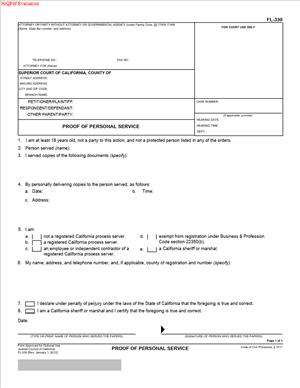
FL-330 – Proof of Personal Service
Fill out nowJurisdiction: Country: United States | Province or State: California
FL-330 – Proof of Personal Service is a court form used in California family law cases to confirm that someone was formally handed legal papers in person. It tells the court when, where, and how delivery happened.
If you are filing documents in a family law case, you often must show that the other party received copies. This form provides that confirmation. Without it, the court may not move your case forward.
You do not complete this form yourself if you are the person who filed the documents. The person who actually handed the papers to the other party fills them out and signs them.
Understanding FL-330 – Proof of Personal Service helps you avoid delays. If the form is incomplete or incorrect, your hearing or request may be postponed.
What is FL-330 – Proof of Personal Service?
Clear definition
FL-330 – Proof of Personal Service is a written statement filed with the Superior Court of California in family law cases. It confirms that legal documents were personally delivered to another party.
“Personal service” means the documents were handed directly to the person being served. It is not mailing, emailing, or leaving papers at a doorstep.
The form records key details. These include the server’s name, the date and time of service, the address where service occurred, and the specific documents delivered.
Once completed and signed, the form becomes part of the court record. It shows the judge that proper notice was given.
Who typically uses this form?
This form is commonly used in divorce, parentage, child custody, child support, and domestic violence matters in California.
The person who serves the documents completes the form. This may be a friend, relative, professional process server, or sheriff, as long as they meet basic eligibility requirements.
The party who filed the original papers arranges for service but does not personally serve the documents. That same party also does not sign this form.
Court clerks and judges review the completed form to confirm that service was done correctly before taking further action in the case.
Why might you need this form?
You may need this form when you file a motion, request for order, or other family law papers that require personal delivery.
Courts require proof that the other side received notice. This protects each person’s right to respond.
If you are asking for court orders that affect custody, visitation, support, or property, personal service is often required for certain documents, especially at the beginning of a case.
Without a properly completed proof of service, the court may refuse to hear your request.
Typical real-life scenarios
- You file for divorce and need to serve your spouse with the summons and petition. The person who hands those papers to your spouse completes this form to confirm delivery.
- You request a modification of child custody. After filing your request, someone personally delivers the filed copies to the other parent. The server fills out the proof of service.
- You file a motion related to child support enforcement. The other party must receive the papers in person. The form records that the service took place.
- You respond to a petition and need to serve your response personally because of court rules or prior orders. The server documents the delivery using this form.
When would you use FL-330 – Proof of Personal Service?
You use FL-330 – Proof of Personal Service when court rules require personal delivery of family law documents. This commonly applies at the start of a case, such as when serving a summons and petition.
It is also used for certain post-judgment motions and hearings where the court requires strict notice. The specific type of document often determines whether personal service is necessary.
In many family law matters, the person requesting orders must ensure the other party receives formal notice within a set time frame. Personal service provides strong proof of delivery because the documents are handed directly to the recipient.
If you are the petitioner or moving party, you arrange for someone else to serve the documents. If you are the respondent and filing certain responsive papers, you may also need to arrange personal service in some situations.
The timing of service matters. Courts often require service to occur a certain number of days before a hearing. The date listed on the form helps the court determine whether notice was timely.
Legal characteristics of FL-330 – Proof of Personal Service
This form is a sworn statement. The server signs it under penalty of perjury. That means the server declares the information is true to the best of their knowledge.
For the form to be effective, it must be complete and accurate. It must clearly identify the documents served and the person served. It must also include the correct date, time, and location of service.
Common problems include missing signatures, incomplete addresses, incorrect case numbers, or failure to list every document that was delivered. If any required detail is missing, the court may reject the filing.
The form does not replace actual service. It only proves that service occurred. If the delivery itself did not meet the required method, the proof form cannot fix that problem.
Requirements may vary depending on the type of document and stage of the case. Initial filings often have stricter service rules than later filings. Some documents may allow service by mail instead of personal delivery.
This form does not create or change any legal rights. It does not request orders. It does not argue your position. Its sole function is to document that personal service took place.
Is it legally binding?
The form is legally significant because it is signed under penalty of perjury. Providing false information can have serious consequences.
When properly completed and filed, the form serves as official evidence that notice was given. Courts rely on it to decide whether they can proceed with a hearing or issue orders.
It is not a contract and does not bind the parties to any agreement. Its binding effect relates only to the truthfulness of the statements made by the server.
If the information is challenged, the court may require further proof or testimony about how the service was completed.
How to fill out FL-330 – Proof of Personal Service
Step 1 – Fill in the court information
At the top of the form, enter the name of the Superior Court of California, the street and mailing address, and the branch name if applicable. Use the same court information that appears on your other filed documents.
Step 2 – Complete the case caption
Fill in the names of the petitioner and respondent exactly as they appear in the case. Enter the case number in the space provided. Accuracy here is important because the form must match the existing court file.
Step 3 – Identify the server
In the section asking for information about the person who served the documents, the server writes their full name, address, and telephone number. The server must confirm they are at least 18 years old and not a party to the case.
Step 4 – List the documents served
The server checks the boxes or writes in the titles of every document that was personally delivered. Each document must be clearly identified. If additional space is needed, an attachment may be referenced.
Step 5 – Provide details of the service
The server enters the exact date and time the documents were handed to the recipient. The full address where the service took place must also be listed, including city and state.
Step 6 – Identify the person served
The form requires the name of the person who received the documents. The server states that the papers were personally handed to that individual.
Step 7 – Sign under penalty of perjury
At the end of the form, the server writes the date and signs their name. By signing, the server declares that all information provided is true and correct.
Step 8 – File the completed form with the court
After signing, the completed form is returned to the filing party. It is then submitted to the court clerk so it becomes part of the official case record.
Legal terms you might encounter in FL-330 – Proof of Personal Service
- Personal Service: This means the documents were physically handed to the person being served. On this form, the server confirms that delivery was done face-to-face, not by mail or electronic means. The date, time, and location of that in-person delivery must be listed clearly.
- Server: The server is the person who delivered the documents. This cannot be you if you are a party in the case. The server must be at least 18 years old and not involved in the case, and their name, address, and contact details appear on this document.
- Party: A party is someone directly involved in the court case, such as the petitioner or respondent. The form identifies which party’s documents were served and which party received them. Accuracy here matters because the court tracks service by party name.
- Case Number: This is the unique number assigned to your court case. It appears at the top of the form and must match the number on all other filed documents. If this number is wrong, the proof may not be connected to your case.
- Declaration Under Penalty of Perjury: The server signs a statement saying the information provided is true. Signing under penalty of perjury means giving false information can lead to legal consequences. The court relies on this sworn statement to confirm that service happened properly.
- Date of Service: This is the exact calendar date when the documents were handed to the other person. It establishes deadlines for responses. The court calculates timelines based on this date.
- Time of Service: The specific time of day the documents were delivered. While it may seem minor, it helps confirm details if service is ever challenged. The time should be as accurate as possible.
- Address of Service: This is where the documents were physically handed to the person. It could be a home, workplace, or public place. The server must provide enough detail to show where the in-person delivery occurred.
- Documents Served: This section lists each form or paper that was handed to the other party. Every document must be named exactly as it appears on the original paperwork. If something is missing from the list, the court may treat it as not served.
- Service List or Attachment: Sometimes, there is not enough space to list all documents on the main page. An attachment can be added to continue the list. If an attachment is used, it must be clearly referenced on the main form.
FAQs
Do I need to file FL-330 – Proof of Personal Service even if the other person admits they received the papers?
Yes. The court does not rely on informal confirmation. It relies on a completed and filed proof of service. Even if the other person tells you they received the documents, the judge will look for this form in the case file before moving forward. Without it, deadlines may not start, and hearings may be delayed.
Who is allowed to complete and sign this document?
The person who physically handed over the documents must complete and sign it. That person must be at least 18 years old and cannot be a party to the case. You cannot sign it for yourself if you are involved in the case. The server fills in their name, address, phone number, and signs under penalty of perjury.
What exact date should be written as the date of service?
You must enter the actual date the documents were handed directly to the other person. Do not use the date the paperwork was prepared or the date it was filed. The court uses the service date to calculate response deadlines. Double-check the calendar date before filing.
What if I realize a document was served but not listed on the form?
Only documents listed on this form are officially proven as served. If something was handed over but not included, the record does not show that it was served. You may need to complete a corrected or new proof that accurately lists every document delivered. Make sure the titles match the original paperwork exactly.
Does the name of the person served have to match the court records exactly?
Yes. The name written as the person served should match the name used in the case caption. If there is a mismatch, the court may question whether the correct person was served. Review the case caption and copy the spelling exactly.
What happens if the court rejects the filing?
If the clerk rejects the filing, the proof is not officially part of the case record. This can delay hearings or prevent the court from taking action. You should review the reason for rejection, correct the issue, and resubmit promptly so the service is properly recorded.
Is the address where service happened made part of the public record?
Yes. The address listed as the place of service becomes part of the court file. Anyone reviewing the file can see it unless the record is confidential. Make sure the server writes the location accurately and clearly, because that detail stays in the official record.
What changes in the case after this form is filed?
Once filed, the court recognizes that service has been completed. Response deadlines begin based on the date listed. The judge can move forward with hearings or decisions because there is written confirmation that notice was properly given.
Checklist: Before, During, and After FL-330 – Proof of Personal Service
Before
- Confirm the documents require personal service, not service by mail or another method
- Choose a server who is at least 18 and not a party to the case
- Provide the server with complete copies of every document to be delivered
- Verify the full legal name of the person to be served
- Confirm the correct case number and court information
- Review deadlines so service happens on time
- Make extra blank copies of the proof form for safety
During
- Ensure the server personally hands the documents to the correct person
- Confirm the server notes the exact date of delivery
- Confirm the server records the exact time of delivery
- Have the server write down the full address or detailed location of the service
- Make sure every document delivered is listed clearly
- Check that any attachments are properly referenced
- Ensure the server signs and dates the declaration
After
- Review the completed form for accuracy and legibility
- Make at least two copies of the signed proof
- File the original with the court clerk
- Confirm the clerk accepts and stamps the filing
- Keep a stamped copy for your personal records
- Calendar response deadlines based on the service date
- Bring a filed copy to the next hearing if required
Common mistakes to avoid with FL-330 – Proof of Personal Service
- Mistake: Letting a party to the case serve the documents because it seems convenient; this happens when people want to save time, but it invalidates service and can cause court delays—do not forget the server must be over 18 and not involved in the case.
- Mistake: Listing the wrong service date because the form was filled out later from memory; this happens when details are not recorded immediately, which can create deadline disputes—do not forget to confirm the exact calendar date before signing.
- Mistake: Forgetting to list every document delivered; this happens when multiple forms are served at once, leading the court to treat unlisted documents as not served—do not forget to copy each title exactly as written.
- Mistake: Using nicknames or shortened names for the person served; this happens out of habit, but it can raise questions about identity—do not forget to match the name to the case caption exactly.
- Mistake: Submitting the form without the server’s signature; this happens during rushed filings, making the proof invalid—do not forget that the declaration under penalty of perjury must be signed and dated.
- Mistake: Writing an incomplete service address, such as only a city name; this happens when service occurs in public places, but vague details weaken the record—do not forget to include a clear street address or detailed location.
- Mistake: Filing late because you assume service alone is enough; this happens when people forget the court must receive the proof—do not forget to file promptly so deadlines and hearings stay on track.
- Mistake: Attaching extra pages without referencing them on the main form; this happens when space runs out, causing confusion in the record—do not forget to clearly indicate any attachments in the designated section.
What to do after filling out FL-330 – Proof of Personal Service
Once the server completes and signs the form, your job is to review it carefully. Do not assume it is correct. Read every line. Confirm the case number matches your court documents. Confirm that the date and time of service are accurate. Make sure the person served is clearly identified.
Next, make copies before you file anything. You want at least one copy for your records and one spare. If your case is ongoing, you may need to show proof of service at a hearing.
- Step 1: Review the completed form for accuracy, including names, dates, times, and listed documents.
- Step 2: Make at least two copies of the signed form.
- Step 3: File the original with the court clerk handling your family law case.
- Step 4: Confirm the clerk stamps your copies as filed.
- Step 5: Check that the filing appears in your case record if your court provides access to case status information.
- Step 6: Mark your calendar with any response deadlines triggered by the service date.
- Step 7: Store your stamped copy in a safe, organized file with the documents that were served.
- Step 8: Bring a filed copy to your next hearing in case the judge asks for confirmation.
- Step 9: If the court rejects the filing, correct the issue immediately and resubmit.
- Step 10: Keep a written timeline of when service occurred and when proof was filed for your personal records.
Filing this form moves your case forward. It tells the court that the other party received proper notice. From that point on, timelines begin to run. Stay organized and track every deadline connected to the date of service.
Disclaimer: This guide is provided for informational purposes only and is not intended as legal advice. You should consult a legal professional.