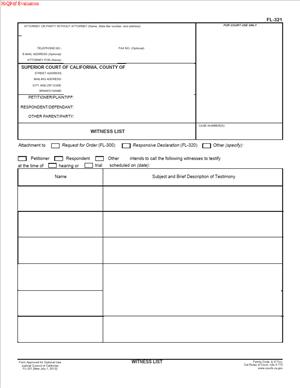
FL-321 – Witness List
Fill out nowJurisdiction: Country: United States | Province or State: California
If you are preparing for a family law hearing in California, the FL-321 – Witness List is a form you may need to complete. It is used to tell the court and the other party who you plan to call as witnesses at your hearing or trial. This form helps organize testimony before the court date.
The FL-321 – Witness List is not where you argue your case. It is not where you explain what happened. Instead, it is a structured document that lists the people who may speak under oath about issues in your case.
You may encounter this form when you are handling your own family law matter, such as custody, support, or property division. Courts often require advance notice of witnesses so that both sides have a fair opportunity to prepare.
If you are about to fill it out, focus on accuracy and clarity. The information you provide affects how your hearing is scheduled and how evidence is presented. Taking time to understand the purpose of the form can prevent delays or confusion later.
What is FL-321 – Witness List?
Clear definition
The FL-321 – Witness List is a California family law court form used to identify the witnesses a party expects to call at a hearing or trial. It is part of the pre-hearing or pre-trial preparation process.
This document typically includes each witness’s name and may include contact information or a brief description of the subject of their testimony. Its purpose is to give notice, not to present full testimony.
The form becomes part of the court file once it is submitted. It informs the judge and the opposing party about who may appear to testify in person.
Who typically uses this form?
Self-represented individuals in family court often use this form when they are preparing for a contested hearing. It is also commonly used by attorneys representing clients in divorce, custody, visitation, support, or property cases.
You may use this form if you plan to call witnesses other than yourself. For example, you might list teachers, counselors, relatives, financial professionals, or other individuals with direct knowledge of the issues in your case.
In some situations, both parties submit separate witness lists. Each side identifies its own witnesses, even if some names overlap.
Why might you need this form?
Courts generally expect transparency before trial. The FL-321 – Witness List helps ensure that no one is surprised by last-minute witnesses.
Providing this information in advance supports orderly court proceedings. The judge can better manage time and decide how long the hearing may take.
Failing to list a witness when required may limit your ability to have that person testify. In many cases, advance disclosure is tied to fairness and due process.
This form also helps you think strategically about your case. Listing witnesses forces you to consider who has firsthand knowledge and what each person can realistically contribute.
Typical real-life scenarios
- You may be involved in a child custody dispute where you want a teacher to testify about your child’s attendance or behavior. In that situation, you would list the teacher as a witness before the hearing.
- In a support case, you might call an employer or accountant to explain income or employment history. That individual would appear on your witness list.
- During property division proceedings, a financial professional may be needed to discuss asset values. Listing that person alerts the court that expert or professional testimony may be presented.
- If there are allegations of domestic violence or substance abuse, a counselor or treatment provider may be identified as a witness. The court then knows to expect testimony on those topics.
- In some cases, family members are listed because they observed parenting practices or financial arrangements. Even when witnesses are relatives, they must be disclosed in advance if they will testify.
When would you use FL-321 – Witness List?
You use this form when your family law case is moving toward a contested hearing or trial, and live testimony will be presented. It is generally not needed for simple status conferences or uncontested matters.
This document is often part of a group of pre-trial forms. Courts may set deadlines for submitting witness lists before the hearing date. Timing matters because the other party relies on this information to prepare questions and evidence.
You may also use this form if the court specifically orders both parties to exchange witness information. In that situation, completing the form becomes part of complying with the court’s scheduling instructions.
If your case involves multiple issues, such as custody and support, your witness list may cover testimony related to each topic. The form does not limit you to one issue, but it does require clarity about who will testify.
Even if you expect only one additional witness, the form may still be required. It applies whether you have one witness or several.
Legal characteristics of FL-321 – Witness List
The FL-321 – Witness List functions as a disclosure document. Its effectiveness comes from accurate, timely submission and proper service to the other party when required.
A complete form generally includes all requested identifying information. Omitting key details, listing incomplete names, or failing to file by the deadline can create procedural problems. Courts often enforce deadlines to maintain fairness.
The form does not prove your case. It does not establish facts by itself. It simply identifies who may provide testimony under oath at a future proceeding.
In California family law matters, procedures may vary slightly by county. Some courts have local rules that affect timing or format. The core purpose of the form, however, remains consistent: advance identification of witnesses.
This document also does not guarantee that every listed witness will be allowed to testify. Judges may limit testimony if it is repetitive, irrelevant, or outside the scope of the issues set for hearing.
Is it legally binding?
The FL-321 – Witness List is not a contract or agreement between parties. It does not create legal rights on its own. Instead, it serves as a procedural notice within an active court case.
Once filed and served as required, it becomes part of the court record. You are generally expected to be truthful and accurate in listing your intended witnesses. Providing false information can affect your credibility.
While the form itself is not “binding” in the way a settlement agreement is, courts often rely on it to manage the hearing. If a witness is not listed when required, the court may limit that witness’s testimony.
In that sense, the form carries practical weight. It shapes how your case is presented and how the court allocates time during trial.
How to fill out FL-321 – Witness List
Step 1 – Review the case caption
At the top of the form, you will see the case caption. This section includes the court name, case number, and the names of the parties. Enter the information exactly as it appears on other documents filed in your case. Consistency prevents clerical errors and confusion in the court file.
Step 2 – Identify yourself correctly
Indicate whether you are the petitioner, respondent, or another party in the case. Use the same role designation used in earlier filings. This clarifies which side is submitting the witness list.
Step 3 – List each witness’s full name
Write the full legal name of every person you plan to call as a witness. Avoid nicknames unless that is the only name known. Accurate identification reduces the risk of confusion, especially if multiple individuals share similar names.
Step 4 – Provide required contact or identifying details
If the form requests addresses, phone numbers, or other identifying information, complete those sections carefully. Make sure the information is current. Inaccurate details can interfere with scheduling or service of subpoenas if needed.
Step 5 – Describe the subject of testimony if requested
Some versions of the form include space to summarize what each witness will testify about. Keep descriptions brief and factual. Focus on the topic, such as parenting time, income, or property value, rather than making arguments.
Step 6 – Review for completeness
Read through the entire document before signing. Confirm that no intended witness has been left out. Check spelling, case number, and party names for accuracy.
Step 7 – Sign and date the form
Sign the form where indicated. By signing, you confirm that the information is true to the best of your knowledge. Dating the document shows when it was completed.
Step 8 – Prepare for filing and service
After completing the form, make the required copies. The original is typically filed with the court, and copies are provided to the other party as part of the submission process. Keep a copy for your records so you can refer to it while preparing for the hearing.
Legal terms you might encounter in FL-321 – Witness List
- Caption: The caption is the heading section at the top of the form. It lists the court name, courthouse address, case number, and the names of the parties. You must copy this information exactly as it appears on other filed documents in your case so the court matches your witness list to the correct file.
- Case Number: This is the unique number assigned to your family law case. It connects every document you file to your court record. If you enter the wrong number, the clerk may reject the form or place it in the wrong case file.
- Petitioner: The petitioner is the person who started the case by filing the initial paperwork. This title stays the same throughout the case, even if circumstances change. When completing this document, you must list the party names exactly as they appear in the case caption.
- Respondent: The respondent is the person who responded to the petition. Like “petitioner,” this label does not change. You should not replace it with “mother,” “father,” or other descriptions unless the form specifically asks for additional identifying information.
- Witness: A witness is a person who will testify at your hearing or trial. On this form, you list each witness by full legal name. The court uses this list to understand who may speak and what evidence may be presented.
- Testimony: Testimony is the information a witness provides under oath in court. When the form asks for the subject of testimony, you briefly describe what the witness will talk about. Keep it specific and relevant to the issues in your case.
- Service: Service means delivering a copy of the filed document to the other party, in your case. After you complete and file your witness list, you usually must ensure the other side receives a copy. Proof of service may need to be filed to show you met this requirement.
- Proof of Service: This is a separate document showing that the other party was properly given a copy of what you filed. It states who served the documents, how they were served, and on what date. Without proper proof of service, the court may refuse to consider your witness list.
- Continuance: A continuance is a postponement of a scheduled court hearing. If your hearing is continued, you may need to update your witness list. Always check whether the court requires an amended list if new witnesses are added.
- Exhibit: An exhibit is a document, photo, or other item you present as evidence. While this form focuses on witnesses, their testimony often relates to exhibits. Make sure your listed witnesses are connected to the evidence you plan to present.
FAQs
Do I have to list every person who might testify, even if I am not sure they will be called?
You should list anyone you reasonably expect to call as a witness. Courts often require advance disclosure so the other side can prepare. If you leave someone off this document and later try to call them, the judge may limit or exclude their testimony. Review your notes and planned evidence before finalizing your list.
What happens if I forget to include a witness on the FL-321 – Witness List?
If you realize the mistake before filing, correct the form and complete a clean copy. If you discover the omission after filing, you may need to file an updated witness list and serve it on the other party. Waiting until the day of the hearing can lead to objections and possible exclusion of that witness, so act quickly and keep records of any updates.
Do I need to include contact information for each witness?
Follow the instructions in this document carefully. If it asks for addresses or phone numbers, provide them clearly and accurately. If it only requires names and a brief description of testimony, do not add extra personal information. Always check that names are spelled correctly and match identification documents.
How detailed should the description of each witness’s testimony be?
Keep it short but specific. State the main topic or issue the witness will address, such as parenting time observations, financial records, or communication history. Do not write a long narrative. The goal is to give fair notice of what the witness will talk about, not to argue your case on the form.
Can I update this form if my hearing date changes?
If the hearing is continued or rescheduled, confirm whether the court requires a new or amended witness list. If you add or remove witnesses, prepare an updated version and make sure the case caption and hearing date are correct. Serve the revised document on the other party so the court record stays accurate.
Do I need to sign the witness list before filing it?
Yes. Review the signature section carefully. You must sign and date the form where indicated. By signing, you confirm the information is accurate to the best of your knowledge. Unsigned forms may be rejected or disregarded by the court.
Will filing this document automatically notify my witnesses to appear in court?
No. This form informs the court and the other party who you intend to call. It does not compel a witness to attend. If a witness is reluctant or unavailable, you may need to take additional steps to ensure their attendance, and you should plan ahead so you are not surprised on the hearing date.
What should I check before submitting FL-321 – Witness List to the court clerk?
Confirm that the case number matches your other filings, the party names are identical to the caption in your case, and the hearing date is correct. Make sure every witness is clearly listed and that you have signed and dated the form. Prepare the required number of copies so the clerk can file-stamp them and return a copy for your records.
Checklist: Before, During, and After FL-321 – Witness List
Before
- Review your hearing notice to confirm the correct date, time, and department.
- Gather a complete list of potential witnesses and narrow it to those you truly plan to call.
- Check prior court orders to see if there are deadlines for exchanging witness information.
- Confirm the exact spelling of each witness’s full legal name.
- Outline what each witness will testify about so you can summarize it clearly.
- Locate your case number and confirm the caption format from earlier filings.
- Determine how and when you must serve the other party.
- Prepare a draft so you can review it before creating a final version.
During
- Enter the court name and case number exactly as shown on your other documents.
- List the petitioner and respondent names without changing titles.
- Add each witness on a separate line if space allows.
- Provide a brief, focused description of each witness’s testimony.
- Double-check spelling and readability.
- Avoid emotional language or argument in the testimony descriptions.
- Sign and date the form in the correct place.
- Make clean copies for filing and service.
After
- File the original with the court clerk by the required deadline.
- Obtain file-stamped copies for your records.
- Serve a copy on the other party using the appropriate method.
- Complete and file a proof of service if required.
- Keep a copy in your hearing folder.
- Notify your witnesses of the hearing date and time.
- Prepare questions for each listed witness.
- Monitor for any objections or responses from the other party.
Common mistakes to avoid with FL-321 – Witness List
- Mistake: Listing vague entries like “friends” or “family members,” which happens when you rush, can lead to objections and excluded testimony; do not forget to provide each witness’s full legal name and a clear description of their topic.
- Mistake: Using nicknames or incorrect spellings, often because you rely on memory, can create confusion in the record and weaken credibility; do not forget to verify names against reliable documents.
- Mistake: Missing the filing deadline, which commonly occurs when you misread the hearing notice, can result in the court refusing to consider your witnesses; do not forget to calendar all deadlines in advance.
- Mistake: Failing to serve the other party, usually because you assume filing is enough, can cause delays or sanctions; do not forget that service and proof of service are separate steps from filing.
- Mistake: Writing long argumentative statements instead of brief summaries, which happens when you try to prove your case on paper, can irritate the court and obscure the purpose of the form; do not forget that this document is a notice, not your closing argument.
- Mistake: Forgetting to sign and date the form, often due to printing in a hurry, can lead to rejection by the clerk; do not forget to check the signature line before making copies.
- Mistake: Bringing witnesses to court who are not listed, because you changed strategy at the last minute, can result in the judge excluding their testimony; do not forget to update and properly serve any amended list if your plans change.
- Mistake: Listing witnesses who have no relevant knowledge, often out of frustration or to overwhelm the other side, can damage your credibility; do not forget that each witness should connect directly to an issue the court must decide.
What to do after filling out FL-321 – Witness List
Once you complete the form, shift your focus from paperwork to preparation. This document is only useful if you follow through correctly.
- Step 1: Review the entire form one more time for accuracy, including spelling, case number, and hearing date.
- Step 2: Make at least two copies—one for yourself and one for the other party—before filing the original.
- Step 3: File the original with the court clerk by the required deadline, either in person or through the approved filing method for your court.
- Step 4: Ask the clerk to file-stamp your copies so you have proof of submission.
- Step 5: Arrange for service on the other party using an adult who is not you, if required.
- Step 6: Complete a proof of service form and file it with the court if the rules require it.
- Step 7: Place your stamped copy and proof of service in a dedicated hearing folder.
- Step 8: Contact each listed witness to confirm they know the date, time, and location of the hearing.
- Step 9: Prepare a short list of questions for each witness that stay within the topics you described.
- Step 10: Bring extra copies of your witness list to court in case the judge or the other party needs one.
Keep your records organized. Store a digital copy if possible, along with scanned file-stamped versions. If anything changes—such as a new hearing date or a new witness—update your records immediately and follow the proper steps to amend and serve the revised document.
Stay proactive. A clear and properly handled witness list strengthens your presentation and helps the court focus on the issues that matter most.
Disclaimer: This guide is provided for informational purposes only and is not intended as legal advice. You should consult a legal professional.