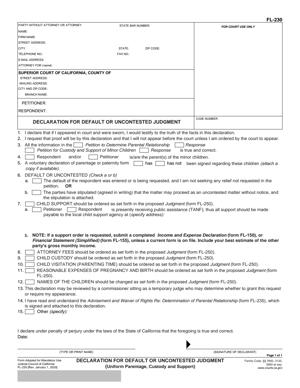
FL-230 – Declaration for Default or Uncontested Judgment
Fill out nowJurisdiction: Country: United States | Province or State: California
The FL-230 – Declaration for Default or Uncontested Judgment is a family law court form used in California when a case moves forward without active dispute. You use it to tell the court key facts before a judge enters a final judgment.
This document often comes into play in divorce, legal separation, or nullity cases. It supports a request for judgment when the other party has not responded or when both sides agree on all issues.
If you are representing yourself, this form helps you present the required information in a structured way. It explains your situation to the court in writing.
The FL-230 – Declaration for Default or Uncontested Judgment matters because a judge relies on it when deciding whether to sign your proposed judgment. If it is incomplete or inconsistent, your case can be delayed.
Understanding what this form does and how it fits into your case can save time and reduce rejected filings.
What is FL-230 – Declaration for Default or Uncontested Judgment?
Clear definition
FL-230 – Declaration for Default or Uncontested Judgment is a written statement filed in a California family law case. It provides the court with sworn information needed to enter a judgment when there is no active dispute.
A “default” usually means the other party did not file a response within the required time. An “uncontested” case generally means both parties agree on all issues, even if a response was filed.
This form summarizes important facts. It may address service of papers, agreements between the parties, property division, support, and parenting arrangements. It gives the judge a clear record before signing the final judgment.
You are declaring, under penalty of perjury, that the information you provide is true and correct. That makes accuracy essential.
Who typically uses this form?
This form is commonly used by a petitioner in a divorce or legal separation case. The petitioner is the person who started the case.
It may also be used in cases involving the nullity of marriage or domestic partnership. In some situations, it is filed along with a proposed judgment package.
Self-represented individuals frequently complete this document. It is also used by attorneys handling uncontested matters.
In default cases, the petitioner usually prepares and files it after requesting entry of default. In uncontested cases, one party typically prepares the paperwork reflecting the parties’ agreement.
Why might you need this form?
You may need this form if your spouse or partner did not respond after being properly served. The court still needs certain facts before granting a judgment.
You may also need it if you and the other party have reached a full agreement. Even when there is agreement, the judge must review the terms to ensure they meet legal standards.
The court uses this declaration to confirm that procedural steps were completed. For example, it may address whether financial disclosures were exchanged.
Without this form, the judge may not have enough information to enter judgment. That can result in the court returning your paperwork for correction.
Typical real-life scenarios
- You filed for divorce and properly served your spouse. Thirty days passed, and no response was filed. You request entry of default and then submit this declaration so the court can enter judgment based on your requests.
- You and your spouse agreed on property division and support. A response was filed, but there is no dispute. You submit a written agreement and use this declaration to confirm the case is ready for an uncontested judgment.
- You have no children and minimal property. The other party did not participate in the case. You complete this form to confirm there are no unresolved issues before the court signs the judgment.
- You have children together and agreed on custody and support. You use this form to declare that the required disclosures were completed and that your proposed parenting plan reflects your agreement.
When would you use FL-230 – Declaration for Default or Uncontested Judgment?
You use this form near the end of a family law case. It is not a starting document. It comes after the initial petition, service of process, and other required filings.
In a default situation, you typically use it after the clerk enters the other party’s default. Entry of default means the other party did not respond in time.
In an uncontested situation, you use it when all issues are resolved. This may happen after negotiations or after exchanging financial information.
The person who filed the petition usually prepares the form. However, in an uncontested case, both parties may review the final paperwork before submission.
This document often accompanies a proposed judgment form and other supporting documents. The court reviews the full package together.
If your case involves children, support, or property, the declaration helps the judge understand what orders are being requested and why.
Legal characteristics of FL-230 – Declaration for Default or Uncontested Judgment
This form is a sworn declaration. You sign it under penalty of perjury. That means you are legally stating that the information is true.
For the court to accept it, the information must be consistent with the rest of your file. Dates, names, and requested orders must match your petition and proposed judgment.
One common reason for rejection is inconsistency. For example, if your petition requested spousal support but your proposed judgment says none, the court may require clarification.
Another common issue is missing disclosures. In many family law cases, both parties must exchange financial information. If this requirement is not addressed, the court may not enter judgment.
The form does not replace other required filings. It works together with your judgment package. It does not, by itself, grant a divorce or create enforceable orders.
Family law procedures can vary by state. In California, courts generally require clear documentation before entering a default or uncontested judgment. Local practices may differ slightly by county, but the core purpose of the form remains the same.
Is it legally binding?
The declaration itself is not the final order. It supports the judgment.
Once the judge reviews your declaration and signs the judgment, the judgment becomes legally binding. That judgment may address marital status, property division, custody, and support.
Because you sign under penalty of perjury, the statements in the declaration carry legal weight. Providing false information can have serious consequences.
The binding effect comes from the court’s signed judgment, not from the declaration alone. The declaration helps the court decide whether to grant that judgment.
How to fill out FL-230 – Declaration for Default or Uncontested Judgment
Step 1 – Identify the case information
At the top of the form, fill in your name, address, and contact details as required. Enter the court’s name and address. Write the full names of both parties exactly as they appear on earlier filings. Include the correct case number. Make sure every detail matches the court record.
Step 2 – State the type of judgment requested
Indicate whether the case is proceeding by default or as an uncontested matter. This section tells the court why no trial is needed. Confirm that the other party either did not respond or that both parties have resolved all issues.
Step 3 – Confirm service and default status
Provide information about the service of the initial petition and summons. If you are proceeding by default, confirm that the default was entered. The dates listed must match the court file. This shows the court that proper notice requirements were met.
Step 4 – Address required disclosures
State whether financial disclosures were completed, if required in your case. Indicate whether both parties exchanged the necessary documents. If disclosures were waived in an uncontested matter where permitted, reflect that accurately. Consistency with other filed forms is essential.
Step 5 – Describe agreements or requested orders
Summarize the key terms of your proposed judgment. This may include division of property and debts, spousal or partner support, and issues related to children. Ensure the summary aligns with your attached proposed judgment and any written agreement.
Step 6 – Review for consistency and completeness
Read the entire form carefully before signing. Check names, dates, and requested orders against your petition and proposed judgment. Confirm that no section is left incomplete if it applies to your case. Courts often return forms for small errors.
Step 7 – Sign and date the declaration
Sign the form where indicated. By signing, you declare under penalty of perjury that the information is true and correct. Enter the date of signing. Make sure your signature matches your name as listed in the case.
Step 8 – Prepare the full judgment package for submission
Attach the completed declaration to your proposed judgment and any other required documents. Organize the paperwork in a clear order. Ensure that all forms are properly completed before submitting them to the court clerk for review and filing.
Legal terms you might encounter in FL-230 – Declaration for Default or Uncontested Judgment
- Default: A default occurs when the responding party does not file a response within the required time after being properly served. In this form, you confirm that a default has been entered or that you are requesting judgment based on default. The court relies on this statement to decide whether it can issue orders without the other party’s participation.
- Uncontested Case: An uncontested case is one where both parties agree to the terms or where no response was filed, and no dispute remains. In this document, you indicate that there is no disagreement requiring a hearing. This allows the judge to review your paperwork without scheduling a trial.
- Declaration: A declaration is a written statement made under penalty of perjury. When you complete this form, you are swearing that the facts you provide are true and correct. The judge treats your declaration as sworn testimony.
- Proof of Service: Proof of service shows that the other party was formally given copies of the required documents. The court cannot proceed unless the service rules are followed. This form asks you to confirm that the service was completed and documented.
- Preliminary Disclosure: Preliminary disclosures are financial information documents exchanged between parties in certain family law cases. You may need to confirm that disclosures were served before the court will grant judgment. The judge checks this requirement carefully in property or support matters.
- Petitioner and Respondent: The petitioner is the person who started the case. The respondent is the other party. On this form, you must clearly identify who you are and ensure your role matches the rest of the case file.
- Judgment: A judgment is the final court order that resolves the issues in your case. This declaration supports your request for that judgment. The judge reviews it before signing the final order.
- Relief Requested: Relief requested refers to the specific orders you want the court to make. This may include property division, custody, support, or other matters. The court can only grant what you properly request and document.
- Settlement Agreement: A settlement agreement is a written agreement between parties resolving their issues. If your case is uncontested because of an agreement, you may reference it here. The judge reviews it to ensure it meets legal standards before approving it.
- Entry of Default: Entry of default is the formal court action that records the responding party’s failure to respond. This must usually occur before a default judgment is granted. You confirm this status in your declaration so the judge can verify it in the court file.
FAQs
What exactly am I confirming when I sign this form?
You are confirming key facts that allow the court to enter judgment without a contested hearing. This includes that the other party was properly served, that the time to respond has passed, or that the matter is fully agreed upon, and that required disclosures were completed if applicable. When you sign, you are declaring under penalty of perjury that these statements are accurate.
Do I need a hearing after filing FL-230 – Declaration for Default or Uncontested Judgment?
In many situations, the judge reviews this document and the rest of your judgment package without a hearing. If the paperwork is complete and consistent, the court may issue a judgment based solely on the written submission. If something is unclear or missing, the court may request corrections or set a hearing.
What happens if the names on this document do not exactly match the original petition?
The court compares this document to the original petition and other filings. If names are spelled differently or formatted inconsistently, the clerk may reject the submission. You should check that the case number, party names, and designations match the existing court record exactly.
What attachments usually go with this declaration?
You typically submit it with the proposed judgment and any required supporting documents, such as financial disclosure confirmations or written agreements. The court expects a complete judgment package. If attachments are referenced in this document, they must be included, or the filing may be returned.
What if the other party filed something late after the default was entered?
If a response appears in the court file after default, the judge will review the timing and status before granting judgment. You should confirm that the docket reflects the entry of default and no pending response that would block a default judgment. If there is uncertainty, you may need to clarify the procedural posture before submitting this form.
Does signing this document change my marital or legal status immediately?
No change occurs the moment you sign. Your status changes only when the judge signs and enters the final judgment. This document supports that process, but it does not itself finalize the case.
What if I realize I made an error after submitting this form?
If you discover an error before the judge signs the judgment, you may need to submit corrected documents. If the judgment has already been entered, correcting mistakes can be more complicated. Review all figures, dates, and requested orders carefully before filing to avoid delays.
Will the orders I request automatically become part of the final judgment?
Only if they are properly stated, supported, and legally allowable. The judge reviews the requested relief for fairness and compliance with the law. If something is incomplete or inconsistent, the court may modify the proposed orders or reject the submission until corrected.
Checklist: Before, During, and After FL-230 – Declaration for Default or Uncontested Judgment
Before
- Confirm that the default has been entered or that the case is truly uncontested.
- Verify the case number and party names exactly match prior filings.
- Ensure all required disclosures were completed and documented.
- Review the proposed judgment for accuracy and consistency.
- Gather all referenced attachments and supporting documents.
- Check that proof of service is on file with the court.
- Make sure response deadlines have passed.
- Read the entire declaration to understand each statement you will sign.
During
- Fill in the caption with the correct court and case information.
- Identify your role as petitioner or respondent accurately.
- Mark the correct boxes regarding default or uncontested status.
- Confirm service details align with the proof of service already filed.
- State that disclosures were served if required in your case.
- Reference any written agreement clearly and attach it.
- Review each section for blanks or unchecked boxes.
- Sign and date the declaration where indicated.
After
- Make copies of the completed form and all attachments.
- Assemble the full judgment package in the required order.
- Submit the documents through the appropriate filing method.
- Monitor the case status for acceptance or rejection notices.
- Respond promptly if the clerk requests corrections.
- Keep a stamped copy for your records.
- Update your personal records once judgment is entered.
- Calendar any future deadlines created by the judgment.
Common mistakes to avoid with FL-230 – Declaration for Default or Uncontested Judgment
- Mistake: Marking the case as default when no entry of default exists, which often happens from confusion about deadlines, leading to rejection by the clerk, and you must not forget to verify that the court has officially entered default.
- Mistake: Forgetting to complete financial disclosures, because parties assume agreement makes them unnecessary, which can delay or block judgment, and you must not forget to confirm disclosure compliance if required.
- Mistake: Submitting inconsistent terms between this declaration and the proposed judgment, usually due to editing one document but not the other, causing the court to return the package, and you must not forget to cross-check every requested order.
- Mistake: Leaving sections blank, which happens when you think a question does not apply, resulting in incomplete filings, and you must not forget to mark boxes clearly or indicate when something is not applicable.
- Mistake: Using outdated case information, often from copying prior drafts, which creates confusion in the court record, and you must not forget to confirm the current case number and party details.
- Mistake: Failing to attach referenced agreements, because you assume the court already has them, leading to processing delays, and you must not forget to include every document mentioned in your declaration.
- Mistake: Signing without reviewing under penalty of perjury, which happens when rushing to meet deadlines, potentially exposing you to serious consequences, and you must not forget to verify every factual statement before signing.
- Mistake: Not keeping copies of what you filed, often due to last-minute submissions, making it harder to respond to court questions later, and you must not forget to retain complete copies for your records.
What to do after filling out FL-230 – Declaration for Default or Uncontested Judgment
Once you complete the declaration, your focus shifts to submitting a complete and organized judgment package. Courts expect clarity and consistency. Small errors can cause delays.
- Step 1: Review the entire judgment package, including the proposed judgment and all attachments, to confirm everything matches.
- Step 2: Make at least two complete copies of everything—one for you and one for your records if a conformed copy is returned.
- Step 3: Assemble the documents in logical order, placing the declaration with the other required judgment forms.
- Step 4: Submit the paperwork using the filing method accepted in your case, whether in person, by mail, or electronically if available.
- Step 5: Pay any required filing fees or confirm that a fee waiver is on file.
- Step 6: Track the status of your submission through the court’s case information system or by contacting the clerk.
- Step 7: Review any notice from the court carefully. If the clerk rejects the paperwork, correct the issues promptly and resubmit.
- Step 8: Once the judge signs the judgment, obtain a filed-endorsed copy for your records.
- Step 9: Store the signed judgment and declaration in a safe place with other important legal documents.
- Step 10: Update practical matters affected by the judgment, such as financial accounts, property titles, or personal records, based on the final court orders.
Stay organized throughout the process. Keep a simple checklist of what you submitted and when. If the court requests clarification, respond quickly and provide exactly what is requested. A complete and accurate submission increases the chance that your judgment will be entered without unnecessary delay.
Disclaimer: This guide is provided for informational purposes only and is not intended as legal advice. You should consult a legal professional.