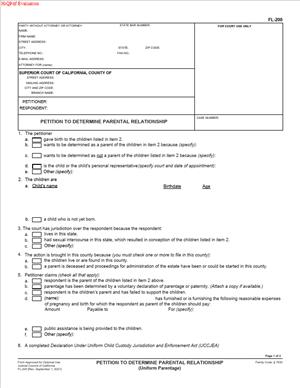
FL-200 – Petition to Determine Parental Relationship
Fill out nowJurisdiction: Country: United States | Province or State: California
The FL-200 – Petition to Determine Parental Relationship is a California court form used to ask a judge to legally recognize a parent-child relationship. You file it when a child’s legal parents have not been officially established.
This form starts a court case. It tells the court who you are, who the other parent is, and what orders you are asking for. Those orders often relate to custody, visitation, and child support.
You may use this form if you are a mother, a presumed father, an alleged father, or another person claiming to be a legal parent. It can also be used in situations involving assisted reproduction or same-sex parents, depending on the facts.
Filing this document matters because legal parentage affects rights and responsibilities. It can determine who has custody, who pays support, and who can make decisions for the child.
What is FL-200 – Petition to Determine Parental Relationship?
Clear definition
FL-200 – Petition to Determine Parental Relationship is a formal written request filed in a California family court. It asks the court to declare who the child’s legal parents are under state law.
This form opens a parentage case. Once filed, the court gains authority to decide issues related to the child, including custody, visitation, and financial support. It is not just an information sheet. It is the document that begins the legal process.
The form requires identifying information about the child or children involved. It also asks for details about each person who may be a parent. This ensures the court has enough information to notify everyone whose rights could be affected.
Who typically uses this form?
You might use this form if you believe you are a child’s legal parent but your name is not legally recognized. This often happens when parents were not married at the time of the child’s birth.
A mother may file it to establish legal fatherhood and obtain child support. An alleged father may file it to seek custody or visitation rights.
In some cases, a presumed parent who has acted as a parent may file to confirm their legal status. The form can also be used in more complex family structures, including cases involving assisted reproduction.
Government agencies sometimes file related actions for child support. However, this specific petition is commonly filed by a private individual seeking a court order.
Why might you need this form?
You may need this form when there is no existing court order identifying the child’s legal parents. Without that legal determination, parental rights and obligations may be unclear.
Establishing parentage can affect child support. A court cannot order a person to pay support unless that person is legally recognized as a parent.
Parentage also impacts custody and visitation. If you are not legally recognized, you may not have enforceable rights to see or make decisions for the child.
In addition, a legal parent-child relationship can affect inheritance, access to benefits, and the child’s right to medical history. The court’s determination creates legal clarity.
Typical real-life scenarios
- You and the other parent were never married, and your name is not on the child’s birth certificate. You want the court to confirm you are the legal father and set a custody schedule.
- You are a mother seeking child support from a man you believe is the father. There has been no voluntary declaration of parentage, and he disputes paternity.
- You have been raising a child as your own and believe you qualify as a presumed parent under California law. Another person is challenging your parental status.
- You and your former partner used assisted reproduction, and there is a disagreement about who is legally recognized as a parent. You need a court order to resolve the dispute.
When would you use FL-200 – Petition to Determine Parental Relationship?
You use this form when parentage has not already been legally established. This usually means there is no court judgment and no valid voluntary declaration of parentage on file.
If the parents were married when the child was born, parentage is often presumed under the law. In those situations, this form may not be necessary unless someone is challenging that presumption.
If you want the court to make custody or support orders and there is no prior parentage finding, this petition may be the starting point. The court generally needs to determine who the legal parents are before issuing related orders.
This form is commonly used by biological mothers, alleged fathers, presumed parents, and sometimes intended parents in assisted reproduction cases. Each person filing must state their relationship to the child and what orders they are requesting.
You might also use it if the other parent denies parentage. In that case, the court may order genetic testing as part of the case. The petition creates the legal framework for that process.
Legal characteristics of FL-200 – Petition to Determine Parental Relationship
FL-200 – Petition to Determine Parental Relationship is a pleading filed with the court. It must be completed accurately and filed according to court procedures. The information you provide becomes part of the official court record.
For the filing to move forward, the other party must be formally served with the petition and a summons. Proper service is essential. If service is not completed correctly, the court may delay the case or refuse to issue orders.
The form must include accurate names, dates of birth, and identifying details. Missing or inconsistent information can cause delays. For example, listing the wrong child or failing to include all possible parents can complicate the case.
In some situations, the court may require additional forms along with this petition. These often relate to custody jurisdiction or child support. The FL-200 – Petition to Determine Parental Relationship itself does not cover every required document.
This form does not automatically grant custody, visitation, or support. It asks the court to consider those issues. A judge must review the case and issue orders before anything becomes enforceable.
Parentage laws can involve presumptions. For example, a person married to the child’s mother at the time of birth may be presumed to be a parent. Rebutting or confirming those presumptions can involve specific legal standards. The petition starts that process but does not resolve it on its own.
Is it legally binding?
By itself, the filed petition is not a final order. It is a request. It becomes part of a binding legal process once the court accepts it for filing and the case proceeds.
The legally binding effect comes from the court’s judgment or orders issued after reviewing the case. If the court signs a judgment determining parentage, that judgment has legal force.
Once a judgment is entered, it can be enforced. This may include enforcing child support obligations or custody arrangements. The petition is the first step toward that result.
If no court order is issued, the petition alone does not create or change legal rights. The binding nature depends on the court’s final decision.
How to fill out FL-200 – Petition to Determine Parental Relationship
Step 1 – Identify yourself and your role in the case
At the top of the form, fill in your name, address, and contact information in the designated section. Identify whether you are the mother, alleged father, presumed parent, or another person claiming parentage. This tells the court your connection to the child.
Step 2 – Provide information about the other parent
Enter the full legal name and contact information of the other parent or alleged parent. Accuracy is important because this person must be formally notified of the case. Include as much identifying detail as the form requests.
Step 3 – List the children involved
Write the full names and dates of birth of each child whose parentage you want the court to determine. Make sure the information matches official records, such as birth certificates, to avoid confusion in the court file.
Step 4 – State whether parentage has already been addressed
Indicate whether there have been any prior court cases involving these children. This may include custody, support, or domestic violence matters. The court needs to know if another case is already pending or decided.
Step 5 – Explain the basis for parentage
Complete the section that explains why you believe the person named is a legal parent. This may involve biological parentage, marriage at the time of birth, or other legal grounds. Provide clear and consistent information.
Step 6 – Request custody and visitation orders if applicable
If you are asking for custody or visitation orders, check the appropriate boxes and specify the type of custody you are requesting. The form allows you to indicate whether you seek legal custody, physical custody, or both.
Step 7 – Request child support if applicable
If you want the court to order child support, indicate that request in the designated section. This alerts the court that financial issues will need to be addressed after parentage is determined.
Step 8 – Review and sign the form
Carefully review every section before signing. Make sure names, dates, and requested orders are consistent throughout the document. Sign and date the form where indicated to confirm that the information is true to the best of your knowledge.
Step 9 – Prepare the form for filing and service
Make copies of the completed form as required by court procedures. The original is filed with the court, and copies are used for service on the other party and for your records. After filing, ensure the other parent is formally served according to court rules so the case can move forward.
Legal terms you might encounter in FL-200 – Petition to Determine Parental Relationship
- Petitioner: The petitioner is the person who starts the case by filing this form with the court. In this document, you identify yourself as the petitioner if you are asking the court to determine a parent-child relationship. Your name and contact information must match your other court filings exactly.
- Respondent: The respondent is the other parent or person alleged to be a parent. This person must be formally notified that you filed the case. The name you list here becomes part of the official court record and must be spelled correctly.
- Parentage: Parentage refers to the legal relationship between a parent and a child. This form asks the court to decide whether a legal parent-child relationship exists. Legal parentage affects custody, visitation, and child support rights and responsibilities.
- Presumed Parent: A presumed parent is someone the law assumes is a parent based on certain facts, such as being married to the child’s other parent at the time of birth. This status can affect how the court analyzes your request. The form may require you to state whether anyone qualifies as a presumed parent.
- Alleged Parent: An alleged parent is someone who may be a biological parent but whose legal status has not been confirmed. When you identify an alleged parent on this form, you are asking the court to determine whether that person is legally recognized as a parent.
- Voluntary Declaration of Parentage: This is a signed document that establishes parentage without a court order, if properly completed and filed. The form asks whether such a declaration exists. If it does, you may need to provide details or attach a copy.
- Custody and Visitation: These terms refer to legal and physical decision-making authority and parenting time with the child. On this form, you can request custody and visitation orders along with a determination of parentage. What you request here may shape future court hearings.
- Child Support: Child support is financial support paid for the care of a child. You may request child support orders within the same case. The court uses the parentage determination as a foundation for issuing support orders.
- Summons: A summons is a separate court document that notifies the respondent that a case has been filed. When you file this petition, a summons is typically issued. The summons must be served together with your petition.
- Service of Process: Service of process is the formal delivery of court documents to the other party. After filing, you must arrange for someone else to serve the papers. Proper service is required before the court can move forward with your case.
FAQs
Do I need to complete every section of FL-200 – Petition to Determine Parental Relationship?
You should complete every section that applies to your situation. If a section does not apply, follow the form’s instructions for leaving it blank or marking it as not applicable. Do not skip required information such as names, addresses, or details about the children.
What information about the child do I need to include?
You must list each child involved in the case, including full legal name, date of birth, and sex as requested on the form. Make sure the spelling matches the child’s birth certificate or other official records. If you are including more than one child, confirm that each child’s information is complete and accurate.
What if I am not sure who the biological parent is?
You can still file this document if parentage is uncertain. You may identify someone as an alleged parent and ask the court to determine parentage. The court may later address genetic testing, but this form itself records your request and the identities of the people involved.
How does this form affect custody and visitation?
If you request custody or visitation orders on this form, you are asking the court to address those issues as part of the case. The court will not automatically grant what you request. What you write becomes part of the official record and frames what the judge will consider at hearings.
Do I need to attach other forms when I file this document?
In many cases, this form is filed together with a summons and possibly additional forms related to custody, visitation, or child support. Review the filing packet requirements carefully. If you reference other orders or declarations, make sure any required attachments are included and properly labeled.
What happens after I file FL-200 – Petition to Determine Parental Relationship?
After you file, the court clerk processes your paperwork and assigns a case number. You must then arrange for service of the filed documents on the respondent. The case does not move forward until service is completed and documented.
Can I change information after I submit the form?
If you discover an error after filing, you may need to file an amended petition or correct the record through an additional filing. Minor spelling errors might be addressed quickly, but substantive changes, such as adding a child or changing a party’s name, usually require formal correction. Act promptly so the record stays accurate.
Does filing this form automatically establish parentage?
No. Filing this document starts the case, but parentage is established only when the court issues an order or recognizes a valid declaration. Until a judge signs an order, the legal relationship is not officially determined by the court.
Checklist: Before, During, and After FL-200 – Petition to Determine Parental Relationship
Before
- Confirm your full legal name and contact information are consistent across all court documents.
- Gather each child’s full legal name, date of birth, and place of birth.
- Identify the correct legal name and address of the other parent.
- Check whether a voluntary declaration of parentage already exists.
- Decide whether you will request custody, visitation, or child support orders.
- Review any prior court orders involving the child.
- Prepare a draft of your responses to avoid mistakes on the final form.
During
- Print clearly or type your responses to avoid processing delays.
- Complete all required sections and mark non-applicable items properly.
- Double-check spelling of all names against official records.
- Ensure you list every child involved in the case.
- Sign and date the form where required.
- Prepare the summons and any additional required forms.
- Make at least two copies of everything before filing.
After
- File the original documents with the court clerk.
- Obtain a filed-stamped copy for your records.
- Arrange for proper service of the documents on the respondent.
- File proof of service with the court.
- Calendar all hearing dates and response deadlines.
- Keep copies of all documents in a dedicated folder.
- Monitor the case status and check for any court notices.
- Prepare for the next hearing or case management conference.
Common mistakes to avoid with FL-200 – Petition to Determine Parental Relationship
- Mistake: Leaving out a child because you assume the case only applies to one child, which happens when families have multiple children with similar circumstances; this can result in incomplete orders and delays, so do not forget to list every child involved.
- Mistake: Misspelling a party’s name or using a nickname, which often occurs when copying information from memory; this can create confusion in court records, so do not forget to verify names against official identification.
- Mistake: Failing to request custody or support orders when you want them, because you think they will be addressed automatically; this can limit what the court considers, so do not forget to clearly check the appropriate boxes.
- Mistake: Forgetting to sign and date the form, which commonly happens when focusing on the content; this can cause the clerk to reject your filing, so do not forget to review the signature section carefully.
- Mistake: Not arranging proper service of process, often due to misunderstanding the rules about who can serve; this can stall your case indefinitely, so do not forget that you cannot serve the papers yourself.
- Mistake: Ignoring existing declarations or prior orders, which happens when paperwork is misplaced; this can lead to conflicting information in the record, so do not forget to disclose relevant prior determinations.
What to do after filling out FL-200 – Petition to Determine Parental Relationship
Once you complete the form, pause and review it line by line. Check names, dates, and boxes. Make sure your requests reflect what you actually want the court to decide. Accuracy now prevents delays later.
- Step 1: Make at least two copies of the completed form and all attachments. One copy is for you. One is for the respondent. The original is for the court.
- Step 2: Complete the summons and any additional required forms that must be filed with your petition.
- Step 3: File the original documents with the court clerk, either in person or through the court’s accepted filing method.
- Step 4: Pay the required filing fee or submit a fee waiver request if you qualify.
- Step 5: Receive a filed-stamped copy showing the case number and filing date. Write this case number on all future documents.
- Step 6: Arrange for someone over 18 who is not a party to the case to serve the filed documents on the respondent.
- Step 7: Ensure the server completes a proof of service form. Review it for accuracy before it is filed.
- Step 8: File the proof of service with the court so the judge knows the respondent was properly notified.
- Step 9: Mark your calendar with any response deadlines or scheduled hearings listed in your paperwork.
- Step 10: Organize all filed documents, proofs of service, and court notices in a dedicated folder. Bring this folder to every hearing.
As your case moves forward, respond promptly to any documents you receive. Read every notice from the court. If a hearing is scheduled, prepare your documents and any evidence you plan to present. Keep your contact information updated with the court so you do not miss important communications.
Disclaimer: This guide is provided for informational purposes only and is not intended as legal advice. You should consult a legal professional.