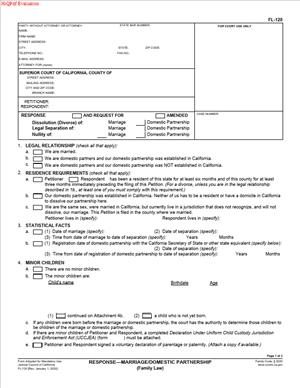
FL-120 – Response—Marriage or Domestic Partnership (Family Law)
Fill out nowJurisdiction: Country: United States | Province or State: California
FL-120 – Response—Marriage or Domestic Partnership (Family Law) is the form you use to formally respond to a divorce, legal separation, or nullity case in California. If your spouse or domestic partner started a case by filing a Petition, this is the document that tells the court your side of the story.
When you are served with family law papers, the clock usually starts running. This response form is how you participate in the case. Without it, the court may move forward based only on what the other party requested.
This document covers key issues in your relationship. That includes property, debts, support, and children. It gives you a structured way to say what you agree with and what you do not.
FL-120 – Response—Marriage or Domestic Partnership (Family Law) matters because it protects your ability to be heard. It ensures that decisions about your marriage or domestic partnership are not made without your input.
It is filed with the Superior Court of California in the county where the case was started. Once filed and properly served, it becomes part of the official court record.
What is FL-120 – Response—Marriage or Domestic Partnership (Family Law)?
Clear definition
FL-120 – Response—Marriage or Domestic Partnership (Family Law) is a formal court document used to answer a Petition in a family law case. The Petition is typically filed by the person asking for a divorce, legal separation, or annulment. The Response is your written reply.
In this form, you state your position on the main issues raised in the Petition. You can admit or deny statements. You can also request your own orders from the court.
The form follows a standard format used across California. This makes it easier for judges and court staff to understand the issues in dispute.
Who typically uses this form?
You use this form if you are the Respondent in a marriage or registered domestic partnership case. The Respondent is the person who did not start the case but was served with court papers.
It is commonly used by spouses who have been served with divorce papers. It is also used by registered domestic partners when one partner files to end the partnership.
Sometimes, both parties want similar outcomes, such as a straightforward divorce. Even then, the Respondent may still file this form to ensure their agreement is clearly on record.
Why might you need this form?
You need this form if you want the court to consider your position. Filing it allows you to participate fully in the case.
If you disagree with how property should be divided, this form is where you say so. If you have a different view about child custody or support, this is where you raise it.
You may also use the form to request your own relief. For example, you can ask the court to confirm certain property as separate property or to award spousal support.
Without filing a Response, the court may enter a default judgment. That means decisions could be made based only on the Petitioner’s requests.
Typical real-life scenarios
- One common situation is when your spouse files for divorce and asks for sole legal and physical custody of your children. You disagree and want joint custody. Filing a Response allows you to clearly state that position.
- Another scenario involves property division. The Petition may list certain assets as community property. You believe some of those assets are your separate property. The Response gives you a place to identify that disagreement.
- In some cases, the Petitioner asks for spousal support. You may believe support is not appropriate or should be limited in amount or duration. The Response allows you to address that issue.
- There are also cases where you agree with most of the Petition but want small changes. For example, you may agree to end the marriage but want a different arrangement for debt allocation. Filing the form ensures those differences are documented.
- You might also use this form in a legal separation case. Instead of ending the marriage, one party asks to live separately while dividing finances. Your Response clarifies whether you agree with that approach.
- In annulment cases, the Petition claims the marriage or partnership is legally invalid. Your Response allows you to state whether you agree with the grounds for nullity.
When would you use FL-120 – Response—Marriage or Domestic Partnership (Family Law)?
You use this form after you have been served with a Petition for dissolution, legal separation, or nullity of marriage or domestic partnership. Service means you received official notice of the case.
It is typically used early in the case. There is often a deadline to file a Response after being served. The timing can affect how the case proceeds.
The form is used whether the issues are simple or complex. Even if you expect to reach an agreement, filing a Response keeps your procedural rights intact.
If children are involved, the Response becomes especially important. It allows you to state your position on custody, visitation, and child support at the start of the case.
The form is also used in contested cases. If there are disagreements about property, support, or parental responsibilities, this document frames those disputes for the court.
In some situations, parties later reconcile or settle. Even then, the Response may still serve as the foundation for final agreements or judgments.
Legal characteristics of FL-120 – Response—Marriage or Domestic Partnership (Family Law)
This form is a court pleading. That means it is a formal written statement filed in a legal proceeding. It becomes part of the official case file.
For the document to be effective, it generally must be completed accurately, signed, filed with the correct court, and properly served on the other party. Filing alone is not enough; service ensures the other party receives notice of your response.
The form must correspond to the original Petition. It uses the same case number and party names. Mismatched information can cause delays or rejection by the clerk.
Common problems include incomplete sections, missing signatures, incorrect case numbers, or failing to indicate whether you agree or disagree with specific requests. Clerks may reject forms that are not filled out clearly.
In California, family law forms are standardized statewide. However, local courts may have additional procedural requirements, such as specific filing methods or cover sheets. The underlying purpose of the Response remains consistent across counties.
This document does not, by itself, resolve the case. It does not grant a divorce or set support. It simply states your position and preserves your right to participate.
It also does not replace financial disclosures. Separate forms are typically used to disclose income, expenses, assets, and debts. The Response focuses on your requests and disagreements.
Is it legally binding?
FL-120 – Response—Marriage or Domestic Partnership (Family Law) is legally significant once it is properly filed and served. It represents your official position in the case.
The statements you make can influence how the court views the issues. They may shape settlement discussions and court hearings.
However, the Response itself is not a final order. It does not bind the court to rule in your favor. The judge makes decisions based on evidence, law, and, in many cases, agreements between the parties.
Your signature on the form typically confirms that the information is true and correct to the best of your knowledge. Providing false information can create serious legal consequences.
If both parties later reach a written agreement and the court approves it, that agreement becomes binding. The Response helps define what issues need to be resolved before reaching that point.
How to fill out FL-120 – Response—Marriage or Domestic Partnership (Family Law)
Step 1 – Fill in the court and case information
At the top of the form, enter the name and address of the court where the case was filed. Use the same county and courthouse listed on the Petition. Then fill in the case number exactly as it appears on the Petition. Identify yourself as the Respondent and the other party as the Petitioner.
Step 2 – Provide your contact information
Complete the section that asks for your name, address, and contact details. If you are representing yourself, indicate that you are self-represented. Make sure this information is current so the court and the other party can reach you.
Step 3 – Respond to the type of case
Indicate whether you are responding to a dissolution, legal separation, or nullity case. Check the box that matches the type of case listed in the Petition. This aligns your Response with the original filing.
Step 4 – State your position on residence requirements
The form asks about residency. Review what the Petition states and indicate whether you agree or disagree. This section relates to whether the court has the authority to handle the case.
Step 5 – Address date of marriage or partnership and separation
Confirm or dispute the dates of marriage or registration and the date of separation. These dates can affect property division and support issues. Enter the information clearly in the spaces provided.
Step 6 – Respond to issues about children
If you and the other party have minor children together, complete the section about children. Indicate whether you agree with the statements in the Petition and state your position on custody and visitation. If there are no minor children, mark the appropriate box.
Step 7 – Address community and separate property
Review the property section carefully. Indicate whether you agree that there are community and quasi-community assets and debts to divide. If you claim certain property as separate property, identify that in the space provided.
Step 8 – Respond to support requests
State your position on spousal or partner support. If the Petition requests support, indicate whether you agree or disagree. You may also request support if you believe it is appropriate.
Step 9 – State any additional requests
Use the section provided to request any other relief. This may include attorney’s fees, name restoration, or other orders related to the marriage or partnership. Write clearly and limit your statements to what the form asks for.
Step 10 – Review and sign the form
Read the entire form before signing. Confirm that all sections are complete and consistent with the Petition. Sign and date the form where indicated. Your signature confirms that the information is true to the best of your knowledge.
Step 11 – Make copies and prepare for filing
Make copies of the completed and signed form. You will typically need the original for the court and copies for yourself and the other party. Keep your copy in a safe place with your other case documents.
Step 12 – File and arrange for service
Submit the form to the court clerk for filing. After filing, arrange to have a copy served on the Petitioner according to court procedures. Once service is completed, ensure proof of service is properly documented and filed with the court.
Legal terms you might encounter in FL-120 – Response—Marriage or Domestic Partnership (Family Law)
- Petitioner: The petitioner is the person who started the divorce or domestic partnership case. Their name appears on the original petition and on the case caption. On this form, you are responding to the petitioner’s requests.
- Respondent: The respondent is you, the person filing this response. Your role is listed in the case caption. You use this document to tell the court which parts of the petition you agree with or disagree with.
- Summons: The summons is the document that officially notifies you that a case has been filed. It includes deadlines and restrictions, such as automatic restraining orders related to property and insurance. Your response must be filed within the time stated in the summons.
- Community Property: Community property generally refers to assets and debts acquired during the marriage or domestic partnership. This form asks whether you agree that such property exists and how it should be divided. Your answer affects how financial issues move forward in the case.
- Separate Property: Separate property usually includes assets or debts acquired before the marriage or after separation, or received as gifts or inheritance. In this document, you can state whether you believe certain property is separate. This helps define what should not be divided as community property.
- Date of Separation: This is the date when one spouse or partner decided to end the relationship and acted consistently with that decision. The date matters because it can affect property division and support. You may agree or disagree with the date listed in the petition.
- Spousal or Partner Support: Also called alimony, this refers to financial support one spouse or partner may pay to the other. On this form, you indicate whether you want support, oppose it, or agree with the petitioner’s request. Your response guides the court on whether support will be an issue.
- Legal Custody: Legal custody refers to the right to make important decisions about a child’s health, education, and welfare. If children are involved, you state your position on custody arrangements. Your answer signals whether you agree or want a different order.
- Physical Custody: Physical custody relates to where the child lives. This document allows you to agree with the proposed living arrangement or request a different schedule. The court will use this information to determine if custody is contested.
- Jurisdiction: Jurisdiction means the court’s authority to hear and decide the case. The form asks about residence requirements to confirm the court has authority. If jurisdiction is not properly established, the case may be delayed or dismissed.
FAQs
What happens if I miss the deadline to file this form?
If you do not file your response within the time stated in the summons, the petitioner may request a default. That means the court could make orders without your input. Filing on time ensures your position is part of the official court record and allows you to participate in decisions about property, support, and children.
Do I need to agree with everything listed in the petition?
No. This document is your opportunity to agree with some parts and disagree with others. You can accept basic information, such as the date of marriage, but dispute issues like the date of separation, property division, or support. Be clear and consistent in each section you complete.
What if I do not know all the financial details yet?
You are not expected to have every document at the response stage. Use this form to state your general position, such as that community property exists and should be divided equally. Detailed financial disclosures usually happen later in the case, through separate required forms.
Do I have to file FL-120 – Response—Marriage or Domestic Partnership (Family Law) if we agree on everything?
Even if you agree with the petition, filing a response protects your rights and confirms your participation in the case. If you choose not to file, the case may proceed by default. Filing the FL-120 – Response—Marriage or Domestic Partnership (Family Law) ensures you receive notices and can review proposed final orders.
Can I ask for something different from what the petitioner requested?
Yes. This document allows you to state your own requests. For example, you can ask for spousal support even if the petition did not. Make sure your requests are clearly marked in the appropriate sections so the court understands what orders you want.
What if there are no children or no property to divide?
You still need to complete the sections that apply and indicate that there are no minor children or no community property. Do not leave sections blank if they require a response. Mark the appropriate boxes so the record accurately reflects your situation.
Do I need to attach other forms when I file this response?
In many cases, additional documents are required, such as a proof of service showing that the other party received a copy. If you are requesting specific custody or support orders, other forms may be needed later. Review the filing instructions carefully to confirm what must accompany this document.
How do I know the court accepted my filing?
After you submit this form, the clerk will stamp it as filed or provide confirmation if you file electronically. Keep the stamped copy for your records. That file-stamped version proves that your response was received and entered into the case.
Checklist: Before, During, and After FL-120 – Response—Marriage or Domestic Partnership (Family Law)
Before
- Read the summons to confirm your filing deadline.
- Review the petition so you understand each request made.
- Gather basic information about your marriage or partnership dates.
- Make a preliminary list of community and separate property.
- Consider your position on custody and support issues.
- Confirm the correct court name and case number.
- Decide whether you want to request any orders different from the petition.
During
- Write your name exactly as it appears in the case caption.
- Enter the correct case number on every page.
- Check boxes carefully to show agreement or disagreement.
- Provide accurate dates for marriage and separation.
- Clearly mark whether minor children are involved.
- State your requests about property and support.
- Review each section to ensure nothing is left incomplete.
- Sign and date the form where required.
After
- Make at least two copies of the completed form.
- File the original with the court clerk or through the e-filing system.
- Arrange for someone over 18 to serve the petitioner.
- Complete and file a proof of service form.
- Keep a stamped copy in a safe place.
- Calendar future court dates and deadlines.
- Begin preparing the required financial disclosure forms.
- Update your personal records to reflect the pending case.
Common mistakes to avoid with FL-120 – Response—Marriage or Domestic Partnership (Family Law)
- Mistake: Missing the filing deadline because you assume you can respond later, which can lead to a default judgment; do not forget to check the summons and calendar the exact due date.
- Mistake: Leaving sections blank because you are unsure, which may create confusion or delay; do not forget to mark boxes clearly, even if your answer is “none” or “not applicable.”
- Mistake: Using the wrong case number or court location, often due to copying errors, which can cause rejection by the clerk; do not forget to verify the caption against the petition.
- Mistake: Failing to request what you want, assuming the court will automatically consider it, which may limit your options later; do not forget to state your own requests clearly.
- Mistake: Not signing and dating the form, usually due to rushing, which makes the filing incomplete; do not forget that your signature confirms the information is true.
- Mistake: Forgetting to serve the other party, which can stall the case; do not forget that service must be completed by someone who is not you.
- Mistake: Confusing community and separate property because of unclear records, which can complicate division later; do not forget to review when each asset or debt was acquired.
- Mistake: Assuming agreement on informal terms replaces the need for a response, which can result in court orders that do not reflect your understanding; do not forget that only filed documents become part of the official record.
What to do after filling out FL-120 – Response—Marriage or Domestic Partnership (Family Law)
Once you complete the form, focus on proper filing and follow-through. Your response only becomes part of the case when it is officially filed and served.
- Step 1: Review the entire document for accuracy. Confirm names, dates, and the case number match the petition.
- Step 2: Sign and date the form in the required section. Unsigned forms are not valid.
- Step 3: Make at least two copies. One is for you. One is for the other party.
- Step 4: File the original with the Superior Court of California in the county where the case was started. Follow local procedures for in-person or electronic filing.
- Step 5: Pay any required filing fee or submit a fee waiver request if needed.
- Step 6: Arrange for service. Someone over 18 who is not involved in the case must deliver a copy to the petitioner or their attorney.
- Step 7: Ensure a proof of service form is completed and filed. This shows the court that proper notice was given.
- Step 8: Confirm acceptance. Obtain a file-stamped copy or electronic confirmation for your records.
- Step 9: Organize a case folder. Keep your response, proof of service, and all future filings together.
- Step 10: Prepare for the next stage. This may include financial disclosures, mediation, or court hearings.
Stay organized and track all deadlines. Monitor mail and court notices carefully. Your active participation helps protect your rights and keeps the case moving forward in a structured way.
Disclaimer: This guide is provided for informational purposes only and is not intended as legal advice. You should consult a legal professional.