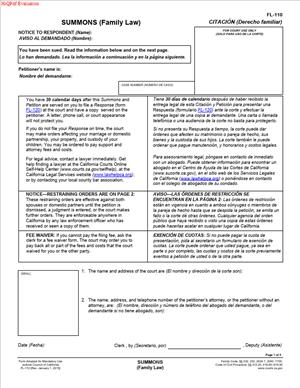
FL-110 – Summons
Fill out nowJurisdiction: Country: United States | Province or State: California
The FL-110 – Summons is one of the first documents issued in a California family law case. It formally notifies the other party that a legal action has started in the Superior Court of California.
If you are filing for divorce, legal separation, or nullity, this form is part of the initial paperwork. It is not something you write from scratch. It is a standardized court document that sets out important legal notices.
When you receive the FL-110 – Summons, it means someone has opened a family law case that involves you. The form explains your rights and responsibilities, including deadlines and restrictions that apply once the case begins.
This document matters because it triggers time limits and automatic court orders. Ignoring it can affect your ability to participate in the case. Understanding what it says helps you avoid mistakes early in the process.
What is FL-110 – Summons?
Clear definition
FL-110 – Summons is an official court form used in California family law cases. It serves as a formal notice that a legal proceeding has been filed.
The document tells the respondent, also called the person being served, that they have a limited time to file a response. It also includes standard restraining orders that apply to both parties once the case is filed and served.
This form is issued under the authority of the Superior Court of California. It is part of the required opening documents in most family law matters.
Who typically uses this form?
The person who starts the case, often called the petitioner, includes this form when filing initial paperwork with the court. The court clerk issues it after the case is opened.
The other party, known as the respondent, receives it through formal service. That person does not fill it out but must read it carefully because it outlines key obligations.
Court staff handles the issuance of the summons. A third party, not involved in the case, usually serves it on the respondent according to court rules.
Why might you need this form?
You need this form if you are starting a family law case, such as a divorce or legal separation. It is required to properly notify the other party that the case exists.
Without proper service of the summons, the court generally cannot move forward. The summons establishes the court’s authority over the respondent once service is completed.
If you are on the receiving end, you need this document to understand your deadline to respond. It also explains automatic restrictions that take effect immediately.
Typical real-life scenarios
- You file for divorce after separating from your spouse. As part of your initial filing, the court issues a summons that must be served with your petition.
- You decide to request legal separation instead of divorce. The case still begins with a summons, which informs your spouse of the legal action.
- You receive a packet of documents from a process server. Inside is a summons telling you that your spouse has filed for the nullity of the marriage.
- You and your spouse have children together. Once the summons is served, standard restraining orders apply to financial decisions and changes to insurance or property.
When would you use FL-110 – Summons?
You use this form at the very beginning of a family law case in California. It is not used later in the process. It is part of opening the case and notifying the other party.
If you are the petitioner, the summons is included when you file your petition with the court clerk. The clerk issues it, and it becomes part of the service packet.
If you are the respondent, you do not choose to use this form. Instead, you receive it after the case has been filed. It marks the start of your deadline to respond.
In cases involving divorce, legal separation, or nullity, this document is commonly required. It works together with the petition to give the court jurisdiction over the case and the people involved.
The form is typically used regardless of whether the case is contested or uncontested. Even if both parties agree on everything, the summons is still part of the formal process.
Legal characteristics of FL-110 – Summons
This form is an official court document. It becomes effective once it is issued by the court and properly served on the respondent.
One key feature is the inclusion of automatic temporary restraining orders. These orders usually restrict both parties from transferring property, changing insurance coverage, or removing children from the state without consent or court permission.
The summons also sets a deadline for filing a response. In many cases, this period is 30 days from the date of service. The exact timing depends on how and when service occurs.
Common problems arise when the service is not done correctly. If the respondent is not properly served, the court may not be able to proceed. Incorrect names, missing case numbers, or unsigned forms can also create delays.
The form itself does not explain the details of the dispute. It does not state who will receive property, custody, or support. Those issues are addressed in other documents and later court orders.
There can be procedural differences depending on the county, such as local filing practices. However, the core legal effect of the summons is generally consistent throughout California.
Is it legally binding?
The summons is legally binding in the sense that it carries the authority of the court. Once served, the automatic restraining orders described in the document apply to both parties.
Failure to follow those orders can have legal consequences. The court may consider violations when making decisions later in the case.
The summons also binds the respondent to the court’s process. After proper service, the court may move forward even if the respondent does not participate.
However, the summons does not decide any issues by itself. It does not grant a divorce, divide assets, or set custody. It simply starts the legal process and sets the rules that apply while the case is pending.
How to fill out FL-110 – Summons
Step 1 – Complete the caption section
At the top of the form, fill in the name of the court, including the county and branch, if known. Enter the names of the petitioner and respondent exactly as they appear on the petition. Leave the case number blank if you have not yet received one; the clerk will assign it when you file.
Step 2 – Review the standard restraining orders
Read the section that lists the automatic temporary restraining orders. These are preprinted on the form. You do not modify this language. Make sure you understand what actions are restricted once the summons is served.
Step 3 – Check the notice to the respondent
Review the notice that explains the time limit for filing a response. Confirm that the information matches your case type. This section is part of the standard form and should not be edited.
Step 4 – Leave signature lines for the clerk
Do not sign the area reserved for the court clerk. The clerk signs, dates, and issues the summons after you file your petition. This step officially activates the document.
Step 5 – Make copies for service
After the clerk issues the summons, make copies for service. The original is usually kept in the court file. The copies are served on the respondent along with the petition and any other required documents.
Step 6 – Arrange for proper service
Provide the issued summons and related documents to an eligible server. The person serving must follow court rules for personal service. Once service is completed, proof of service is prepared and filed with the court to show that the respondent received the documents.
Legal terms you might encounter in FL-110 – Summons
- Petitioner: This is the person who starts the case. Their name appears at the top of the first page in the caption. The petitioner is responsible for having this document served on the other party and moving the case forward.
- Respondent: This is the person who is being notified about the case. The respondent’s name must match exactly across all filed forms. The summons formally tells the respondent that a legal action has been started and that deadlines now apply.
- Standard Family Law Restraining Orders: These are automatic court orders printed directly in the summons. They limit certain actions, such as transferring property or taking minor children out of state without consent. They apply immediately when the summons is served and remain in effect unless changed by the court.
- Service of Process: This refers to the formal delivery of court papers to the respondent. The summons must be properly served for the court to gain authority over the respondent. Service must follow strict rules about who can serve and how delivery happens.
- Proof of Service: This is a separate form completed by the person who served the documents. It confirms when, where, and how the summons was delivered. Without proof of service, the court cannot move forward with deadlines or default procedures.
- Response: This is the respondent’s formal written answer to the petition. The summons states the deadline for filing this response. If no response is filed within the required time, the petitioner may request a default.
- Default: A default occurs when the respondent does not file a response within the allowed time. The petitioner may then ask the court to proceed without the respondent’s participation. This can affect property division, support, and custody decisions.
- Jurisdiction: This means the court’s authority to make decisions about the people and issues in the case. Proper service of the summons is what gives the court jurisdiction over the respondent.
- Case Number: This unique number is assigned by the court clerk when the petition is filed. It must appear on the summons and all related documents. It helps the court track your case.
- Clerk’s Issuance: The summons becomes official only when the court clerk signs, dates, and stamps it. Until the clerk issues it, you cannot serve it on the respondent.
FAQs
When does the deadline for the respondent start?
The deadline starts on the date the respondent is personally served with the documents. It does not begin on the filing date or the date the clerk signs the summons. Check the Proof of Service to confirm the exact date of delivery, because that date controls the response timeline.
What happens if the names on this form do not exactly match the petition?
The court expects the petitioner’s and respondent’s names to be identical across all filed documents. If the spelling, order, or middle initials are inconsistent, the clerk may reject later filings, or the case record may become confusing. Before serving the documents, confirm that the caption on the summons matches the petition word for word.
Do I need to sign the FL-110 – Summons myself?
No. The summons is issued by the court clerk, not by you. You complete the caption and submit it with your petition, but the clerk signs and dates it. Do not add your own signature in the clerk’s section, and do not alter the form after the clerk issues it.
What exactly is being recorded in the public court file when this document is filed?
Once issued and filed, this document becomes part of the public court record. It shows who filed the case, who is being notified, the case number, and the existence of automatic restraining orders. It does not decide property or custody issues, but it formally starts the legal process.
Can the respondent ignore the restraining orders printed in this document?
No. The restraining orders take effect once the respondent is served. They are court orders, even though no hearing has happened yet. Violating them can lead to legal consequences, so both parties should read them carefully and understand what actions are restricted.
What if the respondent lives outside California?
Service rules still apply, but the method of service may vary depending on location. The key point is that the service must comply with court requirements and be properly documented. The court cannot exercise authority over the respondent until service is completed and proven.
Do I file this document before or after serving the other party?
The summons is filed and issued by the clerk before service. After it is issued, you arrange for service. Then the Proof of Service is filed to show that delivery was completed.
What happens if the clerk rejects the FL-110 – Summons?
If the clerk rejects it, you will usually receive a notice explaining what needs correction. Common reasons include missing case numbers, incomplete captions, or attaching it to an unfiled petition. Correct the issue exactly as instructed, resubmit it, and confirm that the clerk signs and stamps the updated version.
Checklist: Before, During, and After FL-110 – Summons
Before
- Confirm the petition has been properly completed.
- Make sure the petitioner and respondent names are consistent across all documents.
- Leave the clerk’s signature area blank.
- Verify the correct court location and branch name.
- Prepare at least two copies of the summons.
- Check that the case number is written clearly once assigned.
- Review the restraining orders printed on the form.
- Ensure you understand who is legally allowed to serve the documents.
During
- Submit the summons with the petition to the clerk for issuance.
- Wait for the clerk to sign, date, and stamp the form.
- Confirm the case number appears on the issued copies.
- Arrange for personal service by someone over 18 who is not involved in the case.
- Provide the server with all required documents.
- Instruct the server not to alter or mark the documents.
- Track the exact date and time of service.
After
- Have the server complete the Proof of Service form.
- Review the Proof of Service for accuracy before filing it.
- File the Proof of Service with the court promptly.
- Calculate the respondent’s response deadline based on the service date.
- Keep stamped copies in a secure file.
- Monitor the case docket for any filed response.
- Prepare next steps if no response is received by the deadline.
- Continue to follow the automatic restraining orders.
Common mistakes to avoid with FL-110 – Summons
- Mistake: Serving the documents before the clerk signs and stamps them, which happens when you rush the process; this makes service invalid and forces you to start again, so do not forget to confirm clerk issuance first.
- Mistake: Writing in the clerk’s signature section because you assume every form needs your signature; this can cause rejection, so do not forget that only the clerk signs that portion.
- Mistake: Using inconsistent names between the petition and summons, often due to typos; this creates confusion in the court record and possible delays, so do not forget to double-check spelling and order of names.
- Mistake: Having the petitioner serve the documents personally because it seems easier; this violates service rules and can invalidate the case progress, so do not forget that service must be done by a non-party adult.
- Mistake: Forgetting to file the Proof of Service after delivery; this prevents the court from recognizing that service occurred, so do not forget that deadlines do not move forward without it on file.
- Mistake: Ignoring the automatic restraining orders because no hearing has occurred yet; this can lead to serious consequences, so do not forget that these orders are effective once served.
- Mistake: Miscalculating the response deadline by counting from the filing date instead of the service date; this can lead to premature default requests, so do not forget to verify the actual service date.
- Mistake: Failing to keep stamped copies for your records; this creates problems if questions arise later, so do not forget to store issued and filed copies securely.
What to do after filling out FL-110 – Summons
Once you complete the caption and submit the summons with your petition, your focus shifts to proper issuance and service. The document is not effective until the clerk signs and stamps it. After that, timing becomes critical.
- Step 1: File the petition and summons together with the court clerk and pay any required filing fee or submit a fee request if applicable.
- Step 2: Wait for the clerk to assign a case number and officially issue the summons by signing and stamping it.
- Step 3: Make endorsed copies of the issued summons and the filed petition.
- Step 4: Select a qualified adult who is not involved in the case to serve the documents.
- Step 5: Provide the server with clear instructions and all required papers, including any blank response forms if required.
- Step 6: Confirm the exact date, time, and address where the service takes place.
- Step 7: Have the server complete the appropriate Proof of Service form immediately after delivery.
- Step 8: Review the Proof of Service carefully to ensure accuracy in names, dates, and method of service.
- Step 9: File the completed Proof of Service with the court as soon as possible.
- Step 10: Mark the respondent’s response deadline on your calendar based on the date of service.
- Step 11: Monitor court records to see whether a response is filed before the deadline.
- Step 12: If no response is filed on time, prepare the necessary documents to request a default and continue following court procedures.
Keep a dedicated file for your case. Store issued copies, filed proofs, and any correspondence in chronological order. Update your records each time you file or receive a document. Staying organized will help you track deadlines, demonstrate compliance, and move your case forward with confidence.
Disclaimer: This guide is provided for informational purposes only and is not intended as legal advice. You should consult a legal professional.