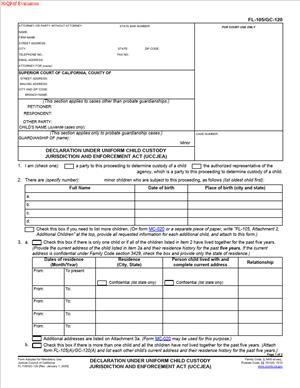
FL-105 and GC-120 – Declaration Under Uniform Child Custody Jurisdiction and Enforcement Act (UCCJEA)
Fill out nowJurisdiction: Country: United States | Province or State: California
If you are involved in a child custody case in California, you will likely need to complete the FL-105 and GC-120 – Declaration Under Uniform Child Custody Jurisdiction and Enforcement Act (UCCJEA). This form gives the court basic but critical information about your child’s living history and any other custody cases.
This document is not about arguing who should have custody. It is about telling the court where the child has lived and whether any other court has made custody decisions. That information helps the judge decide if California has the authority to handle your case.
You usually file this form at the start of a custody or parentage case. It can also be required in guardianship matters. If you are representing yourself, understanding this form will help you avoid delays.
Courts take jurisdiction seriously. If the wrong state handles a custody case, orders can become unenforceable. This declaration helps prevent conflicting orders between states.
Completing the form carefully and accurately supports a smoother filing process and reduces the risk of rejection by the clerk.
What is FL-105 and GC-120 – Declaration Under Uniform Child Custody Jurisdiction and Enforcement Act (UCCJEA)?
Clear definition
The FL-105 and GC-120 – Declaration Under Uniform Child Custody Jurisdiction and Enforcement Act (UCCJEA) is a required court form in California custody and guardianship cases. It is a sworn statement about the child’s recent residential history and any other custody-related court proceedings.
The form asks you to list every place the child has lived during the past five years. If the child is under five, you list every place the child has lived since birth. You must also identify who the child lived with at each address.
You are also required to disclose whether you know of any other court cases involving custody or visitation for the child. This includes cases in other states or countries.
By signing the form, you declare under penalty of perjury that the information is true and correct.
Who typically uses this form?
Parents filing for divorce or legal separation with minor children often complete this form. It is also common in parentage cases where custody or visitation is being requested.
Unmarried parents asking the court for custody orders use it as well. If you are starting a guardianship case for a minor, you may file the GC-120 version of the form.
In some situations, a person responding to a custody request must also complete and file the form. Each party provides its own declaration.
Even if both parents agree on custody, the court still requires this information to confirm it has jurisdiction.
Why might you need this form?
Custody cases are governed by uniform laws adopted by most states. These laws are designed to prevent parents from moving a child to another state to seek a more favorable court.
The form gives the court the facts it needs to determine the child’s “home state.” The home state is usually where the child has lived for the last six consecutive months.
If another state has already made custody orders, that state may keep authority over the case. Your answers on this form help the judge identify those situations early.
Without this declaration, the court may refuse to move forward with your custody request.
Typical real-life scenarios
- You are filing for divorce in California and have two minor children. They have lived in California for three years. You complete the form to confirm that California is their home state and that no other custody cases exist.
- You recently moved to California with your child after living in another state. The other parent still lives in that state. The court will look closely at the dates you list to decide which state has jurisdiction.
- You are asking for custody orders as part of a parentage case. There has never been a formal custody order before. You still complete the form to confirm the child’s residence history and that no other court is involved.
- A grandparent is filing for guardianship of a child who has lived in multiple households. The guardian must list each address and the adults who cared for the child. The court uses this to confirm it has the authority to appoint a guardian.
When would you use FL-105 and GC-120 – Declaration Under Uniform Child Custody Jurisdiction and Enforcement Act (UCCJEA)?
You use this form when you are requesting custody or visitation orders in California. It is typically filed at the same time as your initial petition or request for order.
In divorce or legal separation cases involving children, it is part of the required starting paperwork. In parentage cases, it is filed along with the petition to establish a parental relationship.
In guardianship matters, the GC-120 version is filed when asking the court to appoint a guardian for a minor. The purpose remains the same: to inform the court about the child’s living history and any other custody proceedings.
If you are responding to a custody request, the court may require you to file your own declaration. Each party provides its own account of the child’s residence and court history.
You may also need to file an updated declaration if circumstances change or if the court requests clarification. For example, if a new custody case starts in another state while your case is pending, the court must be informed.
Legal characteristics of FL-105 and GC-120 – Declaration Under Uniform Child Custody Jurisdiction and Enforcement Act (UCCJEA)
This form is a sworn declaration. When you sign it, you are stating that the information is true under penalty of perjury. That gives the document legal weight.
The form becomes effective when it is properly completed, signed, and filed with the court. Filing usually occurs at the clerk’s office along with your other case documents.
Accuracy is critical. Missing addresses, incomplete date ranges, or failing to list another custody case can create delays. The court may require corrections or additional information before proceeding.
Common problems include leaving out short-term residences, failing to include full addresses, or not identifying all adults the child lived with. Even temporary moves can matter.
This document does not decide custody. It does not grant rights or determine parenting time. Its purpose is limited to establishing whether the court has jurisdiction to make custody orders.
Different states follow similar uniform laws, but details may vary. California courts apply their version of the UCCJEA. If another state is involved, that state’s court may apply its own procedures to determine jurisdiction. The basic goal remains consistent: one state at a time should control custody decisions.
Is it legally binding?
The declaration itself does not create custody rights. It does not function as an agreement between parents. Instead, it is legally binding as a sworn statement of facts.
When you sign the form, you are subject to penalties if you knowingly provide false information. Courts rely on the accuracy of these declarations when deciding jurisdiction.
If the court determines that California has jurisdiction, it may then issue custody or visitation orders. Those later orders can be legally binding and enforceable.
If the court finds that another state has jurisdiction, your California case may be paused, dismissed, or transferred. The information in this declaration directly affects that outcome, even though the form itself is not a custody order.
How to fill out FL-105 and GC-120 – Declaration Under Uniform Child Custody Jurisdiction and Enforcement Act (UCCJEA)
Step 1 – Identify the case information
At the top of the form, fill in the court name and address, the county, and the case number if one has already been assigned. Write the names of the parties exactly as they appear on your petition or other filed documents. Consistency matters to avoid processing delays.
Step 2 – Provide your information as the declarant
Enter your name and indicate your role in the case, such as petitioner, respondent, or other party. This tells the court who is making the declaration. Make sure your contact information matches what you have provided in other filings.
Step 3 – List each child covered by the case
Write the full legal name and date of birth of each child involved in the custody or guardianship matter. Double-check spelling and dates. The information must match other court documents.
Step 4 – Complete the child’s address history
For each child, list every address where the child has lived during the past five years. If the child is under five, list every address since birth. Include the city and state, the dates the child lived there, and the name of each person the child lived with at that address. Do not leave gaps in the timeline.
Step 5 – Disclose other custody proceedings
State whether you have participated in any other court case involving custody or visitation for the child. This includes divorce, separation, domestic violence, child support, or guardianship cases. If yes, provide the court name, location, case number if known, and the status of the case.
Step 6 – Disclose knowledge of other proceedings
Indicate whether you know of any other custody case that could affect this one, even if you were not a party. This may include cases filed by the other parent or by another relative. Provide as much identifying information as you have.
Step 7 – Identify other claimants to custody or visitation
State whether you know of any person who claims custody or visitation rights to the child. This can include relatives or other adults who have acted as caregivers. If someone does claim rights, list their name and address if known.
Step 8 – Review and sign the declaration
Read the entire form carefully before signing. Confirm that dates are accurate and that no residences or court cases are missing. Sign and date the form where indicated, acknowledging that you are declaring under penalty of perjury that the information is true and correct. Once signed, file the form with the court clerk along with your other required documents.
Legal terms you might encounter in FL-105 and GC-120 – Declaration Under Uniform Child Custody Jurisdiction and Enforcement Act (UCCJEA)
- Home State: This is the state where a child has lived with a parent or person acting as a parent for at least six consecutive months immediately before the custody case starts. On this form, you help the court determine the child’s home state by listing addresses and dates. The court uses this information to decide if it has authority to make custody orders.
- Jurisdiction: Jurisdiction means the legal power of a court to make decisions in a case. In this document, you provide facts so the court can confirm it has child custody jurisdiction. If another state has jurisdiction, your case may be delayed or transferred.
- Custody Proceeding: A custody proceeding includes any court case that involves legal custody, physical custody, or visitation. The form asks you to disclose past or current custody proceedings in any state. This prevents conflicting orders between different courts.
- Visitation: Visitation refers to the time a noncustodial parent or other authorized person spends with a child. If another court has made visitation orders, you must report that on this document. The court needs to know about existing visitation arrangements before making new ones.
- Legal Custody: Legal custody means the right to make important decisions about a child’s health, education, and welfare. Even if a case focuses mainly on physical custody, legal custody is still relevant. The court may review past legal custody orders when evaluating jurisdiction.
- Physical Custody: Physical custody refers to where the child lives on a day-to-day basis. The address history section of the form relates directly to physical custody. Accurate dates and locations help establish which state qualifies as the home state.
- Person Acting as a Parent: This term includes someone who has physical custody of the child and claims a right to legal custody or visitation. It might be a grandparent, guardian, or other caregiver. If such a person has had custody, you must include them in the child’s address history and related disclosures.
- Simultaneous Proceedings: This occurs when more than one court case involving the same child is pending in different states. The form requires you to disclose whether you know of any such proceedings. Courts communicate with each other to decide which one should move forward.
- Continuing, Exclusive Jurisdiction: Once a state court properly makes a custody determination, it usually keeps authority over future modifications. This concept is important if there are prior orders from another state. Your answers help the court decide whether another state still has continuing jurisdiction.
- Declaration Under Penalty of Perjury: When you sign this document, you swear that the information is true and correct. Providing false information can result in penalties. Always review your entries carefully before signing.
FAQs
Do I have to file FL-105 and GC-120 – Declaration Under Uniform Child Custody Jurisdiction and Enforcement Act (UCCJEA) in every custody case?
In most child custody and visitation cases, you must file this document with your first set of papers. The court uses it to confirm jurisdiction before making any custody orders. If you do not file it when required, your paperwork may be rejected or your hearing delayed.
What if my child has moved many times in the past five years?
You must list every address where your child lived during the past five years, even if the stay was short. Include the full address if possible, along with the dates the child lived there and the name of the person the child lived with. If you cannot remember exact dates, provide your best estimate and note that it is approximate rather than leaving it blank.
What happens if I forget to list another custody case?
Failing to list another case can create serious problems. The court may believe you are withholding information, which can damage your credibility. It can also result in conflicting court orders. If you realize you made an omission after filing, you should correct the record promptly by filing updated information.
Do I need to attach copies of previous custody orders?
This document asks you to identify other cases and orders, but you may also need to provide copies of those orders depending on the court’s requirements. If you have certified copies of prior custody or visitation orders, keep them ready. The judge may review them to confirm dates and terms.
What if I do not know whether another parent filed a case in a different state?
You are required to disclose what you know. If you have reason to believe a case was filed but lack details, state that clearly and provide as much information as possible, such as the state and approximate year. Do not guess specific case numbers or outcomes.
Can I update the information in FL-105 and GC-120 – Declaration Under Uniform Child Custody Jurisdiction and Enforcement Act (UCCJEA) after I file it?
Yes. If new information becomes available or circumstances change, you can file an updated declaration. Make sure the updated version clearly reflects current facts. Courts rely on accurate jurisdictional information at every stage of a custody case.
Does this document become part of the public court record?
In most cases, yes. The information you provide is filed with the court and becomes part of the case file. Because you are listing residential history and related details, review everything carefully for accuracy before filing.
What if my child lived outside the United States?
You must still list the foreign address and the dates the child lived there. For jurisdiction purposes, foreign countries are often treated similarly to U.S. states. Provide as much detail as possible so the court can evaluate whether it has authority to make custody decisions.
Checklist: Before, During, and After FL-105 and GC-120 – Declaration Under Uniform Child Custody Jurisdiction and Enforcement Act (UCCJEA)
Before
- Gather the child’s complete address history for the past five years.
- Locate prior custody or visitation orders from any state or country.
- Confirm the correct spelling of all names, including parents and caregivers.
- Check case numbers for any previous or pending proceedings.
- Review your main custody petition to ensure names and dates match.
- Make a timeline to avoid missing short-term moves.
- Verify court location and case caption information.
During
- Fill in the case number exactly as it appears on your main filing.
- List each child separately if the form requires it.
- Provide full addresses, not just cities or states.
- Include the month and year for move-in and move-out dates.
- Disclose all known court cases involving custody or visitation.
- Identify anyone claiming custody or visitation rights.
- Use additional pages if you run out of space, labeling them clearly.
- Review each section before moving to the next.
After
- Read the entire document from start to finish.
- Confirm all dates follow a logical timeline with no gaps.
- Sign and date the declaration under penalty of perjury.
- Make copies for yourself and other parties as required.
- File the original with the court clerk.
- Check that the clerk stamps your copies.
- Keep filed copies in a safe and organized folder.
- Update your personal records with the filing date.
Common mistakes to avoid with FL-105 and GC-120 – Declaration Under Uniform Child Custody Jurisdiction and Enforcement Act (UCCJEA)
- Mistake: Leaving out short-term addresses because you think they do not matter, which often happens when families move frequently, can lead the court to question jurisdiction and delay your case, so do not forget to include every location where the child lived, even for a few months.
- Mistake: Guessing exact move-in or move-out dates without noting they are estimates, which happens when records are unavailable, may create inconsistencies in the timeline, so do not forget to double-check dates against leases, school records, or messages.
- Mistake: Failing to disclose an out-of-state case because you believe it is closed, which can mislead the court and cause credibility issues, so do not forget to list all prior cases, regardless of status.
- Mistake: Misspelling a child’s or parent’s legal name, often due to using nicknames, can create filing or identification problems, so do not forget to use full legal names exactly as they appear on official documents.
- Mistake: Forgetting to sign under penalty of perjury, which commonly occurs when rushing to file, can result in rejection by the clerk, so do not forget to review the signature section before submission.
- Mistake: Providing incomplete information about people who lived with the child, which may prevent the court from fully assessing custody history, so do not forget to include full names and relationships.
- Mistake: Not attaching additional pages when space runs out, which leads to cramped or missing information, so do not forget to clearly label and reference any attachments.
What to do after filling out FL-105 and GC-120 – Declaration Under Uniform Child Custody Jurisdiction and Enforcement Act (UCCJEA)
Once you complete the form, pause and review it with fresh eyes. Look for missing dates, incomplete addresses, or unanswered questions. Make sure the case caption matches your main custody filing exactly.
- Step 1: Sign and date the form under penalty of perjury.
- Step 2: Make at least two copies—one for your records and one for service on the other party.
- Step 3: Attach the declaration to your initial custody petition or response if required.
- Step 4: File the original with the court clerk in the same courthouse handling your custody case.
- Step 5: Confirm the clerk stamps your copies “Filed” and returns them to you.
- Step 6: Serve a filed copy on the other party according to the required method of service.
- Step 7: Keep proof of service with your case documents.
- Step 8: Organize all related custody documents in one folder, including prior orders and case numbers.
- Step 9: Monitor your mail and court notices in case the judge requests additional information.
- Step 10: Update the court promptly if you learn of new custody proceedings in another state.
Stay organized. Courts rely heavily on jurisdictional accuracy in custody matters. Keeping clean records and consistent information across all filings helps your case move forward without unnecessary delays.
Disclaimer: This guide is provided for informational purposes only and is not intended as legal advice. You should consult a legal professional.