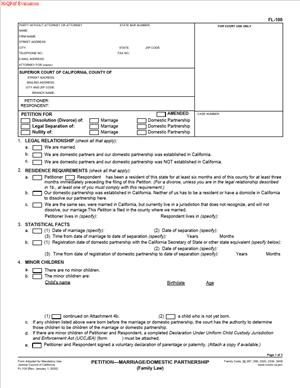
FL-100 – Petition—Marriage or Domestic Partnership (Family Law)
Fill out nowJurisdiction: Country: United States | Province or State: California
FL-100 – Petition—Marriage or Domestic Partnership (Family Law) is the document that starts a divorce, legal separation, or annulment case in California. When you file it with the court, you are formally asking a judge to end or change your legal relationship.
This form is often the first official step in a family law case. It tells the court basic facts about you, your spouse or partner, and your relationship. It also outlines what you are requesting regarding property, support, and children.
If you are representing yourself, this document can feel overwhelming. It covers several legal topics in a small space. Each box matters because it shapes how your case moves forward.
Understanding what this form does and how it works will help you complete it with more confidence. The clearer and more accurate your information, the smoother the filing process tends to be.
What is FL-100 – Petition—Marriage or Domestic Partnership (Family Law)?
Clear definition
FL-100 – Petition—Marriage or Domestic Partnership (Family Law) is a court form used to open a family law case in the Superior Court of California. It is the official petition that tells the court you want a divorce, legal separation, or nullity of marriage or domestic partnership.
This form identifies both parties, states when and where the marriage or partnership began, and confirms that residency requirements are met. It also includes your initial requests about children, property division, and financial support.
When you file this document, you become the “petitioner.” The other party becomes the “respondent.” The court uses the information in this form to create your case file and assign a case number.
Who typically uses this form?
You use this form if you want to end a marriage or registered domestic partnership in California. It applies to both opposite-sex and same-sex marriages, as well as registered domestic partnerships recognized under California law.
People who are seeking a divorce commonly file this form. It is also used by those asking for a legal separation, where the relationship remains legally intact, but financial and custody issues are resolved.
In some cases, a person may file this form to request a nullity. A nullity asks the court to declare that the marriage or partnership was not legally valid from the beginning under certain conditions.
Self-represented individuals frequently complete this form without a lawyer. It is also used by attorneys when representing clients in family law cases.
Why might you need this form?
You need this form to formally start your case. Without filing it, the court cannot take action on your requests.
If you want court orders about child custody, visitation, child support, or spousal support, this petition sets the stage. It tells the court what issues are involved in your case.
The form also signals that you want the court to divide property and debts. This includes community property and separate property acquired during the marriage or partnership.
Filing this petition begins important timelines. For example, in a divorce, there is a waiting period before the marital status can be terminated. That period typically starts when the respondent is served with the papers.
Typical real-life scenarios
- You have decided that your marriage is over and want to legally dissolve it. You and your spouse may agree on many issues, but you still need a court order to finalize the divorce. This form opens the case so the court can later approve your agreement or make decisions if needed.
- You and your registered domestic partner no longer live together and need clear rules about finances and parenting. You are not ready to divorce but want legal separation. Filing this petition allows the court to issue binding orders while keeping the legal relationship intact.
- You recently discovered information that affects the validity of your marriage. You believe the marriage may not have been legally valid from the start. This form lets you ask the court to review the situation and determine whether a nullity is appropriate.
- You have children and need a formal custody and support arrangement. Even if the separation is amicable, the court requires a filed petition before it can issue enforceable custody or support orders tied to the marriage or partnership.
When would you use FL-100 – Petition—Marriage or Domestic Partnership (Family Law)?
You use this form at the very beginning of a family law case involving marriage or domestic partnership. It is not filed after a case has already been decided. It is the document that creates the case.
If you are the person initiating the process, you complete and file this petition. The court then issues a summons and assigns a case number. After filing, the other party must be formally served with the documents.
This form is used whether your case is contested or uncontested. Even if both parties agree on all terms, the court still requires a filed petition to process and finalize the case.
You would not use this form for issues that do not involve ending or changing marital or partnership status. For example, certain custody disputes between unmarried parents may involve different forms. This petition is specific to marriage or registered domestic partnership cases.
In general, the person who wants to move forward with ending the relationship files this document. The other party has an opportunity to respond through a separate response form.
Legal characteristics of FL-100 – Petition—Marriage or Domestic Partnership (Family Law)
This document is a formal pleading filed with the Superior Court of California – Family Law. It becomes part of the official court record. Once filed, it opens a legal proceeding that can result in binding court orders.
For the form to be accepted, it must be complete and accurate. Missing signatures, incomplete sections, or inconsistent information may lead to rejection by the court clerk. Incorrect case details can also delay processing.
Residency requirements play an important role. In California, at least one spouse or partner generally must meet certain residency rules before filing for divorce. If those requirements are not met, the court may not be able to grant a dissolution of status, though other types of relief may still be available in some situations.
This petition does not by itself divide property, set custody schedules, or order support. It only requests those outcomes. The actual orders come later, either through agreement, default, or a judge’s decision.
The form also does not automatically end your marriage or partnership. Even after filing, the legal status continues until the court enters a final judgment.
Is it legally binding?
The act of filing this petition creates a formal court case. In that sense, it has legal effect because it triggers court procedures and timelines. It also subjects both parties to certain automatic temporary restraining orders related to property and children once the summons is served.
However, the requests you list in the petition are not automatically binding on the other party. They are proposals or claims. The court must review and approve any final agreement or issue orders after proper process.
If the other party does not respond within the required time after being served, the court may allow the case to proceed by default. In that situation, the court can grant the relief requested in the petition, as long as it is legally permitted and properly supported.
How to fill out FL-100 – Petition—Marriage or Domestic Partnership (Family Law)
Step 1 – Identify the parties and the court
At the top of the form, fill in your name, address, and contact information in the space for the petitioner. Leave the case number blank if you do not yet have one. Enter the name of the county where you are filing and the branch of the Superior Court. This information ensures the case is opened in the correct court location.
Step 2 – Confirm your legal relationship
In the section asking what type of case you are filing, check the box that applies to your situation. Indicate whether you are requesting dissolution, legal separation, or nullity. Also specify whether the case involves a marriage or a registered domestic partnership. This choice tells the court what type of legal outcome you are seeking.
Step 3 – Provide residency information
Complete the section about residency. State how long you, your spouse, or partner has lived in California and in the county where you are filing. These details help the court determine whether it has authority to decide your case.
Step 4 – State dates and registration details
Enter the date of your marriage or domestic partnership and the date of separation. If you are in a registered domestic partnership, provide the place of registration if requested. Accurate dates are important because they affect property and support issues.
Step 5 – Identify minor children
If you and the other party have minor children together, list their names, dates of birth, and ages in the space provided. If there are no minor children from the relationship, indicate that clearly. The court uses this section to determine whether custody and support issues must be addressed.
Step 6 – Address legal grounds
Select the legal grounds for your request. In many cases, this involves stating irreconcilable differences. If you are requesting nullity, indicate the specific ground that applies. The ground you select frames the legal basis for ending or altering the relationship.
Step 7 – Request custody and visitation orders
If there are minor children, complete the section requesting custody and visitation orders. Indicate whether you are asking for legal custody, physical custody, or both. You may also request that the court determine visitation. This section outlines your initial position on parenting arrangements.
Step 8 – Request child support and spousal or partner support
Mark the boxes related to child support if applicable. If you want the court to order spousal or partner support, indicate that in the support section. You can also state whether you want the court to reserve the issue of support for a later decision.
Step 9 – Address property and debts
In the property section, indicate whether there are community and quasi-community assets and debts to divide. You can also note if there are separate property claims. This section alerts the court that the financial division will be part of the case.
Step 10 – Restore a former name if applicable
If you want to restore a former legal name after divorce, complete the name restoration section. Write the exact former name you wish to have restored. This request becomes part of the final judgment if granted.
Step 11 – Review and sign the form
Carefully read through every section before signing. Make sure all applicable boxes are checked, and all required information is filled in. Sign and date the form where indicated. Your signature confirms that the information provided is true and correct to the best of your knowledge.
Step 12 – Prepare for filing and service
Make copies of the completed form according to court filing requirements. The original is filed with the court clerk, and copies are used for your records and for service on the other party. Once filed, the case number assigned by the court will appear on your documents and be used in all future filings.
Legal terms you might encounter in FL-100 – Petition—Marriage or Domestic Partnership (Family Law)
- Petitioner: The petitioner is the person who starts the court case. On this form, that is you if you are filing it. Your name appears at the top as the party asking the court to make orders about your marriage or domestic partnership.
- Respondent: The respondent is your spouse or domestic partner. This is the person you are asking the court to serve with the petition. Their full legal name must match official records to avoid delays.
- Summons: The summons is a separate document that goes with this form. It officially notifies the respondent that a case has been filed and explains deadlines to respond. The court clerk issues it when you file your papers.
- Community Property: Community property generally refers to property acquired during the marriage or domestic partnership. On this form, you indicate whether there are community and quasi-community assets and debts. This tells the court that property division will need to be addressed.
- Separate Property: Separate property usually includes assets owned before the marriage or received by gift or inheritance. You may identify separate property claims in your petition. This signals that you believe certain items should not be divided.
- Legal Custody: Legal custody refers to the right to make important decisions about a child’s health, education, and welfare. If you have minor children, you can request legal custody orders in this document. You must clearly state what arrangement you want the court to order.
- Physical Custody: Physical custody concerns where the child lives. On the form, you can request primary physical custody, joint physical custody, or another arrangement. The court uses your request as a starting point for custody decisions.
- Spousal or Partner Support: This refers to financial support paid by one spouse or partner to the other. You can request that the court order support or reserve the issue for later. Checking the correct box affects whether the court keeps authority to address support in the future.
- Restoration of Former Name: This section allows you to ask the court to restore your former legal name. If granted, the final judgment will state your restored name. You must clearly print the exact former name you want reinstated.
FAQs
What date do I list as the date of separation?
You must enter the date when you and your spouse or partner separated with the intent to end the relationship. This is not just when you moved out. It is the date when at least one of you decided the marriage or partnership was over and acted on that decision. Be consistent with this date in all other documents you file.
Do I need to attach anything when I file this document?
In most cases, you file this document together with a summons and, if you have minor children, a declaration related to child custody jurisdiction. The clerk will review the packet for completeness. If required attachments are missing, the court may reject your filing.
What if I do not know all of our property or debts yet?
You are not required to list every asset and debt on this initial petition. You simply indicate whether there are community or separate assets and debts. Detailed financial disclosures usually happen later in the case through separate forms. Do not guess values here; just answer the checkboxes accurately.
Can I change what I asked for after filing FL-100 – Petition—Marriage or Domestic Partnership (Family Law)?
Yes, but you must follow the court’s procedure to amend your petition. That may involve filing an amended version of this form and serving it again. Until you formally amend it, the court relies on the requests in your original filing.
What happens if I make a mistake in a name or date?
If the court has not yet processed your paperwork, you may be able to correct it before filing. After filing, corrections often require an amended petition. Errors in legal names, marriage dates, or children’s birthdates can delay the case or create confusion in the final judgment.
Does this form legally end my marriage or partnership?
No. Filing this form starts the case, but it does not terminate the marriage or domestic partnership. Your status changes only after the court enters a final judgment and any required waiting period has passed. Until then, you are still legally married or partnered.
What if my spouse or partner does not respond?
If the respondent does not file a response within the required time after being served, you may request a default. You will need proof of service showing when and how this document was delivered. The court can then proceed based on your filed requests, subject to review and approval.
Will the information I enter become part of the public record?
Yes, most information you provide becomes part of the court file. That includes names, dates of marriage, and requests for custody or support. Financial account numbers and other sensitive data are generally handled in separate disclosures, not on this petition.
Checklist: Before, During, and After FL-100 – Petition—Marriage or Domestic Partnership (Family Law)
Before
- Confirm you meet residency requirements before filing.
- Gather your marriage or domestic partnership registration details.
- Verify full legal names for both parties.
- Identify accurate dates for marriage and separation.
- List the full legal names and birthdates of minor children.
- Decide what you are requesting for custody, support, and property.
- Review prior court orders involving your family, if any.
- Prepare the related summons and any required child custody forms.
During
- Print or type clearly using black or blue ink.
- Use complete legal names without nicknames.
- Check every box that applies to your situation.
- Leave sections blank only if they truly do not apply.
- Double-check dates for consistency across the form.
- Clearly state your requests for custody and visitation.
- Indicate whether you want spousal or partner support.
- Sign and date the form where required.
After
- Make at least two copies of all filed documents.
- File the originals with the court clerk.
- Pay the required filing fee or submit a fee waiver request.
- Obtain a filed-stamped copy for your records.
- Arrange for proper service for the respondent.
- File proof of service with the court.
- Calendar the response deadline.
- Keep all court-stamped documents organized in one place.
Common mistakes to avoid with FL-100 – Petition—Marriage or Domestic Partnership (Family Law)
- Mistake: Using nicknames or incomplete legal names because it feels informal, which can cause confusion in court records and delay service, so do not forget to match names exactly to government-issued identification.
- Mistake: Listing the wrong date of separation due to uncertainty about what it means, which can affect property and support issues later, so do not forget to use the date when the intent to end the relationship was clear and acted upon.
- Mistake: Failing to check the box about community property because you plan to work it out privately, which may limit what the court addresses, so do not forget to indicate whether assets and debts exist, even if you expect agreement.
- Mistake: Overlooking the request to restore a former name because it seems minor, which means you must file additional paperwork later, so do not forget to include the exact former name if you want it restored.
- Mistake: Forgetting to sign and date the form because you focused on the content, which leads the clerk to reject the filing, so do not forget to review the signature line before submitting.
- Mistake: Requesting custody or support without completing the required forms, which can delay hearings or orders, so do not forget to prepare and file all companion documents.
- Mistake: Assuming filing alone ends the marriage or partnership, which creates false expectations and planning errors, so do not forget that only a final judgment changes your legal status.
- Mistake: Not keeping copies of filed documents because you believe the court keeps everything, which leaves you without proof of what you requested, so do not forget to store stamped copies safely.
What to do after filling out FL-100 – Petition—Marriage or Domestic Partnership (Family Law)
Once you complete the form, slow down and review every page. Check names, dates, and boxes. Make sure your requests reflect what you actually want the court to order.
- Step 1: Make at least two copies of the completed form and all attachments.
- Step 2: Assemble your filing packet, including the summons and any required child-related documents.
- Step 3: Submit the originals to the court clerk for filing and pay the filing fee or request a fee waiver.
- Step 4: Receive filed-stamped copies back from the clerk and confirm the case number is on every page.
- Step 5: Arrange for someone over 18 who is not you to serve the respondent with the filed documents.
- Step 6: Ensure the server completes a proof of service form accurately.
- Step 7: File the proof of service with the court to show the respondent was properly notified.
- Step 8: Mark the response deadline on your calendar and track whether a response is filed.
- Step 9: Begin preparing your required financial disclosures and any additional declarations.
- Step 10: Organize a dedicated folder for all court notices, filings, and correspondence.
- Step 11: Monitor mail and court communications so you do not miss hearing dates or requests for corrections.
- Step 12: Update your personal records as needed once a final judgment is entered, including name changes or financial arrangements reflected in the court order.
Stay organized from the start. Keep copies of everything you file and everything you receive. Careful recordkeeping will save you time and stress as your case moves forward in the Superior Court of California.
Disclaimer: This guide is provided for informational purposes only and is not intended as legal advice. You should consult a legal professional.