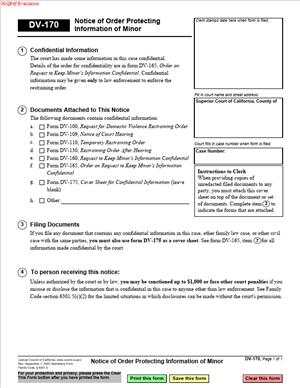
DV-170 – Notice of Order Protecting Information of Minor
Fill out nowJurisdiction: Country: United States | Province or State: California
The DV-170 – Notice of Order Protecting Information of Minor is a court form used in California domestic violence cases. It tells people that a judge has ordered certain personal information about a child to be kept confidential.
You usually see this document after a court hearing involving a request for protection. It does not create the protection itself. Instead, it gives notice that an order is already in place to shield a minor’s private details.
If you are filling it out or receiving it, you are likely involved in a domestic violence restraining order case. You may be a parent, guardian, protected party, restrained person, or another individual connected to the case.
This form matters because children’s personal information can be sensitive. When the court decides that sharing details like a home address or contact information could put a child at risk, it can issue an order limiting access. This document communicates that decision clearly.
Understanding how this form works helps you avoid mistakes in filing, service, or compliance. It also helps you know what information must remain confidential during the case.
What is DV-170 – Notice of Order Protecting Information of Minor?
Clear definition
The DV-170 – Notice of Order Protecting Information of Minor is a formal court notice issued in connection with a domestic violence proceeding in California. It states that the court has made an order protecting specific personal information about a minor child.
The form is part of the domestic violence restraining order process. It does not request protection. It confirms that protection has already been ordered and explains what information is covered.
This document may reference identifying details such as a child’s address, school location, or other contact information. Its purpose is to restrict access to that information within court records and related filings.
Who typically uses this form?
This form is typically used by a party in a domestic violence case involving a child. Often, it is connected to a parent or guardian who has asked the court to protect the child’s safety.
It may also involve the restrained person, who must be informed that certain information is being withheld. Court staff use the form as part of the official case record to document the confidentiality order.
Attorneys sometimes prepare or review the form, but many people using it are self-represented. If you are handling your own case, you may come across this document when the court grants protection related to a minor’s information.
Why might you need this form?
You might need this form if revealing a child’s personal information could create a safety risk. In domestic violence cases, sharing an address or school location can sometimes expose a child to harm.
The court may determine that limiting access to that information is necessary. When that happens, this notice becomes part of the case file to reflect the court’s order.
You may also need this form if you are required to serve or receive notice of all orders in a domestic violence case. It ensures that all involved parties understand what information is protected and how the court expects it to be handled.
Typical real-life scenarios
- A parent seeks a restraining order after incidents of domestic violence. The parent and child have relocated to a confidential address. The court orders that the child’s address not appear in public filings. This form documents that decision.
- In another situation, a child attends a new school after safety concerns arise. The court decides that disclosing the school’s name could put the child at risk. The notice confirms that this detail must remain confidential.
- Sometimes a restraining order case includes ongoing custody or visitation issues. The court may limit access to specific contact information while allowing other aspects of the case to move forward. The form helps separate what can be shared from what cannot.
- There are also cases where a minor’s identifying information appears in earlier filings. After reviewing the circumstances, the judge may order that certain records be sealed or redacted. The notice then reflects that protective step.
- In high-conflict cases, even routine disclosures can create tension or risk. The court may use this form to clearly define boundaries about what information stays private throughout the proceeding.
When would you use DV-170 – Notice of Order Protecting Information of Minor?
You would use this form in connection with a domestic violence restraining order case that involves a minor. It appears that the court makes a specific order to protect the child’s personal information.
It is commonly used when there is concern about safety or harassment. If a child’s location or contact details could be used to intimidate, threaten, or locate the child, the court may decide to restrict access.
The form may be prepared or issued at the same time as other restraining order documents. It can accompany temporary or longer-term orders, depending on what the judge decides.
Parents or guardians involved in the case may encounter this document when reviewing the court’s orders. The restrained person may receive notice of the confidentiality protections through service of this form, along with other related documents.
Court staff includes it in the case record to make clear that certain information is not available for general inspection. This can affect how future filings are handled, especially if they reference protected details.
Legal characteristics of DV-170 – Notice of Order Protecting Information of Minor
This form reflects a court order. Its authority comes from the judge’s decision in the domestic violence case. The document itself serves as an official notice of that order.
For it to be effective, it must be properly issued within an active case. It typically includes identifying information about the case, such as the court name and case number. Accurate completion is important because errors can cause confusion about which child or case is covered.
Common problems arise when the form is incomplete or inconsistent with other court documents. If names, dates, or case numbers do not match the main restraining order paperwork, it can delay processing or create misunderstandings.
Another issue can occur if parties continue to include protected information in later filings. Even with the notice in place, submitting documents that disclose confidential details may conflict with the court’s order.
In general, confidentiality rules can vary depending on the type of case and the court’s specific findings. Some protections apply automatically in certain proceedings, while others require a clear order from a judge. This form is used when the court has made a specific determination about protecting a minor’s information.
It is important to understand what this form does not do. It does not create a custody order. It does not decide visitation. It does not, by itself, issue a restraining order. It only addresses the protection of certain information about a minor within the court process.
Is it legally binding?
Yes, the order described in this form is legally binding because it reflects a judge’s directive in an active court case. Once issued, the confidentiality protections apply as stated in the order.
The binding effect comes from the court’s authority, not from the act of signing the notice alone. The form serves as proof that the order exists and communicates its terms to the parties.
If someone ignores the confidentiality order and discloses protected information in violation of the court’s directive, the court may address that conduct within the case. The specific consequences depend on the circumstances and the court’s findings.
The protections remain in effect according to the terms set by the judge. They may continue as long as the underlying restraining order or related case remains active, or as otherwise specified by the court.
How to fill out DV-170 – Notice of Order Protecting Information of Minor
Step 1 – Review the related court orders
Before completing the form, review the restraining order documents in your case. Confirm that the judge has made an order protecting a minor’s information. Make sure you understand exactly what information is covered.
Step 2 – Enter the court information
At the top of the form, fill in the name and address of the court handling the case. Use the same court details shown on your other domestic violence forms to keep the record consistent.
Step 3 – Identify the parties
Provide the names of the petitioner and the respondent exactly as they appear in the case. Accuracy matters. The names must match the other filings to avoid confusion in the court file.
Step 4 – Include the case number
Write the case number assigned by the court. Double-check it against prior documents. An incorrect number can delay processing or attach the notice to the wrong case.
Step 5 – Identify the minor whose information is protected
Enter the name of the child covered by the order. If more than one minor is included, list each as required by the form. Ensure the spelling matches earlier filings.
Step 6 – Specify the protected information
Indicate the type of information the court has ordered to be kept confidential. This may include addresses, contact details, school information, or other identifying data. Follow the wording of the court’s order carefully.
Step 7 – Review for consistency with the court’s ruling
Compare the completed form with the judge’s ruling. Confirm that the notice reflects the scope of the confidentiality order without adding or omitting details.
Step 8 – Sign and date where required
If the form requires a signature, sign and date it in the appropriate section. Use the same name format you have used in the rest of the case paperwork.
Step 9 – File and ensure proper service
Submit the completed form to the court clerk as part of your case filing. Make sure it is included with the other required documents and handled according to the court’s procedures for service and recordkeeping.
Legal terms you might encounter in DV-170 – Notice of Order Protecting Information of Minor
- Protected Information: This refers to specific details about a minor that the court has ordered to be kept confidential. It often includes home address, school location, contact details, or other identifying information. In this form, you are confirming what information is covered by the protection order.
- Minor: A minor is a person under 18 years old. In this document, the minor is the child whose information the court has decided must be protected. You must clearly identify the correct child by full legal name to avoid confusion.
- Protective Order: A protective order is a court order that limits certain actions or access to information to protect someone’s safety. In this context, the protective order restricts disclosure of the minor’s personal information. This form notifies others that such an order exists.
- Confidentiality: Confidentiality means that certain information cannot be shared publicly or with unauthorized individuals. The form serves as a formal notice that the minor’s information must not be disclosed except as allowed by the court.
- Case Number: The case number is the unique identifier assigned by the court to your case. You must enter it exactly as it appears on other court documents. A missing or incorrect case number can cause delays or filing rejection.
- Petitioner: The petitioner is the person who asked the court for protection. This title appears in the case caption at the top of the form. You must use the same designation that appears in the original court case.
- Respondent: The respondent is the person against whom the protective order was requested. This title also appears in the case caption. Consistency in names and roles is critical when completing the form.
- Sealed Record: A sealed record is a court record that is not accessible to the public. If the court orders certain information sealed, it cannot be viewed without special permission. This form helps ensure that the protected information stays out of the public file.
- Effective Date: The effective date is the date the court’s order becomes active. This is usually the date the judge signed the order unless stated otherwise. You must confirm that the effective date on this document matches the court’s ruling.
- Service: Service refers to formally delivering legal documents to another party. Even though this form is a notice, you may still need to ensure proper service depending on court instructions. Proof of service may be required to show the other party was notified.
FAQs
What does DV-170 – Notice of Order Protecting Information of Minor actually do?
This form officially notifies parties and relevant agencies that the court has ordered certain information about a minor to be kept confidential. It does not create the protective order itself. Instead, it reflects and communicates what the judge has already ordered so that the information is handled properly in court records and related systems.
Do I need to attach a copy of the judge’s order to this form?
You should check the court’s instructions or your existing order. In many situations, this document is issued alongside the signed order, and the clerk handles distribution. If you are submitting it yourself, make sure the protective order is already signed and filed. Do not assume the notice replaces the actual order.
What information about the child is usually protected?
The most common items are home address, school name and address, phone numbers, and other identifying contact details. The specific items depend on what the judge wrote in the order. Before completing this form, carefully read the exact wording of the court’s ruling so you accurately reflect what is protected.
What if the child’s name is spelled differently on earlier paperwork?
The name on this document must match the name used in the court’s case file. If you notice a spelling difference, review the official court order. Use the spelling that appears on the signed order unless the court has formally corrected it. Inconsistent names can create confusion in court databases.
When does the protection of the minor’s information start?
Protection usually begins on the effective date listed in the signed court order. This form does not change that date. Check the judge’s signature date and any specific language about when the order becomes active. Make sure the effective date is clear and consistent across your documents.
Who is allowed to see the protected information?
Only individuals or agencies authorized by the court may access it. That may include the judge, certain court staff, or law enforcement when legally necessary. The general public and unauthorized parties should not have access once the order is in place and properly recorded.
Do I have to serve the other party with this document?
Service requirements depend on the court’s instructions. In many cases involving protective orders, the court ensures proper notice. If you are responsible for service, confirm who must be served, how service must occur, and whether proof of service must be filed. Do not skip this step if it applies.
What happens if I realize there is an error after filing?
If you discover a mistake, act quickly. Review the field version to confirm the exact error. You may need to request a corrected order or file an amended notice, depending on the issue. Do not ignore even small errors, especially in names, case numbers, or the description of protected information.
Checklist: Before, During, and After DV-170 – Notice of Order Protecting Information of Minor
Before
- Read the signed protective order carefully and highlight the exact information the judge protected.
- Confirm the correct spelling of the minor’s full legal name.
- Verify the case number from the most recent court document.
- Check the roles of petitioner and respondent as listed in the case caption.
- Confirm the court location and branch handling your case.
- Review any clerk instructions about attachments or additional forms.
- Make sure you understand whether you are responsible for filing or if the clerk will issue the notice.
- Gather copies of related court orders for reference.
During
- Enter the court name and address exactly as shown on other case documents.
- Fill in the case number without adding or removing digits.
- Identify the petitioner and respondent consistently with prior filings.
- Clearly state the minor’s full legal name without abbreviations.
- Describe the protected information exactly as ordered by the judge.
- Double-check dates, especially the effective date of the order.
- Review the entire form for blank fields before signing.
- Sign and date the form where required, using the correct legal name.
After
- Make at least two copies of the completed and signed form.
- File the original with the court clerk if you are responsible for filing.
- Confirm that the clerk stamps your copies as filed.
- Verify whether proof of service is required and complete it if necessary.
- Keep one copy in a safe place with your other court papers.
- Provide copies to authorized parties as directed by the court.
- Check the court’s online docket, if available, to confirm acceptance.
- Monitor any follow-up notices from the court regarding confidentiality status.
Common mistakes to avoid with DV-170 – Notice of Order Protecting Information of Minor
- Mistake: Entering the wrong case number because you rely on memory instead of checking a recent court document, which can lead to rejection or misfiling, so do not forget to copy the number exactly as it appears.
- Mistake: Misspelling the minor’s name due to rushing through the form, which can create inconsistencies in sealed records and delay enforcement, so do not forget to match the spelling to the signed court order.
- Mistake: Listing information as protected that the judge did not include in the order, often because of a misunderstanding of the ruling, which can cause confusion or correction requests, so do not forget to rely only on the exact language of the order.
- Mistake: Leaving required fields blank because you assume they are optional, which may result in the clerk rejecting the filing, so do not forget to review every section before submission.
- Mistake: Failing to check the effective date, which can create uncertainty about when confidentiality begins, so do not forget to confirm the date directly from the signed order.
- Mistake: Not keeping stamped copies after filing because you assume the court retains everything, which can leave you without proof of filing later, so do not forget to secure your own filed copies.
- Mistake: Skipping service when required because you think the notice is automatic, which can delay enforcement or compliance, so do not forget to verify service requirements with the court’s instructions.
- Mistake: Using outdated information from earlier drafts of orders, which can conflict with the final signed version and cause record errors, so do not forget to work from the most recent signed document.
What to do after filling out DV-170 – Notice of Order Protecting Information of Minor
Once you complete the form, pause before filing. Read it slowly from top to bottom. You are checking for accuracy, not speed. Small errors in names, dates, or case numbers can cause unnecessary delays.
- Step 1: Compare the completed form line by line with the signed protective order to confirm every detail matches.
- Step 2: Make at least two clean copies of the completed document before submitting it.
- Step 3: File the original with the court clerk if you are responsible for filing, or confirm that the clerk will process it.
- Step 4: Ask the clerk to stamp your copies as “Filed” so you have proof of submission.
- Step 5: Confirm whether the court will distribute the notice or whether you must arrange for service.
- Step 6: If service is required, complete it according to the court’s rules and file proof of service promptly.
- Step 7: Store your filed copy in a secure folder with all related protective order documents.
- Step 8: Update your personal records to reflect that the minor’s information is now protected under court order.
- Step 9: Inform authorized individuals, such as attorneys or designated representatives, that the confidentiality order is active if the court allows disclosure to them.
- Step 10: Periodically review your case docket or court communications to ensure the order remains properly recorded and active.
Taking these steps helps you maintain clear records. It also ensures that the minor’s protected information remains confidential as the court intended. Careful follow-through reduces the risk of accidental disclosure and strengthens compliance with the court’s order.
Disclaimer: This guide is provided for informational purposes only and is not intended as legal advice. You should consult a legal professional.