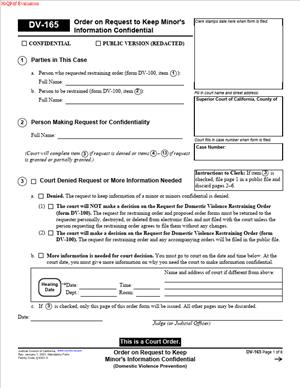
DV-165 – Order on Request to Keep Minor’s Information Confidential (Domestic Violence Prevention)
Fill out nowJurisdiction: Country: United States | Province or State: California
If you are involved in a domestic violence case in California and want to protect a child’s privacy, DV-165 – Order on Request to Keep Minor’s Information Confidential (Domestic Violence Prevention) is the court order that addresses that request. It deals specifically with whether a minor’s identifying information will remain confidential in court records.
This document is part of the domestic violence prevention process. It focuses on protecting a child’s personal details, such as home address or contact information, from being publicly disclosed.
When you are filling out court paperwork, it can be stressful to understand which forms control what. This order is not the initial request. It reflects the judge’s decision about whether a child’s information will be kept confidential.
If you are representing yourself, it helps to understand how this order fits into your case. Knowing what it does and what it does not do will make the filing process clearer and less overwhelming.
What is DV-165 – Order on Request to Keep Minor’s Information Confidential (Domestic Violence Prevention)?
Clear definition
DV-165 – Order on Request to Keep Minor’s Information Confidential (Domestic Violence Prevention) is a court order issued in a domestic violence case. It states whether the court grants or denies a request to keep a minor’s identifying information confidential.
This form does not start a case. It documents the court’s ruling on a specific request. That request is usually made to prevent sensitive information about a child from appearing in publicly accessible court records.
The order may limit who can see certain details. It can apply to information filed with the court or shared with other parties in the case.
Who typically uses this form?
This form is used in domestic violence prevention proceedings. The people involved are often a parent or guardian requesting protection, and the other parent or restrained person responding to the case.
A parent who is concerned about safety may ask the court to keep a child’s address, school, or other identifying details confidential. The judge then reviews that request.
Court staff prepare or processes this order after the judge makes a decision. You may receive a filed copy showing what the court decided.
Self-represented individuals often encounter this form when they are trying to protect a child while seeking a restraining order.
Why might you need this form?
You may need this order if revealing a child’s information could create a safety risk. In domestic violence situations, location details can sometimes increase danger.
Court files are generally part of the public record. Without a confidentiality order, certain information may be accessible to others.
This form creates a formal court record of the judge’s decision. It provides clarity about what information must remain confidential and how it will be handled.
It also helps prevent disputes later. If the order clearly states that specific information is confidential, everyone in the case has notice of that protection.
Typical real-life scenarios
- A parent files for a domestic violence restraining order after leaving an abusive relationship. The child now lives at a confidential address. The parent asks the court not to include the new address in public records. The judge reviews the request and issues this order.
- In another case, a child attends a new school after relocation due to safety concerns. The requesting party asks the court to keep the school’s name confidential. The court decides whether that information will be sealed or limited.
- Sometimes the restrained person has a history of harassment or stalking. The requesting parent believes that access to identifying details could lead to further harm. The court considers these concerns when ruling.
- There are also situations where both parents share custody, but one seeks a restraining order. The court must balance the need for confidentiality with the other parent’s legal rights. The order explains how that balance is handled.
- In some cases, the request is denied. The court may decide that confidentiality is not legally justified under the circumstances. The order then reflects that decision.
When would you use DV-165 – Order on Request to Keep Minor’s Information Confidential (Domestic Violence Prevention)?
You would encounter this form during an active domestic violence prevention case in California. It is used after a request has been made to keep a minor’s information confidential.
The timing usually follows the filing of a request for a restraining order or related domestic violence documents. If a party submits a request for confidentiality, the judge reviews it along with other case materials.
This form becomes relevant when the court makes its decision. It may be issued at a hearing or based on written submissions, depending on how the case proceeds.
Parents, legal guardians, or other caretakers involved in the case may be directly affected by this order. The restrained person is also affected because it may limit access to certain information.
You might see this document attached to other domestic violence court orders. It becomes part of the official case file.
If you are preparing paperwork and see a reference to the confidentiality of a minor’s information, this order is likely the final written decision on that issue.
Legal characteristics of DV-165 – Order on Request to Keep Minor’s Information Confidential (Domestic Violence Prevention)
This order is issued by a judge of the Superior Court in California. It is effective once signed and filed with the court.
For the order to be valid, it must clearly identify the case, the parties, and the specific information covered. It must also reflect a judicial decision. An unsigned draft has no legal effect.
Common problems arise when the underlying request is incomplete. If the request does not clearly explain what information needs protection, the court may deny it. Inaccurate case numbers or missing party names can also delay processing.
Another issue is confusion between sealing a record and keeping certain information confidential. These are related but distinct legal actions. This order addresses confidentiality in the context of a minor’s identifying information in a domestic violence case.
In California, domestic violence forms follow statewide standards. However, court procedures can vary slightly by county. Filing steps, hearing scheduling, and processing times may differ.
This order does not create a restraining order by itself. It does not determine custody, visitation, or support. It only addresses whether specific information about a minor will remain confidential.
It also does not automatically remove information that has already been widely shared outside the court system. Its effect is limited to how the court handles and discloses information in the case.
Is it legally binding?
Yes, once signed by a judge and filed, this order is legally binding. It directs how the court and the parties must treat the specified information.
If the order states that certain details are confidential, those details must be handled according to the court’s ruling. Failing to follow a court order can have legal consequences.
The binding effect applies within the scope of the case. It governs the conduct of the parties and the court regarding the protected information.
If the request for confidentiality is denied, that decision is also binding unless modified by the court. The order then confirms that the information will not receive the requested level of protection.
Like other court orders, it remains in effect unless changed by a later court order. Any modification generally requires a new request and judicial review.
How to fill out DV-165 – Order on Request to Keep Minor’s Information Confidential (Domestic Violence Prevention)
Step 1 – Review the case caption
Start by looking at the top section of the form. This area includes the court name, case number, and the names of the parties. Make sure this information matches your domestic violence case exactly. The case number must be identical to the number assigned by the court. Errors here can delay processing or cause confusion in the court file.
Step 2 – Identify the minor involved
Locate the section that identifies the minor whose information is at issue. Enter the child’s name as it appears in the case documents. Ensure spelling is accurate and consistent with other filings. If the form refers to more than one minor, confirm that each child is properly listed.
Step 3 – Reference the request for confidentiality
The form connects to a previously filed request. Check that the date and title of that request are correct. This helps the court link the order to the right document. If you are reviewing a proposed order before submission, confirm that it clearly reflects the request made.
Step 4 – Indicate the court’s decision
There will be a section showing whether the request to keep the minor’s information confidential is granted or denied. This part is typically completed by the judge. If you are preparing the form for the court’s review, ensure the options are clearly presented and not altered from the official format.
Step 5 – Specify the information covered
If the request is granted, the order may list the types of information that are confidential. This can include home address, mailing address, school name, or other identifying details. Make sure the description matches what was requested and is clearly stated.
Step 6 – Review any limitations or conditions
Some orders include conditions or explanations. For example, the court may allow limited disclosure under certain circumstances. Read this section carefully. It explains how confidentiality will be applied in practice in the case.
Step 7 – Confirm judge’s signature and date
The order is not effective until signed and dated by a judge. Check that the signature line is completed after the court reviews the request. The date of signing establishes when the order takes effect.
Step 8 – File and distribute according to court procedure
Once signed, the order must be filed with the court clerk. A filed copy becomes part of the official record. Copies are typically provided to the parties in the case. Keep your copy in a safe place with your other domestic violence court documents.
Legal terms you might encounter in DV-165 – Order on Request to Keep Minor’s Information Confidential (Domestic Violence Prevention)
- Confidential Information: This refers to personal details about a minor that are kept out of the public court file. This document, it usually includes the child’s address, contact details, or other identifying information. The court decides whether that information will be sealed from public access.
- Minor: A person under 18 years old. This form applies specifically to a child involved in a domestic violence prevention case. The minor’s identity is central to the request for confidentiality.
- Protected Party: The person the restraining order is meant to protect. In many cases, this includes a parent and the minor. The order may extend confidentiality protections to the minor as part of the safety plan.
- Restrained Party: The person against whom the domestic violence restraining order is sought or issued. Even if the minor’s information is confidential from the public, the restrained party may still receive certain information depending on the court’s decision.
- Sealed Record: A court record that is not available for public viewing. If the judge grants the request, the minor’s identifying details may be placed in a sealed section of the file.
- Case Number: The unique number assigned to your court case. This number must match exactly on this document and all related forms. If it is incorrect, the order may not be processed correctly.
- Court Order: A written decision signed by a judge. Once signed, it becomes legally enforceable. This document is a court order if the judge grants the request.
- Judicial Officer: The judge or commissioner who reviews and signs the order. The judicial officer’s signature and date make the order effective.
- Public Record: Information in a court file that anyone can request to see. This document determines whether specific details about a minor will remain in the public record or be removed from it.
- Attachment: An additional page included with the form. If the order references attachments, those pages are part of the court’s decision and must stay with the order.
FAQs
Does DV-165 – Order on Request to Keep Minor’s Information Confidential (Domestic Violence Prevention) automatically hide my child’s information from everyone?
No. This document only hides the minor’s information if the judge signs and grants the request. You must check the section showing the court’s decision. Look for boxes marked “granted” or similar language and confirm the judge’s signature and date. Without a signed order, the information may still be part of the public file.
Where do I check if the judge approved the request?
Look at the section that states the court’s findings and orders. The judge will mark whether the request is granted or denied. Confirm there is a date and a signature from the judicial officer. If either is missing, the order may not be effective yet.
What specific information about the minor is kept confidential?
This document usually covers identifying details such as home address, contact information, or other data that could reveal the child’s location. Read the section that describes what information is protected. If attachments are listed, review them to see exactly what is sealed.
Do I need to attach anything to this form?
If the order references attachments, those pages must be included. Check for boxes that say “Attachment” or “See attached.” Make sure any referenced pages are actually attached before filing or serving copies. Missing attachments can cause confusion about what is protected.
Does the restrained party still get access to my child’s information?
This form limits public access, but it does not always block the restrained party from seeing certain details. Review the language carefully to understand who is allowed to access the information. The court’s order controls what is shared and with whom.
When does the order become effective?
The order becomes effective on the date it is signed by the judicial officer. Look for the signature line and the date next to it. If you receive a filed copy, check the court stamp to confirm it has been entered into the record.
What should I do if the minor’s name is spelled incorrectly on the order?
Ask the court clerk about the process to correct a clerical error. The name must match other court documents and identification records. Do not ignore a misspelling, because it can create problems when enforcing or referencing the order later.
How does this document change what appears in the public court file?
Once signed, this document directs the court to keep certain minor information out of public view. The clerk will handle the file according to the order. You can confirm by asking what parts of the file are sealed and ensuring your copy reflects the granted protections.
Checklist: Before, During, and After DV-165 – Order on Request to Keep Minor’s Information Confidential (Domestic Violence Prevention)
Before
- Confirm the correct case number from your domestic violence case.
- Review the related request form to understand what was asked.
- Gather accurate identifying information for the minor.
- Double-check spelling of names and dates of birth.
- Review any prior court orders about confidentiality.
- Prepare any attachments referenced in the request.
- Make at least two extra copies of all documents.
During
- Ensure the case caption matches all other filed documents.
- Verify the minor’s name is consistent throughout the form.
- Check the box that reflects the court’s decision.
- Confirm all referenced attachments are included.
- Review the judicial officer’s signature and date.
- Make sure the clerk stamps the filed copy.
- Ask the clerk how confidential records are maintained.
After
- Keep a stamped copy in a safe place.
- Provide copies to your attorney, if you have one.
- Review the public file to confirm that protected information is not visible.
- Update any personal records to reflect the court’s order.
- Bring a copy to future hearings if the minor is involved.
- Monitor future filings to ensure confidential details are not disclosed.
- Request clarification from the clerk if anything appears incorrect.
Common mistakes to avoid with DV-165 – Order on Request to Keep Minor’s Information Confidential (Domestic Violence Prevention)
- Mistake: Assuming the request is automatically granted because it was filed, which happens when people confuse a request with an order, leading to unprotected information in the public file, so do not forget to confirm the judge’s signature and marked decision.
- Mistake: Using the wrong case number, often due to multiple related cases, which can cause the order to be filed in the wrong file, so do not forget to match the case number exactly as it appears on prior court documents.
- Mistake: Forgetting to attach referenced pages, which happens when boxes indicating attachments are overlooked, resulting in incomplete protection, so do not forget to include every page mentioned in the order.
- Mistake: Ignoring spelling errors in the minor’s name, often because the focus is on safety, not details, which can create enforcement and identification issues later, so do not forget to review all names carefully.
- Mistake: Failing to keep a filed copy, which happens when you rely on the court to maintain records, making it harder to prove confidentiality later, so do not forget to secure a stamped copy for yourself.
- Mistake: Believing the order hides information from all parties, which occurs due to misunderstanding the difference between public access and party access, potentially leading to surprise disclosures, so do not forget to read who the order applies to.
- Mistake: Not checking the effective date, which happens when people overlook the signature date, causing confusion about when protections begin, so do not forget to confirm the date next to the judicial officer’s signature.
- Mistake: Sharing the confidential information in later filings, often by copying old documents without review, which can undo the protection granted, so do not forget to review future filings for sensitive details.
What to do after filling out DV-165 – Order on Request to Keep Minor’s Information Confidential (Domestic Violence Prevention)
Once the judge signs the order, your job is to make sure the protections are actually in place and respected. Do not assume the system will handle everything automatically. Take active steps to protect the minor’s information.
- Step 1: Review the signed order carefully. Confirm the judge marked the request as granted and signed and dated the form.
- Step 2: Make several copies of the signed order. Keep one for yourself and store it somewhere secure.
- Step 3: File the original with the court clerk if it has not already been filed. Ask for a stamped “filed” copy for your records.
- Step 4: Ask the clerk how the court stores confidential information. Confirm which parts of the file are sealed and how they are labeled.
- Step 5: Check the public court file, if accessible, to ensure the minor’s protected information does not appear.
- Step 6: Provide a copy to anyone who needs to know about the confidentiality order, such as your attorney or a trusted legal advocate.
- Step 7: Bring a copy of the order to future hearings involving the minor, especially if custody or visitation issues are discussed.
- Step 8: Review any new court documents before filing them. Remove or separately protect any information that should remain confidential.
- Step 9: If you notice a breach of confidentiality, contact the court clerk promptly and ask about the process to address it.
- Step 10: Keep the order with other important legal documents related to your domestic violence case so you can quickly reference it when needed.
Staying organized is key. Create a folder—physical or digital—for all domestic violence prevention documents. Label it clearly. Keep the confidentiality order at the front so you can access it quickly.
If your contact information changes, be careful about how you update it with the court. Follow court procedures for protected addresses rather than placing new sensitive details directly into public filings.
Finally, remember that this order works together with your broader domestic violence restraining order. Each document serves a specific purpose. This one focuses on keeping a minor’s identifying details out of public view. Treat it as an active part of your safety plan and review it whenever your case status changes.
Disclaimer: This guide is provided for informational purposes only and is not intended as legal advice. You should consult a legal professional.