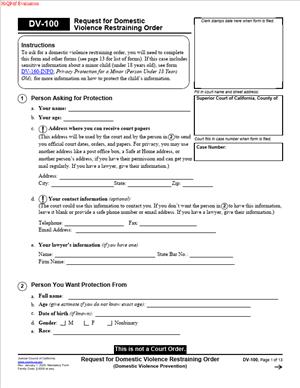
DV-100 – Request for Domestic Violence Restraining Order (Domestic Violence Prevention)
Fill out nowJurisdiction: Country: United States | Province or State: California | County: Tuolumne
DV-100 – Request for Domestic Violence Restraining Order (Domestic Violence Prevention) is the main court form used to ask a judge for protection from domestic violence in California. It starts a court case and tells the judge what happened and what protection you are requesting.
If you are dealing with abuse, threats, stalking, or harassment by someone close to you, this form is often the first formal step in seeking court protection. It gives the court the details needed to decide whether to issue temporary restraining orders.
This document is part of the domestic violence prevention process in family court. It works together with other related forms, but it is the central request that explains your situation in your own words.
Understanding how this form works can help you prepare clear, organized information. That makes it easier for the court to understand your concerns and evaluate your request.
What is DV-100 – Request for Domestic Violence Restraining Order (Domestic Violence Prevention)?
Clear definition
DV-100 – Request for Domestic Violence Restraining Order (Domestic Violence Prevention) is a written request filed with the court asking for legal protection from abuse by someone with whom you have or had a close relationship. It outlines the relationship, describes recent incidents, and specifies what orders you want the judge to make.
The form includes sections about personal information, the other person involved, children, property, and specific types of protection. It allows you to request orders such as no contact, stay-away orders, move-out orders, and temporary custody arrangements.
It is not the restraining order itself. It is the application that asks the court to issue one.
Who typically uses this form?
You typically use this form if you are seeking protection from a spouse, former spouse, domestic partner, former partner, person you dated, co-parent, close family member, or someone you live with or used to live with.
Parents may use it to protect themselves and their children. In some cases, a guardian or other qualified person may complete it on behalf of a minor.
The person who fills out the form is called the petitioner or protected person. The person against whom the protection is requested is often called the respondent.
Why might you need this form?
You may need this form if you want a court order requiring someone to stop contacting or coming near you. This can include physical violence, threats, stalking, harassment, or disturbing your peace.
It can also be used if you need temporary decisions about child custody, visitation, or support as part of the protection process.
In some situations, you may need written court protection to feel safer at home, at work, or in public places. A court order can also provide clear boundaries that law enforcement can enforce if violated.
Typical real-life scenarios
- You recently separated from a spouse who has been threatening you and showing up uninvited at your home. You want the court to order that person to stay away and stop contacting you.
- You ended a dating relationship, and the other person continues to call, text, and appear at your workplace despite repeated requests to stop. You are seeking an order that prohibits further contact.
- You share children with a former partner who has acted violently during exchanges. You are asking for protective orders and temporary custody arrangements to ensure safe contact with the children.
- You live with a family member who has physically harmed you or damaged property during arguments. You are requesting that the court order that person to move out and avoid further abuse.
When would you use DV-100 – Request for Domestic Violence Restraining Order (Domestic Violence Prevention)?
You would use this form when you want the court to review your situation and consider issuing a domestic violence restraining order. It is commonly filed when there has been a recent incident of abuse or an ongoing pattern of threatening behavior.
Many people use it immediately after a serious event, such as a physical assault or credible threat. Others file after repeated incidents that show a pattern of control or harassment.
It is also used when protection is needed quickly. The form allows you to request temporary orders that can take effect before a full court hearing takes place.
If children are involved, you may use this form when you want the court to address safety concerns while also setting temporary custody and visitation terms. The document provides space to explain why certain arrangements are necessary for safety.
In some cases, the form is filed alongside or before other family law matters, such as divorce or parentage cases. The restraining order process can operate separately from those cases, even if the same people are involved.
Legal characteristics of DV-100 – Request for Domestic Violence Restraining Order (Domestic Violence Prevention)
This form becomes effective once it is properly completed, filed with the court, and reviewed by a judge. The judge may issue temporary orders based on the information provided. Those orders are typically written on a separate document.
For the request to be considered, the form must be filled out clearly and completely. Missing identifying information, unclear descriptions of incidents, or failing to request specific orders can slow the process or require corrections.
Courts generally require detailed descriptions of recent abuse, including dates, locations, and what occurred. Vague statements without context may make it harder for the court to understand the urgency or seriousness of the situation.
Procedures can vary slightly by county, including filing methods and scheduling. However, the structure and content of the form remain consistent across California.
This form does not, by itself, create criminal charges. It is part of a civil court process. It also does not automatically resolve long-term issues like property division or permanent custody. Those issues may require separate proceedings.
Is it legally binding?
DV-100 – Request for Domestic Violence Restraining Order (Domestic Violence Prevention) is not legally binding on its own. It is a request for the court to issue legally binding orders.
If the judge grants temporary or permanent restraining orders after reviewing the form and holding a hearing, those resulting court orders are legally binding. Once served, the restrained person is required to follow them.
Violating a granted restraining order can lead to legal consequences. The binding effect comes from the signed court order, not from the request form itself.
How to fill out DV-100 – Request for Domestic Violence Restraining Order (Domestic Violence Prevention)
Step 1 – Provide your personal information
Enter your full legal name, address, and contact information in the section for the person seeking protection. If you have safety concerns about listing your home address, the form includes space to provide a mailing address instead. Use consistent information that matches other court documents, if any exist.
Step 2 – Identify the person you want protection from
Fill in the respondent’s full name and, if known, details such as address, age, and physical description. Provide as much identifying information as you reasonably can. Accurate details help ensure proper service of documents and reduce confusion with others who may have similar names.
Step 3 – Describe your relationship to the respondent
Indicate how you and the respondent are connected. The form provides categories such as spouse, former spouse, dating partner, co-parent, family member, or someone you live with. Choose the option that best describes the relationship, as this establishes eligibility under domestic violence laws.
Step 4 – List the people you want protected
Specify whether you are requesting protection only for yourself or also for children or other household members. Include full names and ages where requested. This section clarifies who the restraining order would cover if granted.
Step 5 – Explain the abuse
Describe the most recent incident of abuse in detail. Include dates, locations, and what happened. Focus on clear facts: what the person did or said, whether there were injuries, and whether law enforcement was involved.
If there were prior incidents, use the space provided to summarize them. Keep your statements organized and chronological when possible. If you need more room, attach additional pages as allowed and reference them clearly in the form.
Step 6 – Request specific restraining orders
Mark the boxes for the types of protection you are asking for. Options may include personal conduct orders, no contact, stay-away orders, move-out orders, and protection for pets.
Only select the orders that match your situation. The judge reviews what you request and decides what to grant. Clear selections help the court understand the scope of protection you seek.
Step 7 – Address child custody and visitation, if applicable
If you have children with the respondent, complete the sections about custody and visitation. Provide basic information about existing court cases involving the children, if any.
Explain why the requested custody arrangement supports safety. This section allows the court to consider temporary parenting orders within the restraining order process.
Step 8 – Include information about firearms and other safety concerns
The form asks whether the respondent owns or has access to firearms. Answer based on what you know. This information can affect the type of orders the judge considers.
If there are other safety concerns, ensure they are clearly described in the narrative sections. Specific details help the court assess potential risks.
Step 9 – Review, date, and sign the form
Read through the entire document before signing. Confirm that names are spelled correctly, dates are accurate, and all requested sections are complete.
Sign and date the form where indicated. Your signature confirms that the information provided is true to the best of your knowledge. Once signed, the form is ready for filing with the court clerk for review.
Legal terms you might encounter in DV-100 – Request for Domestic Violence Restraining Order (Domestic Violence Prevention)
- Petitioner: This is you, the person asking the court for protection. On this form, you are identified as the protected party requesting restraining orders. Your name must be written exactly as it appears on your identification and other court documents.
- Respondent: This is the person you want protection from. You must provide their full name and any identifying details you know. The court uses this information to issue and serve the restraining order correctly.
- Temporary Restraining Order (TRO): This is a short-term court order that can be granted before a full court hearing. If approved, it usually lasts until the hearing date listed by the court. It becomes enforceable once the respondent is properly served.
- Protected Person: This includes you and anyone else you list for protection, such as children or household members. You must clearly identify each person by name and age. The court will only protect the people specifically listed.
- Personal Conduct Orders: These are restrictions on the respondent’s behavior. They may prohibit harassment, threats, contact, stalking, or disturbing your peace. You must check the boxes that match what protection you need.
- Stay-Away Order: This requires the respondent to stay a certain distance away from you, your home, your workplace, your children’s school, or other locations. The distance is usually measured in yards. The court will specify the exact distance if granted.
- Move-Out Order: This order requires the respondent to move out of a shared residence. You must explain why you have the right to live there and why the move-out is necessary for safety. The judge decides whether this request is appropriate.
- Custody and Visitation Orders: These address temporary arrangements for children. You can ask for sole or joint custody and request supervised or restricted visitation. The court will review what you request and may set conditions.
- Firearm Relinquishment: If the order is granted, the respondent may be required to turn in, sell, or store firearms. The form asks about firearms because possession can affect safety. Courts take this issue seriously.
- Proof of Service: This is a separate document showing that the respondent received the filed papers. The restraining order cannot be enforced until service is properly completed. You must ensure this step is done and documented.
FAQs
When does the restraining order become effective?
A temporary restraining order becomes effective once the judge signs it and the respondent is properly served with the filed documents. It is not enforceable just because you submitted this form. Check the signed order for the issue date and confirm that proof of service has been filed with the court.
Do I need to attach evidence to this document?
You are not always required to attach evidence when submitting this form, but detailed written descriptions are critical. If you include photos, messages, police reports, or medical records, make sure they are clearly labeled and referenced in your explanation. Attachments should support the incidents you describe and match the timeline you provide.
What if I do not know the respondent’s current address?
You should provide the most recent address you know or any location where the person can be found. This information is needed for service. If the address is incomplete, service may be delayed, and the hearing could be postponed.
Can I change information after filing DV-100 – Request for Domestic Violence Restraining Order (Domestic Violence Prevention)?
You cannot simply edit the original document after it is filed. If you made an error or left something out, you may need to file an amended form or additional paperwork, depending on court procedures. Make sure any updated information is clearly identified and re-served if required.
Do I have to sign this form in front of a notary?
This document does not require notarization. You must sign it under penalty of perjury, which means you are declaring that everything written is true to the best of your knowledge. Your signature gives the court authority to rely on your statements.
What happens if the judge denies my request for a temporary order?
The judge may deny a temporary order but still set a hearing date. In that situation, you must attend the hearing and present your evidence in person. Review the court’s written decision carefully so you understand what was granted, what was denied, and what will be addressed later.
How do I know my paperwork was accepted by the court?
After filing, the clerk will stamp your documents with a filing date and case number. Review each page to confirm it has the court stamp. Keep endorsed copies for your records and for service on the respondent.
Will this form automatically protect my children?
Only the individuals you list as protected persons are covered by the court’s orders. If you want your children protected, you must clearly include their full names and request specific custody or visitation orders. The court will review those requests and state in the signed order who is protected.
Checklist: Before, During, and After DV-100 – Request for Domestic Violence Restraining Order (Domestic Violence Prevention)
Before
- Gather full legal names, birthdates, and contact information for yourself and the respondent.
- Write a clear timeline of abusive incidents with dates and locations.
- Collect supporting documents such as messages, reports, or photos.
- Identify all people you want listed as protected persons.
- Decide what specific orders you need, such as stay-away or move-out.
- Confirm the correct courthouse for filing.
- Review your draft for complete and accurate information.
During
- Fill out every required section without leaving blanks where information is available.
- Use clear, factual language when describing abuse.
- Check all boxes that match the protections you are requesting.
- Attach additional pages if you need more space and label them clearly.
- Sign and date the form under penalty of perjury.
- Make the required number of copies before filing.
- Submit the paperwork to the court clerk and obtain filed copies.
After
- Review the signed temporary orders carefully.
- Arrange for proper service on the respondent.
- File proof of service with the court.
- Mark the hearing date on your calendar.
- Prepare your evidence and testimony for the hearing.
- Keep a copy of the restraining order with you at all times.
- Provide copies to schools or workplaces if relevant.
- Update your address with the court if it changes.
Common mistakes to avoid with DV-100 – Request for Domestic Violence Restraining Order (Domestic Violence Prevention)
- Mistake: Writing vague statements about abuse because you feel overwhelmed, which can weaken your request, leading the judge to lack detail; do not forget to include specific dates, actions, and how the behavior affected you.
- Mistake: Leaving out children or other household members who need protection because you assume they are automatically covered, which can result in them not being protected; do not forget to list every person by full name.
- Mistake: Providing an incomplete address for the respondent due to uncertainty, which can delay service and the hearing; do not forget to include any known work or alternate locations.
- Mistake: Forgetting to request specific orders, such as move-out or custody, because you think the judge will decide everything automatically, which may limit the protections granted; do not forget to check every box that applies.
- Mistake: Failing to sign the form under penalty of perjury because you rushed, which can cause rejection by the clerk; do not forget to review and sign before filing.
- Mistake: Not making enough copies before filing, which can complicate service and recordkeeping; do not forget to keep stamped copies for yourself and for service.
- Mistake: Missing the court hearing because you believed the temporary order was permanent, which can result in dismissal; do not forget to attend the scheduled hearing.
- Mistake: Not filing proof of service after the respondent is served, which prevents enforcement; do not forget to submit the completed proof form to the court.
What to do after filling out DV-100 – Request for Domestic Violence Restraining Order (Domestic Violence Prevention)
Once you complete the form, your next focus is filing, service, and preparation for the hearing. The paperwork alone does not create enforceable protection. You must follow through on each procedural step.
- Step 1: Make at least three copies of everything, including attachments, before you file. You will need copies for yourself, the respondent, and possibly for law enforcement or other protected persons.
- Step 2: File the original forms with the court clerk. The clerk will stamp them and assign a case number. Check that every page is endorsed with the court stamp.
- Step 3: Review any temporary restraining order signed by the judge. Read each provision carefully so you understand what was granted and the exact terms.
- Step 4: Arrange for service of the filed documents. You cannot serve the papers yourself. A qualified adult who is not involved in the case must personally deliver the documents to the respondent.
- Step 5: Ensure the person who served the documents completes the proof of service form. This document confirms when, where, and how the service occurred.
- Step 6: File the completed proof of service with the court promptly. Without it, the judge cannot proceed at the hearing, and law enforcement may not enforce the order.
- Step 7: Mark your hearing date, time, and department clearly in your calendar. Plan to arrive early and bring organized copies of all evidence.
- Step 8: Prepare a short, factual summary of what happened and what protection you are asking the judge to order. Focus on the strongest and most recent incidents.
- Step 9: Keep a copy of the signed restraining order with you once it is issued. Provide copies to your children’s school, your workplace, or building security if the order includes stay-away terms.
- Step 10: Update your records if your contact information changes. Notify the court according to its procedures so you do not miss important notices.
Following these steps helps ensure that your request moves forward smoothly and that any order granted can be enforced when you need it.
Disclaimer: This guide is provided for informational purposes only and is not intended as legal advice. You should consult a legal professional.