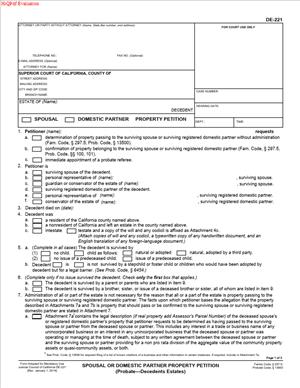
DE-221 – Spousal or Domestic Partner Property Petition (Probate-Decedents Estates)
Fill out nowJurisdiction: Country: United States | Province or State: California
If you are a surviving spouse or registered domestic partner in California, DE-221 – Spousal or Domestic Partner Property Petition (Probate—Decedents Estates) is a court form used to ask the probate court to confirm that certain property belongs to you after your partner’s death. It is filed in the Superior Court of California as part of a probate matter.
This form is often used when you believe that some or all of the deceased person’s property already belongs to you under California law. Instead of opening a full probate administration for those assets, you ask the court to formally confirm your ownership.
The form focuses on community property and other property that passes directly to a surviving spouse or domestic partner. It is not a general probate petition for distributing an entire estate. It is a targeted request about specific assets.
You are usually filling out this document at a difficult time. Understanding what the form does and what information it requires can make the process more manageable. This guide explains what the form is for, when it is used, and how to complete it step by step.
What is DE-221 – Spousal or Domestic Partner Property Petition (Probate—Decedents Estates)?
Clear definition
DE-221 – Spousal or Domestic Partner Property Petition (Probate—Decedents Estates) is a probate court document used in California to ask a judge to determine that certain property passes to the surviving spouse or registered domestic partner of a deceased person.
In simple terms, you are asking the court to confirm that specific assets are legally yours because of your marital or domestic partnership status. The court reviews the petition and, if appropriate, issues an order confirming your interest in the property.
The form is part of a probate case filed in the Superior Court. Even though it is related to probate, it is more limited than a full petition for probate administration. It focuses on the character of the property and how it passes to you.
Who typically uses this form?
This form is typically used by a surviving spouse or a surviving registered domestic partner. You may use it whether or not there is a will, depending on the circumstances.
In many cases, the surviving spouse files the petition personally, especially if they are self-represented. In other situations, a personal representative, executor, or administrator may be involved in the broader estate proceeding while you file this petition regarding your specific property rights.
You might also see this form used when there are questions about whether certain property was community property, quasi-community property, or separate property. The surviving spouse uses the petition to clarify and confirm their share.
Why might you need this form?
You may need this form when the title to the property is not automatically clear after your spouse or domestic partner dies. Financial institutions, title companies, or others may require a court order before transferring or confirming ownership.
For example, a house, bank account, or investment account may be in the deceased person’s name alone. Even if you believe it was community property, you may need a court order to reflect your legal interest.
This form can also help avoid unnecessary probate administration for property that legally belongs to you. Instead of going through a full estate process for those assets, you request confirmation of your share.
It creates a clear court record of your rights. That record can help prevent future disputes with heirs, beneficiaries, or creditors.
Typical real-life scenarios
- You and your spouse bought a home during your marriage. The title was taken only in your spouse’s name. After your spouse dies, the property records do not show your ownership. You file this petition to confirm that the home, or your portion of it, passes to you as community property.
- Your registered domestic partner had a retirement account funded during your partnership. The account lists only your partner’s name. You use this form to ask the court to confirm your community property interest in the account.
- Your spouse left a will that gives certain property to other relatives. However, you believe some of that property is community property and that you are entitled to your share regardless of the will. You file the petition to have the court determine the proper character of the property.
- There are adult children from a prior relationship. After your spouse’s death, questions arise about which assets are separate property and which are community property. You use this form to ask the court to clarify and confirm your legal interest.
- A bank refuses to release funds from an account solely in your spouse’s name. Even though the money was earned during the marriage, the bank requires a court order. You file the petition to obtain an order confirming that the funds pass to you.
When would you use DE-221 – Spousal or Domestic Partner Property Petition (Probate—Decedents Estates)?
You would use this form when a spouse or registered domestic partner has died, and there is property that may pass to you by operation of law, but formal court confirmation is needed.
This often happens early in the probate process. In some cases, you file the petition as part of an existing probate case. In others, you open a limited probate matter specifically to address your spousal or domestic partner’s property rights.
You might use the form whether there is a will or not. If there is a will, it may not control community property in the same way it controls separate property. The petition allows the court to determine what portion of the estate belongs to you before distribution to other beneficiaries.
You may also use this form when there is no personal representative yet appointed, but you need a court order regarding specific assets. In other situations, a personal representative has already been appointed, and the petition helps define which assets are part of the probate estate and which belong to you.
The form is typically used when title issues, creditor concerns, or disputes among heirs require a clear judicial determination. It provides a structured way to present the facts to a judge and request a formal order.
Legal characteristics of DE-221 – Spousal or Domestic Partner Property Petition (Probate—Decedents Estates)
This petition is a formal court filing. It must be filed in the appropriate Superior Court in California, in the probate division. It includes sworn statements about your relationship to the deceased and the nature of the property involved.
For the petition to be effective, it must accurately describe the property and explain why you are entitled to it. Real property generally requires a legal description. Financial accounts require identifying information. Vague or incomplete descriptions can delay the process.
The petition also requires proper notice to interested parties. These often include heirs, beneficiaries named in a will, and sometimes creditors. If required notice is not given, the court may continue the hearing or deny the request until notice rules are satisfied.
Common reasons for problems include mischaracterizing property, failing to disclose all relevant information, or not attaching required supporting documents. Inconsistencies between the petition and other court filings can also create delays.
California is a community property state. That framework shapes how this form works. In states without community property laws, similar issues may be handled differently. This specific form is designed to reflect California’s property system for spouses and registered domestic partners.
It is important to understand what this form does not do. It does not automatically transfer property by itself. A judge must review the petition and sign an order. It also does not resolve all estate issues. It addresses the character and passing of specific property to a surviving spouse or domestic partner.
Is it legally binding?
The petition itself is not legally binding just because you file it. It becomes legally effective when the court issues an order granting the relief requested.
Once the judge signs an order confirming that certain property passes to you, that order is legally binding. It can be used to change the title to real estate, access financial accounts, and clarify ownership in official records.
The binding effect depends on the proper procedure. The court must have jurisdiction, required notice must be given, and the information provided must be accurate. If the process is defective, the order can be challenged.
A court order under this petition typically resolves the property characterization issues presented in the filing. However, it does not prevent all possible future disputes, especially if new facts emerge or if other legal claims exist.
How to fill out DE-221 – Spousal or Domestic Partner Property Petition (Probate—Decedents Estates)
Step 1 – Complete the caption and court information
At the top of the form, fill in the name of the Superior Court of California where the probate matter is filed. Include the county and the court address if required. Enter the name of the deceased person exactly as it appears on the death certificate and other court documents. If a case number already exists, use that same number.
Step 2 – Identify yourself as the petitioner
Provide your full legal name and indicate your relationship to the deceased. The form asks whether you are the surviving spouse or registered domestic partner. Make sure the information matches other documents in the probate case. Consistency helps avoid delays.
Step 3 – State basic information about the decedent
Enter the date of death and the county where the decedent resided at the time of death. This establishes the court’s connection to the case. Use the death certificate as your reference to ensure accuracy.
Step 4 – Indicate whether there is a will
The form asks whether the decedent died with or without a will. If there is a will, identify it as required in the form. This helps the court understand the broader estate context, even though your petition focuses on spousal or domestic partner property rights.
Step 5 – Describe the property at issue
Carefully list each item of property you are asking the court to confirm as passing to you. For real estate, include the legal description, not just the street address. For bank or investment accounts, include the institution name and partial account numbers if requested. Be specific and complete.
Step 6 – Explain the character of the property
Indicate whether the property is community property, quasi-community property, or separate property passing to you. Provide the factual basis requested in the form. This may include when and how the property was acquired. Clear explanations help the court understand your claim.
Step 7 – State how the property should pass to you
The form allows you to request that the court confirm that the entire property or a specific portion passes to you. Complete this section carefully so the requested order matches your intended outcome. Review the language to ensure it reflects your understanding of your share.
Step 8 – Address notice and interested parties
Identify heirs, beneficiaries, and others who may be entitled to notice of the hearing. The form works together with separate notice documents. Make sure the names and relationships are accurate. Proper notice is a key part of the process.
Step 9 – Review and sign the petition
Read the completed form from start to finish. Confirm that names, dates, and property descriptions are correct. Sign and date the petition where indicated. Your signature confirms that the information provided is true to the best of your knowledge.
Step 10 – File the petition with the court clerk
Submit the completed form to the probate clerk in the appropriate Superior Court. The clerk assigns or confirms the case number and sets a hearing date if required. Keep a stamped copy for your records and for use in providing notice to interested parties.
Legal terms you might encounter in DE-221 – Spousal or Domestic Partner Property Petition (Probate—Decedents Estates)
- Petitioner: This is you, the surviving spouse or registered domestic partner, asking the court to confirm property rights. Your name must appear exactly as it does on your identification and any supporting documents. If your name has changed, you need to make sure the paperwork clearly connects your current name to the one on the marriage or partnership record.
- Decedent: The person who passed away. You will enter their full legal name as it appears on the death certificate. Any mismatch between the form and the death certificate can delay processing.
- Community Property: Property acquired during the marriage or registered domestic partnership that is generally considered owned equally by both partners. On this form, you may need to identify which assets qualify as community property. You should describe each item clearly and state why you believe it fits this category.
- Separate Property: Property owned by the decedent alone, often acquired before marriage or received by gift or inheritance. The form may require you to explain whether certain assets are separate property and how you are entitled to them. The court relies on the facts you provide.
- Character of Property: This refers to the legal classification of the asset as community, quasi-community, or separate property. You must clearly state the character for each asset listed. The judge uses this information to decide how the property passes.
- Quasi-Community Property: Property acquired while living outside the state that would have been community property if acquired in the state. If this applies, you must identify it and explain why. This can affect your share of the estate.
- Personal Representative: The person appointed to administer the estate, sometimes called an executor or administrator. If one has already been appointed, you must provide their information. If not, this petition may allow certain property to pass without full probate administration.
- Notice of Hearing: A formal notification sent to interested parties informing them of the court date. You are responsible for ensuring proper notice is given. The court will not grant your request without proof that notice requirements were met.
- Order Determining Property: The court’s written decision after reviewing your petition. This order confirms that the specific property belongs to you. You may need certified copies of this order to transfer title to real estate or financial accounts.
- Verification: Your sworn statement that the information in the petition is true and correct. You sign under penalty of perjury. This means you must be accurate and complete.
FAQs
Do I need to file DE-221 – Spousal or Domestic Partner Property Petition (Probate—Decedents Estates) if there is a will?
Yes, you may still need to file this form even if a will exists. The will does not automatically transfer title to property. This document asks the court to confirm that certain assets legally belong to you as the surviving spouse or partner, regardless of what the will says. You must review the will and identify whether the property you list is community, quasi-community, or separate property.
What documents should I attach to this form?
You typically need a certified copy of the death certificate. If you are claiming property as a spouse or registered domestic partner, you should attach proof of the relationship, such as a marriage certificate or registration document. If real property is involved, include a clear legal description, not just the street address. Make sure every attachment is labeled and referenced in the petition.
How do I describe real estate correctly?
Use the full legal description found on the deed, not the tax bill or listing sheet. The legal description often includes lot numbers, tract numbers, or metes and bounds language. Copy it exactly as written. If you shorten it or paraphrase it, the court may reject your request or require an amended filing.
What if there is already a probate case open?
If a personal representative has been appointed, you must provide the case number and court information on this document. The court will consider how your request fits within the existing estate proceeding. You also need to ensure that the personal representative and other interested parties receive proper notice of your petition.
How do I know what to list as community versus separate property?
Start by identifying when and how each asset was acquired. Property purchased during the marriage with joint funds is often community property. Property owned before marriage or received by inheritance is often separate property. On this form, you must state the character clearly and provide facts that support your position.
Does this document transfer title automatically once I file it?
No. Filing alone does not transfer title. The court must review the information, hold a hearing if required, and issue a signed order. After the order is entered, you may need certified copies to change title with a county recorder or financial institution. The transfer becomes effective based on the court’s order, not the filing date.
What happens at the hearing?
The judge reviews the information in this form and any objections filed by others. You may be asked to confirm facts about your marriage or the property’s history. Bring copies of all attachments and be prepared to explain how you determined the character of each asset. If everything is in order and no one objects, the court may grant the petition.
What if I make a mistake after submitting DE-221 – Spousal or Domestic Partner Property Petition (Probate—Decedents Estates)?
If you notice an error before the hearing, you can usually file an amended petition with corrected information. If the mistake affects property description or names, correct it promptly to avoid title problems later. Once an order is issued, fixing errors becomes more complicated and may require additional court action.
Checklist: Before, During, and After DE-221 – Spousal or Domestic Partner Property Petition (Probate—Decedents Estates)
Before
- Obtain a certified copy of the death certificate.
- Gather your marriage certificate or domestic partnership registration.
- Collect deeds, account statements, and titles for all property you plan to list.
- Confirm the exact legal description for any real estate.
- Identify whether a probate case is already open.
- Determine the character of each asset (community, quasi-community, separate).
- Prepare a complete list of interested parties who must receive notice.
- Review the form carefully to understand every section before writing.
During
- Enter the court name and case number accurately.
- Print the decedent’s full legal name exactly as shown on the death certificate.
- List each asset separately with a clear description.
- State the character of each asset and your basis for that classification.
- Attach required supporting documents and label them clearly.
- Double-check spelling of names and property details.
- Sign the verification under penalty of perjury.
- Make copies of the completed petition and attachments.
After
- File the original petition with the court clerk.
- Pay the required filing fee or submit a fee waiver request if eligible.
- Obtain a hearing date from the court.
- Serve notice to all required parties within the required time frame.
- File proof of service with the court.
- Attend the hearing with organized copies of all documents.
- Request certified copies of the signed order if granted.
- Record the order or provide it to financial institutions to transfer title.
- Keep a complete file for your personal records.
Common mistakes to avoid with DE-221 – Spousal or Domestic Partner Property Petition (Probate—Decedents Estates)
- Mistake: Using only a street address for real estate because it seems simpler, which happens when you rely on tax bills; this can lead to rejection or an unenforceable order, so do not forget to include the full legal description from the deed.
- Mistake: Listing property without stating its character, often because you assume the court will decide; this can delay approval or cause denial, so do not forget to clearly label each asset as community, quasi-community, or separate property.
- Mistake: Failing to notify all interested parties due to uncertainty about who qualifies; this can result in a continued hearing or invalid order, so do not forget to review and complete proper notice and proof of service.
- Mistake: Misspelling names or using inconsistent versions of the decedent’s name, which happens when copying from memory; this can create title issues later, so do not forget to match the death certificate exactly.
- Mistake: Forgetting to attach the death certificate or proof of relationship because you think the court already has it; this can stall your case, so do not forget to include all required attachments.
- Mistake: Assuming filing the petition alone transfers ownership, which happens due to misunderstanding the process; this can delay financial access, so do not forget that you must obtain a signed court order.
- Mistake: Signing without reviewing under penalty of perjury because you are rushing; this can expose you to legal consequences, so do not forget to read every statement carefully before signing.
- Mistake: Not obtaining certified copies of the final order, often to save money; this can prevent you from updating titles, so do not forget to request certified copies for recording or financial transfers.
What to do after filling out DE-221 – Spousal or Domestic Partner Property Petition (Probate—Decedents Estates)
Once you complete the form, focus on accuracy and organization. Small errors can create long delays. Take time to review every page and attachment before you move forward.
- Step 1: Review the entire petition for completeness, including attachments and signatures.
- Step 2: Make at least two complete copies of everything, one for your records and one for service.
- Step 3: File the original with the probate clerk at the correct court location.
- Step 4: Pay the filing fee or submit a fee waiver application if needed.
- Step 5: Obtain the hearing date and note all deadlines for giving notice.
- Step 6: Serve notice of the hearing and a copy of the petition on all required parties.
- Step 7: File proof of service with the court before the hearing date.
- Step 8: Prepare for the hearing by organizing your documents in the order listed in your petition.
- Step 9: Attend the hearing and answer the judge’s questions clearly and directly.
- Step 10: After the court signs the order, request certified copies from the clerk.
- Step 11: Record the order with the county recorder if real property is involved.
- Step 12: Provide certified copies to banks or financial institutions to retitle accounts.
After the transfer is complete, update your personal records. Keep copies of the signed order, proof of recording, and any confirmation letters from financial institutions. You may also need to update your estate planning documents to reflect the new ownership structure. Staying organized now will prevent problems later.
Disclaimer: This guide is provided for informational purposes only and is not intended as legal advice. You should consult a legal professional.