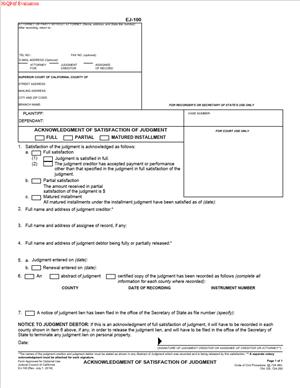
EJ-100 – Acknowledgment of Satisfaction of Judgment
Fill out nowJurisdiction: Country: United States | Province or State: California
The EJ-100 – Acknowledgment of Satisfaction of Judgment is a court form used in California to confirm that a money judgment has been paid. It tells the court that the judgment creditor has received what the court awarded. Once filed, it updates the official court record.
If you are filling out this form, you are likely closing out a court case involving a money judgment. This often happens after the debtor pays in full or after the parties reach a settlement that satisfies the judgment. The form serves as formal proof that the debt is no longer owed under that judgment.
This document matters because judgments can affect wages, bank accounts, property, and credit. Until the court record shows the judgment is satisfied, enforcement actions may continue. Filing this form helps prevent further collection efforts tied to that judgment.
You may be a creditor who received payment, a debtor confirming the record is cleared, or someone assisting with the paperwork. Understanding what this form does helps you complete it accurately and avoid delays.
What is EJ-100 – Acknowledgment of Satisfaction of Judgment?
Clear definition
EJ-100 – Acknowledgment of Satisfaction of Judgment is a California court document used to confirm that a judgment has been fully satisfied. In simple terms, it tells the court that the person who won the case has been paid what they were awarded.
A judgment is a court’s final decision requiring one party to pay money or perform an act. When the obligation under that judgment is fulfilled, this form provides written confirmation. It updates the court’s official record to show that the debt is resolved.
The form is filed in the same court that issued the judgment. It becomes part of the case file and may also affect related records, such as liens recorded against property.
Who typically uses this form?
The most common user is the judgment creditor. This is the person or business who won the case and is owed money. After receiving full payment, the creditor signs and files the form to acknowledge satisfaction.
Sometimes an attorney signs the form on behalf of the creditor. In cases where the creditor has assigned the judgment to another party, the assignee may complete the form.
Judgment debtors also have an interest in this form. While they do not usually sign it, they often request that the creditor file it after payment. If the creditor does not act, other legal procedures may be available, but those are separate from this form.
Why might you need this form?
You may need this form once the judgment has been paid in full. Courts do not automatically update their records when payment is made. The satisfaction must be formally acknowledged.
If a lien was created because of the judgment, recording a satisfaction can be important. Property sales, refinancing, or title transfers may be delayed if a judgment still appears unpaid.
Filing this form also helps prevent further enforcement actions. Wage garnishments, bank levies, or other collection tools are based on an active judgment. Once satisfied and properly recorded, those actions should stop in connection with that judgment.
Typical real-life scenarios
- You sued someone in small claims court and won. The court entered a money judgment in your favor. Months later, the other party pays you the full amount owed, including any allowed costs and interest. You then complete and file the form to confirm payment.
- A landlord obtained a judgment against a former tenant for unpaid rent. The tenant later pays the balance in a lump sum. The landlord uses this form to officially acknowledge that the debt under the judgment is resolved.
- A business won a contract dispute and recorded an abstract of judgment, creating a lien on the debtor’s property. When the debtor refinances and pays off the judgment through escrow, the business files the acknowledgment so the lien can be cleared from the property record.
- Two parties agree to a settlement after judgment is entered. The debtor makes payments under the settlement agreement. Once the agreed amount is fully paid, the creditor files the form to show that the judgment is satisfied, even if the settlement amount differs from the original award.
When would you use EJ-100 – Acknowledgment of Satisfaction of Judgment?
You use this form after full satisfaction of a judgment. Satisfaction generally means the total amount owed under the judgment has been paid. This may include principal, court-awarded costs, and any accrued interest.
The timing matters. The form is typically filed after the last payment is received and cleared. If payments were made in installments, it is completed only when the entire judgment amount has been satisfied.
In some cases, the form is used when property subject to a lien is being sold. Escrow may require written confirmation that the judgment is paid. Filing the acknowledgment ensures the court record matches the financial reality.
If enforcement actions are ongoing, such as wage garnishment, the creditor may use this form once the debt is paid. It serves as a formal notice that the collection under that judgment is complete.
The roles involved usually include a judgment creditor, a judgment debtor, and possibly attorneys or assignees. The filing party confirms to the Superior Court of California that no further balance is owed under the specified case number.
Legal characteristics of EJ-100 – Acknowledgment of Satisfaction of Judgment
This form is effective because it directly updates the court’s official case record. Once properly completed and filed, it signals that the monetary obligation under the judgment has been fulfilled.
For the form to function as intended, it must accurately identify the case. This includes the correct court name, case number, and names of the parties. Errors in these details can cause processing delays or rejection.
Signatures are critical. The acknowledgment must be signed by the correct party, typically the judgment creditor or an authorized representative. If the wrong person signs, or if authority is unclear, the court may not accept the filing.
If a lien was created by recording an abstract of judgment, additional steps outside the court file may be involved. While the court form updates the case record, clearing public records may require consistent information and proper recording procedures.
Requirements can vary slightly depending on the type of case and whether the judgment was from small claims or another civil division. The core function remains the same: it confirms satisfaction of a monetary judgment.
It is also important to understand what this form does not do. It does not change the original judgment. It does not erase the fact that a case was filed or that a judgment was entered. It only confirms that the amount owed under that judgment has been paid.
Is it legally binding?
Yes, this form has legal effect once properly signed and filed. It represents a formal acknowledgment that the debt under the judgment has been satisfied. The court relies on this statement when updating its records.
Because it is filed with the court, the information provided carries legal significance. A false acknowledgment could create legal consequences, particularly if it affects enforcement rights or property interests.
The binding nature comes from its role in closing out the enforceable aspects of the judgment. After filing, the creditor generally cannot continue collection efforts based on that satisfied judgment. The court record reflects that no balance remains due.
However, the form does not create new rights or obligations. It confirms the completion of an existing court order. Its legal force depends on accurate information and proper filing with the Superior Court of California.
How to fill out EJ-100 – Acknowledgment of Satisfaction of Judgment
Step 1 – Identify the court and case information
At the top of the form, enter the name of the Superior Court of California where the judgment was entered. Include the court’s address and branch name if requested. Fill in the case number exactly as it appears on the judgment and list the full names of the judgment creditor and judgment debtor.
Step 2 – Provide your contact information
Complete the section that asks for the name, address, and contact details of the person filing the form. This is usually the judgment creditor or their attorney. Make sure the information is current and legible so the court can process the filing without confusion.
Step 3 – Identify the judgment being satisfied
Enter the date the judgment was entered. Confirm that this matches the court’s records. If the form asks for details about an abstract of judgment or lien, provide the recording information accurately to ensure the satisfaction applies to the correct record.
Step 4 – Indicate full satisfaction
Mark or state that the judgment has been satisfied in full. Review the wording carefully so it reflects complete payment. If the form includes options for partial satisfaction, confirm that you are selecting the appropriate statement based on the actual payment status.
Step 5 – Sign and date the form
The judgment creditor or authorized representative signs and dates the form. Print the name clearly under the signature if required. By signing, you confirm that the judgment has been fully satisfied as stated in the document.
Step 6 – File the form with the court
Submit the completed form to the same Superior Court of California that issued the judgment. Ensure the case number and party names match the original case. Once filed and processed, the court record will reflect that the judgment has been satisfied.
Legal terms you might encounter in EJ-100 – Acknowledgment of Satisfaction of Judgment
- Judgment Creditor: This is the person or business who won the case and is owed money. On this form, the judgment creditor is usually the one who signs to confirm that the debt has been paid. You must make sure the name matches exactly what appears on the judgment.
- Judgment Debtor: This is the person or business who owes the money under the judgment. Their name must appear exactly as it does in the court’s records. Even small differences in spelling can create problems in clearing liens or updating the record.
- Full Satisfaction of Judgment: This means the entire amount owed under the judgment has been paid. That includes the original amount, any court-approved costs, and any interest that accrued. When you check the box for full satisfaction, you are confirming that nothing more is owed.
- Abstract of Judgment: This is a separate document that creates a lien on real property. If an abstract was recorded with a county recorder, filing this form alone may not release that lien. You may need to record an additional document to clear the property title.
- Accrued Interest: Judgments usually earn interest over time. Accrued interest is the extra amount that builds up between the date of judgment and the date of payment. Before signing, confirm that the interest has been calculated and paid correctly.
- Assignee of Record: Sometimes, the judgment creditor transfers the right to collect the judgment to someone else. If that transfer was filed with the court, the assignee of record may be the person who must sign this form. The court relies on its records to confirm who has authority.
- Partial Satisfaction: This means only part of the judgment has been paid. This form allows acknowledgment of partial satisfaction in some situations. Be clear about whether the payment fully resolves the debt or only reduces it.
- Proof of Service: This is documentation showing that a filed document was delivered to the other party. Even if not always required for this form, courts often expect parties to notify each other. Keep written proof that you provided a copy.
- Court Clerk: The clerk processes and files your document. The clerk does not give legal advice but checks for completeness. If required fields are missing, the clerk may reject your filing.
- Lien Release: When a judgment creates a lien, a separate release may be necessary to remove it from property records. Filing this form updates the court file, but it may not automatically update county land records.
FAQs
What date should I use as the satisfaction date?
Use the actual date the final payment cleared, and the full amount was received. Do not use the date you agreed to settle unless payment was completed that same day. The court record reflects the date the obligation was fully satisfied, not the date of negotiation.
Who is allowed to sign this document?
The judgment creditor or the assignee of record must sign. If a business is the creditor, an authorized representative signs and may need to indicate their title. Check the court’s case docket to confirm who is listed as the current creditor before signing.
Do I need to attach proof that the judgment was paid?
In most cases, you do not attach receipts or payment records when filing the EJ-100 – Acknowledgment of Satisfaction of Judgment. However, you should keep proof of payment in your own records. If there is a dispute later, you will need documentation showing how and when the debt was paid.
What if the names on the payment agreement and the court judgment are slightly different?
Use the exact names shown on the judgment when completing this form. Even small spelling changes or missing middle initials can create confusion in the public record. If the judgment contains an error, that usually requires a separate court process to correct it.
Can this form be used if only part of the judgment has been paid?
Yes, this document allows acknowledgment of partial satisfaction in certain cases. Be sure you clearly indicate that it is partial and not full. If you accidentally mark full satisfaction, the court record may show the debt as completely resolved.
What happens in the public record after I file the EJ-100 – Acknowledgment of Satisfaction of Judgment?
Once filed and accepted, the court updates the case docket to show the judgment has been satisfied. This signals that enforcement should stop. However, if an abstract of judgment was recorded with a county recorder, you may need an additional step to clear that separate record.
How do I confirm the court accepted my filing?
After submission, check for a filed stamp or electronic confirmation. The clerk’s acceptance means the document was entered into the case record. If it was rejected, you will usually receive a notice explaining what needs correction.
Do I need to notify the other party after filing?
Even if not always required, it is good practice to provide a copy to the other party. This helps avoid confusion about enforcement actions. Keep written proof that you delivered or mailed the copy in case questions arise later.
Checklist: Before, During, and After EJ-100 – Acknowledgment of Satisfaction of Judgment
Before
- Confirm the total judgment amount, including interest and costs.
- Verify that full payment has been received and cleared.
- Review the court docket to confirm the correct case number.
- Check who is listed as the current judgment creditor or assignee.
- Gather a copy of the original judgment for reference.
- Determine whether any abstract of judgment was recorded.
- Make sure you have the correct court name and branch location.
- Confirm whether the satisfaction is full or partial.
During
- Enter the exact court name as shown on the judgment.
- Write the case number exactly as it appears in court records.
- Use full legal names without abbreviations.
- Select the correct box for full or partial satisfaction.
- Review every field for completeness before signing.
- Ensure the signer has proper authority.
- Sign and date the document clearly.
- Make copies before submitting the original.
After
- File the signed original with the court clerk.
- Obtain a filed-stamped copy for your records.
- Confirm the case docket reflects satisfaction.
- Provide a copy to the other party.
- Record any required lien release with the county recorder if applicable.
- Store proof of payment with your case documents.
- Monitor your records to ensure enforcement actions stop.
- Update any internal accounting records to show the judgment resolved.
Common mistakes to avoid with EJ-100 – Acknowledgment of Satisfaction of Judgment
- Mistake: Marking full satisfaction before confirming interest is paid, which happens when people overlook accrued interest, leading to disputes later and possible claims that money is still owed, so do not forget to calculate and verify the final payoff amount.
- Mistake: Using nicknames or shortened business names, which happens because people copy names from checks or emails, causing rejection or record mismatches, so do not forget to match the judgment exactly.
- Mistake: Having the wrong person sign, which occurs when a company employee signs without authority, resulting in rejection or challenges to validity, so do not forget to confirm signer authority.
- Mistake: Forgetting to address recorded property liens, which happens when parties assume court filing clears everything, leaving title problems unresolved, so do not forget to check county records.
- Mistake: Filing in the wrong court location, which can occur if there are multiple branches, causing processing delays, so do not forget to verify the correct branch on the judgment.
- Mistake: Failing to keep proof of payment, which often happens after informal settlements, leading to problems if the debt is questioned later, so do not forget to retain receipts and confirmations.
- Mistake: Submitting an incomplete form, which happens when required boxes or dates are skipped, causing clerk rejection, so do not forget to review each section carefully before filing.
- Mistake: Not confirming court acceptance, which occurs when people assume mailing equals filing, leaving the record unchanged, so do not forget to obtain stamped confirmation.
What to do after filling out EJ-100 – Acknowledgment of Satisfaction of Judgment
Once you complete the form, your job is not quite finished. You need to make sure the court processes it and that the public record reflects the change. Taking a few extra steps now prevents future problems.
Start by reviewing the signed document one more time. Look for missing dates, unchecked boxes, or unclear signatures. Small errors can delay acceptance.
- Step 1: Make at least two copies of the signed form before filing.
- Step 2: Submit the original to the Superior Court of California listed on the judgment.
- Step 3: Request a filed-stamped copy for your records.
- Step 4: Check the case docket after filing to confirm it shows satisfaction.
- Step 5: Mail or deliver a copy to the judgment debtor for their records.
- Step 6: If an abstract of judgment was recorded, prepare and record any required lien release with the county recorder.
- Step 7: Keep proof of filing, such as a receipt or electronic confirmation.
- Step 8: Store all payment records, correspondence, and copies together in one file.
- Step 9: Update your accounting or internal records to show the judgment has been resolved.
- Step 10: Monitor for any continued collection activity and address it promptly with proof of satisfaction.
Keep your filed copy in a safe place. You may need it years later if questions arise about credit reports, property sales, or background checks. Having a clear, stamped record protects you from claims that the judgment remains unpaid.
If you later discover an error in what was filed, act quickly. Contact the court clerk to learn the correction process. Fixing mistakes early is easier than resolving disputes after someone relies on the record.
Staying organized is your best protection. A complete file with the judgment, proof of payment, and filed acknowledgment gives you confidence that the matter is fully closed.
Disclaimer: This guide is provided for informational purposes only and is not intended as legal advice. You should consult a legal professional.