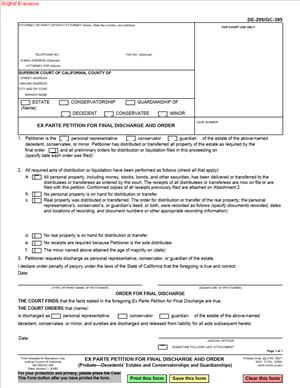
DE-295 and GC-395 – Ex Parte Petition for Final Discharge and Order (Probate – Decedents’ Estates and Conservatorship and Guardianships)
Fill out nowJurisdiction: Country: United States | Province or State: California
The DE-295 and GC-395 – Ex Parte Petition for Final Discharge and Order (Probate – Decedents’ Estates and Conservatorship and Guardianships) is a court form used to formally close out your responsibilities in a probate, conservatorship, or guardianship case. You use it when you have already completed your court-approved duties and want the court to release you from further obligation.
If you served as a personal representative of an estate, a conservator, or a guardian, your role does not automatically end when the assets are distributed. The court must issue a final order discharging you. This form starts that final step.
The document is filed “ex parte,” which means you are asking the court to make an order without a full notice hearing. It is typically used when all required actions are already complete, and no disputes remain.
For self-represented individuals, this filing can feel technical. You may be unsure what “final discharge” really means or what must happen before you submit it. Understanding the purpose and structure of this form helps you confirm that your administration is truly finished.
This guide explains what the form does, who uses it, when it applies, and how to complete it clearly and accurately.
What is DE-295 and GC-395 – Ex Parte Petition for Final Discharge and Order (Probate – Decedents’ Estates and Conservatorship and Guardianships)?
Clear definition
DE-295 and GC-395 – Ex Parte Petition for Final Discharge and Order (Probate – Decedents’ Estates and Conservatorship and Guardianships) is a combined petition and proposed court order. It asks the probate court to officially release a fiduciary from their duties after the estate, conservatorship, or guardianship has been fully administered.
In simple terms, it is your written request to be “let out” of your role. Once the judge signs the order, you are no longer responsible for managing assets, filing reports, or acting on behalf of the estate or protected person.
The form typically confirms that all court orders have been followed. It may reference prior accountings, distribution orders, or judgments. It also states that all required actions have been completed and that nothing further remains for the fiduciary to do.
Because this is an ex parte petition, the court often reviews it based on the written submission. If everything is in order, the judge may sign the discharge without setting a hearing.
Who typically uses this form?
This form is commonly used by personal representatives in decedents’ estates. That includes executors named in a will and administrators appointed when there is no will.
Conservators of the estate or person also use this document once the conservatorship ends. A conservatorship may end because the conservatee has died, regained capacity, or the court has otherwise terminated the proceeding.
Guardians of the estate or person may use this form when the guardianship ends. For example, a guardianship often ends when a minor turns 18 or when the court issues an order terminating the guardianship.
In each situation, the person filing the form has already completed the core responsibilities of their role. The discharge is the final administrative step.
Why might you need this form?
Even after assets are distributed and reports are filed, your legal authority continues until the court formally discharges you. Without a discharge order, you may still be considered responsible in your official capacity.
A final discharge provides closure. It signals that the court accepts your administration as complete. It also limits future obligations tied to your fiduciary role.
Financial institutions and third parties sometimes require proof that your authority has ended. A signed discharge order serves as official confirmation that you no longer act on behalf of the estate or protected person.
The form also protects you. Once discharged, your duties generally end. This reduces the risk of future claims related to ongoing management, because there is no longer ongoing management.
Typical real-life scenarios
- You served as executor of your parents’ estate. You gathered assets, paid debts, filed a final accounting, and distributed property according to the will. The court approved your final report and distribution. After you complete those distributions, you file this petition to be formally discharged.
- You were appointed conservator of an elderly relative’s estate. The conservatee later passed away. You filed a final accounting covering the period up to the date of death, and the court approved it. You then use this form to request discharge from your role as conservator.
- You acted as guardian of the estate for a minor who received a settlement. When the child turned 18, you transferred the remaining funds as required. With court approval of your final report, you file for discharge to end your authority.
- You were the administrator of an estate with modest assets. After paying creditors and distributing the remainder, you realized your appointment is still active. You submit this ex parte petition to close the matter completely.
- In each of these situations, the administrative work is done. The discharge makes that completion official in the court record.
When would you use DE-295 and GC-395 – Ex Parte Petition for Final Discharge and Order (Probate – Decedents’ Estates and Conservatorship and Guardianships)?
You use this form after the court has approved your final accounting and distribution, or after the court has otherwise determined that no further reporting is required. The discharge does not replace those earlier steps. It follows them.
In a decedent’s estate, this usually occurs after the order settling the final account and authorizing distribution has been entered and carried out. Once you have transferred property to beneficiaries and resolved all estate matters, you may request discharge.
In a conservatorship, the timing depends on why the conservatorship is ending. If it ends due to death, you first complete a final accounting up to the date of death. If it ends for another reason, you comply with the court’s termination order and any final reporting requirements before filing this petition.
In a guardianship of the estate, the filing commonly follows the minor reaching adulthood and receiving the remaining assets. In a guardianship of the person, the process may involve confirming that the guardianship has been terminated and that no further duties remain.
You would not use this form at the beginning of a case. It is not used to resign mid-case or to request removal. It is specifically for final discharge after the court’s requirements have been satisfied.
Self-represented filers often reach this stage after months or years of administration. The key question at this point is whether everything ordered by the court has been completed. If so, this filing is the mechanism to close your role.
Legal characteristics of DE-295 and GC-395 – Ex Parte Petition for Final Discharge and Order (Probate – Decedents’ Estates and Conservatorship and Guardianships)
This document is procedural. It does not create new rights or distribute assets. Instead, it confirms that prior court orders have been fulfilled and asks the court to end your appointment.
For the petition to be effective, the underlying case must be in good standing. Required accountings must have been filed and approved. Any required bonds must be addressed. Court-ordered distributions must be completed.
Accuracy matters. If the form references incorrect dates, incomplete distributions, or missing orders, the court may delay or reject the request. Clerical errors, such as incorrect case numbers or inconsistent names, can also slow processing.
Because this is an ex parte filing, the court may review it without a hearing. However, the court still examines whether the statutory requirements have been met. If something appears incomplete, the judge may require further documentation or set a hearing.
The form does not resolve disputes. If objections are pending or if beneficiaries have raised concerns about the final account, a discharge may not be appropriate until those issues are resolved. The discharge assumes that the administration is settled.
It also does not reopen or modify prior orders. If there was an error in the final accounting, that issue generally must be addressed before discharge. The petition is not a substitute for correcting earlier filings.
Procedural details can vary depending on whether the matter is a decedent’s estate, conservatorship, or guardianship. The underlying authority for discharge may arise from different sections of probate law, but the practical effect is similar: termination of fiduciary authority.
Is it legally binding?
Yes, once the judge signs the order portion of the form, it becomes a binding court order. The discharge officially ends your authority and duties in the role described.
Before the judge signs it, the petition itself is only a request. It has no independent legal effect. The binding effect begins when the court enters the signed order in the case record.
The discharge generally releases you from further responsibility for future acts in that capacity. It does not erase actions taken during your administration. If disputes about past conduct arise, those issues are typically evaluated based on the record created before discharge.
The signed order serves as formal proof that your appointment has ended. It is part of the court file and can be referenced if questions later arise about your authority.
How to fill out DE-295 and GC-395 – Ex Parte Petition for Final Discharge and Order (Probate – Decedents’ Estates and Conservatorship and Guardianships)
Step 1 – Complete the case caption
At the top of the form, fill in the court name, branch location, and case number exactly as they appear on prior filings. Enter the name of the estate, conservatorship, or guardianship in the same format used throughout the case. Consistency prevents processing delays.
Step 2 – Identify your role
Indicate whether you are acting as executor, administrator, conservator, or guardian. Use the same title that appears in your original appointment order. This clarifies which authority you are asking the court to terminate.
Step 3 – State that administration is complete
The form includes language confirming that you have completed all required duties. Review this section carefully. Ensure that all referenced actions, such as filing final accounts or completing distributions, have actually occurred.
Step 4 – Reference prior court orders
Provide the dates of relevant court orders, such as the order settling the final account or approving distribution. Copy the dates directly from the signed orders. Accurate references help the court confirm that the case is ready for discharge.
Step 5 – Confirm distribution of assets
If the case involved the distribution of property or funds, confirm that those transfers have been made according to the court’s order. Make sure your records match what the court previously authorized. The discharge relies on the fact that nothing remains to be distributed.
Step 6 – Address bond status if applicable
If a bond was required during your appointment, review whether it must remain in place until discharge. The form may include statements related to bond exoneration. Ensure that the information matches the bond status in your case file.
Step 7 – Review the proposed order section
The lower portion of the document typically includes the proposed order for the judge to sign. Do not complete the judge’s signature line. Confirm that the order language clearly states that you are discharged from your duties in the specified role.
Step 8 – Sign and date the petition
Sign the petition where indicated. Use your full legal name as it appears in prior filings. Enter the date of signing. Your signature confirms that the statements in the petition are true to the best of your knowledge.
Step 9 – Prepare the form for filing
Before submitting, read the entire form from top to bottom. Check names, dates, and the case number one more time. Ensure that any required attachments or related documents have already been filed in the case.
Step 10 – Submit the filing to the probate court
File the completed document with the probate division handling your case. Once submitted, the court will review the petition and, if everything is complete, may sign the order discharging you from your role.
Legal terms you might encounter in DE-295 and GC-395 – Ex Parte Petition for Final Discharge and Order (Probate – Decedents’ Estates and Conservatorship and Guardianships)
- Final Discharge: This is the court’s formal release of you from your duties as a personal representative, conservator, or guardian. Once the judge signs the order, you are no longer legally responsible for managing the estate or conservatorship. The discharge ends your authority and your liability for future actions related to the case.
- Ex Parte: This means you are asking the court to act without a full hearing with all parties present. In this context, you are requesting final discharge based on completed duties and prior court approvals. The court may review your paperwork without requiring everyone to appear in person.
- Personal Representative: This is the person appointed to manage a decedent’s estate. If you were appointed as executor or administrator, this term applies to you. Your name and title must match exactly what appears in the court’s original appointment order.
- Conservator: A conservator manages the financial affairs or personal care of an adult who cannot do so independently. If you were appointed as a conservator, this form asks the court to confirm that you have completed your responsibilities and can be released.
- Guardian: A guardian manages the care or finances of a minor. When the guardianship ends—often because the minor turns 18—you may seek final discharge. The form confirms you have completed all required duties and reporting.
- Order for Final Distribution: This is a prior court order approving how estate assets were distributed. You typically cannot request final discharge until distribution has been completed according to that order. The petition asks you to confirm that the distribution is finished.
- Bond: A bond is a type of insurance that protects the estate or conservatorship against misconduct. If you were required to post a bond, the form addresses whether it can now be terminated. The court’s order often releases the bond once you are discharged.
- Receipts on Distribution: These are signed documents from beneficiaries confirming they received their share. You may need to confirm that receipts were filed or are available. This supports your statement that all assets were properly distributed.
- Letters: Letters (such as Letters Testamentary, Letters of Administration, or Letters of Conservatorship) are official documents showing your authority. Once you are discharged, these letters are no longer valid. The order effectively cancels your authority.
- Accounting: An accounting is a detailed financial report of income, expenses, and distributions. Final discharge usually follows court approval of a final accounting, unless waived. The petition relies on the fact that your accounting duties have been satisfied.
FAQs
When can I file DE-295 and GC-395 – Ex Parte Petition for Final Discharge and Order (Probate – Decedents’ Estates and Conservatorship and Guardianships)?
You can file once you have completed all required duties and the court has approved your final accounting or otherwise authorized distribution. You must have actually distributed the assets as ordered. Check your prior court orders to confirm that nothing remains pending, such as unpaid fees or unresolved objections.
Do I need to attach proof that I distributed all assets?
You may need to confirm that receipts or other proof of distribution have been filed or are available. Review the court’s prior order for instructions about filing receipts. If the order required receipts before discharge, make sure they are in the court file or submitted with your request.
What date should I use when stating that the administration is complete?
Use the actual date when you finished carrying out the court’s distribution order or completed your final duties. This is often the date when the last check cleared, or the last asset was transferred. Make sure this date matches your records and any final accounting you filed.
Who signs this document?
The person who was appointed by the court must sign. That means the personal representative, conservator, or guardian listed in the official appointment order. Your signature should match the name exactly as it appears in the court’s records.
What happens to my bond after the court signs the order?
If you were required to post a bond, the signed order typically releases it. That means the bonding company is no longer responsible for your actions in the case. Wait for a filed, stamped copy of the signed order before assuming the bond has been terminated.
Will the court automatically grant my request?
Not automatically. The court reviews your filing to confirm that all requirements have been met. If something is missing—such as proof of distribution or a required accounting—the court may delay or deny the request until you correct the issue.
What changes in the public record after discharge?
Once the order is entered, the court record shows that you are discharged. Your authority under the letters ends. Anyone searching the file will see that the estate, conservatorship, or guardianship is closed and that you are no longer acting in that role.
Do I need to notify beneficiaries or interested persons before filing?
In many cases, notice requirements were handled earlier in the process when the final accounting or distribution was approved. Review the prior court order to see if additional notice is required before discharge. If notice is required, confirm you completed it and note that in your filing.
Checklist: Before, During, and After DE-295 and GC-395 – Ex Parte Petition for Final Discharge and Order (Probate – Decedents’ Estates and Conservatorship and Guardianships)
Before
- Confirm the court approved your final accounting or waived it.
- Verify that all assets were distributed according to the court’s order.
- Ensure all debts, taxes, and expenses were paid.
- Check whether receipts on distribution were required and filed.
- Review your appointment order to confirm your exact title.
- Confirm whether a bond was required and is still active.
- Gather copies of prior relevant court orders.
- Make sure there are no pending objections or hearings.
During
- Enter the case name and number exactly as shown in court records.
- Identify your role correctly (personal representative, conservator, or guardian).
- State clearly that the administration is complete.
- Reference the date of the order approving final distribution.
- Confirm that all required acts have been performed.
- Address the bond and request its release if applicable.
- Review the proposed order section for accuracy.
- Sign and date the petition using your full legal name.
- Make copies before filing.
After
- File the original with the probate court clerk.
- Pay any required filing fee.
- Obtain a filed-stamped copy for your records.
- Monitor the case docket for the signed order.
- Request certified copies of the signed order if needed.
- Provide a copy to the bonding company if a bond was posted.
- Close any remaining estate or conservatorship bank accounts.
- Store all records securely for future reference.
Common mistakes to avoid with DE-295 and GC-395 – Ex Parte Petition for Final Discharge and Order (Probate – Decedents’ Estates and Conservatorship and Guardianships)
- Mistake: Filing before completing distribution, often because you assume court approval alone is enough; this can lead to rejection or delay, so do not forget to actually transfer all assets first.
- Mistake: Using a name or title that does not exactly match your appointment order, which happens when people shorten titles; this may cause processing issues, so do not forget to copy your title word-for-word from the court’s letters.
- Mistake: Forgetting to address the bond, usually because you believe it ends automatically; this can delay release of liability, so do not forget to request termination if applicable.
- Mistake: Omitting required receipts on distribution, often due to a misunderstanding of earlier orders; this can result in denial of discharge, so do not forget to confirm whether receipts were required and filed.
- Mistake: Submitting the petition without checking for pending matters, which happens when you overlook scheduled hearings; this can prevent closure, so do not forget to review the docket.
- Mistake: Failing to keep copies of the signed discharge order, often because you assume the court keeps everything; this can create problems later, so do not forget to secure and store filed-stamped and certified copies.
- Mistake: Assuming discharge is immediate upon filing, which happens when you misunderstand the review process; this may cause premature closure of accounts, so do not forget to wait for the signed order.
- Mistake: Leaving sections blank that require confirmation statements, often because you think they do not apply; this can cause rejection, so do not forget to complete every applicable section clearly.
What to do after filling out DE-295 and GC-395 – Ex Parte Petition for Final Discharge and Order (Probate – Decedents’ Estates and Conservatorship and Guardianships)
Once you complete the form, slow down and review it carefully. This is your final step in closing the estate, conservatorship, or guardianship. Accuracy matters because the court relies on your statements to release you from duty.
- Step 1: Review every page for completeness and consistency with prior court orders.
- Step 2: Confirm that dates match your final accounting and distribution records.
- Step 3: Make at least two copies of the signed petition and proposed order.
- Step 4: Assemble any required supporting documents, such as proof of filed receipts.
- Step 5: File the original documents with the probate court clerk handling your case.
- Step 6: Pay any required filing fee and obtain a filed-stamped copy.
- Step 7: Track the status of your request through the court’s docket or clerk’s office.
- Step 8: Obtain a copy of the signed order once the judge grants discharge.
- Step 9: If a bond was posted, send a copy of the signed order to the bonding company.
- Step 10: Close estate or conservatorship bank accounts only after discharge is official.
- Step 11: Store all financial records, court orders, and correspondence in a secure place.
After the court signs the order, your legal authority ends. You should stop acting on behalf of the estate or conservatorship. Do not enter new contracts, write checks, or represent yourself as holding authority under the letters.
Keep your records organized even after closure. Questions can arise months or years later, especially about tax filings or distributions. Having a complete file protects you and makes it easier to respond if needed.
Finally, confirm that your internal records reflect closure. Mark the case as closed, note the date of discharge, and retain the signed order with your permanent documents. This gives you a clear endpoint and proof that your responsibilities were fully completed.
Disclaimer: This guide is provided for informational purposes only and is not intended as legal advice. You should consult a legal professional.