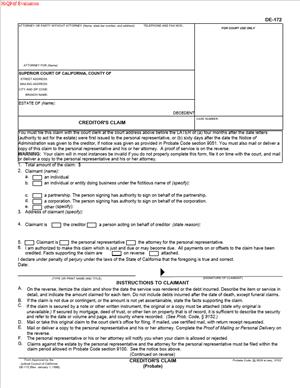
DE-172 – Creditor’s Claim (Probate)
Fill out nowJurisdiction: Country: United States | Province or State: California
If someone who owed you money has died, DE-172 – Creditor’s Claim (Probate) is the form used to formally request payment from that person’s estate. It is part of the California probate process and is filed with the court handling the estate.
This form allows you to state how much you are owed and why. It creates an official record of your claim during the administration of the estate. Without this filing, your request for payment may not be recognized in the probate case.
You may be a business, a lender, a medical provider, a landlord, or an individual who is owed money. The document gives you a structured way to present your claim to the personal representative managing the estate.
Timing matters in probate. Estates follow specific procedures for notifying creditors and resolving debts. Filing this form within the required time frame can affect whether your claim is considered.
Understanding what the form does and what it does not do helps you avoid delays and mistakes. The sections below explain how the document works and how to complete it clearly and accurately.
What is DE-172 – Creditor’s Claim (Probate)?
Clear definition
DE-172 – Creditor’s Claim (Probate) is a court form used in California probate cases to assert that a deceased person owed you money or property. It is a written demand for payment from the estate.
When someone dies, their debts do not disappear. Instead, those debts are handled through the estate. The estate is managed by a personal representative, sometimes called an executor or administrator, under court supervision.
This form provides details about the amount owed, the basis for the claim, and supporting information. It becomes part of the official probate court file.
Who typically uses this form?
You might use this form if you are a creditor of the deceased person. A creditor is anyone to whom the deceased owed money or property at the time of death.
Common users include financial institutions that issued loans or credit cards. Medical providers may use it for unpaid treatment bills. Landlords may file for unpaid rent. Contractors may file for unpaid services.
Individuals also use the form. For example, you may have loaned money to the deceased and were not repaid. Or you may have a written agreement showing a balance still due.
Attorneys or collection agents sometimes complete the document on behalf of a creditor. However, self-represented individuals can also prepare and file it.
Why might you need this form?
You may need DE-172 – Creditor’s Claim (Probate) if you want to be considered for payment from the estate. Probate has a structured process for handling debts. Filing the form is often the way to participate in that process.
If you only send a letter or invoice to the personal representative, it may not have the same formal effect as a filed claim. The court-supervised process typically requires claims to be submitted in a specific format.
Filing the document also helps establish a timeline. Probate cases include deadlines for creditors. Submitting the form within the allowed period can affect whether your claim is evaluated.
The form also gives the personal representative a clear record of what you are requesting. This can make it easier for them to accept, reject, or negotiate the claim.
Typical real-life scenarios
- A credit card company learns that a cardholder has died with an outstanding balance. The company files a claim in the probate case to request payment from available estate assets.
- A hospital provided treatment shortly before the person’s death. The bill remains unpaid. The hospital files a creditor’s claim so the debt can be addressed as part of estate administration.
- A friend loaned the deceased a significant amount of money and has a written agreement showing repayment terms. The friend uses the form to formally request the remaining balance.
- A landlord is owed several months of unpaid rent at the time of the tenant’s death. The landlord files the claim to recover those amounts from the estate.
- A contractor completed home repairs but was not paid before the homeowner passed away. The contractor files the form to assert the unpaid invoice as a debt of the estate.
When would you use DE-172 – Creditor’s Claim (Probate)?
You use this form after a probate case has been opened for the deceased person’s estate in California. Probate generally begins when a petition is filed, and the court appoints a personal representative.
Once the estate is open, creditors may receive notice that probate is underway. In many cases, there are specific deadlines tied to that notice or to the date letters are issued to the personal representative.
You would use the form when you have a claim that arose before the person’s death. This includes debts based on contracts, loans, services, or other legal obligations that existed at the time of death.
You might also use it if you believe the estate is responsible for certain obligations connected to the deceased. The probate process is designed to gather assets, pay valid debts, and then distribute what remains to beneficiaries.
The form is generally not used if there is no probate case. Some estates are handled outside formal probate. In those situations, different procedures may apply.
You also would not use this form to dispute a will or challenge how property is distributed. It is specifically for asserting a financial claim against the estate.
Legal characteristics of DE-172 – Creditor’s Claim (Probate)
This form is part of a court-supervised process. Once filed, it becomes part of the probate record. The personal representative reviews the claim and decides whether to allow or reject it.
For a claim to be effective, it usually needs to be complete and accurate. That includes clearly identifying the estate, stating the amount claimed, and describing the basis of the debt. Missing information can cause delays or questions.
Documentation often matters. Claims that reference contracts, invoices, promissory notes, or judgments may need to include copies or detailed descriptions. Vague or unsupported claims may face challenges.
Timing is also central. Probate procedures typically include strict deadlines for creditors. A late filing may be treated differently from one submitted on time.
The form itself does not guarantee payment. It only places your claim into the probate process. The estate’s available assets, the priority of debts, and the personal representative’s review all affect the outcome.
Common problems include listing the wrong estate case number, misstating the amount owed, or failing to sign the form. Inconsistent information between the claim and attached documents can also create issues.
Procedural details may vary depending on the specific county court or the complexity of the estate. While the core purpose of the document is consistent across California, filing steps can differ slightly.
The document does not create a new debt. It does not rewrite the original agreement. It simply asserts an existing obligation against the estate for review.
Is it legally binding?
DE-172 – Creditor’s Claim (Probate) is not a contract between you and the estate. It is a formal statement of an alleged debt within a court process.
Once you sign and file the form, you are declaring that the information provided is true to the best of your knowledge. That representation carries legal significance within the probate case.
The claim becomes binding in the sense that it must be addressed by the personal representative. They may accept it in whole or in part, or reject it. Their response follows the procedures set out in probate law.
If the claim is allowed, it can lead to payment from estate assets according to priority rules. If it is rejected, additional legal steps may be available in some situations, but those involve separate procedures.
The binding effect depends on compliance with procedural rules. An incomplete or untimely claim may not carry the same weight as one properly filed.
How to fill out DE-172 – Creditor’s Claim (Probate)
Step 1 – Identify the estate and court case
Enter the name of the deceased person exactly as it appears in the probate case. Include the case number assigned by the court and the name of the court handling the matter. This information connects your claim to the correct estate file.
Step 2 – Provide your creditor information
List your full legal name and mailing address. If you are filing on behalf of a business, use the registered business name. If an attorney or authorized agent is submitting the form, include their contact details where indicated.
Step 3 – State the amount of the claim
Write the total amount you believe is owed. Be clear about whether this amount includes interest, fees, or other charges. If the claim is not yet due, indicate that and explain the circumstances in the space provided.
Step 4 – Describe the basis of the claim
Explain why the estate owes you money. Identify the type of obligation, such as a loan, unpaid services, rent, or goods provided. Include relevant dates, such as when the debt was incurred and when payment was due.
Step 5 – Indicate whether the claim is secured or unsecured
If the debt is backed by collateral, describe the security interest. For example, note if there is a lien on specific property. If there is no collateral, indicate that the claim is unsecured.
Step 6 – Attach supporting documentation
Attach copies of contracts, invoices, promissory notes, account statements, or judgments that support your claim. Make sure the documents match the amount and description stated in the form.
Step 7 – Review for accuracy and completeness
Check that all names, dates, and amounts are consistent. Confirm that the case number is correct and that all required sections are filled in. Incomplete information can delay processing.
Step 8 – Sign and date the form
Sign the document where indicated. By signing, you are affirming that the information is true and correct to the best of your knowledge. Include the date of your signature.
Step 9 – File and serve the claim
Submit the completed form to the probate court handling the estate. Provide a copy to the personal representative or their attorney as required in the probate process. Keep a copy for your records so you can track the status of your submission.
Legal terms you might encounter in DE-172 – Creditor’s Claim (Probate)
- Decedent: The person who has died. This form relates to debts the decedent owed at the time of death. You must correctly identify the decedent exactly as listed in the probate case.
- Personal Representative: The individual appointed by the court to manage the estate. This person may be called an executor (if named in a will) or an administrator (if there is no will). You must serve your claim on this person.
- Estate: All property, money, and rights owned by the decedent at death. Your claim is against the estate, not against family members personally.
- Claim Period: The legal deadline for creditors to submit claims. It usually runs for a set number of months after official notice is given. If you file late, your claim may be barred.
- Secured Claim: A debt backed by specific property, such as a mortgage or car loan. On this form, you must state whether your claim is secured and describe the collateral.
- Unsecured Claim: A debt not tied to specific property, such as credit card debt or medical bills. You still must provide documentation showing the amount owed.
- Contingent Claim: A claim that depends on a future event that may or may not happen. You must describe the event that would trigger payment and estimate the amount if possible.
- Interest: Additional money owed on top of the principal balance. If you claim interest, you must state the rate and the date from which it runs.
- Assignment: A transfer of the right to collect a debt from the original creditor to another party. If the debt was assigned to you, you must disclose that and attach proof.
- Verification: A sworn statement that the information in the claim is true. You sign under penalty of perjury. This makes your statements legally binding.
FAQs
What information must match the probate case exactly?
You must match the decedent’s full legal name, the case number, and the court name exactly as they appear in the probate file. If even one letter is wrong, the clerk may reject the filing, or the personal representative may challenge it. Double-check the caption on prior court documents before submitting this form.
How do I know if my claim is filed on time?
You need to confirm the date notice was first issued to creditors and calculate the claim deadline from that date. Write down the filing date you plan to use and compare it to the deadline in the probate record. If you are close to the deadline, file as early in the day as possible and keep proof of submission for DE-172 – Creditor’s Claim (Probate).
What amount should I enter if interest is still accruing?
Enter the principal owed as of a specific date and clearly state that interest continues to accrue after that date. Include the interest rate and how it is calculated. Attach a payoff statement or calculation sheet so the estate can verify your numbers.
What if I do not have the original contract or invoice?
You should attach the best available evidence, such as account statements, billing summaries, payment histories, or correspondence confirming the debt. Explain briefly why the original document is unavailable. The court and personal representative need enough detail to understand how the amount was calculated.
Do I need to sign DE-172 – Creditor’s Claim (Probate) in front of a notary?
This document is signed under penalty of perjury, not typically notarized. Read the verification language carefully before signing. Make sure the signer has authority, especially if you are signing on behalf of a business or as an assignee.
What happens after I file this form?
The personal representative reviews the claim and decides whether to allow or reject it. You should receive written notice of the decision. Keep track of the date of any rejection because it may affect your next steps and deadlines.
Can I amend this document if I made a mistake?
If you notice an error after filing, act quickly. You may need to submit a corrected claim or additional documentation before the claim period expires. Clearly label any new filing so the court and the estate understand it relates to your earlier submission.
Will my claim become part of the public record?
Yes. Once filed, this form and its attachments typically become part of the probate case file. Anyone reviewing the court file can see the amount you claim and the basis for it, so review sensitive information and redact what is not required before filing.
Checklist: Before, During, and After DE-172 – Creditor’s Claim (Probate)
Before
- Confirm the decedent’s full legal name and probate case number.
- Verify the claim filing deadline in the court record.
- Gather contracts, invoices, account statements, and payment histories.
- Calculate the exact amount owed as of a specific date.
- Determine whether the claim is secured, unsecured, or contingent.
- Identify who has the authority to sign on behalf of the creditor.
- Make copies of all supporting documents.
- Review prior correspondence with the estate, if any.
During
- Enter the court name and case number exactly as shown in the probate file.
- Spell the decedent’s name consistently throughout the form.
- Clearly state the total amount claimed and the calculation date.
- Describe the basis of the claim in plain, factual language.
- Indicate whether the claim is secured and describe any collateral.
- Attach copies of all supporting documents.
- Review every figure for math errors.
- Sign and date the verification section.
After
- Make at least one complete copy of the signed claim for your records.
- File the original with the probate court clerk.
- Serve a copy on the personal representative or their attorney.
- Keep proof of filing and proof of service.
- Calendar follow-up dates to check the status.
- Monitor for a written notice allowing or rejecting the claim.
- Store all related documents in one organized file.
- Update your internal accounting records to reflect the filed claim.
Common mistakes to avoid with DE-172 – Creditor’s Claim (Probate)
- Mistake: Listing the wrong case number because you copied it from memory, which can cause the clerk to misfile or reject the claim, so do not forget to verify it directly from the probate docket.
- Mistake: Filing after the claim deadline because you assumed you had more time, which can permanently bar recovery, so do not forget to confirm the exact cutoff date.
- Mistake: Claiming an estimated amount without showing how you calculated it, which may lead to rejection, so do not forget to attach detailed supporting documentation.
- Mistake: Failing to state whether the claim is secured, which creates confusion about rights to property, so do not forget to clearly describe any collateral.
- Mistake: Forgetting to sign under penalty of perjury, which makes the claim defective, so do not forget to complete the verification section.
- Mistake: Serving the wrong person because you did not confirm who the personal representative is, which can delay or invalidate your claim, so do not forget to check the court’s appointment order.
- Mistake: Submitting originals of important contracts without keeping copies, which can leave you without proof later, so do not forget to retain complete duplicates.
- Mistake: Ignoring a written rejection notice, which can limit your ability to act further, so do not forget to track all correspondence dates carefully.
What to do after filling out DE-172 – Creditor’s Claim (Probate)
Once you complete the form, slow down and review it one more time. Check every number. Confirm every name. Make sure your attachments are in logical order.
You now move from preparation to action.
- Step 1: Make at least two complete copies of the signed form and all attachments.
- Step 2: Assemble the original signed claim with copies of supporting documents.
- Step 3: File the original with the probate court clerk handling the estate case.
- Step 4: Obtain a file-stamped copy or other confirmation showing the date received.
- Step 5: Serve a copy on the personal representative or their attorney as required in the case.
- Step 6: Keep written proof of service with your records.
- Step 7: Enter the filing date and expected response timeline in your calendar.
- Step 8: Monitor incoming mail and court notices for acceptance or rejection.
- Step 9: Update your accounting or case management system to reflect that the claim is pending.
- Step 10: If you receive a response, review it carefully and store it with your original claim documents.
Stay organized. Keep everything in one dedicated file, whether physical or digital. Label documents clearly with the case number.
If the claim is allowed, monitor the estate administration process so you know when distributions may occur. If the claim is rejected, note the date of rejection immediately and gather all supporting documents in case further action is required.
Throughout the process, maintain clear records of all communications. Write down dates, names, and summaries of conversations. Good documentation protects you if there is ever a dispute about timing or content.
Your goal is simple: create a clear paper trail that shows you filed a timely, complete, and well-supported claim against the estate.
Disclaimer: This guide is provided for informational purposes only and is not intended as legal advice. You should consult a legal professional.