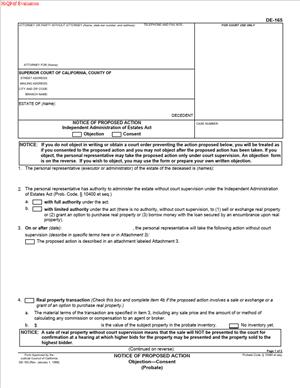
DE-165 – Notice of Proposed Action – Objection-Consent (Probate)
Fill out nowJurisdiction: Country: United States | Province or State: California
The DE-165 – Notice of Proposed Action – Objection-Consent (Probate) is a form used in California probate cases to notify interested parties about actions a personal representative plans to take. If you are handling an estate, this document helps you move the process forward without going back to court for every decision.
When someone dies, and a probate case is opened, the court appoints a personal representative. This person may be called an executor or administrator. In many situations, the representative can act independently, but must first give notice of certain proposed actions. That is where this form comes in.
The DE-165 – Notice of Proposed Action – Objection-Consent (Probate) gives heirs, beneficiaries, and other interested persons a chance to object before something happens. It also allows them to consent in writing, which can speed up the administration of the estate.
If you are about to fill out this form, you likely want to know what it does, when to use it, and how to complete it correctly. Understanding the purpose of this document helps you avoid delays and confusion during probate.
What is DE-165 – Notice of Proposed Action – Objection-Consent (Probate)?
Clear definition
The DE-165 – Notice of Proposed Action – Objection-Consent (Probate) is a formal notice used in California probate cases. It tells interested parties that the personal representative intends to take a specific action related to the estate.
The form describes the proposed action in writing. It also explains that recipients have a limited time to object. If they agree, they can sign the consent portion of the form and return it.
This document serves two functions. First, it provides notice. Second, it creates a written record of either consent or objection. That written record becomes part of the probate file if needed.
Who typically uses this form?
The person who usually completes and sends this form is the personal representative of the estate. That may be an executor named in a will or an administrator appointed by the court when there is no will.
In some cases, the representative works with a probate attorney who prepares the document. However, self-represented individuals also use this form when they are managing an estate without legal counsel.
The recipients are typically beneficiaries named in the will, heirs at law, and sometimes other interested parties. These are the people who have a legal or financial interest in what happens to estate property.
Why might you need this form?
You may need this form if you want to take certain actions without filing a separate court petition. In many probate cases, California law allows a personal representative to act independently, as long as proper notice is given.
The DE-165 – Notice of Proposed Action – Objection-Consent (Probate) helps you avoid unnecessary court hearings. If no one objects within the allowed time, you can generally proceed with the proposed action.
This form also protects you as the representative. By giving notice and allowing time for objections, you reduce the risk of later disputes about whether beneficiaries were informed.
Typical real-life scenarios
- One common scenario involves the sale of real property owned by the estate. If you plan to sell a house, you may need to notify beneficiaries of the proposed sale terms before completing the transaction.
- Another example is when the estate plans to settle a claim or lawsuit. Before agreeing to a settlement, the personal representative may send notice describing the proposed agreement and giving interested parties the opportunity to object.
- You might also use this form when distributing estate assets. For example, if you intend to make a partial distribution of funds to beneficiaries, notice may be required before doing so.
- A further scenario involves borrowing money on behalf of the estate or entering into a significant contract. If the action could affect the value of the estate, notice allows others to review and respond.
When would you use DE-165 – Notice of Proposed Action – Objection-Consent (Probate)?
You would use this form after being officially appointed as personal representative by the probate court. It is not used to open a probate case. It is used during the administration phase.
This document is commonly used when the court has granted the personal representative authority to administer the estate with certain independent powers. Even with that authority, notice is often required before taking major actions.
If you are planning to sell, lease, exchange, or encumber estate property, this form may be used to notify interested parties of the terms. The notice usually includes details such as price, buyer, and relevant conditions.
You may also use this form when compromising or settling a creditor’s claim, continuing a business owned by the estate, or making certain investment decisions. The key factor is whether the proposed action requires notice under the governing probate rules.
Timing matters. The notice must be sent before the action is taken. Recipients are given a specific period to object. If an objection is received within that period, the proposed action may require court approval instead of proceeding independently.
Legal characteristics of DE-165 – Notice of Proposed Action – Objection-Consent (Probate)
For this document to be effective, it must clearly describe the proposed action. Vague or incomplete descriptions can lead to confusion or objections. The notice should provide enough detail for recipients to understand what is planned.
Proper service is also critical. The form must be mailed or delivered to all required interested parties. Failing to notify someone who is entitled to notice can create problems later. That person may challenge the action if they were not informed.
Deadlines play a central role. The notice period gives recipients time to review and object. Acting before the objection period ends can undermine the validity of the action.
Common problems include incorrect case numbers, missing signatures, or failing to attach necessary descriptions of the proposed transaction. These errors can delay administration or increase the risk of disputes.
In California, probate procedures are governed by state law and local court rules. While the general concept of notice and consent exists in many states, the specific format and timing requirements vary. This form is tailored to California probate practice.
It is important to understand what this form does not do. It does not transfer property by itself. It does not replace required deeds, contracts, or court orders. It also does not resolve disputes if someone files a timely objection.
Is it legally binding?
The notice itself is not a contract between parties. However, the consent portion can carry legal weight. If a beneficiary signs the consent section, that written consent may limit their ability to later object to the described action.
If no objection is received within the allowed time, the personal representative may generally proceed. The lack of objection can have a practical legal effect, even though it is not the same as a court order.
If an objection is filed on time, the representative typically cannot proceed under independent authority for that action. In that situation, court approval may be required. The binding effect depends on whether proper notice was given and whether any objections were made within the allowed period.
How to fill out DE-165 – Notice of Proposed Action – Objection-Consent (Probate)
Step 1 – Enter the court and case information
At the top of the form, fill in the name and address of the superior court handling the probate case. Include the county where the case is filed. Enter the case number exactly as it appears on prior court documents. Accuracy here ensures the notice is linked to the correct estate file.
Step 2 – Identify the estate and personal representative
Provide the name of the deceased person as it appears in the probate case. Then enter your name as the personal representative. If there is more than one representative, list all names as required. This section confirms who is proposing the action.
Step 3 – Describe the proposed action
Clearly state the action you intend to take. Include specific details such as property address, sale price, buyer’s name, settlement amount, or contract terms, depending on the situation. The description should allow a reader to understand the essential terms without referring to outside documents.
Step 4 – State the notice and objection period
The form includes language explaining that recipients have a limited number of days to object. Review this section carefully to ensure the timeline matches the applicable notice period. Do not alter the standard language unless the form allows customization in a designated space.
Step 5 – List the recipients of the notice
Identify all persons entitled to receive notice. This may include heirs, beneficiaries, and others with a financial interest in the estate. Use complete legal names and correct mailing addresses. Double-check this information against the probate file to avoid missing anyone.
Step 6 – Sign and date the form
As the personal representative, sign and date the notice in the designated area. Your signature confirms that you are giving formal notice of the proposed action. Make sure the date is accurate, as it may affect the calculation of the objection period.
Step 7 – Complete the proof of service
After preparing the notice, arrange for it to be mailed or delivered according to the required method. The person who performs the mailing typically completes a proof of service section. This part documents when and how the notice was sent and to whom.
Step 8 – Handle returned consents or objections
If recipients agree with the proposed action, they may sign the consent portion and return it. Keep these signed consents with your estate records. If you receive a written objection within the allowed time, note the date received and review the next procedural step in the probate process before taking further action.
Legal terms you might encounter in DE-165 – Notice of Proposed Action – Objection-Consent (Probate)
- Personal Representative: This is the person appointed by the court to manage the estate. You may be called an executor (if named in a will) or an administrator (if there is no will). On this form, the personal representative is the one giving notice of the proposed action and signing the document.
- Proposed Action: This is the specific step you plan to take on behalf of the estate. It could be selling property, settling a claim, distributing assets, or paying certain expenses. The form requires you to describe this action clearly so recipients understand exactly what you intend to do.
- Notice: Notice means formally informing interested parties about your planned action. In this document, notice is given in writing. It tells recipients what you plan to do and how long they have to object.
- Objection: An objection is a written statement from an interested person saying they do not agree with the proposed action. The form explains how and when an objection must be delivered. If someone objects in time, you generally cannot move forward without further steps.
- Consent: Consent is written approval from an interested person agreeing to the proposed action. Some recipients may sign the consent portion of the form and return it to you. Written consent can allow you to proceed without waiting for the full objection period.
- Interested Person: This refers to anyone with a legal interest in the estate. That often includes heirs, beneficiaries, and sometimes creditors. You must send notice to all required interested persons listed in the estate records.
- Proof of Service: Proof of service shows that you mailed or delivered the notice to the required individuals. The form includes a section to document who received notice, how it was sent, and when. This record becomes important if there is later disagreement.
- Objection Period: This is the time frame during which recipients can object. The document states how many days a person has to respond. You must calculate this period carefully because acting too soon can cause problems.
- Estate Asset: An estate asset is any property owned by the deceased person that is part of the probate case. When describing the proposed action, you may need to identify the specific asset involved, such as real property, bank accounts, or personal property.
FAQs
Do I have to file DE-165 – Notice of Proposed Action – Objection-Consent (Probate) with the court?
In many situations, you do not immediately file this document with the court. You prepare it, sign it, and send it to the required interested persons. You may later file it, especially if someone objects or if you need the court to confirm that proper notice was given. Always check whether your specific situation requires filing before or after taking action.
How detailed should I be when describing the proposed action?
Be specific enough that a reader understands exactly what you plan to do. If you are selling property, identify the property and the key terms, such as the sale price. If you are settling a claim, state the amount and who will be paid. Vague descriptions can lead to objections because recipients may feel they do not have enough information.
When does the objection period start?
The objection period usually begins on the date you mail or deliver the notice. You need to record the mailing date carefully in the proof of service section. Count the required number of days from that date before taking the action, unless all required persons sign written consents earlier.
What happens if someone sends me an objection?
If you receive a timely written objection, you generally cannot proceed with the proposed action without court involvement. You may need to file the objection and ask the court for approval. Keep the objection with your estate records and do not ignore it, even if you disagree with it.
Can I move forward if everyone signs the consent section?
If all required interested persons sign and return written consents, you may be able to proceed without waiting for the full objection period. Keep each signed consent with your records. Make sure the names on the consents match the names listed in the estate file.
What if I accidentally leave someone off the mailing list?
If you fail to send notice to a required interested person, the action may later be challenged. The person could argue they were not properly notified. Review the estate records carefully before sending this document to confirm you have included everyone entitled to notice.
Do I need to attach supporting documents?
Sometimes you should attach documents that explain the proposed action, such as a copy of a purchase agreement or settlement terms. Attachments help recipients evaluate whether to object or consent. Make sure any attachments are clearly labeled and referenced in this document.
What changes in the public record after I complete DE-165 – Notice of Proposed Action – Objection-Consent (Probate)?
Completing this document itself does not automatically change ownership records or court orders. It documents that notice was given and whether objections were made. The actual change, such as transferring property or paying funds, happens when you carry out the proposed action in accordance with probate procedures.
Checklist: Before, During, and After DE-165 – Notice of Proposed Action – Objection-Consent (Probate)
Before
- Confirm you are officially appointed as personal representative.
- Review the will and court orders for any limits on your authority.
- Identify all interested persons entitled to notice.
- Gather accurate mailing addresses for each recipient.
- Prepare a clear description of the proposed action.
- Collect any supporting documents you may need to attach.
- Verify the correct case number and court information.
- Check the required length of the objection period.
During
- Complete all case caption information exactly as it appears in court records.
- Describe the proposed action in specific, measurable terms.
- State the deadline for objections based on the mailing date.
- List every interested person who will receive notice.
- Sign and date the form as a personal representative.
- Prepare copies for each recipient and your records.
- Mail or deliver the notice using the required method.
- Complete the proof of service section accurately.
After
- Keep proof of mailing or delivery with your estate file.
- Track the objection deadline on your calendar.
- Collect and file any written consents you receive.
- Review any objections immediately upon receipt.
- Avoid taking action before the objection period ends unless all consents are in.
- If necessary, prepare to file documents with the court.
- Update your estate accounting to reflect the proposed transaction.
- Store all signed originals in a secure location.
Common mistakes to avoid with DE-165 – Notice of Proposed Action – Objection-Consent (Probate)
- Mistake: Giving a vague description of the proposed action because you assume everyone already knows the plan, which can lead to confusion, objections, and delays—do not forget to include specific details like amounts, property addresses, and key terms.
- Mistake: Forgetting to send notice to one or more interested persons due to outdated contact information, which can invalidate the process—do not forget to double-check the full list of heirs and beneficiaries before mailing.
- Mistake: Miscalculating the objection period by counting days incorrectly, which may cause you to act too soon—do not forget to start counting from the mailing date and confirm the required time frame.
- Mistake: Failing to complete the proof of service section because you are focused on the main content, which can make it hard to prove notice was given—do not forget to document who mailed the notice and when.
- Mistake: Proceeding with the action after receiving a written objection because you believe it lacks merit, which can result in court challenges—do not forget that a timely objection usually requires court review.
- Mistake: Not keeping copies of signed consents and mailed notices, which can create recordkeeping gaps—do not forget to store complete copies in your estate administration file.
- Mistake: Using names that do not exactly match court records, often due to nicknames or spelling errors, which can raise questions about proper notice—do not forget to copy names exactly as shown in the probate case.
- Mistake: Leaving out important attachments that explain the transaction, which can cause suspicion or objections—do not forget to include supporting documents when they help clarify the action.
What to do after filling out DE-165 – Notice of Proposed Action – Objection-Consent (Probate)
Once you complete the form, your job shifts from drafting to careful follow-through. The effectiveness of your notice depends on how well you handle delivery, tracking, and documentation.
- Step 1: Make a complete copy of the signed form for your records before sending anything out.
- Step 2: Prepare individual copies for each interested person, including all attachments.
- Step 3: Mail or deliver the notice using the appropriate method and record the exact date of mailing.
- Step 4: Complete and sign the proof of service section immediately after mailing.
- Step 5: Calendar the objection deadline so you do not act too early.
- Step 6: Monitor incoming mail and communications for written objections or signed consents.
- Step 7: Organize returned consents together in your estate file.
- Step 8: If you receive an objection, review it carefully and determine whether court involvement is required.
- Step 9: If no objections are received by the deadline, confirm that the objection period has fully expired.
- Step 10: Proceed with the proposed action and document the transaction in your estate accounting.
- Step 11: Keep all originals, copies, proofs of service, and related documents in a secure estate administration folder.
After you complete the action, update your internal records. Adjust your inventory or accounting to reflect the sale, payment, or transfer. If the action affects title to property or financial accounts, follow through with the appropriate transfer documents.
Stay organized. Probate administration is a paper trail. Clear records protect you if questions arise later from beneficiaries or the court.
Disclaimer: This guide is provided for informational purposes only and is not intended as legal advice. You should consult a legal professional.