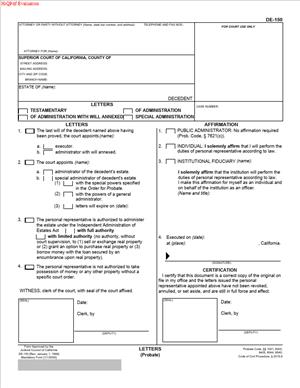
DE-150 – Letters (Probate)
Fill out nowJurisdiction: Country: United States | Province or State: California
DE-150 – Letters (Probate) is the court document that formally authorizes someone to act on behalf of a deceased person’s estate. When a California probate court appoints a personal representative, this is the document that proves that authority to banks, government agencies, and other institutions.
If you are about to fill out or receive DE-150 – Letters (Probate), you are likely involved in opening or managing a probate case. You may be named in a will as executor, or you may be asking the court to appoint you as administrator because there is no will.
This form matters because it turns a court order into practical authority. Without it, you generally cannot access accounts, transfer property, or handle the estate’s financial affairs.
Think of it as your official proof. Institutions will ask to see it before they allow you to act. Understanding what this document is and how it works will help you avoid delays during probate.
What is DE-150 – Letters (Probate)?
Clear definition
DE-150 – Letters (Probate) is a court-issued document from a California probate court that confirms the appointment of a personal representative for a deceased person’s estate. It is commonly referred to as “Letters Testamentary” when there is a will, or “Letters of Administration” when there is no will.
The document states the name of the personal representative and confirms that the court has granted authority to administer the estate. It may also describe any limits on that authority.
The form itself is typically prepared after the court approves a petition for probate. Once signed and issued by the clerk, it becomes the official proof of your role.
Who typically uses this form?
You would use DE-150 – Letters (Probate) if you have been appointed by the court to handle the estate. This person is often called the executor (if named in a will) or the administrator (if there is no will).
Financial institutions rely on this document before releasing funds. Title companies may request it before transferring real property. Government agencies may require it before discussing benefits or tax matters.
Attorneys and self-represented individuals both encounter this form. Even if a lawyer prepares the paperwork, you still need to understand what the Letters represent and how they are used.
Why might you need this form?
You need this document to prove that you have the authority to act for the estate. A death certificate alone is not enough. A will by itself also does not give you legal authority.
For example, a bank will not allow you to close an account simply because you are named in a will. The bank usually requires certified copies of the Letters to confirm your appointment.
The form is also important for real estate transactions. If the estate includes a home that must be sold or transferred, the buyer or title company will generally request the Letters before moving forward.
Typical real-life scenarios
- A parent passes away and leaves a will naming you as executor. You file a petition with the probate court. After the hearing, the judge appoints you. DE-150 – Letters (Probate) is issued so you can collect bank funds and pay debts.
- A relative dies without a will. A family member petitions to be appointed as administrator. Once approved, the court issues Letters of Administration through this form. The administrator uses them to manage and distribute the estate.
- An estate includes rental property. The personal representative needs to collect rent and handle maintenance. Tenants and property managers may ask to see proof of authority before recognizing the new representative.
- An estate includes investment accounts. The brokerage firm requests certified copies of the Letters before allowing changes, transfers, or liquidation of assets.
When would you use DE-150 – Letters (Probate)?
You use this document after the court appoints a personal representative but before taking action on behalf of the estate. It bridges the gap between the court’s order and real-world transactions.
Typically, the process begins with filing a petition for probate. After notice requirements are met and a hearing takes place, the court decides whether to appoint the proposed representative. If the appointment is granted, the Letters are issued.
You would present the Letters when opening an estate bank account. Many representatives open a separate account in the estate’s name to receive funds and pay expenses. Banks usually require certified copies of the Letters to do this.
You also use the document when dealing with creditors. If a creditor contacts the estate, you may provide proof that you are the authorized representative handling claims.
In estates involving lawsuits or ongoing legal matters, the Letters may be used to show that you have standing to act for the estate. Courts and opposing parties may request proof of appointment.
The form may also be relevant when filing certain tax documents. Tax agencies may request confirmation that you are the appointed representative before discussing the decedent’s tax matters.
Legal characteristics of DE-150 – Letters (Probate)
This document becomes effective when issued by the probate court clerk following a court order appointing the personal representative. It reflects the authority granted by the judge.
The validity of the Letters depends on proper court procedures. The petition for probate must be filed correctly. Notice must be given as required. Any bond requirements must be satisfied before issuance.
Common reasons for delay or rejection relate to incomplete filings, missing signatures, unpaid fees, or unresolved objections. If the underlying appointment is not finalized, the Letters will not be issued.
The document may include limitations. In some cases, the court grants “full authority” under specific probate rules. In other cases, authority may be limited, meaning court approval is required before certain actions, such as selling real property.
It is important to understand what this form does not do. It does not transfer ownership of estate property to you personally. It does not eliminate debts. It does not settle disputes automatically. It simply authorizes you to act as the estate’s representative.
In California, probate procedures follow state law and local court rules. While the general purpose of Letters is similar across many states, the specific format and requirements may vary. DE-150 – Letters (Probate) is tailored to California courts.
Is it legally binding?
Yes, once properly issued, the Letters are legally binding proof of your authority as personal representative. Institutions rely on this document to confirm that the court has granted you the power to act for the estate.
The binding effect comes from the court’s appointment order. The Letters are the formal evidence of that order. As long as they remain valid and have not been revoked, they establish your authority.
However, the authority can be limited or terminated. If the court removes a personal representative, or if the estate is closed, the Letters may no longer be effective. In those situations, you would no longer have the authority to act.
The document is binding within the scope of the powers granted. If your authority is limited, actions taken outside those limits may be challenged. The form does not expand your powers beyond what the law and the court order allow.
How to fill out DE-150 – Letters (Probate)
Step 1 – Review the court’s order appointing the personal representative
Before preparing DE-150 – Letters (Probate), confirm that the court has signed an order appointing the personal representative. The information on the Letters must match the order exactly, including the full legal name of the decedent and the appointed representative.
Step 2 – Enter the court information
Fill in the name of the superior court, county, and courthouse address. This information identifies where the probate case is pending. It must match the case filing location shown on other probate documents.
Step 3 – Provide the case number
Insert the probate case number exactly as assigned by the court. Double-check for accuracy. An incorrect case number can create confusion or delay when presenting certified copies to third parties.
Step 4 – Identify the decedent
Enter the full legal name of the deceased person as it appears in the petition and court order. Consistency matters. Differences in spelling or use of middle names may cause questions when dealing with financial institutions.
Step 5 – Identify the personal representative
Enter the full legal name of the appointed executor or administrator. This name must match the court’s appointment order and any identification you will use when presenting the Letters.
Step 6 – Specify the type of Letters
Indicate whether the appointment is based on a will or without a will. The form typically distinguishes between Letters Testamentary and Letters of Administration. The selection reflects the court’s findings in the probate proceeding.
Step 7 – Address bond requirements
If the court required a bond, confirm that the bond has been filed and approved. The Letters are generally not issued until bond requirements are satisfied. The form may reference whether a bond is required or waived.
Step 8 – Review for limitations on authority
Check whether the court granted full or limited authority. The Letters may include language describing the scope of powers. Make sure the form reflects any limitations stated in the court’s order.
Step 9 – Submit the form to the clerk for issuance
After completing the form, submit it to the probate clerk for review and issuance. The clerk signs and affixes the court seal. Once issued, you can request certified copies for use with banks, agencies, and other institutions.
Step 10 – Confirm accuracy before using certified copies
When you receive the issued Letters, review every detail. Confirm names, case number, and type of appointment. If there is an error, address it through the court before presenting the document to third parties.
Legal terms you might encounter in DE-150 – Letters (Probate)
- Personal Representative: The person officially appointed by the court to manage the decedent’s estate. This title appears directly on the Letters and identifies who has legal authority to act. Your name must match the court’s appointment order exactly.
- Executor: A type of personal representative named in a valid will. If the court confirms that you are the executor, that title will be reflected in the Letters. The document shows others that you are carrying out the wishes written in the will.
- Administrator: A personal representative appointed when there is no will or when no executor is available. The Letters will state that you are the administrator. This signals that your authority comes from the court’s appointment, not from a will.
- Letters Testamentary: The official document issued to an executor. It confirms that the will has been admitted to probate and that you may act on behalf of the estate. Financial institutions often ask specifically for this wording.
- Letters of Administration: The official document issued to an administrator. It proves you have court authority even though there is no valid will naming you. The form clearly states this designation.
- Bond: A type of insurance policy that protects the estate against wrongdoing or mistakes by the personal representative. The Letters will indicate whether a bond is required and, if so, whether it has been filed. If a bond is required and not posted, your authority may be limited.
- Limited Authority: Restrictions placed on your powers by the court. The Letters may include language that limits your ability to sell property or take certain actions without additional approval. Always read the document carefully to understand what you can and cannot do.
- Full Authority: Broader powers granted to manage estate assets without prior court approval for certain transactions. If granted, this status will be reflected in the Letters. It affects how quickly you can act in selling or transferring estate property.
- Decedent: The person who has died and whose estate is being administered. The decedent’s full legal name must appear exactly as shown in the court records. Even small differences in spelling can cause problems with banks or title companies.
- Case Number: The unique number assigned to the probate case. It appears at the top of the Letters and must match all other probate filings. You will use this number when communicating with the court or third parties about the estate.
FAQs
When does my authority actually begin?
Your authority begins on the date the court appoints you, and the clerk issues the Letters. Look for the issuance date on the document. You cannot act for the estate before that date, even if the hearing has already occurred.
Do I need a certified copy of DE-150 – Letters (Probate) to deal with banks?
Yes. Most banks, title companies, and financial institutions require a certified copy, not a regular photocopy. A certified copy has the court’s seal and confirms the document is valid and on record.
What if my name is spelled differently on other documents?
The name on this document must match your legal name as shown in the court order. If there is a discrepancy, institutions may reject it. You may need to correct the court record before using the Letters widely.
How long are the Letters valid?
They remain valid until the court ends your appointment or closes the estate. However, many institutions prefer a certified copy issued within the last 60 to 120 days. Check the issuance date before presenting it.
What if the document says bond required, but I have not filed it yet?
If a bond is required, your authority is not fully effective until the bond is filed and approved. The court will not issue effective Letters until this condition is satisfied. Always confirm bond status before trying to act on behalf of the estate.
Can I act alone if there are co-personal representatives?
Only if the Letters state that each representative may act independently. If the document requires joint action, all appointed representatives must sign documents and act together. Review the language carefully before signing anything.
Does this document transfer ownership of estate property to me?
No. This form does not transfer ownership to you personally. It gives you the authority to manage and distribute estate assets according to the law and court supervision.
What changes in the public record when DE-150 – Letters (Probate) is issued?
The issuance confirms in the court’s official record that you are the authorized personal representative. Third parties can verify your appointment using the case number. The document itself becomes part of the probate file maintained by the court.
Checklist: Before, During, and After DE-150 – Letters (Probate)
Before
- Confirm the court has signed the order appointing you as personal representative.
- Verify the correct spelling of the decedent’s full legal name.
- Confirm your own legal name matches your identification.
- Check whether a bond is required and, if so, arrange for it.
- Review whether you have full or limited authority.
- Make sure the case number is accurate on all documents.
- Bring proper identification if appearing at the clerk’s office.
- Prepare payment for certified copies if needed.
During
- Review every field on the form for accuracy.
- Confirm the correct title: executor or administrator.
- Ensure the case number matches the court file.
- Check that the issuance date is clearly stated.
- Verify whether bond language is correctly reflected.
- Confirm any limitations on authority are properly noted.
- Ask the clerk how many certified copies you should obtain.
- Keep a stamped copy for your records.
After
- Store certified copies in a secure place.
- Provide certified copies to banks and financial institutions as required.
- Present the Letters when accessing or transferring estate assets.
- Record the document if required for real property transactions.
- Keep track of where you have submitted copies.
- Monitor expiration preferences from third parties.
- Return unused certified copies to safe storage.
- Notify co-representatives of any actions taken.
- Maintain a log of all transactions made under your authority.
Common mistakes to avoid with DE-150 – Letters (Probate)
- Mistake: Assuming your authority starts at the hearing; this happens because the judge verbally approves your appointment, but the consequence is acting without issued Letters, so do not forget to wait for official issuance.
- Mistake: Using photocopies instead of certified copies; people do this to save time or money, but institutions may reject them, so do not forget to request certified copies from the clerk.
- Mistake: Overlooking bond requirements; this often happens when paperwork feels complete, but the consequence is delayed authority, so do not forget to confirm bond approval if required.
- Mistake: Ignoring limits on authority; some representatives assume they have full powers, which can lead to unauthorized transactions, so do not forget to read the limitations section carefully.
- Mistake: Presenting outdated certified copies; many institutions require recently issued copies, and delays can occur, so do not forget to check the issuance date.
- Mistake: Allowing name discrepancies between court records and identification; this happens due to minor spelling differences, but it can block access to assets, so do not forget to verify exact name consistency.
- Mistake: Acting alone when co-representatives must act jointly; this can invalidate transactions, so do not forget to confirm whether joint signatures are required.
- Mistake: Failing to track where certified copies were submitted; this leads to confusion and possible misuse, so do not forget to maintain a submission log.
What to do after filling out DE-150 – Letters (Probate)
Once the Letters are issued, your role becomes active and practical. You move from court paperwork to real-world administration. Organization is critical at this stage.
Start by making a clear plan for how you will use the document. Think about which institutions need proof of your authority first. Banks and brokerage firms are often the priority because you may need access to funds to pay estate expenses.
- Step 1: Obtain multiple certified copies from the clerk.
- Step 2: Review each certified copy to confirm the seal and issuance date are visible.
- Step 3: Create a tracking list of every institution or agency that will receive a copy.
- Step 4: Open an estate bank account using a certified copy.
- Step 5: Redirect mail for the decedent to ensure you receive financial statements.
- Step 6: Notify financial institutions and provide certified copies as requested.
- Step 7: Secure and inventory estate assets.
- Step 8: Keep detailed records of every transaction you make.
- Step 9: Consult the court file periodically for any required updates or deadlines.
- Step 10: Safely store remaining certified copies and your transaction log.
When presenting the Letters, bring identification that matches the name listed. Some institutions will scan the document and return the certified copy. Others may keep it. Your tracking list helps you know where each copy went.
Keep your estate records separate from your personal finances. Use the estate account for all income and expenses related to the estate. This separation protects you and makes final accounting easier.
As the estate progresses, you may need additional certified copies. Plan ahead so you are not delayed during a property sale or account transfer. Always confirm whether a recently issued copy is required before submitting one.
Finally, remember that your authority continues until the court formally closes the estate. Keep the Letters accessible throughout the administration process. You will likely need them more than once.
Disclaimer: This guide is provided for informational purposes only and is not intended as legal advice. You should consult a legal professional.